


Key Takeaways
- CoreWeave stock has fallen approximately 57% over the past year, closing at $61.12 on October 19, while Wells Fargo maintained its $160 price target.
- Wall Street’s consensus price target remains around $141, supported by expectations for substantial AI infrastructure revenue growth.
- Financing costs remain a major concern, with second-quarter net interest expense reaching $640 million and management forecasting higher costs in the third quarter.
- Wells Fargo’s $160 target looks possible under an optimistic scenario, but would require a substantial valuation recovery despite CoreWeave’s continuing losses.
CoreWeave (NASDAQ: CRWV) has lost approximately 57% of its value since October 16, 2025, when shares closed at $141.74. The stock finished October 19, 2026, at $61.12, highlighting the sharp decline as investors reassessed the company’s AI infrastructure financing costs.
Despite the decline, Wells Fargo analyst Michael Turrin maintained his $160 price target, suggesting approximately 162% upside from the October 19 closing price.
The central question is whether rapidly growing demand for AI computing can generate enough cash flow to justify the company’s expanding debt obligations and a much higher stock valuation.
Why Has CoreWeave Stock Fallen So Much?
CoreWeave’s recent decline reflects mounting concerns about the cost of financing its capital-intensive AI infrastructure business.
According to the company’s second-quarter earnings release filed with the SEC, revenue increased 112% year over year to $2.575 billion.
However, its net loss widened to $626 million from $290 million a year earlier, while net interest expense jumped to $640 million from $267 million.
That financing burden has become increasingly difficult for investors to overlook.
During its second-quarter earnings call, management projected third-quarter interest expense of $860 million to $940 million and full-year capital expenditures of $35 billion to $39 billion.
CoreWeave’s bonds also came under pressure in October, as TIKR reported, reflecting investor concerns about rising borrowing costs and the sustainability of debt-funded AI infrastructure expansion.
The stock declined approximately 25% during the week ending October 16 as those concerns intensified.
Nevertheless, Wall Street remains divided.
Wells Fargo maintained its $160 target on October 19, while Goldman Sachs upgraded CoreWeave to Buy, despite cutting its price target to $106 from $139.
Goldman’s move highlights the conflicting forces affecting CoreWeave: exceptionally strong demand for computing power alongside significant financing risks.
Why Does Wells Fargo See So Much Upside?
Wells Fargo’s optimistic outlook reflects expectations that CoreWeave can turn its growing infrastructure capacity and contracted customer commitments into substantial future revenue.
Turrin previously raised his target from $155 to $160 following the company’s August results, maintaining a positive view of AI computing demand.
Meanwhile, TIKR data as of October 16 showed an average analyst price target of approximately $141, compared with approximately $142 a year earlier.
That suggests analysts’ overall price expectations have ended up at roughly the same level despite the stock’s substantial decline.
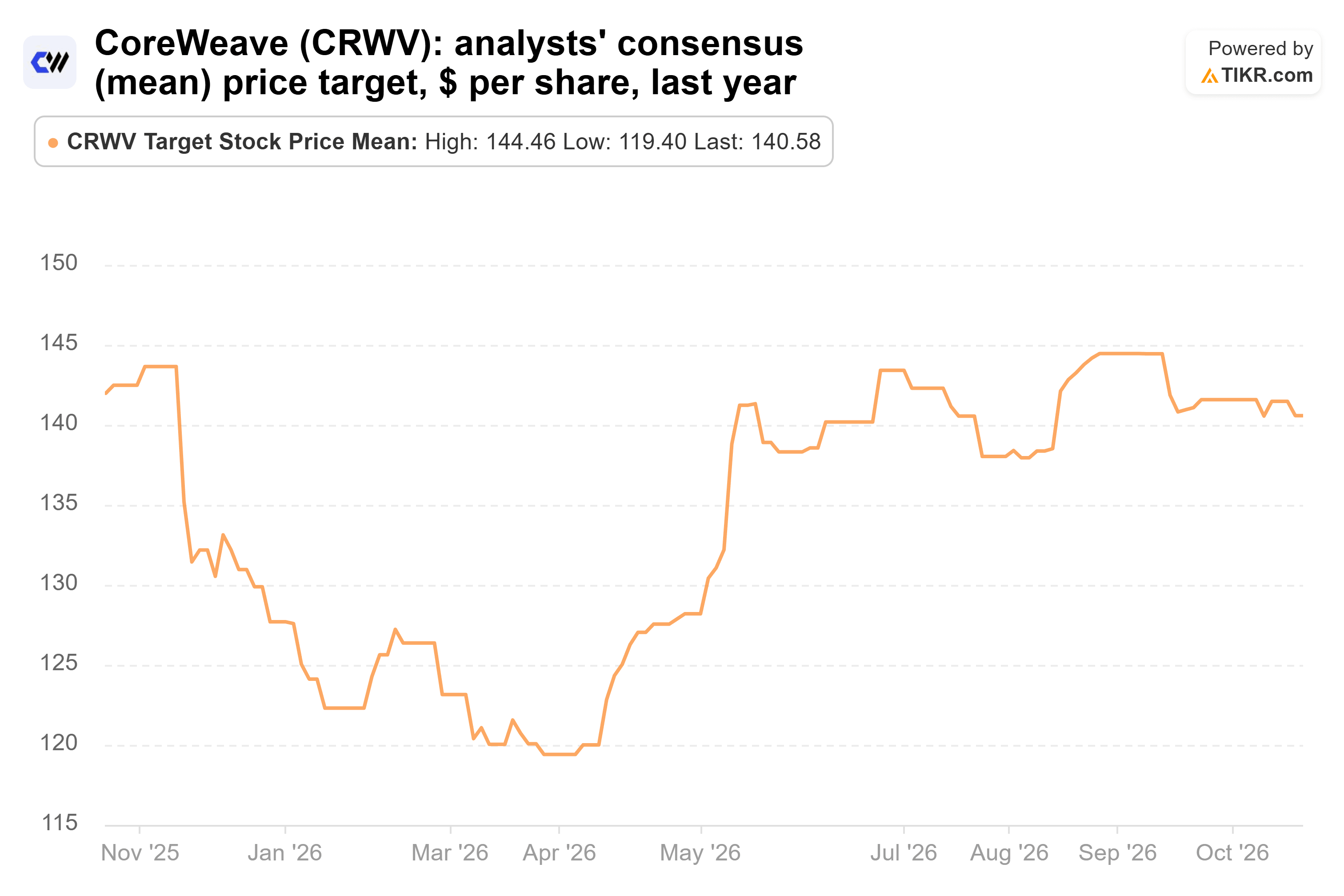
The chart illustrates how analysts’ collective price expectations recovered from earlier declines, even as investors became increasingly concerned about the company’s capital structure.
The optimism is rooted primarily in CoreWeave’s growth potential.
According to TIKR consensus estimates, revenue is expected to increase from approximately $5.1 billion in fiscal 2025 to $12.9 billion in 2026 and nearly $43 billion by 2028.
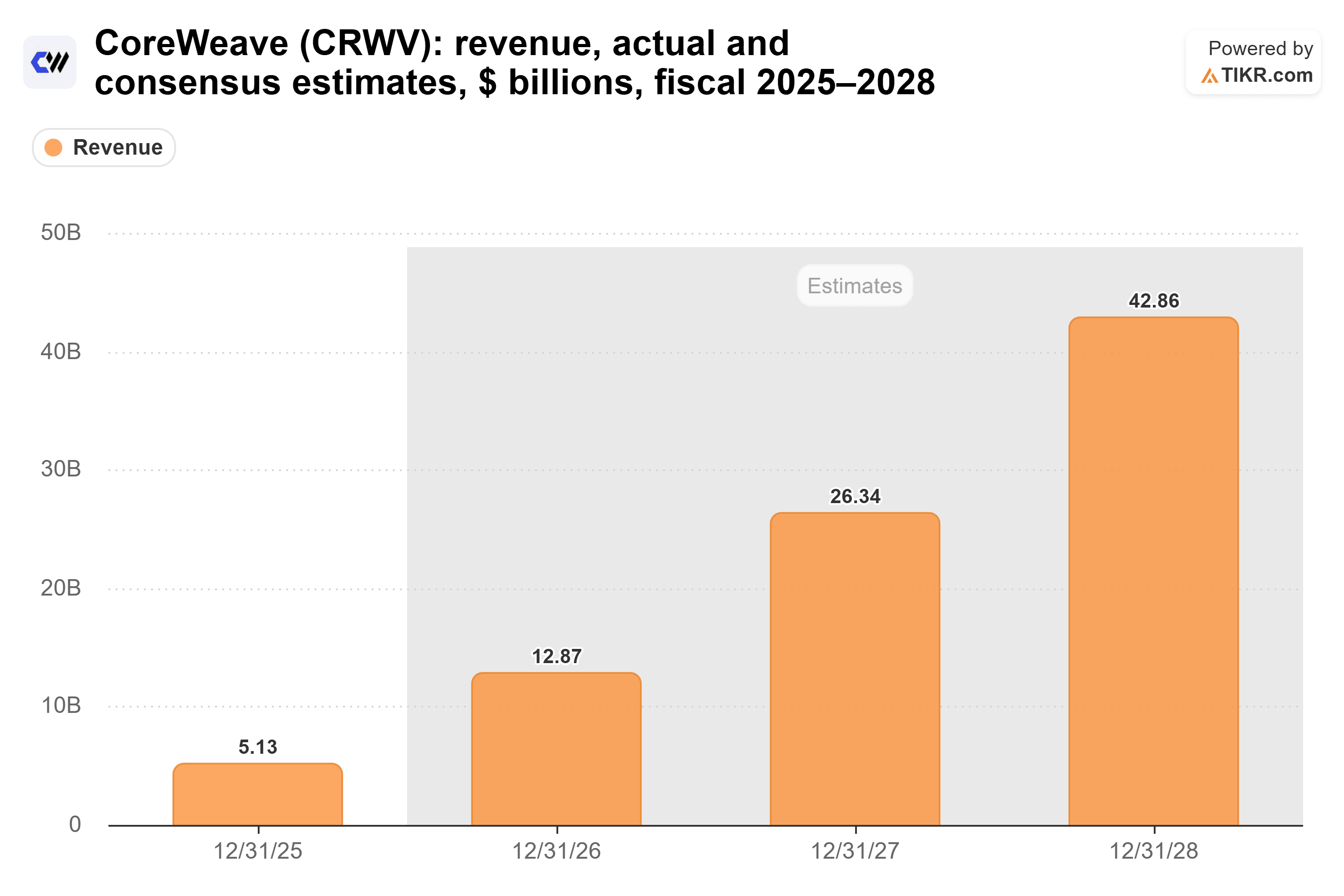
These forecasts point to extraordinary expansion, although they depend on CoreWeave successfully deploying additional infrastructure and converting customer commitments into revenue.
According to its second-quarter financial results, the company reported approximately $104 billion in revenue backlog at the end of June, providing visibility into future demand.
CEO Michael Intrator emphasized that strength during the second-quarter earnings call:
“Our near-term capacity remains effectively sold out.”
CoreWeave’s operating scale is also substantial relative to other AI infrastructure providers.
For comparison, Nebius (NASDAQ: NBIS) reported second-quarter revenue of $582.3 million, compared with CoreWeave’s $2.575 billion, making CoreWeave’s quarterly revenue approximately four times larger.
However, revenue leadership does not eliminate CoreWeave’s profitability challenges.
According to Yahoo Finance analyst estimates, analysts expect CoreWeave to lose approximately $4.24 per share in 2027, compared with a projected loss of roughly $3.48 per share 90 days earlier.
Those downward earnings revisions suggest that CoreWeave’s financial outlook has become more demanding despite expectations for rapid revenue growth.
Does Wells Fargo’s $160 CoreWeave Price Target Make Sense?
CoreWeave’s declining share price has brought its valuation considerably below historical levels.
According to TIKR, the stock traded at approximately 1.7 times next-12-month sales on October 16, near its lowest multiple over the preceding year.
That compares with an average of approximately 3.9 times forward sales and a peak of approximately 8.2 times during the same period.
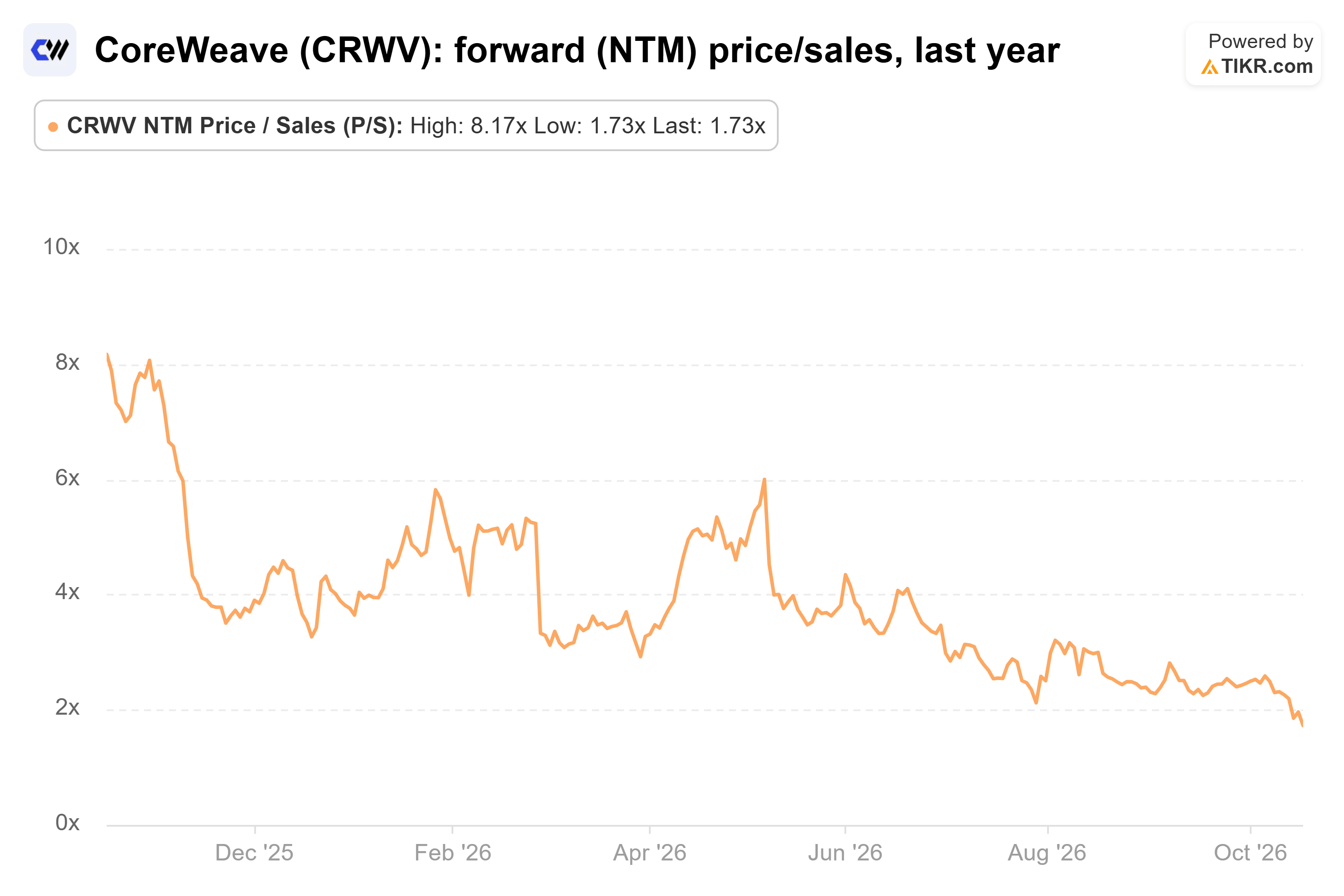
Using the October 16 valuation baseline and assuming unchanged forward sales estimates and share count, Wells Fargo’s $160 target would imply a price-to-sales multiple of approximately 4.5 times.
That is higher than CoreWeave’s one-year average, although considerably below its historical peak.
In other words, reaching $160 would require a meaningful recovery in investor confidence rather than simply maintaining today’s depressed valuation.
The bullish argument is that CoreWeave’s expanding backlog, accelerating revenue and capacity constraints could justify a higher multiple as its infrastructure investments begin generating more revenue.
The bearish argument is that capital spending, interest costs and continued net losses could prevent shareholders from benefiting fully from that growth.
During its second-quarter earnings call, management guided for third-quarter revenue of $3.45 billion to $3.6 billion and expected adjusted operating margins to reach the low teens by the fourth quarter.
Importantly, those are management’s forward-looking expectations, not guaranteed outcomes. Adjusted operating profitability also does not necessarily translate into positive GAAP earnings or free cash flow.
Is CoreWeave Stock Worth Buying After Its 57% Decline?
Wells Fargo’s $160 CoreWeave price target is plausible in a bullish scenario, but it looks aggressive rather than a conservative estimate of fair value.
CoreWeave has demonstrated exceptional customer demand, with substantial contracted revenue and analysts forecasting rapid expansion through 2028.
However, a potential 162% return depends on more than revenue growth alone.
Reaching $160 would require investors to regain confidence in CoreWeave’s ability to finance its infrastructure expansion, improve profitability, and convert its rapidly growing revenue into sustainable cash flow.
The next quarterly report will be particularly important for assessing whether management’s margin improvement plans and infrastructure deployments remain on track.
For now, CoreWeave offers substantial potential upside, but the company’s rising financing costs and worsening earnings expectations make the path to $160 uncertain.
So what is CoreWeave stock actually worth?
Wells Fargo’s $160 price target suggests significant upside, but CoreWeave’s rising financing costs and uncertain profitability make its future valuation particularly sensitive to investor assumptions.
TIKR lets you forecast the future price of any stock in less than a minute. Just enter a few assumptions into TIKR’s valuation model and see what CoreWeave could be worth. Start from Wall Street consensus estimates, or adjust the inputs to reflect your own view of the business. It’s free to use.
Disclaimer:
Please note that the articles on TIKR are not intended to serve as investment or financial advice from TIKR or our content team, nor are they recommendations to buy or sell any stocks. We create our content based on TIKR Terminal’s investment data and analysts’ estimates. Our analysis might not include recent company news or important updates. TIKR has no position in any of the stocks mentioned. Thank you for reading, and happy investing!


