Key Takeaways
- Constellation Energy is down 17% in the past month. It gave back its jump on a big Google deal as investors sold AI power stocks, along with Vistra and GE Vernova.
- Its Google and Amazon contracts run 15 to 20 years and don’t change with an election, so the risk is in the deals it hasn’t signed yet.
- Analysts expect normalized EPS to climb from $9.39 in 2025 to $16.80 in 2028, and the 2028 step depends on new contracts.
- The stock trades well below its three-year average forward P/E, which makes a case for patient buyers ahead of the Nov. 9 third-quarter report.
Constellation Energy (CEG) is down 17% in the past month, and it wasn’t for lack of good news.
In that month Constellation signed what The Wall Street Journal reported as the largest nuclear uprate deal yet between a power producer and a tech company, and Washington offered it a loan of up to $5 billion. Investors sold the stock anyway, along with everything tied to AI’s power build-out. Vistra (VST) and GE Vernova (GEV) are down 22% and 25% over the same stretch, even after Vistra’s 10.6% jump on Nov. 6, when its third-quarter report raised its 2026 outlook.
TIKR tracks 25 analysts on Constellation Energy. How many say “Buy”?
See the full breakdown of Buy, Hold, and Sell ratings on Constellation Energy, along with Wall Street’s revenue and earnings estimates, all in one place. More than 500,000 investors use TIKR to research stocks like this one. See Constellation Energy’s Analyst Ratings
What exactly happened
- Oct. 6: Constellation and Google signed a 3,590 MW power package in PJM. It’s a 20-year deal for 890 MW of new nuclear capacity from uprates, plus 15 years of supply from the existing fleet. The stock jumped 12% that day.
- Oct. 14: The Nuclear Regulatory Commission opened a special inspection at Constellation’s Dresden plant in Illinois after a corroded battery connection broke during maintenance.
- Oct. 22: AI power stocks sold off together, with no Constellation news.
- Oct. 27: Constellation landed a conditional Department of Energy loan of up to $5 billion for uprates at eight plants. CEO Joe Dominguez said the loan can help the company “move faster and go further.”
- Nov. 3: Democrats won both chambers of Congress in the midterms. Texas also elected a new governor, Gina Hinojosa, who had called for a moratorium on new data centers. Constellation fell 6.7% the next day.
Signed deals don’t vote
Google and Amazon have signed on for 15 to 20 years and together back about 1,080 MW of Constellation’s uprates on 20-year terms. An election doesn’t undo any of that.
The risk is in the next round of deals. Only about 30% of its clean baseload output was under long-term contracts in August, before the Amazon and Google deals. Management has said each gigawatt of nuclear output it contracts adds $0.40 to $1.00 to base EPS. Constellation also has Texas exposure through the gas plants it bought with Calpine.
Analysts expect earnings per share to keep climbing through 2029:
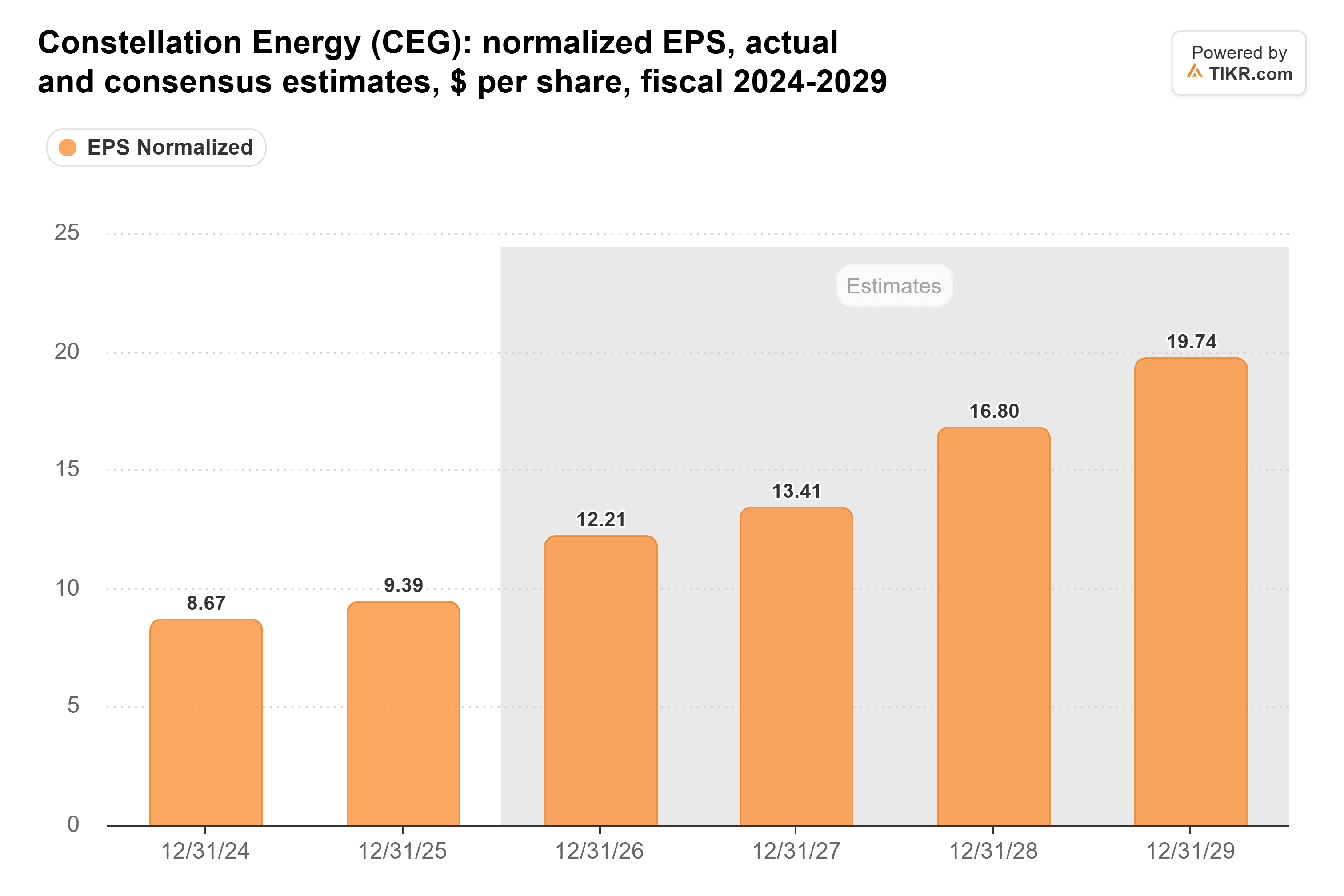
A Congress that takes office in January has little room to change 2026 earnings. The jump to $16.80 in 2028 is the part that needs new buyers to keep signing.
Vistra and GE Vernova sold off on the same worry. Vistra has its own Texas business under a governor-elect who has promised a moratorium on new data center approvals. Its 433 MW of uprates for Meta are also tied to up to $4.2 billion of conditional federal loans that aren’t final yet. GE Vernova raised its 2026 revenue guidance to $46.5 billion to $47.5 billion on Oct. 28 and still slid with the group.
Nov. 9 is the test
Constellation reports third-quarter results on Monday, Nov. 9, and management has said it will revisit its 2026 adjusted operating earnings guidance of $11.50 to $12.50 per share. Analysts’ normalized EPS estimate is already $12.21, above the $12 midpoint. Watch for new contracts and an update on Dresden, too.
The price already allows for a slower build
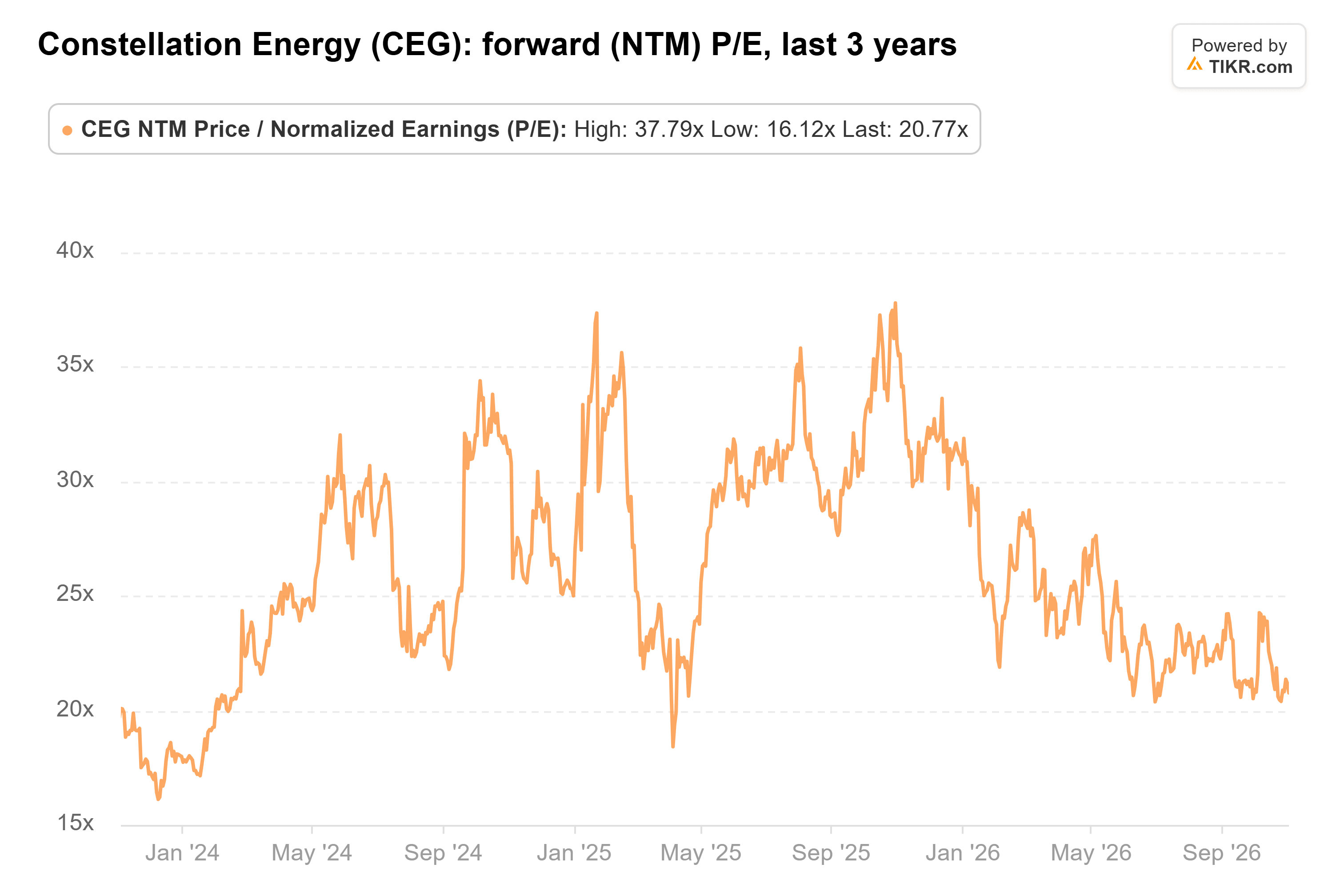
Constellation traded at 21x forward earnings at the Nov. 2 close, well below its three-year average of 26x, and the stock has slipped further since:
Analysts haven’t backed off much. Their consensus target is down from $401 a year ago but held near $339 through this month’s selloff:
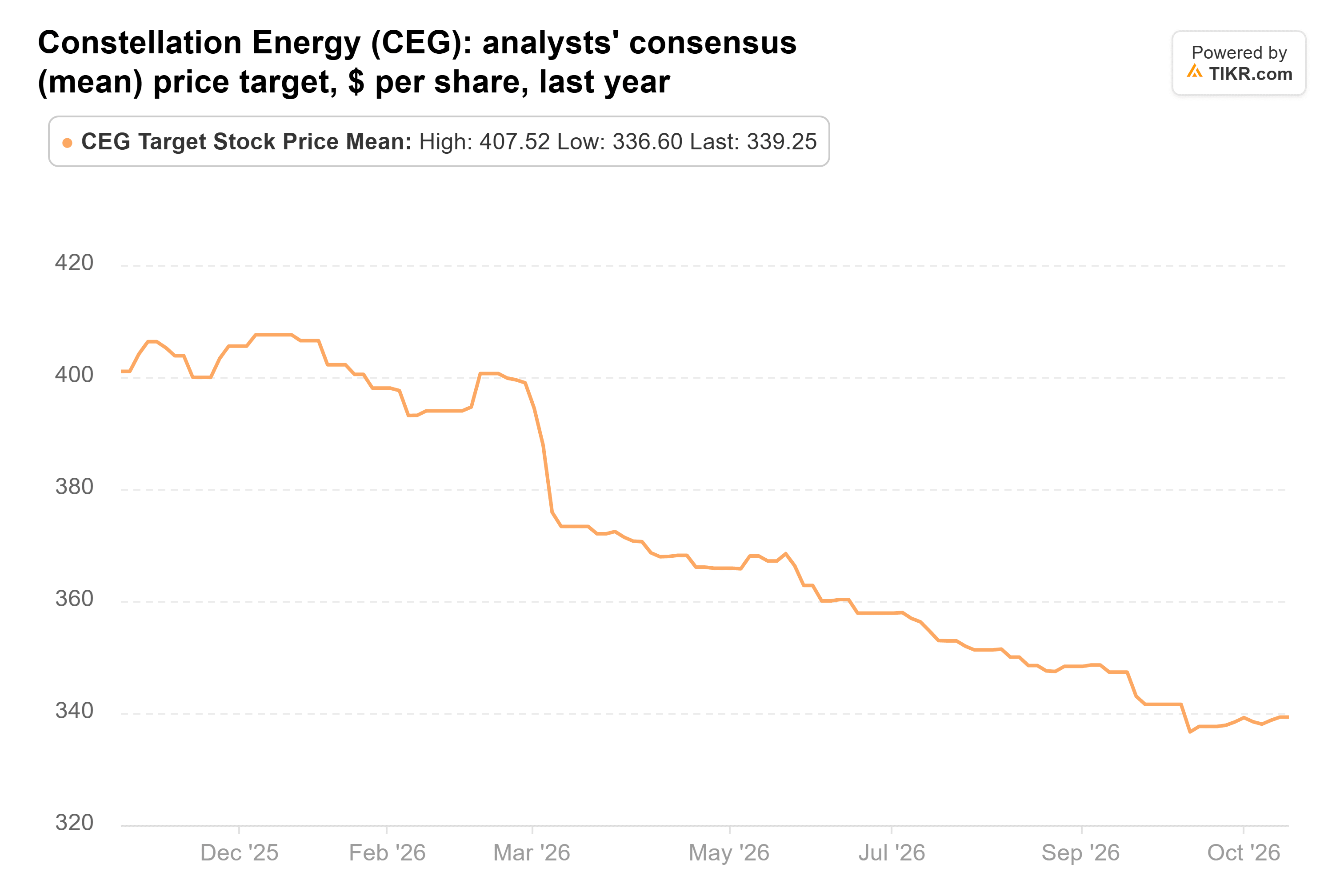
That’s about 36% above the Nov. 6 close of $249.95.
Investors sold Constellation like a data-center bet, even though its biggest deals are locked in for 15 to 20 years. With the multiple this far below its usual level, patient investors have reason to load up.
If Monday’s report brings a lower guidance midpoint and no new signings, that $16.80 for 2028 gets much harder to trust.
So what is Constellation Energy stock actually worth?
TIKR lets you forecast the future price of any stock in less than a minute. Just enter a few assumptions into TIKR’s valuation model and see what Constellation Energy could be worth. Start from Wall Street consensus estimates, or adjust the inputs to reflect your own view of the business. It’s free to use.
Value Constellation Energy for free
Disclaimer:
Please note that the articles on TIKR are not intended to serve as investment or financial advice from TIKR or our content team, nor are they recommendations to buy or sell any stocks. We create our content based on TIKR Terminal’s investment data and analysts’ estimates. Our analysis might not include recent company news or important updates. TIKR has no position in any of the stocks mentioned. Thank you for reading, and happy investing!