Key Takeaways
- Realty Income stock is up 9% in the past month. It came back from a 52-week low as Treasury yields fell.
- Third-quarter AFFO rose 3.7% to $1.12 a share, and management raised its 2026 AFFO guidance to $4.45-$4.46.
- Realty Income still uses debt and stock to pay for its growth, so lower yields cut what its new deals cost to fund.
- The stock still trades below its five-year average multiple of forward AFFO, so it still looks like a buy for income. A rebound in Treasury yields is the main risk.
Realty Income (O) stock is up 9% in the past month through the Nov. 6 close, while the S&P 500 fell 6% and the Nasdaq 100 fell 11%. It even closed higher on Nov. 5, when the S&P 500 lost 4.4%.
Most of that came from the bond market. But when Realty Income reported its third quarter on Nov. 2, it beat estimates and raised guidance, too.
It started with bonds
The stock fell to a 52-week low in early October as Treasury yields climbed to their highest levels in more than 20 years.
Then investors started selling AI stocks and buying bonds. On Oct. 22, Meta Platforms fell 7% on its AI spending plans, the 10-year yield dropped 19 basis points to 4.95%, and Realty Income rose 3%. By Oct. 30, the 10-year note was on track for its biggest monthly rally since 2024.
That’s a bigger deal for Realty Income than for most companies. It still relies on debt and new stock to fund its $10 billion investment target for 2026. CFO Jonathan Pong said in September that new equity effectively costs the stock’s AFFO yield. Lower Treasury yields cut the cost of the debt, and a higher share price cuts the cost of the stock.
TIKR tracks 25 analysts on Realty Income. How many say “Buy”?
See the full breakdown of Buy, Hold, and Sell ratings on Realty Income, along with Wall Street’s revenue and earnings estimates, all in one place. More than 500,000 investors use TIKR to research stocks like this one. See Realty Income’s Analyst Ratings
Then came a beat-and-raise
Third-quarter AFFO rose 3.7% to $1.12 a share from $1.08, a penny above the $1.11 consensus. Management raised its 2026 AFFO guidance to $4.45-$4.46, from $4.44-$4.45, and kept the $10 billion investment target. GAAP net income guidance fell to $1.55-1.56 a share.
The growth looked cleaner, too. AFFO ran $17.4 million above normalized FFO in the quarter, down from $23.5 million in the second quarter, so the add-back gap kept shrinking. Occupancy held at 98.8%, and the dividend used a well-covered 72.6% of AFFO.
The new range is just above the $4.44 analysts expected for 2026 before the report. AFFO per share stays well ahead of the dividend in every year of the estimates:
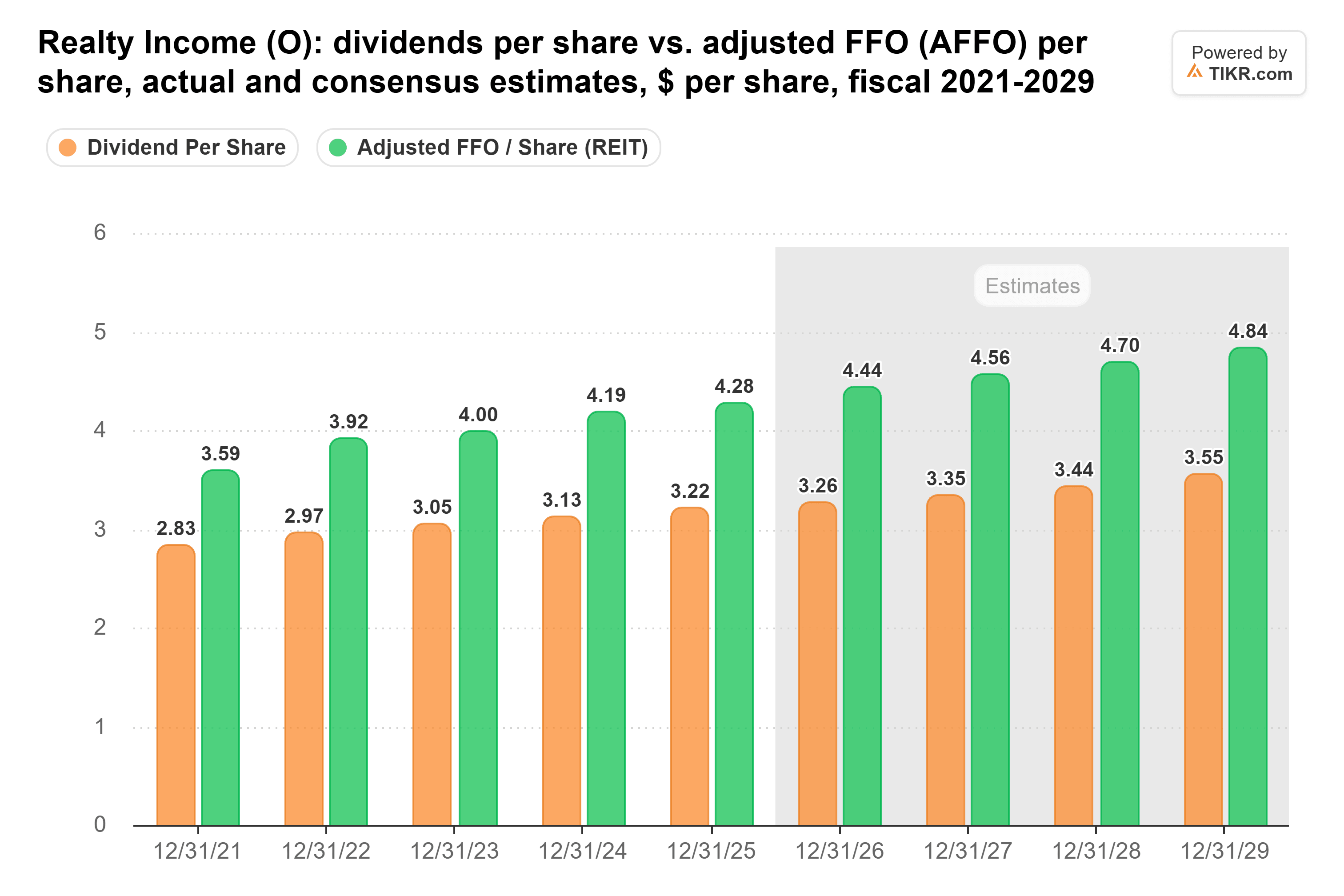
The funding news mattered most. Public stock covered just 18% of investment volume in the first half, against a 47% average over the prior three years. In the quarter, the company also added a European venture with KKR and $1 billion of 3.75% convertible notes. As CEO Sumit Roy said in the release, “This quarter, we funded investments at a realized leverage-neutral spread of approximately 170 basis points and have fully prefunded our equity needs for the remainder of the year.”
A slower finish to the year
Guidance implies fourth-quarter AFFO of $1.10-$1.11 a share, against $1.08 a year earlier, so growth slows to 2%-3%. Cantor Fitzgerald and Freedom Broker both cut their price targets to $63 after the report.
The bigger test is 2027 guidance, due with fourth-quarter results early next year. Before the report, analysts expected 2027 AFFO of $4.56 a share, growth of under 3%.
Still cheap by its own history
Even after the run, the stock trades well below its usual multiple. At the Nov. 2 close, it traded at 13x forward AFFO, against a five-year average of 15x and a peak of 19x in April 2022:
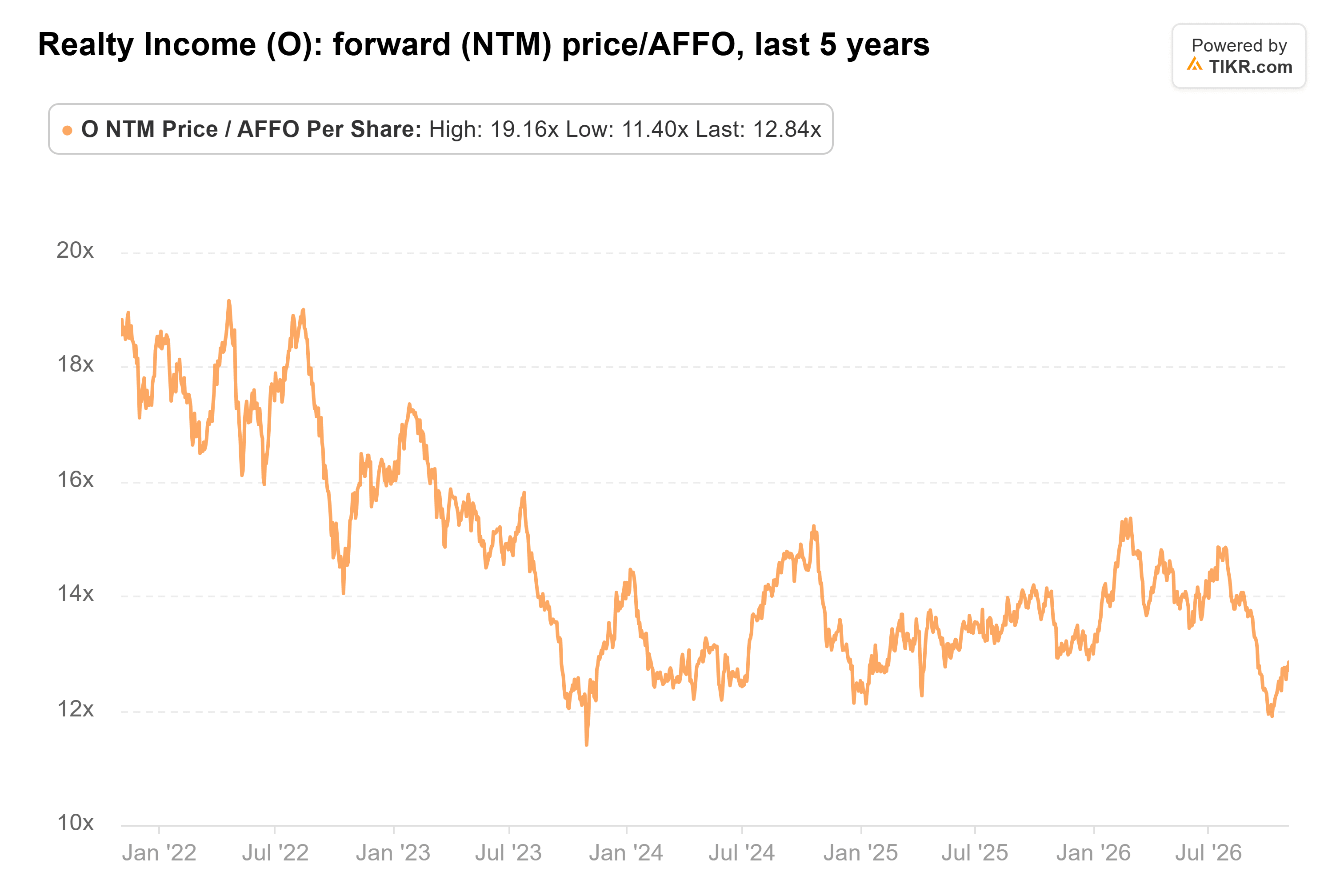
It’s still about 13x at the Nov. 6 close of $59.04, where the stock yields 5.5% on its $3.258 annualized dividend. Even those lower $63 targets are about 7% above that close.
Taking profits here looks early. The stock is still 13% below its 52-week high of $67.94, and the dividend is well covered. At 13x, investors are paying for little more than the slow growth analysts already expect. For income investors, adding more makes sense.
If the 10-year yield climbs back above 5%, Realty Income’s funding costs rise with it, and the shares would likely give back some of this month’s gain.
So what is Realty Income stock actually worth?
TIKR lets you forecast the future price of any stock in less than a minute. Just enter a few assumptions into TIKR’s valuation model and see what Realty Income could be worth. Start from Wall Street consensus estimates, or adjust the inputs to reflect your own view of the business. It’s free to use.
Disclaimer:
Please note that the articles on TIKR are not intended to serve as investment or financial advice from TIKR or our content team, nor are they recommendations to buy or sell any stocks. We create our content based on TIKR Terminal’s investment data and analysts’ estimates. Our analysis might not include recent company news or important updates. TIKR has no position in any of the stocks mentioned. Thank you for reading, and happy investing!