Key Takeaways
- Upstart shares fell 11% in a week after the company cut its 2026 outlook to about $1.35 billion of revenue, even though its third quarter set a record for contribution profit.
- Rising defaults lowered the value of the loans Upstart holds, while Pagaya raised its 2026 profit outlook and SoFi funds most of its lending with deposits.
- The stock trades at about half its usual forward multiple, but the 2027 earnings estimates behind that multiple look likely to come down.
- Selling at this level looks late, but buying more makes sense only once the Upstart Macro Index turns lower.
Upstart Holdings (UPST) fell 11% in the week to Nov. 5, after a record third quarter came with a cut to its 2026 outlook.
Plenty of that drop came with the market: the Nasdaq 100 fell 9% over the same days. But the outlook cut is Upstart’s own problem. Pagaya Technologies (PGY) raised its 2026 profit outlook on Oct. 29, and SoFi Technologies (SOFI) funds most of its lending with deposits, something Upstart can’t do yet.
A record quarter and a smaller 2026
The third quarter, reported on Nov. 3, beat revenue expectations:
- Originations of $4.1 billion, up 44% from a year earlier
- Revenue of $371 million, up 34%, ahead of analysts’ estimates
- Record contribution profit of $218 million, up 48%
- Net income of $36.6 million, up 15%
- A positive contribution margin on secured auto and home loans, a quarter ahead of plan
“Macro comes and goes, but alpha compounds,” co-founder and CEO Paul Gu said in the release.
Then Upstart cut its outlook to about $1.35 billion of 2026 revenue and $260 million of adjusted EBITDA, down from the $1.4 billion and $294 million it had guided to. Analysts were looking for $1.42 billion of revenue.
TIKR tracks 16 analysts on Upstart. How many say “Buy”?
See the full breakdown of Buy, Hold, and Sell ratings on Upstart, along with Wall Street’s revenue and earnings estimates, all in one place. More than 500,000 investors use TIKR to research stocks like this one. See Upstart’s Analyst Ratings
Defaults hit the loans Upstart holds
Upstart blamed rising defaults. The Upstart Macro Index (UMI), the company’s own gauge of how much the economy raises default risk, reached 1.53 in its latest reading, up from 1.39 in its December 2025 reading. As expected defaults climb, the loans and loss-sharing stakes Upstart keeps lose value. On Upstart’s third-quarter call, Gu said that hit “is actually larger than the impact from reducing new originations.”
New loans are slowing too: October’s daily originations fell 9% from September’s. And Upstart’s maximum exposure under its loss-sharing deals, a worst case it calls remote, rose to $1.50 billion at Sept. 30, against $887.4 million of equity, its third-quarter filing shows.
Pagaya’s network volume rose 28.7% to a record $3.61 billion in the third quarter, and it raised its 2026 GAAP net income outlook to 162-182 million. So the damage sits in the risk Upstart holds, not in borrower demand.
SoFi has the funding Upstart lacks: in a record third quarter, 90% of its average liabilities were deposits. Upstart Bank could take FDIC-insured deposits, but it still needs its remaining regulatory approvals before a planned early-2027 opening.
The estimates have further to fall
Going into the report, analysts expected normalized EPS to rise from $2.29 this year to $3.58 in 2027:

A smaller 2026 and a higher UMI point to lower numbers for 2027, too. After the report, BofA put its 2027 estimate at $2.79, and the GAAP consensus for 2027 is just $1.88.
Cheap, but I’d wait for the UMI
Before the report, Upstart traded at 7.0x forward normalized earnings, about half its 14x average over the past year.
Wall Street cut its targets anyway. BofA went to $30 from $37 the day before the report and to $28 after it, and at least eight other firms cut theirs after the results, three of them to $24. Even before those cuts, the average target had roughly halved in a year, to about $38 from $75:
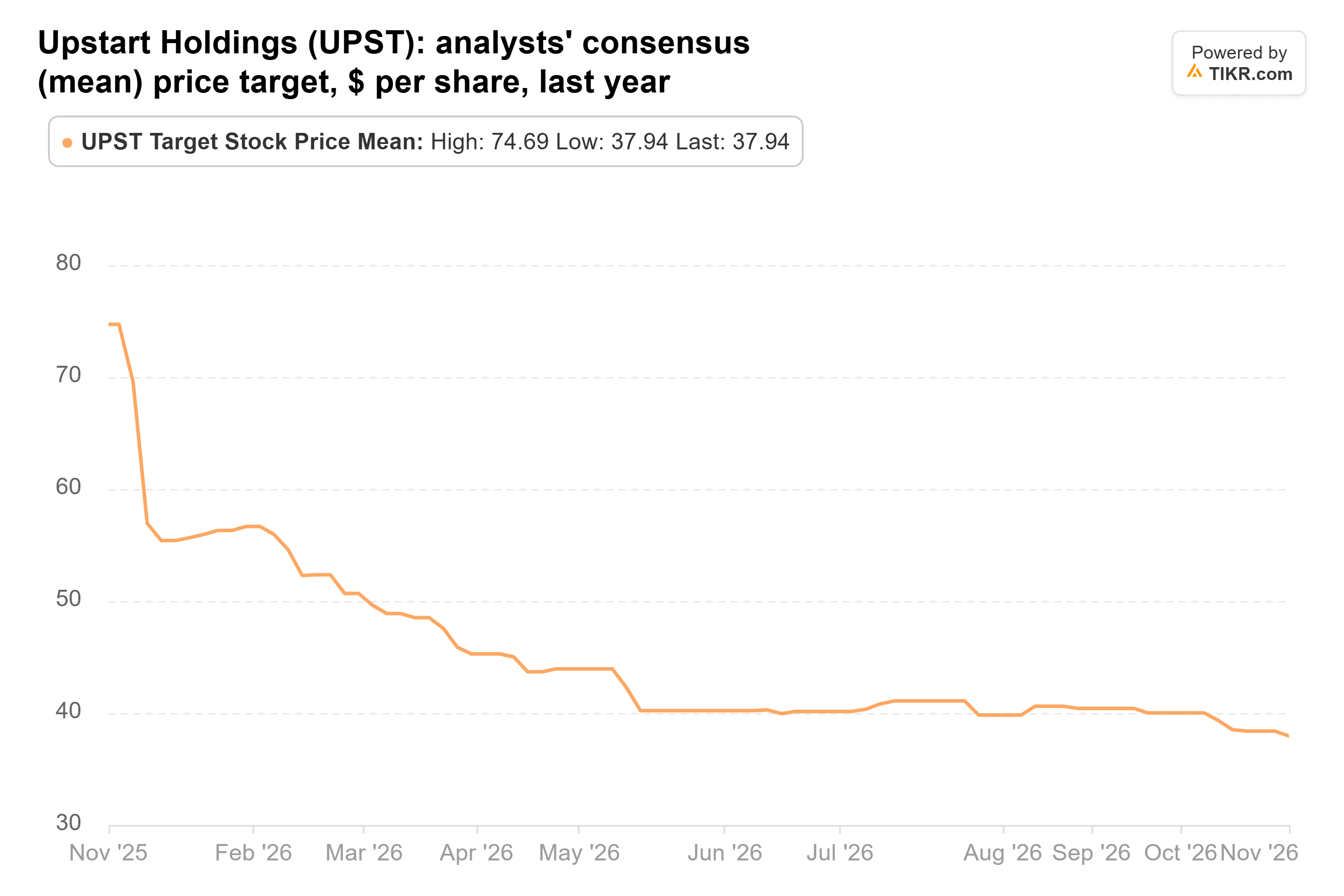
At 7.0x, the stock already prices in a lot of bad news, so selling here looks late. But the earnings behind that multiple are still falling, and more cuts look likely while the UMI climbs. Loading up can wait until the index turns.
November’s originations and the next UMI reading come out in early December. With the UMI back toward 1.4, Upstart should make more loans, and the ones it holds would be worth more.
So what is Upstart stock actually worth?
TIKR lets you forecast the future price of any stock in less than a minute. Just enter a few assumptions into TIKR’s valuation model and see what Upstart could be worth. Start from Wall Street consensus estimates, or adjust the inputs to reflect your own view of the business. It’s free to use.
Disclaimer:
Please note that the articles on TIKR are not intended to serve as investment or financial advice from TIKR or our content team, nor are they recommendations to buy or sell any stocks. We create our content based on TIKR Terminal’s investment data and analysts’ estimates. Our analysis might not include recent company news or important updates. TIKR has no position in any of the stocks mentioned. Thank you for reading, and happy investing!