Key Stats for Coinbase Stock
- Current Price: $175.85
- Target Price (Mid): ~$340
- Street Target: ~$222
- Potential Total Return: ~94%
- Annualized IRR: ~16% / year
- Max Drawdown: 65.89% on 2/12/26
Now Live: Discover how much upside your favorite stocks could have using TIKR’s new Valuation Model (It’s free) >>>
What Happened?
Coinbase Global, Inc. (COIN) spent most of 2026 trading like a company the market had given up on, and then a single sentence from a cabinet official moved it almost 10% in an afternoon. On July 21, shares closed at $175.85, up 9.61%, its sharpest single-session gain in months. The trigger was not earnings or a product. It was Treasury Secretary Scott Bessent telling an interviewer that the Digital Asset Market Clarity Act, the crypto market-structure bill known as the CLARITY Act, was on the Senate’s “one-yard line.” The whole crypto-equity complex moved with it: Robinhood rose about 7%, Bullish gained too, and Bitcoin hit a two-week high. This was a sector rally on a regulatory headline, and Coinbase, as the largest US exchange, sat closest to the news.
That tells where sentiment sits. A company whose core business is healthy does not lurch into double digits on a politician’s football metaphor. Coinbase has been priced as a leveraged bet on crypto trading volume, and that bet has gone badly, with the stock still down more than 20% in 2026 even after the pop. Bulls think regulatory clarity is the missing catalyst that finally lets the market pay for everything else the company has built. Bears think one legislative headline does not fix a revenue engine that just contracted 31%. The reader’s real question lives in that gap: is this the turn, or another false start for a stock that has had several?
Why a Football Metaphor Was Worth $4 Billion in Market Cap
Today, a US crypto exchange operates under a patchwork of state licenses, federal anti-money-laundering rules, and securities law defined largely through enforcement rather than statute. The bill would draw a clear line between the SEC and the Commodity Futures Trading Commission (CFTC), the federal regulator for commodity and derivatives markets, giving the CFTC authority over spot trading in digital commodities. For a company that has spent years litigating what it is even allowed to list, that is the difference between defense and offense.
The honest caveat belongs right here, and it is also the article’s legal protection. What happened on July 21 was a reported agreement between the White House and Senate Republicans on an ethics provision, not a signed law. The bill still needs a full Senate floor vote, where supporters likely need 60 votes, and Democratic support remains conditional. The practical deadline is the August recess, after which the calendar pushes any action toward mid-September. Prediction markets that priced 2026 passage above 80% in February had it closer to a coin flip through June. The market bought the probability, not the outcome.

See historical and forward estimates for Coinbase stock (It’s free!) >>>
The Business the Market Stopped Paying For
Regulatory clarity only matters if there is a business worth de-risking. Coinbase’s Q1 2026 results, reported May 7, were ugly on the surface. Revenue was $1,412.98 million against a $1,478.75 million estimate, down 31% year over year. The company posted a GAAP net loss of $394.12 million, or $1.49 per share, its second straight quarterly loss, driven largely by $482 million in unrealized losses on crypto held on its own balance sheet. Transaction revenue, historically the heart of the business, fell roughly 40% year over year to $756 million.
Underneath that, the mix was shifting. Subscription and services revenue, which includes staking and custody, reached about 44% of the total, and adjusted earnings before interest, taxes, depreciation, and amortization (adjusted EBITDA) stayed positive at $303.3 million, the 13th straight quarter in the black. Coinbase also reported a record 8.6% share of global crypto trading volume. It was gaining ground while its market shrank underneath it. That is the setup the CLARITY Act speaks to: a platform expanding its footprint, waiting for the rules that let it be valued as more than a volume proxy.
The clearest evidence of that expansion came at the June 17 System Update, where management detailed the “Everything Exchange,” a single account to trade crypto, stocks, options, commodities, and prediction markets around the clock. At the event, Coinbase executive Liz Martin made the case for why regulated market access is the prize, noting that crypto derivatives “drive 80% of global crypto volume” and that the majority of that volume still sits offshore. Her point was that Coinbase is trying to bring that volume back onshore to US customers under a compliant framework. A federal market-structure law is what turns that from a compliance gamble into a scalable product.
A Premium That Only Makes Sense If the Transition Works
None of this is cheap, which is the crux of the disagreement. On forward revenue, Coinbase trades near 7x next-twelve-months (NTM) enterprise value to revenue, against a capital-markets peer average around 3.9x on the same measure. Bullish (BLSH) is the only close peer trading richer, near 10x, and it does so at a fraction of Coinbase’s scale. On earnings, the gap is just as wide: Coinbase sits near 69x NTM P/E versus about 40x for Robinhood Markets (HOOD), its closest comparable. Either way you cut it, the premium reflects Coinbase’s breadth and its moat as the largest US crypto custodian, and it is justified only if the Everything Exchange converts optionality into recurring, less cyclical revenue.
The payments business is the strongest sign that the transition is real. Coinbase’s Base blockchain has settled more than $19 trillion in stablecoins in 2026, alongside nearly $1 trillion in stablecoin volume across its products over the past year. Those are payment flows, not trading flows, and they carry a steadier revenue profile than spot crypto. Analysts remain split. Bernstein sits at a Street-high $330 target on the diversification thesis, while Barclays holds an Underweight rating and a $107 target, arguing new products cannot offset muted trading volumes fast enough. The Street mean target is about $222, roughly 26% above the current price.

See how Coinbase performs against its peers in TIKR (It’s free!) >>>
TIKR Advanced Model Analysis
- Current Price: $175.85
- Target Price (Mid): ~$340
- Potential Total Return: ~94%
- Annualized IRR: ~16% / year
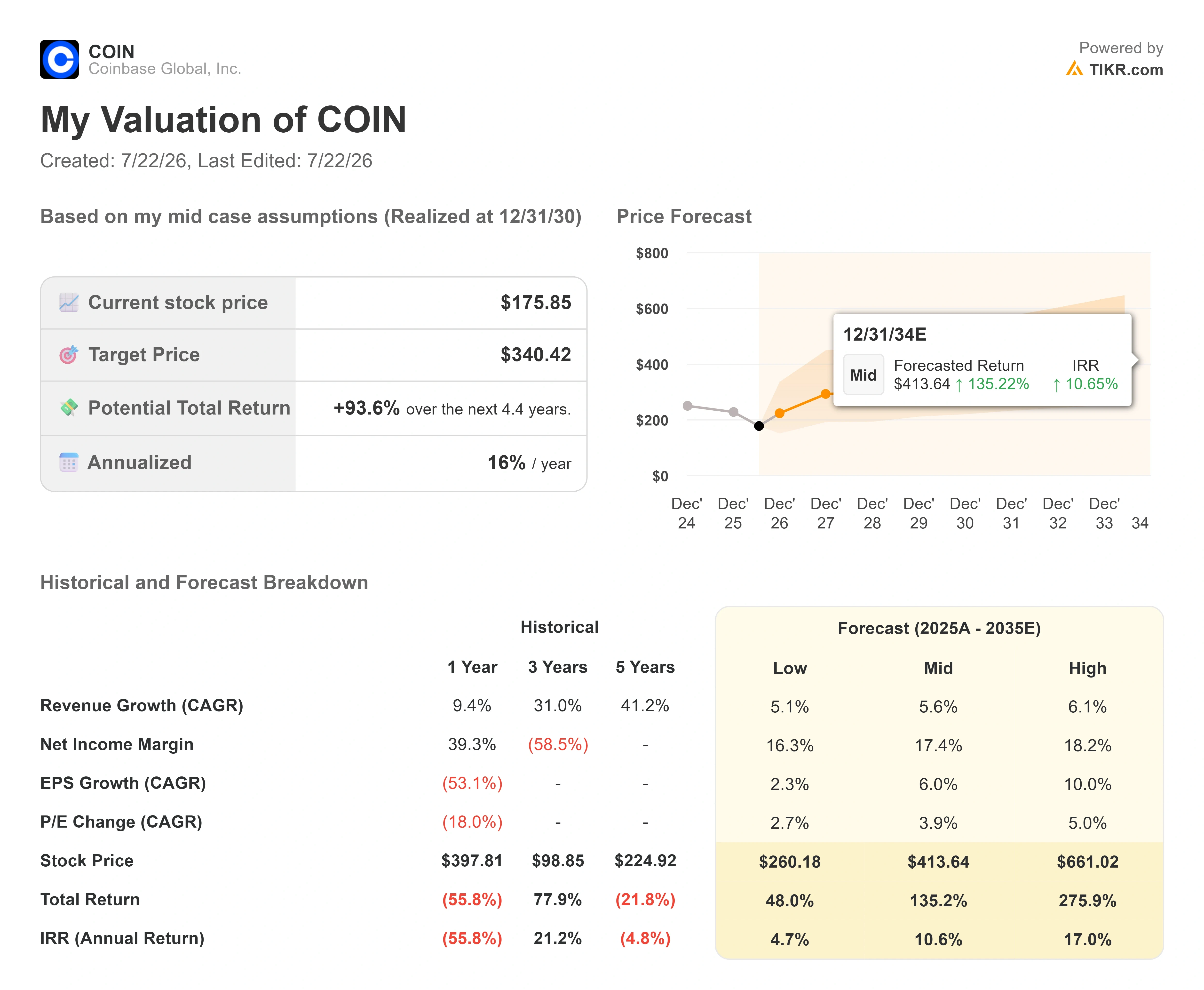
See analysts’ growth forecasts and price targets for Coinbase stock (It’s free!) >>>
The two revenue drivers are the shift toward subscription and services income (staking, custody, and stablecoin economics) and the ramp of newer trading products (derivatives, options, and prediction markets) that broaden the base beyond spot crypto. The margin driver is operating leverage: a 14% workforce reduction and cost discipline mean incremental revenue falls through at high margins, which is why adjusted EBITDA held up as revenue fell. The primary risk is the one the market has priced all year, that trading volume stays depressed, and diversification revenue never scales fast enough to offset it.
The upside case is that regulatory clarity plus the Everything Exchange re-rates Coinbase from a cyclical trading proxy into a diversified financial platform, and the multiple expands with the earnings mix. The downside case is that the CLARITY Act stalls again, volumes stay weak into 2027, and a stock near 70x earnings has a long way to fall.
Conclusion
The next month decides which story is true. Watch the Senate floor calendar ahead of the August recess. A reconciled CLARITY bill that reaches a vote and clears cloture would validate the July 21 move and likely pull the stock toward the Street’s $222 mean. A bill that slips into September strips out the catalyst that added billions in market cap in a session, leaving the stock to lean on fundamentals that still show a shrinking top line. Then comes the harder test in early August, when Coinbase reports Q2. The number that matters is not revenue but the subscription and services line and the derivatives run rate, because that is where the diversification thesis either shows up or gets exposed. Clarity from Washington buys time. Only the mix shift buys the multiple.
See what stocks billionaire investors are buying so you can follow the smart money with TIKR.
Should You Invest in Coinbase?
The only way to really know is to look at the numbers yourself. TIKR gives you free access to the same institutional-quality financial data that professional analysts use to answer exactly that question.
Pull up Coinbase, and you’ll see years of historical financials, what Wall Street analysts expect for revenue and earnings in the quarters ahead, how valuation multiples have moved over time, and whether price targets are trending up or down.
You can build a free watchlist to track Coinbase alongside every other stock on your radar. No credit card required. Just the data you need to decide for yourself.
Analyze Coinbase on TIKR Free →
Looking for New Opportunities?
- See what stocks billionaire investors are buying so you can follow the smart money.
- Analyze stocks in as little as 5 minutes with TIKR’s all-in-one, easy-to-use platform.
- The more rocks you overturn… the more opportunities you’ll uncover. Search 100K+ global stocks, global top investor holdings, and more with TIKR.
Disclaimer:
Please note that the articles on TIKR are not intended to serve as investment or financial advice from TIKR or our content team, nor are they recommendations to buy or sell any stocks. We create our content based on TIKR Terminal’s investment data and analysts’ estimates. Our analysis might not include recent company news or important updates. TIKR has no position in any stocks mentioned. Thank you for reading, and happy investing!