Key Takeaways
- Cloudflare shares jumped 11% after third-quarter revenue rose 39% to $782.5 million. The same week, CoreWeave, Nebius and IREN sank on fears that new rules would limit data center construction.
- CEO Matthew Prince called Cloudflare the “first agentic cloud,” and its results back up the idea that it can grow with AI agent traffic on a network it already runs.
- Quarterly free cash flow has more than doubled since late 2024, and management now expects GAAP profitability in the fourth quarter.
- The stock still trades well above its usual forward earnings multiple, so a slowdown in agent traffic would hit it hard.
Cloudflare (NET) shares soared 11% today after a blowout third quarter, while CoreWeave (CRWV) and the rest of the neoclouds kept sinking.
Democrats won control of both chambers of Congress on Tuesday, and investors worried they’d push harder to curb data center construction. CoreWeave fell 10% on Wednesday to a new 52-week low. By Thursday, CoreWeave, Nebius and IREN had each lost more than 10% since the vote. Cloudflare sank 8% right along with them ahead of its report.
Then, on Thursday’s third-quarter call, CEO Matthew Prince drew the line himself:
“Cloudflare isn’t a neo cloud. We’re also not, as some of you have called us, the fourth public cloud. We’re something different. We’re the first agentic cloud”
Judging by today’s jump, investors are buying it.
TIKR tracks 34 analysts on Cloudflare. How many say “Buy”?
See the full breakdown of Buy, Hold, and Sell ratings on Cloudflare, along with Wall Street’s revenue and earnings estimates, all in one place. More than 500,000 investors use TIKR to research stocks like this one. See Cloudflare’s Analyst Ratings
Agents are moving onto its network
Prince’s case starts with how Cloudflare runs code. He said hyperscalers and neoclouds were built around containers. Cloudflare runs on what it calls isolates instead, a lighter way to run many customers’ programs on the same machine. He argued that this lets it “scale densely with a level of efficiency no hyperscaler or neo cloud can match.”
That efficiency matters because Prince expects agent traffic to dwarf human traffic online, by 1,000 to 1 within five years. He made that call last quarter, and now says he’d “take the under on the timing of that bet.”
And the traffic is already showing up. Prince cited third-party data: “between July 1 and today, we added approximately 5% of the entire web to Cloudflare. That’s wild.” More than 10 million developers were on its platform by October, up from 4.5 million at the end of 2025.
Revenue grew 39% to $782.5 million. That was 6% above the top of management’s own guidance, after three straight quarters of beats between 3% and 5%. Fourth-quarter guidance of $845 million to $846 million is well above the $791 million to $798 million that its August outlook implied.
Going into the report, analysts expected revenue to keep compounding for years:
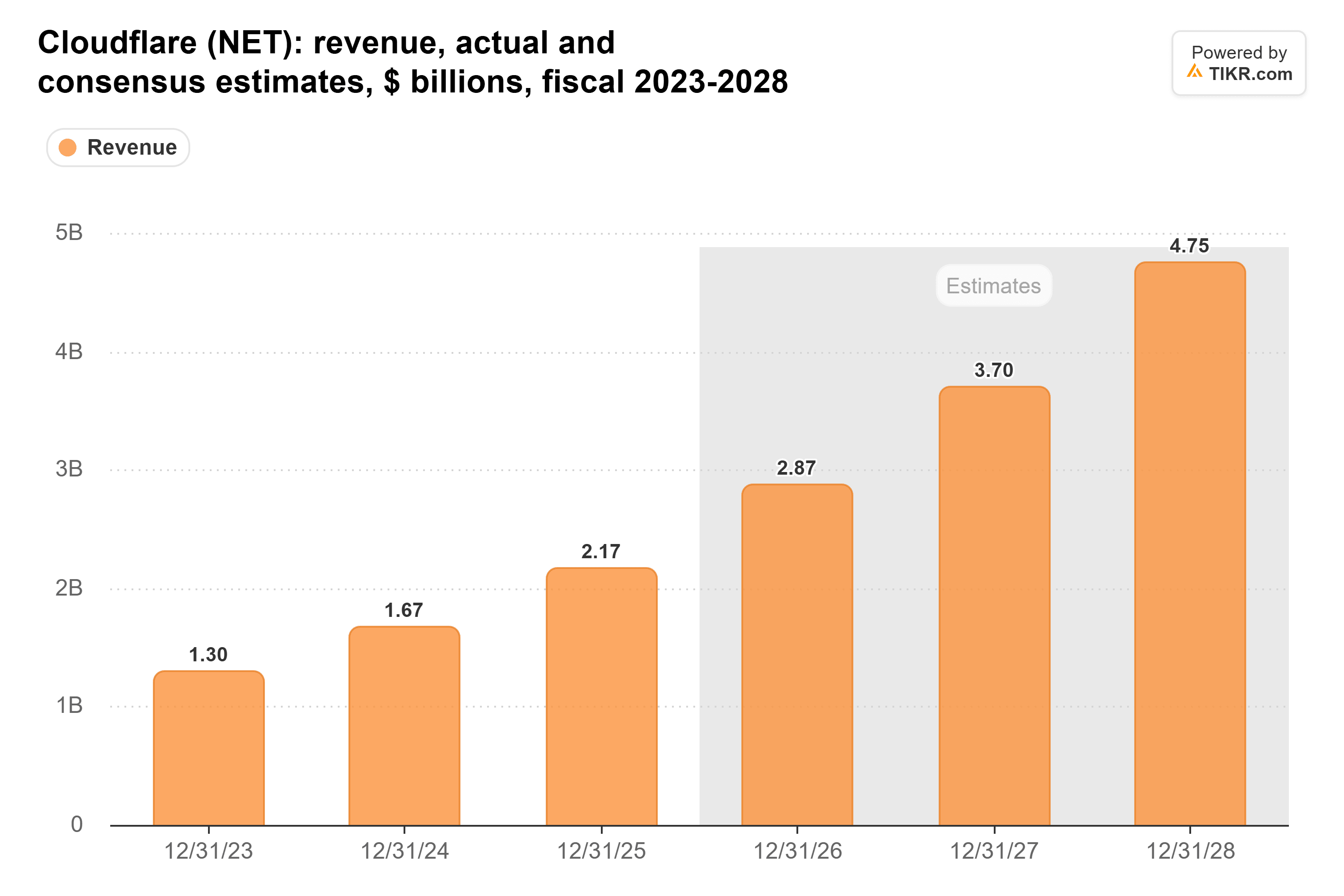
Management’s new guidance of $2.96 billion for 2026 already beats the $2.87 billion analysts expected. And their $3.70 billion for 2027 would be just 25% growth on that guidance. That’s slower than any quarter Cloudflare has reported in the past two years.
The cash shows up, too
CoreWeave, Nebius and IREN are spending heavily on facilities and equipment for AI computing, so a fight over data center permits goes straight at their growth. Cloudflare’s agent traffic runs over a network it already operates. And a year ago, CFO Thomas Seifert said no AI-native customer made up more than 2% of revenue.
On Thursday’s call, Seifert said the developer platform has “slightly lower gross margins, but significantly lower cost to book.” He credited the platform’s growth for the jump in operating margin. Adjusted operating margin rose to 17.5% from 15.3% a year earlier. He added that Cloudflare had aimed to exit the year moving from a Rule of 40 to a Rule of 50: “We are far ahead of that currently.”
Quarterly free cash flow has more than doubled since late 2024:
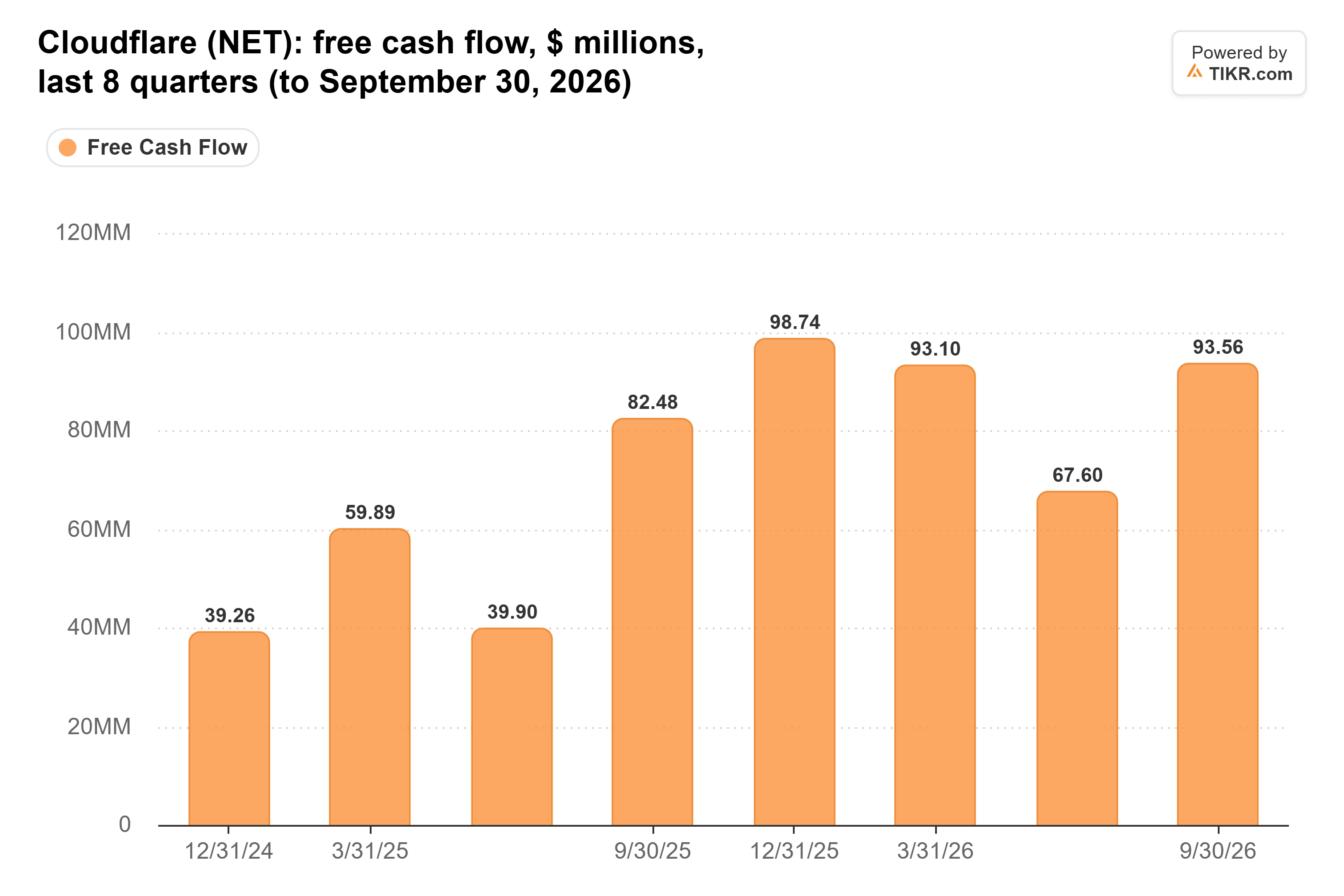
(The second-quarter dip included $98.6 million of restructuring payments after Cloudflare cut 20% of its staff in May.)
Management now guides to GAAP profitability in the fourth quarter. The third quarter had a GAAP operating loss of $67.9 million, which included $174.1 million of stock-based compensation.
The premium is the catch
Cloudflare isn’t cheap, though. It traded at 179x forward earnings on Nov. 2, above its 173x quarter-end average since mid-2023. At that price, investors are counting on agent traffic to keep growing fast. This stock can fall hard when a quarter disappoints: it dropped 24% the day after its first-quarter report in May, when gross margin came in light.
Still, Prince is right. Cloudflare grows with agents on a network it already runs, and it’s getting more profitable as it does. I’d much rather own that than a company that has to win a permit fight to keep growing.
Of course, we’ll get the next big read in February. The fourth-quarter report should bring Cloudflare’s first 2027 outlook, which management has tied to a Rule of 50.
So what is Cloudflare stock actually worth?
TIKR lets you forecast the future price of any stock in less than a minute. Just enter a few assumptions into TIKR’s valuation model and see what Cloudflare could be worth. Start from Wall Street consensus estimates, or adjust the inputs to reflect your own view of the business. It’s free to use.
Disclaimer:
Please note that the articles on TIKR are not intended to serve as investment or financial advice from TIKR or our content team, nor are they recommendations to buy or sell any stocks. We create our content based on TIKR Terminal’s investment data and analysts’ estimates. Our analysis might not include recent company news or important updates. TIKR has no position in any of the stocks mentioned. Thank you for reading, and happy investing!