


Key Takeaways
- IREN co-CEO Daniel Roberts said on the company’s Nov. 5 earnings call that older NVIDIA H100 GPUs were just recontracted at double their original contract price.
- Old chips earning more on a second contract supports IREN’s revenue and the useful life of NVIDIA’s installed base.
- IREN’s capital spending reached $4.82 billion in the September 2026 quarter, and short seller Jim Chanos argues its capital base is too big for its revenue.
- A new contract with a customer prepaying about 90% of the GPU capex answers part of that worry, and IREN traded at 3.1x forward sales on Nov. 2, below its three-year average of 5.2x.
IREN (IREN) went into its Nov. 5 report after a roughly 20% slide, on news from The Information that delays at its Childress, Texas site held up some of Microsoft’s AI spending.
Then co-founder and co-CEO Daniel Roberts gave NVIDIA (NVDA) shareholders a line worth hearing on IREN’s fiscal first-quarter call:
“Older generation H100s, we just recontracted at double the original contract price.”
Which is a remarkable thing to say about hardware that old.
And IREN isn’t the only one seeing it. As Dave Blundin put it on this week’s episode of Moonshots with Peter Diamandis: “we’re seeing H100 prices increasing, which is insane, on chips that are how old? Three years old now.”
TIKR tracks 20 analysts on IREN. How many say “Buy”?
See the full breakdown of Buy, Hold, and Sell ratings on IREN, along with Wall Street’s revenue and earnings estimates, all in one place. More than 500,000 investors use TIKR to research stocks like this one. See IREN’s Analyst Ratings
Old chips that still earn
The worry about GPU clouds has been that the chips lose their value before they pay off. IREN’s own math on its Microsoft contract assumed its GPUs would be worth nothing after five years.
If a three-year-old H100 can rent for twice its first contract, that assumption looks conservative. That’s good news for IREN, which keeps each GPU when a contract ends. It’s good news for NVIDIA too, since its chips are still earning money for its customers years after they shipped.
IREN’s newest deals point the same way. In the days before the call, it signed a five-year contract at about $22 million of annualized revenue per megawatt and a shorter one at more than $40 million, Roberts said. A leading frontier AI lab also expanded its capacity with IREN again.
Analysts already expected IREN’s revenue to roughly quadruple, from $707 million in fiscal 2026 to $2.81 billion in fiscal 2027 (the year ending June 2027), then reach $7.41 billion the year after.
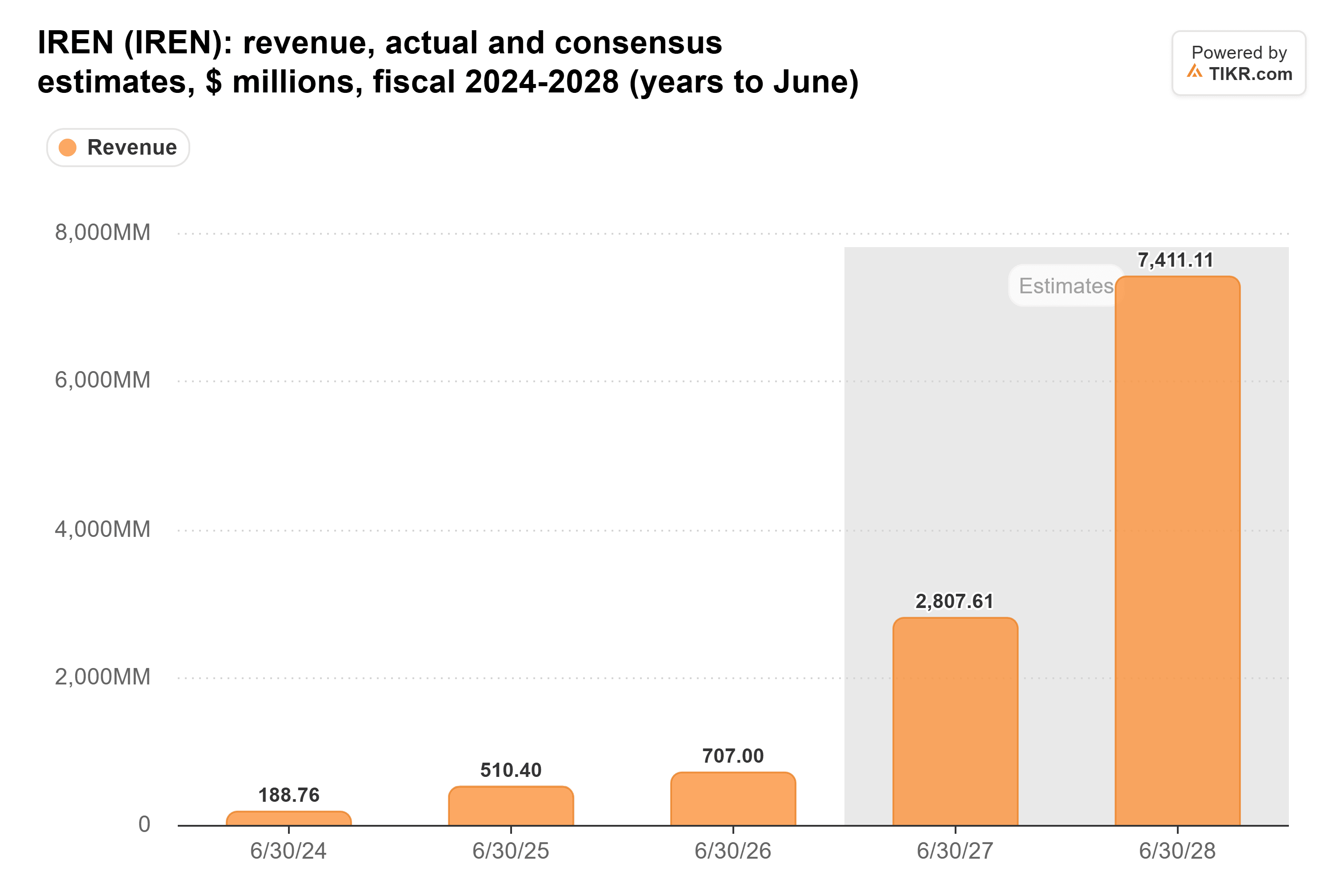
Higher pricing on GPUs IREN already owns only helps those numbers. The one slip is timing. Roberts now targets IREN’s more than $4 billion of contracted ARR for January, adding, “Perhaps it extends to the end of February.” That’s a month or two past the year-end goal IREN had set.
The stock hasn’t caught up
Roberts was asked why IREN keeps trimming its fiscal 2027 capex plan. He said it’s purely down to the state of financial markets, since the demand and the customers are there. “What’s happening at the business level is very disconnected from what we’re seeing in the market,” he said.
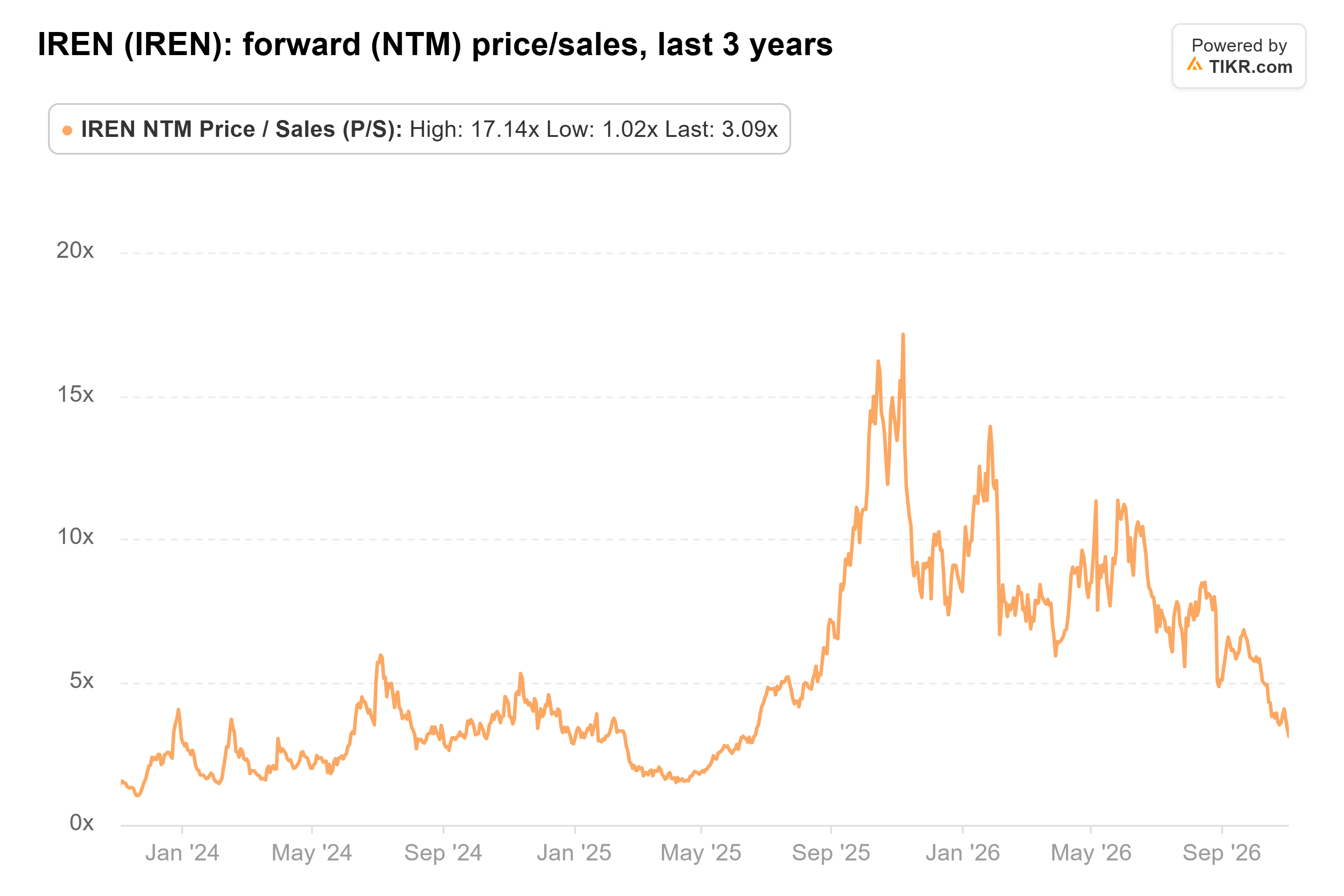
IREN traded at 3.1x forward sales on Nov. 2, well below its three-year average of 5.2x and a fraction of the 17x it reached a year earlier. That was before the slide.
A $20 billion capital bill
The cheap multiple comes with a big check to write. IREN’s quarterly capital spending went from $281 million in the September 2025 quarter to $4.82 billion in the September 2026 quarter.

Short seller Jim Chanos did the math on X. By the time IREN hits its $4 billion ARR target, he expects it to have about $20 billion of average capital employed. “A 5x ratio of capital to revenues is not viable long-term,” he wrote.
The call answered part of that math. The customer on the new five-year contract is prepaying about 90% of the GPU capex, so it funds most of that hardware itself. IREN’s data centers are worth $6 billion today, with $10 billion targeted by June 30. They were paid for with cash, they carry no debt, and management calls them 20-year assets that can hold several generations of chips.
A 5x ratio looks a lot different when the buildings last 20 years and the GPUs inside them can rent at double on a second contract.
The risk is how IREN pays for the rest. Its shares outstanding rose 48% in fiscal 2026, and if financing stays tight, more stock sales would dilute what the higher prices earn.
Good news for IREN and NVIDIA
The way I see it, a three-year-old H100 renting at double is about the clearest sign you’ll get that compute is still in short supply. IREN owns the power, the buildings and the chips to collect on it. With the stock well under its usual multiple, I think the market is pricing in more risk than this call showed.
For NVIDIA, chips it sold years ago are still paying for themselves. That supports the case that customers will keep paying up for its new ones.
Of course, IREN still has to deliver. The next milestone is the 0.3 gigawatts targeted for January, and a delay on Microsoft’s Texas capacity has already cost the stock once.
So what is IREN stock actually worth?
TIKR lets you forecast the future price of any stock in less than a minute. Just enter a few assumptions into TIKR’s valuation model and see what IREN could be worth. Start from Wall Street consensus estimates, or adjust the inputs to reflect your own view of the business. It’s free to use.
Disclaimer:
Please note that the articles on TIKR are not intended to serve as investment or financial advice from TIKR or our content team, nor are they recommendations to buy or sell any stocks. We create our content based on TIKR Terminal’s investment data and analysts’ estimates. Our analysis might not include recent company news or important updates. TIKR has no position in any of the stocks mentioned. Thank you for reading, and happy investing!


