


Space Exploration Technologies Corp. (SPCX) put its first Starlink V3 satellites into orbit on Monday, September 28. Starship Flight 14 lifted off from Starbase, Texas, at 8:49 a.m. EDT, reached orbit for the first time, and deployed 26 V3 satellites, UPI reported. It wasn’t clean: a Raptor 3 engine shut down on ascent and had to be relit for orbital insertion.
The flight matters because Starship is the bottleneck on Starlink. V3 satellites are built to fly on Starship, so its launch cadence caps how much capacity SpaceX can put in orbit and sell. The stock traded at about $150 Monday morning, up less than 1%.
Why Cathie Wood calls it “off the charts”
Ahead of the flight, ARK Invest’s Sam Korus reminded followers on X how big a jump V3 satellites are if they have “1 Tbps and are <2,000kg.” ARK CEO Cathie Wood replied on September 26: “Starship is off the charts!”
The 1 Tbps lines up with SpaceX’s own spec: a full Starship load of V3s is designed to add 60 Tbps of downlink capacity, more than 20 times a V2 Mini launch on Falcon 9.
The money math is ARK’s. Wood wrote on September 16 that “Each Starship launch could generate $1 billion in revenue,” roughly 61 Tbps at about $19 million per Tbps. Herbert Ong amplified Larry Goldberg’s breakdown of that estimate, and Elon Musk replied “Interesting.”
What SPCX consensus already assumes
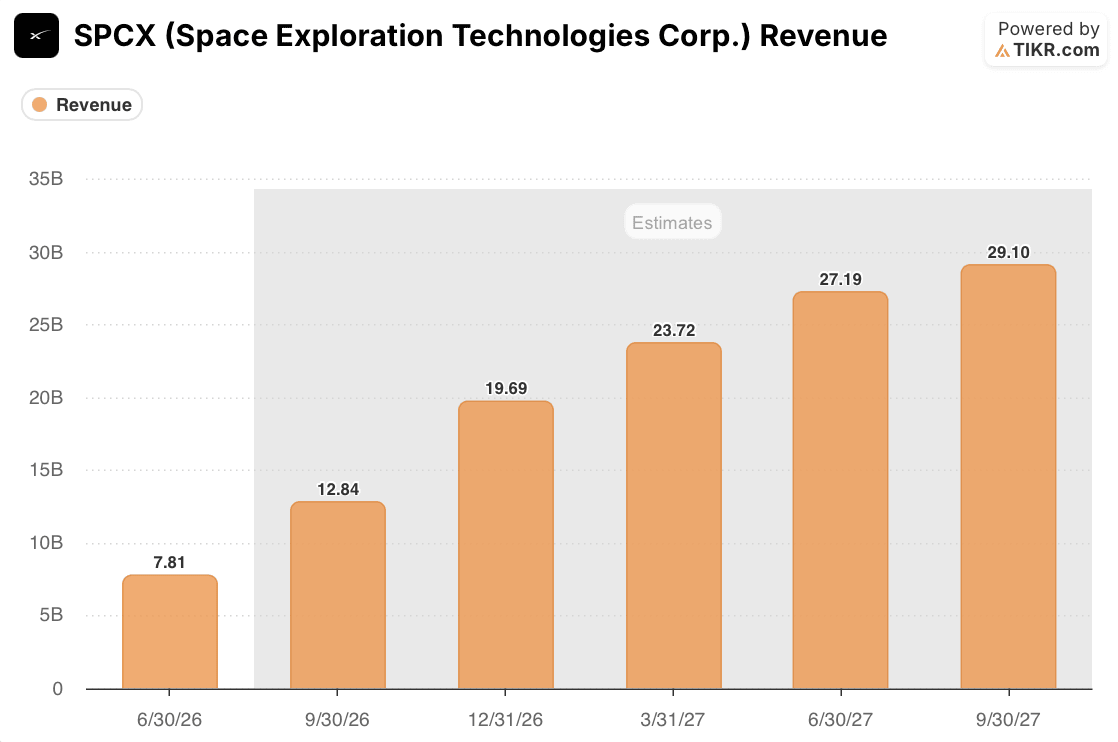
Analysts already expect enormous growth. Consensus has quarterly revenue climbing from $7.81 billion in Q2 2026 to $29.10 billion by Q3 2027, 3.7 times in five quarters.
Against Q3 2027’s $116 billion annualized run rate, one full Starship load at ARK’s $1 billion is under 1%. Today’s 26 satellites, at ARK’s pricing, work out to about $500 million, or roughly 3% of Starlink’s current connectivity run rate ($4.29 billion in Q2).

Capex tells the same story. SpaceX spent $18.37 billion in Q2 2026, 6.4 times the year before, but $15.83 billion of that went to AI. Connectivity and Space together took $2.54 billion, about 14%.
Starship is the cheap part of this story.
The $1 billion needs everything to go right
ARK’s figure assumes every new terabit sells at about $19 million, meaning demand and pricing hold while capacity floods in. Adding 60 Tbps per flight puts steady pressure on the price per bit. Ong flagged it himself: “Of course, there are huge assumptions here.” The $10 trillion scenario in his post needs 10,000 flights a year, and Monday was Starship’s first trip to orbit, carrying 26 satellites instead of a full load.
What SPCX is worth going into the next flight

SPCX trades at 23.46x NTM revenue down from 62.12x in June and about 25% below its 31.27x average since the IPO. The multiple has held between 20x and 25x since the August low of 19.19x.
The market is paying for a consensus path that is already steep and leans heavily on AI, and I don’t see Wood’s launch math in the price yet. The next test is how many V3s SpaceX puts on the second flight. A move toward 60 would matter for Starlink rivals like AST SpaceMobile (ASTS) and Viasat (VSAT), which compete on capacity SpaceX can now add by the terabit.
The revenue path, the capex split, and the multiple since the IPO are all a few clicks away on TIKR, free, so you can check how much launch growth is priced in before the next Starship flight. Learn more here
Disclaimer:
Please note that the articles on TIKR are not intended to serve as investment or financial advice from TIKR or our content team, nor are they recommendations to buy or sell any stocks. We create our content based on TIKR Terminal’s investment data and analysts’ estimates. Our analysis might not include recent company news or important updates. TIKR has no position in any stocks mentioned. Thank you for reading, and happy investing!


