Key Takeaways
- General Motors’ weighted average diluted share count fell from 1.13 billion in Q3 2024 to 0.91 billion in Q2 2026, a reduction of about 19.5% in seven quarters.
- Over the last four quarters, GM generated $14.40 billion in consolidated free cash flow on TIKR’s measure and spent $6.80 billion buying back stock, even while paying out cash for its EV restructuring.
- Cox Automotive expects GM’s US market share to slip to 16.7% in Q3 from 17.4% a year earlier, one of the two steepest declines among 13 automakers.
GM Stock Is Shrinking in Two Directions at Once
The forecast landed on September 24. Cox Automotive projected that General Motors (GM) would finish the third quarter with 16.7% of the US market, down from 17.4% a year earlier, as high fuel prices boosted demand for fuel-efficient vehicles and hybrids that GM currently doesn’t offer. Among the 13 automakers Cox tracks, only Ford is expected to lose more ground.
A day earlier, CFO Paul Jacobson had been on stage at a JPMorgan conference talking about a different kind of shrinkage. GM, he said, is “retiring shares very, very cheaply at a double-digit free cash flow yield.”
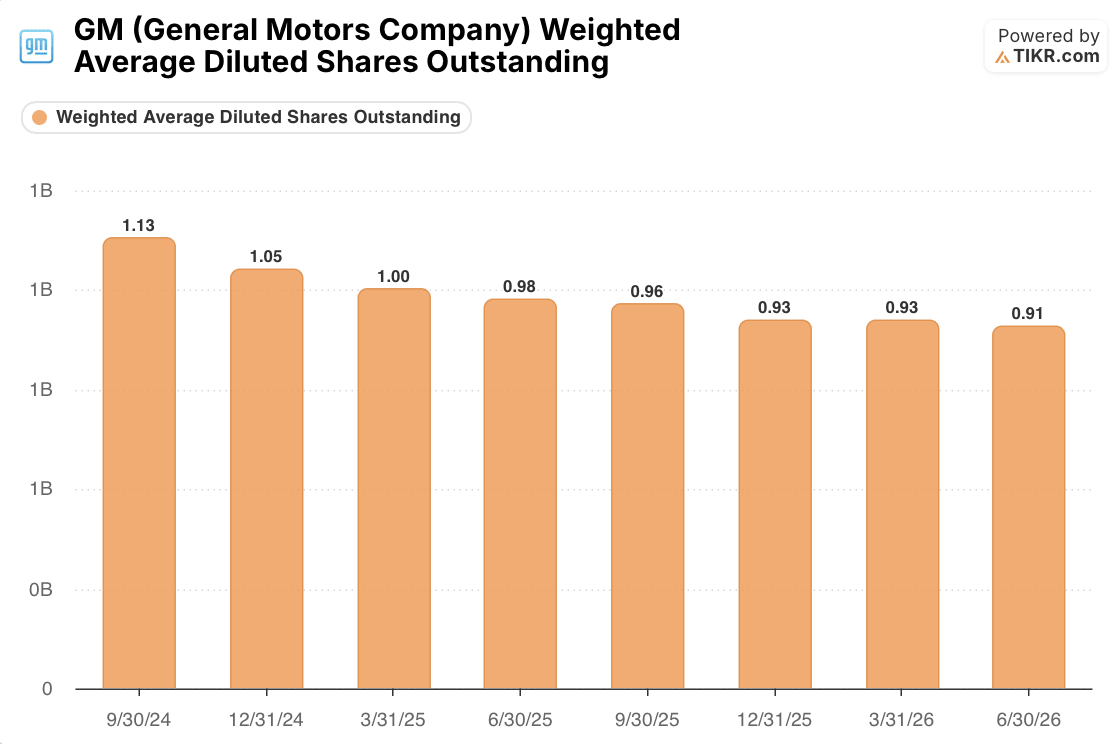
That second story has moved faster. GM’s weighted average diluted share count fell from 1.13 billion in Q3 2024 to 0.91 billion in Q2 2026, about 19.5% in seven quarters. With earnings flat, that alone would lift earnings per share by roughly 24%.

The cash behind those buybacks held up through a messy year. GM has recorded $10.9 billion of EV-related charges since the second half of 2025, about $7.2 billion of which will be paid in cash, and it had paid $4.5 billion of that through June. Even so, TIKR shows $14.40 billion of free cash flow over the last four quarters, almost matching the $14.55 billion in the four quarters before. On that consolidated TIKR measure, $14.40 billion of free cash flow covered the $6.80 billion of buybacks about twice over.
TIKR’s figures include GM Financial, so they run higher than the metric GM prefers. Management guides 2026 adjusted automotive free cash flow to $9.5 billion to $11.5 billion. Against a $72.50 billion market cap, that is a yield of roughly 13% to 16%, which supports Jacobson’s “double-digit” claim.
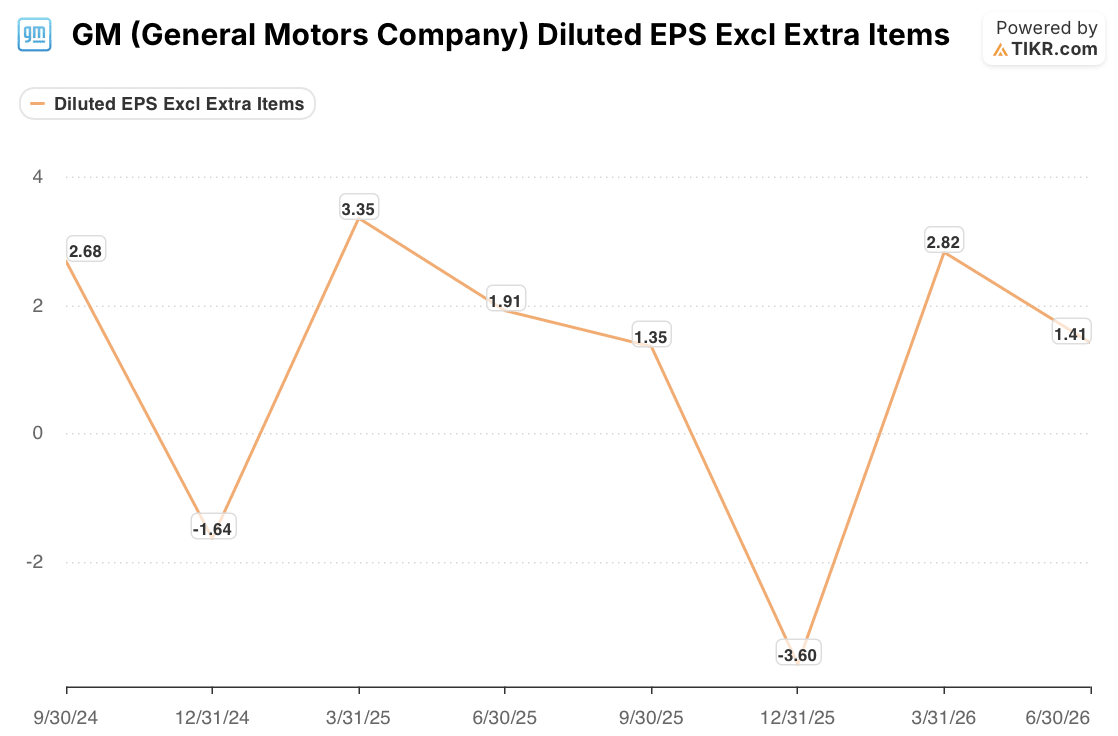
Accounting noise helps explain why this story gets missed. GAAP diluted EPS went from $3.35 in Q1 2025 to negative $3.60 in Q4 2025, then came in at $1.41 in Q2 2026, compared with adjusted EPS of $3.57. The restructuring charges have obscured the effect of the shrinking share count in reported GAAP EPS.
Cheap Shares Are the Payoff, Missing Hybrids Are the Risk
So far, the reduction in GM’s share count has been much larger than the decline in its US market share. Management attributes most of the roughly 60 basis points of first-half share loss to discontinued models such as the Chevrolet Malibu, a smaller EV market, and tight early-year inventory. Over the same stretch, North America’s adjusted EBIT margin rose 2.5 points to 8.6% in Q2.
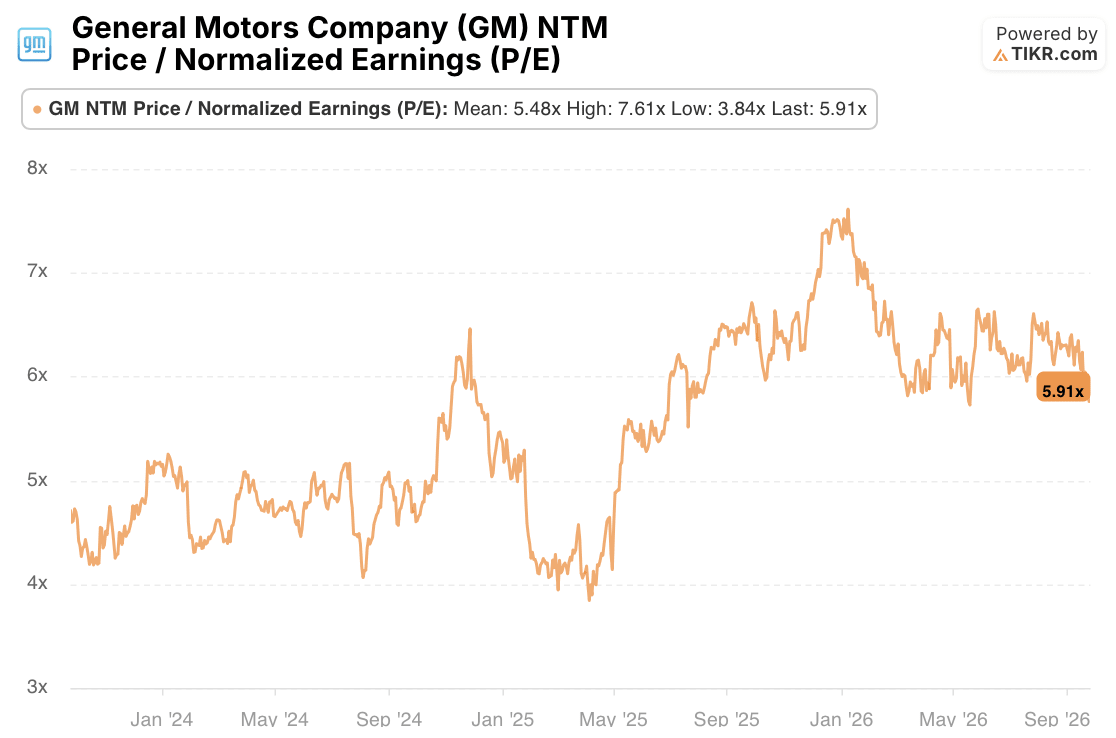
The market hasn’t rewarded that. GM trades at 5.91x NTM normalized earnings, slightly above its three-year average of 5.48x and well below the 7.36x it reached at the end of 2025. A low multiple is exactly what lets each buyback dollar retire more stock, and GM still had $3.5 billion left under its current authorization at the end of June.
The risk is that Cox has the cause right. If buyers are leaving because GM lacks hybrids, the share pressure could persist until GM closes that product gap rather than reverse simply as inventory normalizes, and the next-generation Silverado and Sierra pickups arriving in December don’t address that gap. The Trump administration’s rollback of fuel economy rules reduces regulatory pressure on GM’s truck-heavy lineup, but it doesn’t address demand from buyers who want hybrids.
The next checkpoint is the path into 2027. Jacobson expects cash flow to be “substantially better” once the EV restructuring payments are behind General Motors. The Q3 report should show whether buybacks keep running near the $2 billion GM spent in Q2, and January guidance will show whether that cash step-up survives commodity inflation. If it does, General Motors could continue shrinking its share count faster than it is losing US market share.
Disclaimer:
Please note that the articles on TIKR are not intended to serve as investment or financial advice from TIKR or our content team, nor are they recommendations to buy or sell any stocks. We create our content based on TIKR Terminal’s investment data and analysts’ estimates. Our analysis might not include recent company news or important updates. TIKR has no position in any stocks mentioned. Thank you for reading, and happy investing!