Key Takeaways
- Kimberly-Clark yields 5.4% and Target yields 3.1%, so $10,000 pays $540 a year today at Kimberly-Clark and $310 at Target.
- Target’s dividend is well-covered, using 46% of its free cash flow over the twelve months to Aug. 1, 2026.
- Kimberly-Clark’s dividend used 92% of its free cash flow over the twelve months to June 30, 2026, after costing more than its free cash flow in 2025.
- At each dividend’s current pace, Kimberly-Clark would still pay about twice as much as Target in year 10.
Any retiree hunting for dividend income is going to be tempted by Kimberly-Clark (KMB). Its 5.4% yield is well ahead of the 3.1% at Target (TGT).
A bigger check only helps a retiree if it keeps coming, though. On that front, Target’s dividend uses less than half of its free cash flow, and Kimberly-Clark’s uses nearly all of it.
So which is the better dividend stock for retirees?
| Metric | Target (TGT) | Kimberly-Clark (KMB) |
|---|---|---|
| Dividend yield | 3.1% | 5.4% |
| Annual dividend, current rate | $4.64 | $5.12 |
| Dividend growth, 5 years | 11.0% a year (years to Jan. 2021 to Jan. 2026) | 3.3% a year (2020 to 2025) |
| Latest yearly dividend growth | 1.8% (year to Jan. 2026) | 3.3% (2025) |
| Cash dividend payout ratio (TTM) | 46% (to Aug. 1, 2026) | 92% (to June 30, 2026) |
| Net debt/EBITDA | 1.49x | 1.49x |
| Interest coverage | 12.7x | 12.2x |
Target: room to spare
Target’s sales are picking up. Net sales rose 5.3% to $26.5 billion in the quarter to Aug. 1, 2026, compared with the same quarter a year before. Management now expects sales growth of around 5% for the fiscal year to January 2027.
That business funds a well-covered dividend. Over the twelve months to Aug. 1, 2026, Target paid $2.07 billion in dividends, just 46% of its $4.46 billion of free cash flow. Free cash flow has also covered the dividend in every year on the chart but one…

…the year to January 2023. That year, free cash flow went negative, and Target still paid $1.84 billion in dividends, up from $1.55 billion the year before.
Management says it looks to “support the dividend and build on our more than 50-year record of annual increases.” It’s also balancing that commitment with “our goal of moving towards a 40% payout ratio over time.” That fits the latest raise of 1.8%, to $1.16 a quarter. Before it, the dividend grew 11.0% a year, from $2.70 a share in the year to January 2021 to $4.54 in the year to January 2026.
The risk is how lumpy that cash can be. In the year to January 2026, free cash flow fell to $2.84 billion from $4.48 billion the year before, and dividends took 72% of it.
Kimberly-Clark: a bigger check, a thinner cushion
Kimberly-Clark pays the bigger check, with far less room behind it. Over the twelve months to June 30, 2026, it paid $1.68 billion in dividends, a tight 92% of its $1.82 billion of free cash flow.
Sales are barely moving. Net sales rose 0.6% to $4.2 billion in the second quarter of 2026, compared with the same quarter a year before. Management expects organic sales growth this year to run about a point below the 2% growth of its categories.
Free cash flow covered the dividend every year from 2016 to 2024. Over that stretch and into 2025, though, free cash flow fell from $2.46 billion in 2016 to $1.64 billion in 2025, while dividends paid rose from $1.31 billion to $1.66 billion…
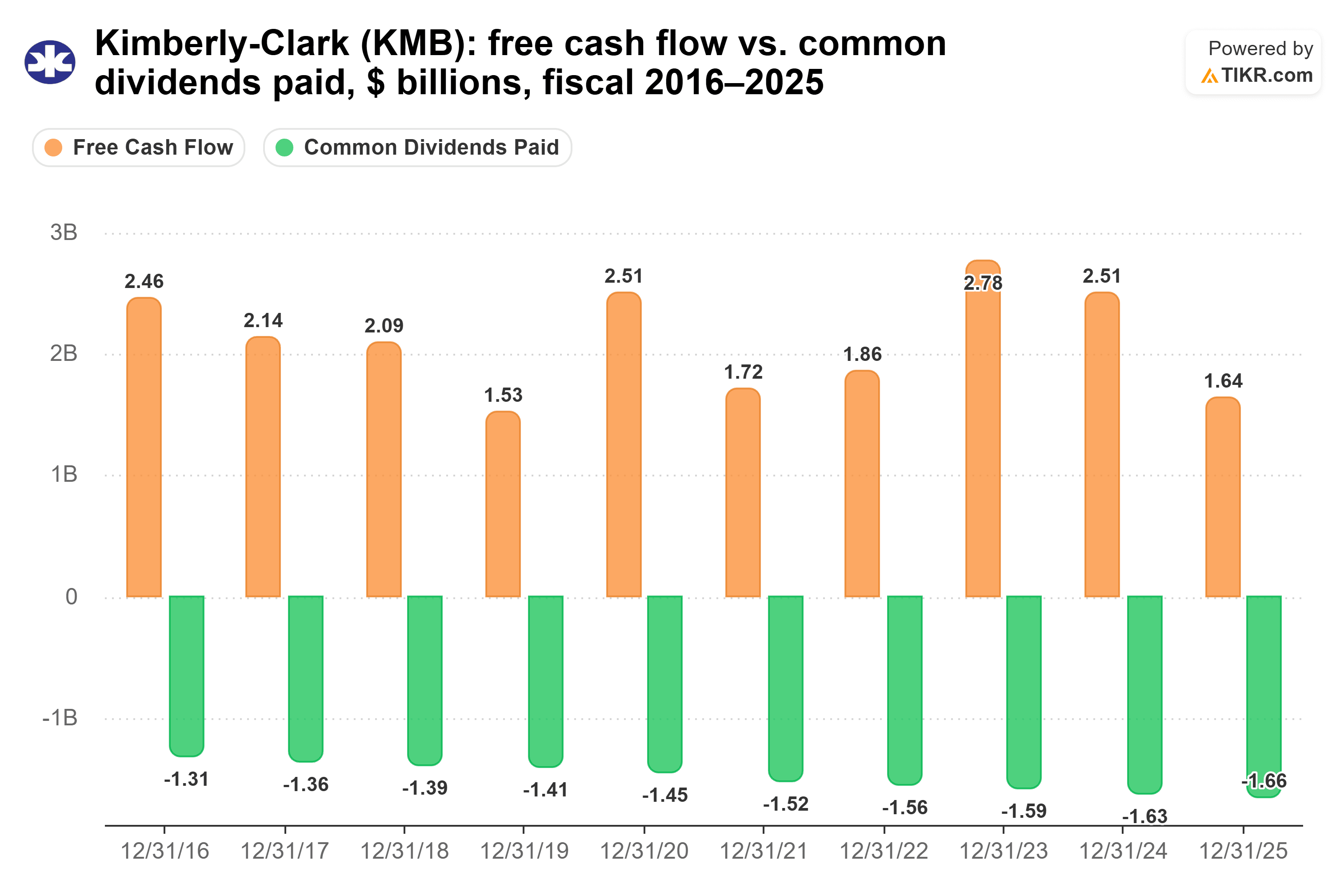
…which left a risky 101% cash dividend payout ratio in 2025.
The first half of 2026 looks better. Cash from operations rose to $1.7 billion from $1.1 billion a year earlier.
So which dividend wins?
For retirees, Target is the better dividend stock. Retirees seeking income want a check they can count on. Target’s dividend uses 46% of its free cash flow, compared with 92% at Kimberly-Clark, and Target’s business expects around 5% sales growth this year.
That isn’t to say Kimberly-Clark’s dividend is in trouble. It pays 5.4% today, and its cash from operations picked up in the first half of 2026. At each dividend’s current pace (Target’s latest 1.8% raise and Kimberly-Clark’s 3.3%), $10,000 would pay about $722 from Kimberly-Clark in year 10 and about $364 from Target. Target only catches up around 2034, and only if its dividend grows at its 11.0% five-year rate.
It’s just that, when it comes down to it, Kimberly-Clark paid out more than its free cash flow in 2025, and Target has the room to keep raising.
Of course, Kimberly-Clark’s pending acquisition of Kenvue (KVUE) will change the business behind that dividend, and management says the deal is on track to close by the end of this year.
So what is Target stock actually worth?
TIKR lets you forecast the future price of any stock in less than a minute. Just enter a few assumptions into TIKR’s valuation model and see what Target could be worth. Start from Wall Street consensus estimates, or adjust the inputs to reflect your own view of the business. It’s free to use.
Disclaimer:
Please note that the articles on TIKR are not intended to serve as investment or financial advice from TIKR or our content team, nor are they recommendations to buy or sell any stocks. We create our content based on TIKR Terminal’s investment data and analysts’ estimates. Our analysis might not include recent company news or important updates. TIKR has no position in any of the stocks mentioned. Thank you for reading, and happy investing!