


Key Takeaways
- Kimberly-Clark yields 5.4% and Hormel Foods yields 6.0%, and in fiscal 2025 each paid out more in dividends than it brought in as free cash flow.
- Over the latest twelve months each has reported, Kimberly-Clark’s dividend used 92% of free cash flow and Hormel’s used 82%.
- Kimberly-Clark’s adjusted EPS from continuing operations rose 10.4% in the second quarter of 2026, while Hormel’s organic net sales fell 2% in its fiscal third quarter.
- To watch: Kimberly-Clark’s pending Kenvue acquisition, which management expects to close by the end of 2026, and Hormel’s fiscal 2026 results.
Any retiree hunting for dividend income is going to look hard at Kimberly-Clark (KMB) and Hormel Foods (HRL), which yield 5.4% and 6.0%. Both also just came through a fiscal 2025 in which the dividend cost more than the free cash flow behind it.
Hormel says it isn’t backing off. On its fiscal third-quarter call in August, management said, “We remain committed to the dividend and are proud to have reached our 392nd consecutive quarterly payout.”
Kimberly-Clark’s $1.28 quarterly dividend has a big deal riding alongside it: its pending acquisition of Kenvue (KVUE), which management says is on track to close by the end of this year.
So which is the better dividend stock for a retiree who needs a check they can count on?
| Metric | Kimberly-Clark (KMB) | Hormel Foods (HRL) |
|---|---|---|
| Dividend yield | 5.4% | 6.0% |
| Annual dividend | $5.12 | $1.17 |
| Dividend growth, fiscal 2020–2025 | 3.3% a year | 4.5% a year |
| Cash dividend payout ratio (TTM) | 92% | 82% |
| Net debt/EBITDA | 1.49x | 1.19x |
| Interest coverage | 12.21x | 12.61x |
| Forward P/E | 13.8x | 13.0x |
Kimberly-Clark’s cushion is thin
Kimberly-Clark’s profits are heading the right way. In the second quarter of 2026, net sales rose 0.6% to $4.2 billion, and adjusted EPS from continuing operations climbed 10.4% to $1.80. International Personal Care sales grew 4.0%.
The dividend has less room. Over the twelve months to June 30, 2026, it used 92% of free cash flow, which is a thin cushion. Dividends paid rose every year, from $1.31 billion in fiscal 2016 to $1.66 billion in fiscal 2025. Free cash flow swung between $1.53 billion in fiscal 2019 and $2.78 billion in fiscal 2023…
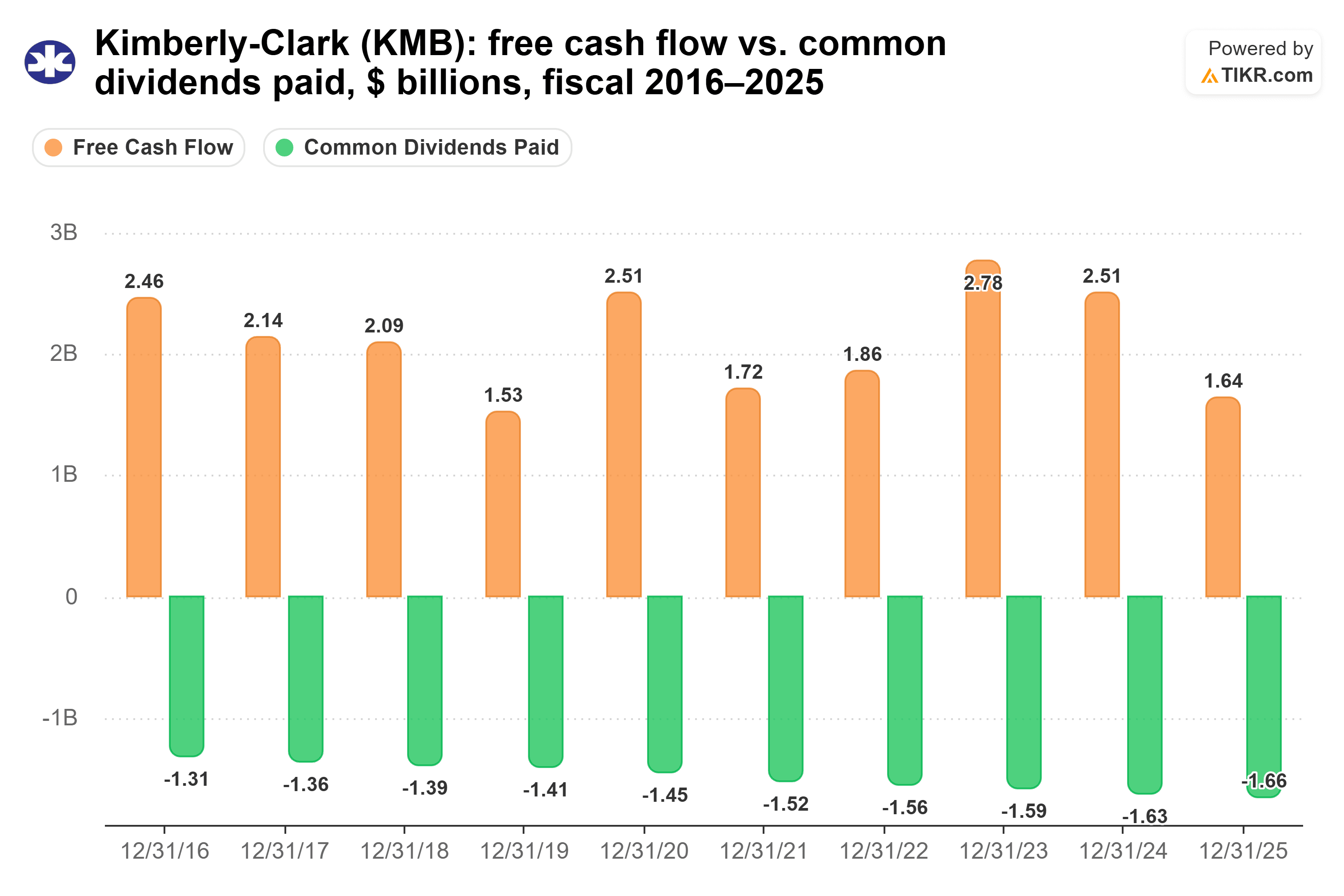
…until fiscal 2025, when free cash flow of $1.64 billion fell just short of the dividend for the first time on the chart.
The main risk is China. Management expects false claims about its diapers on Chinese social media to cost International Personal Care 3 to 4 points of organic growth in 2026.
Hormel hit the same wall
Hormel’s dividend ran into the same problem in fiscal 2025, the year to October. Dividends paid of $633 million topped free cash flow of $534 million. Until then, free cash flow had covered the dividend every year on the chart, ranging from $629 million in fiscal 2019 to $1.01 billion in fiscal 2024. Over the same stretch, dividends paid rose from $296 million in fiscal 2016.
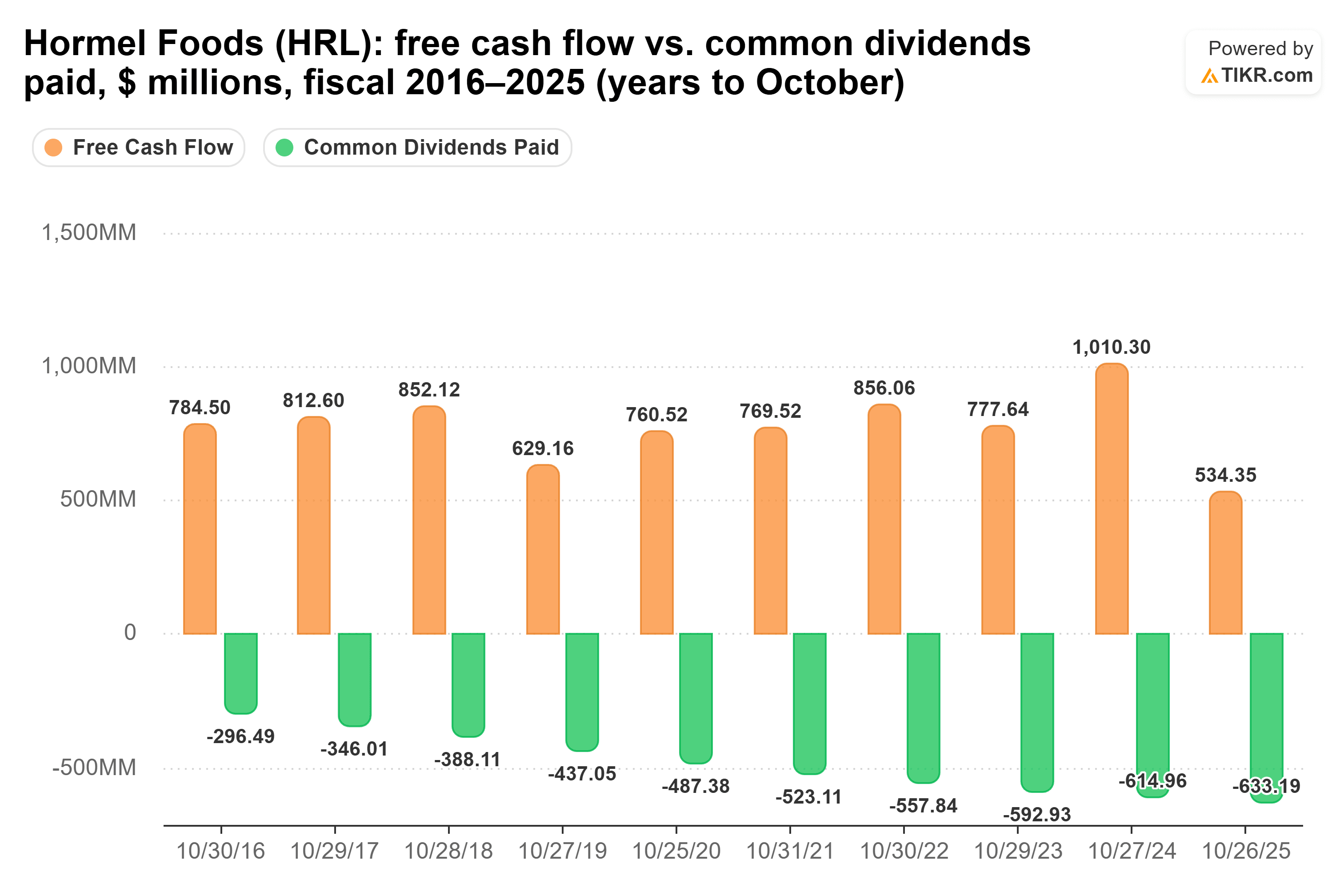
The cash has come back since. Over the twelve months to July 26, 2026, the dividend used 82% of free cash flow, down from 118.5% in fiscal 2025. That’s snug, but covered. Cash flow from operations jumped 54% to $241 million in the fiscal third quarter.
Sales are the weak spot. Third-quarter net sales slipped to $2.96 billion from $3.03 billion a year earlier, and organic net sales fell 2%. Still, management raised its fiscal 2026 adjusted EPS guidance to $1.45 to $1.51, growth of 6% to 10%.
So which dividend wins?
For a retiree who needs a check they can count on, Hormel is the better dividend stock. It pays the bigger yield and covers it with more room: 82% of free cash flow over its latest twelve months, against Kimberly-Clark’s 92%. And it has raised its dividend faster, 4.5% a year from fiscal 2020 to fiscal 2025, against 3.3%.
At those rates, $10,000 in Hormel pays $600 a year now and about $893 in year 10. The same $10,000 in Kimberly-Clark pays $540 now and about $725 in year 10. Kimberly-Clark’s income never catches up.
You aren’t paying up for Hormel’s yield, either. At 13.0x forward earnings on Oct. 6, Hormel sat far below its 21.8x average of the last ten years, and just above the 12.8x low it hit on Sept. 25.

Kimberly-Clark’s dividend still has plenty going for it. Total debt from continuing operations fell to $6.5 billion at June 30, 2026, from $7.2 billion at the end of 2025, and cash from operations reached $1.7 billion in the first half of 2026, up from $1.1 billion a year earlier.
It’s just that Hormel pays more today, with more cash behind it.
Of course, Hormel’s fiscal year ends in October. Its full-year free cash flow will show whether fiscal 2025 was a one-off.
So what is Hormel Foods stock actually worth?
TIKR lets you forecast the future price of any stock in less than a minute. Just enter a few assumptions into TIKR’s valuation model and see what Hormel Foods could be worth. Start from Wall Street consensus estimates, or adjust the inputs to reflect your own view of the business. It’s free to use.
Disclaimer:
Please note that the articles on TIKR are not intended to serve as investment or financial advice from TIKR or our content team, nor are they recommendations to buy or sell any stocks. We create our content based on TIKR Terminal’s investment data and analysts’ estimates. Our analysis might not include recent company news or important updates. TIKR has no position in any of the stocks mentioned. Thank you for reading, and happy investing!


