


Key Takeaways
- Kraft Heinz yields 7.3% and Altria 6.5%, but Kraft Heinz paid the same $1.60 a share in every fiscal year from 2020 to 2025.
- Altria’s dividend grew 4.1% a year from fiscal 2020 to fiscal 2025, from $3.40 to $4.16 a share.
- Altria’s dividend used 78% of free cash flow over the twelve months to June 30, 2026, against 50% for Kraft Heinz over the twelve months to June 27, 2026.
- Kraft Heinz expects 2026 adjusted EPS of $2.03 to $2.09, and its net debt runs 2.71x EBITDA against Altria’s 1.41x.
Kraft Heinz (KHC) took $7.4 billion of non-cash impairment losses in the second quarter of 2026, and its stock still yields 7.3%.
That’s a big check for any income investor, and it’s bigger than the 6.5% at Altria Group (MO). But Kraft Heinz paid $1.60 a share in every fiscal year from 2020 to 2025, while Altria raised its dividend from $3.40 a share to $4.16 over those same years.
So which is the better dividend stock?
| Metric | Altria (MO) | Kraft Heinz (KHC) |
|---|---|---|
| Dividend yield | 6.5% | 7.3% |
| Annual dividend | $4.44 | $1.60 |
| Dividend growth, fiscal 2020–2025 | 4.1% a year | 0.0% a year |
| Cash dividend payout ratio (TTM) | 78% | 50% |
| Net debt / EBITDA (LTM) | 1.41x | 2.71x |
| Interest coverage (LTM) | 13.27x | 4.93x |
| Forward P/E (NTM) | 11.9x | 11.1x |
Altria keeps the raises coming
Altria now pays $4.44 a share a year.
The business under that dividend is shifting. By the company’s account, domestic cigarette volumes are declining, though the industry’s decline has moderated for four quarters running. Meanwhile, on! PLUS nicotine pouches are growing on a national rollout that has reached 120,000 stores. In the second quarter of 2026, revenues net of excise taxes rose 1.2% to $5.36 billion. Altria also narrowed its 2026 adjusted EPS guidance to $5.61 to $5.72, up 3.5% to 5.5% from $5.42 in 2025.
Coverage is tight. Over the twelve months to June 30, 2026, the dividend used 78% of free cash flow: $7.06 billion of $9.11 billion. But free cash flow has topped the dividend every year since fiscal 2018. It rose from $8.15 billion to $9.07 billion by fiscal 2025, while dividends paid grew from $5.42 billion to $6.96 billion…
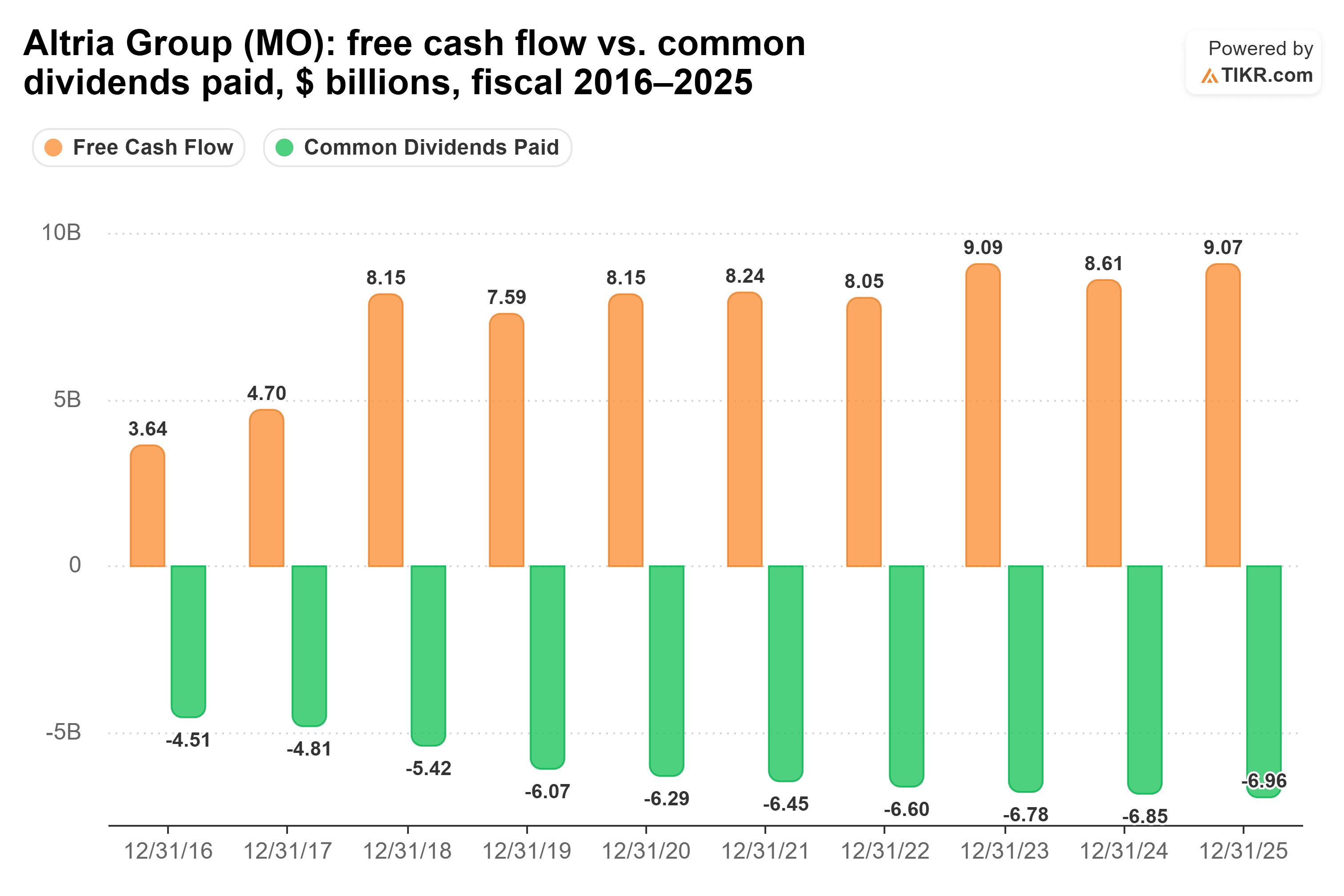
From fiscal 2021 to fiscal 2025, the payout ran between 74.6% and 82.0%, a band steady enough to keep funding raises.
The risk is that thin cushion: at 78%, a faster slide in cigarette volumes would leave little cash for the next raise.
Kraft Heinz has room, but no raises
Where Altria’s coverage is tight, Kraft Heinz has room to spare. Over the twelve months to June 27, 2026, its dividend used a well-covered 50% of free cash flow: $1.90 billion of $3.82 billion. Free cash flow also reached $1.7 billion in the first half of 2026, up 10.3% from the first half of 2025.
The longer record is choppier. Dividends paid fell from $3.18 billion in fiscal 2018 to $1.95 billion in fiscal 2019 and have held between $1.90 billion and $1.97 billion every year since. Over the same stretch, free cash flow swung from $4.46 billion in fiscal 2021 to $1.55 billion in fiscal 2022.
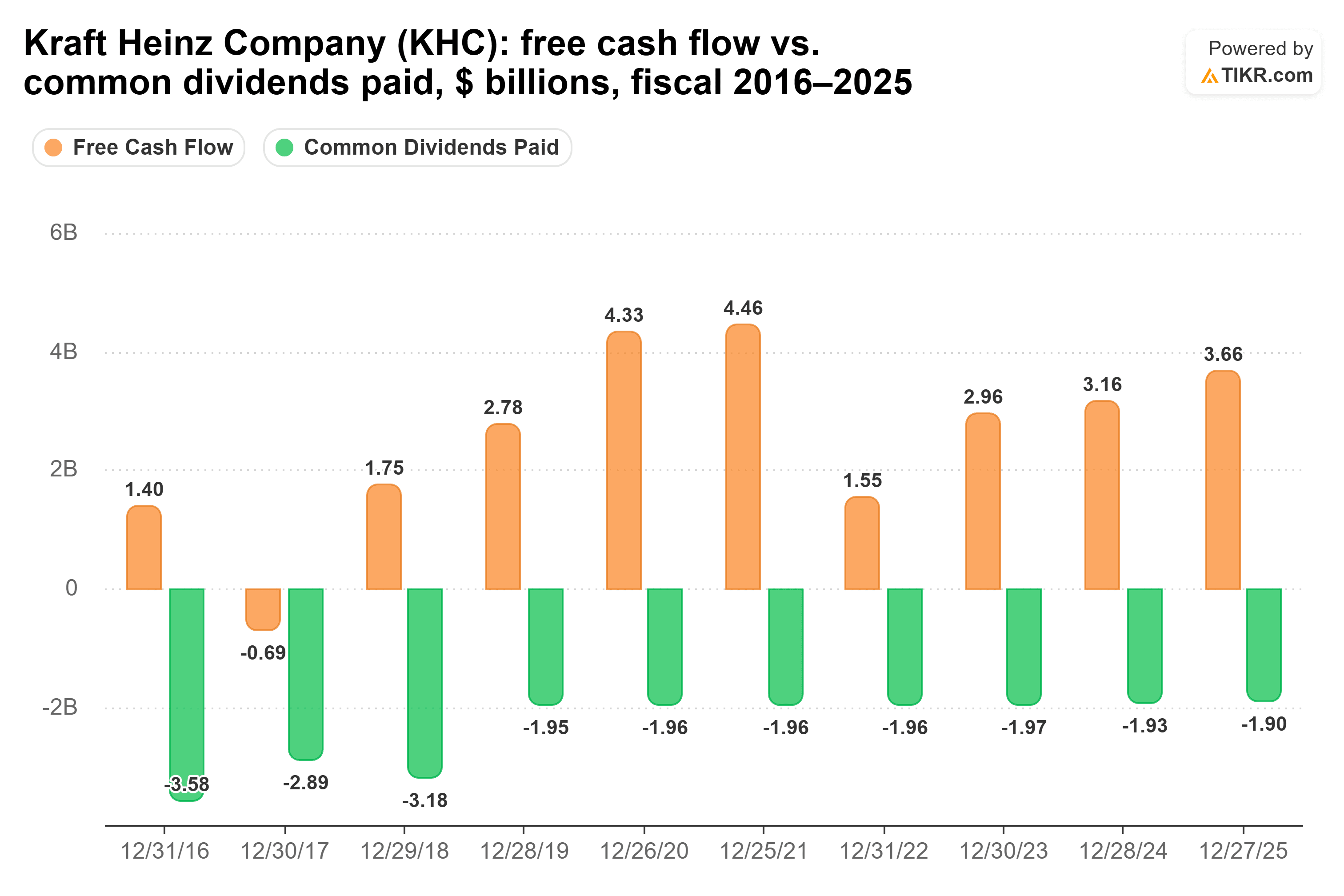
That fiscal 2022 dip pushed the payout to 126%.
On its second-quarter call, management named its priorities as “sustaining the dividend and protecting our investment-grade credit profile.” The 50% payout backs that up, though “sustaining” means holding the dividend where it is.
The business is the harder part. North America organic net sales fell 2.7% in the second quarter of 2026 from a year earlier. Kraft Heinz also expects 2026 adjusted operating income to fall 16% to 18% in constant currency as it puts about $700 million of incremental investment behind its brands. And its net debt runs 2.71x EBITDA, against Altria’s 1.41x.
So which dividend wins?
Altria is the better dividend stock. Kraft Heinz pays the bigger check and covers it more easily today. But Altria’s dividend grows, on a lighter balance sheet, and over time that wins on income.
At their 5-year rates, $10,000 in Altria pays $650 a year now and about $935 in year 10, a 9.3% yield on your cash. The same $10,000 in Kraft Heinz pays $730 now and $730 in year 10. Altria’s income would pass it in about 2.9 years, around 2029.
Kraft Heinz’s earnings don’t point to a raise, either. Normalized EPS fell from $3.06 in fiscal 2024 to $2.60 in fiscal 2025. The 20 analysts in TIKR’s consensus see $2.05 for fiscal 2026, inside the company’s guidance of $2.03 to $2.09.

Even the fiscal 2028 estimate, $2.21, sits well below fiscal 2025’s $2.60.
This isn’t to say Kraft Heinz’s dividend is unsafe. Half its free cash flow pays for it, and management has put the dividend first. If you want the most income today, 7.3% is a lot of money. It’s just that a dividend stuck at $1.60 a share from fiscal 2020 to fiscal 2025, with earnings guided lower and heavier debt, gives me less to count on than Altria’s growing one.
Of course, Altria’s 78% payout leaves less room for error, so its cigarette volumes and free cash flow in its next quarterly report are the numbers to watch.
So what is Altria stock actually worth?
TIKR lets you forecast the future price of any stock in less than a minute. Just enter a few assumptions into TIKR’s valuation model and see what Altria could be worth. Start from Wall Street consensus estimates, or adjust the inputs to reflect your own view of the business. It’s free to use.
Disclaimer:
Please note that the articles on TIKR are not intended to serve as investment or financial advice from TIKR or our content team, nor are they recommendations to buy or sell any stocks. We create our content based on TIKR Terminal’s investment data and analysts’ estimates. Our analysis might not include recent company news or important updates. TIKR has no position in any of the stocks mentioned. Thank you for reading, and happy investing!


