Key Takeaways
- Apple will spend up to $100 million over three years on titanium from Pennsylvania’s Perryman Company, a deal President Trump celebrated on Truth Social.
- The order does very little for Apple’s business, and it doesn’t change how much Apple depends on China.
- Author Patrick McGee says Apple promised in 2016 to invest $275 billion in Chinese factories over five years, which is about five times Apple’s total capex from fiscal 2021 through 2025.
- Apple trades at 38x forward earnings, its highest in five years, ahead of its Nov. 2 report.
President Donald Trump went on Truth Social late Wednesday to celebrate a new win for American manufacturing, courtesy of Apple (AAPL):
That’s a lot of capital letters for a very small check, at least by Apple’s standards. It looks even smaller next to the $275 billion one author says Apple promised China a decade ago.
The details
On Tuesday, Apple said it will commit up to $100 million over three years to Perryman Company, a family-owned titanium producer in Houston, Pennsylvania. Perryman will melt, forge and roll the metal, at least 80% of it recycled, for Apple products. That includes the iPhone Duo, Apple’s first foldable iPhone.
Apple counts the deal toward the $600 billion, four-year US manufacturing commitment it made last year.
For scale, Apple’s own capital spending has run between $9.5 billion and $12.7 billion a year over the last five fiscal years…
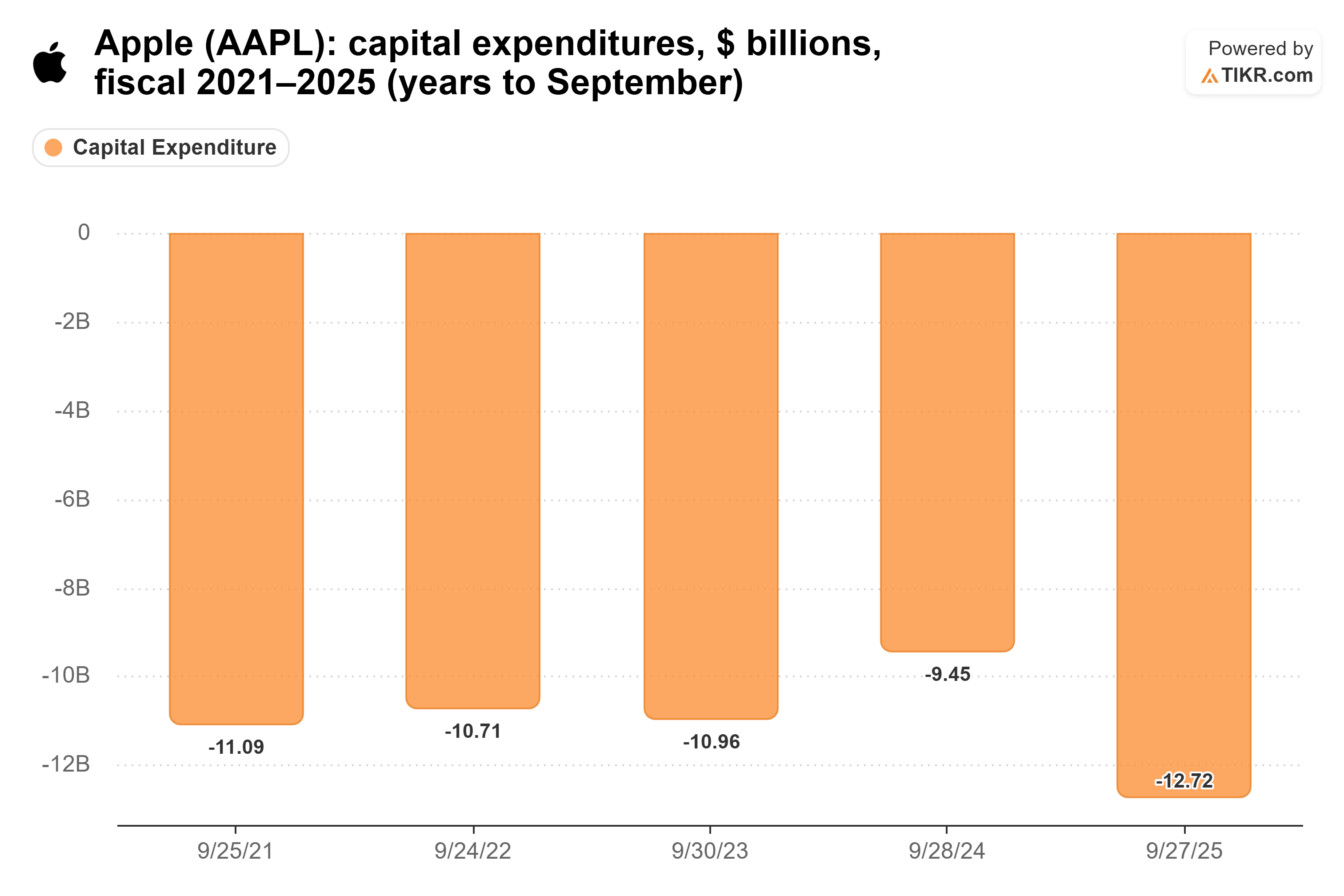
So the whole titanium order, spread over three years, comes to under 1% of one year’s capex.
TIKR tracks 44 analysts on Apple. How many say “Buy”?
See the full breakdown of Buy, Hold, and Sell ratings on Apple, along with Wall Street’s revenue and earnings estimates, all in one place. More than 500,000 investors use TIKR to research stocks like this one. See Apple’s Analyst Ratings
China is a much bigger number
Patrick McGee, author of the book Apple in China, explained the China side on Bloomberg Talks recently. He said that in May 2016, Tim Cook and his operating chief Jeff Williams went to Beijing and promised to make Apple’s spending in China five times bigger over five years:
“So they promised to invest 275 billion dollars into Chinese factories.”
McGee’s figure counts the machinery Apple bought and put on its suppliers’ production lines. It also counts the wages of up to 3 million people a year in Apple’s supply chain, mostly in China. (He says the figure hasn’t been updated since.)
That works out to about $55 billion a year. That’s roughly what Apple spent on capex in all five of the years charted above, combined. (Of course, these are different kinds of spending, so it’s kind of apples and oranges, but it shows how far apart the two numbers are.)
The money paid for more than machines, too. McGee argues Apple spent years training engineers across China, so much that, in his words, “China wouldn’t be China without Apple.” A titanium mill in Pennsylvania doesn’t replace that workforce.
Apple has little reason to move
The supply chain Apple has today is also serving it well. Gross margin rose every year, from 41.8% in fiscal 2021 to 46.9% in fiscal 2025…
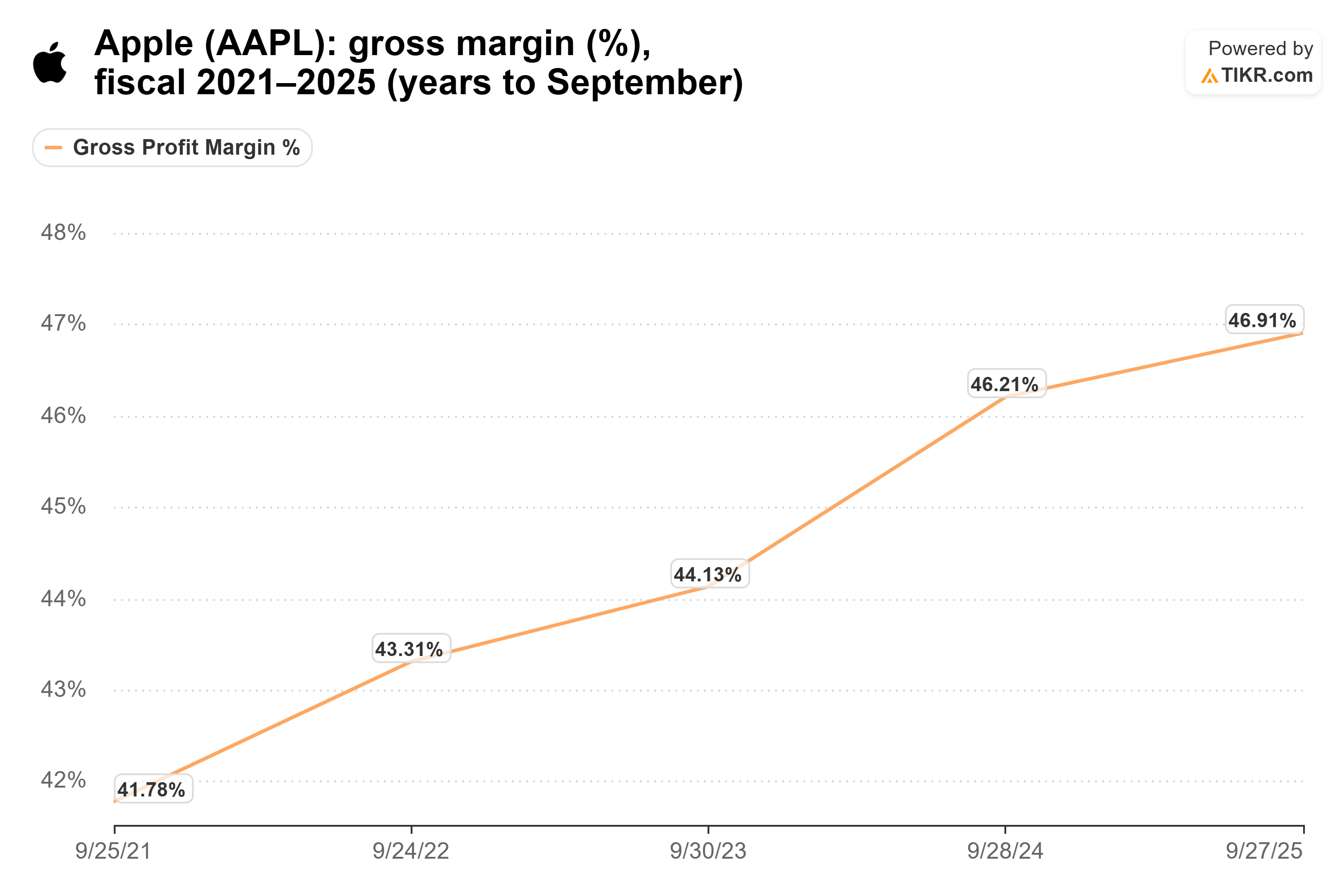
With margins at a five-year high, Apple has little reason to rush to rebuild that supply chain somewhere else. So it keeps both governments happy. Cook is now executive chair after handing the CEO job to John Ternus, and he recently attended the Washington state dinner for Chinese leader Xi Jinping. Meanwhile, a $100 million titanium order buys plenty of goodwill in Washington for very little money.
Priced for things to go right
Investors don’t seem worried about any of this. Apple trades at 38x forward earnings. That’s its highest in five years, well above its 29x average over that stretch and nearly double its 20x low in January 2023…
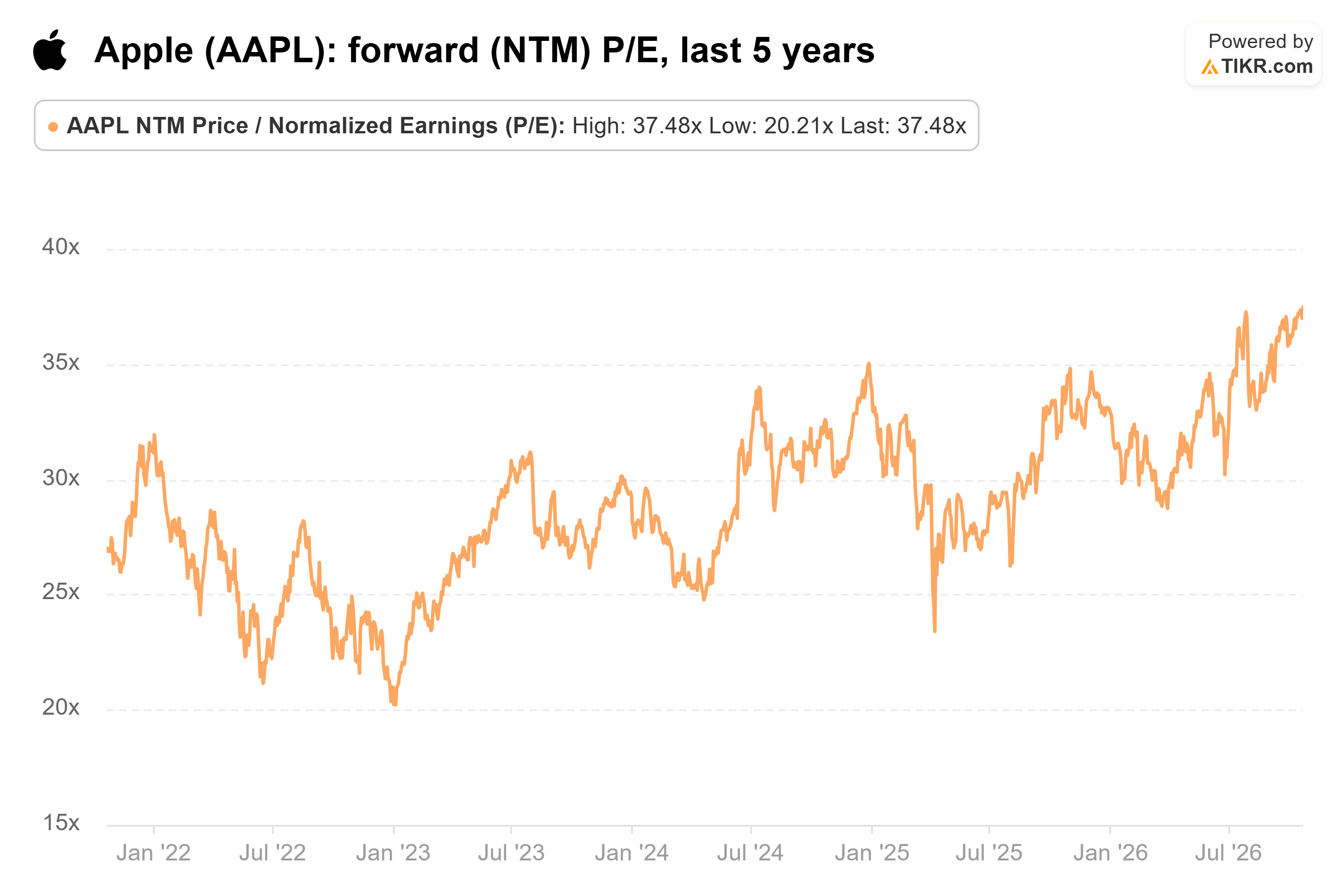
Apple reports fiscal fourth-quarter results after the close on Monday, Nov. 2. It’s Ternus’s first report as CEO, and the gross margin outlook is the number to watch.
My take: the titanium deal is smart politics, but it barely registers for the business. Apple still depends on China, and at 38x earnings, investors are paying as if that carries no risk at all.
Of course, a strong iPhone cycle can hold up a premium multiple for a long time, and the Duo is only just reaching customers.
So what is Apple stock actually worth?
TIKR lets you forecast the future price of any stock in less than a minute. Just enter a few assumptions into TIKR’s valuation model and see what Apple could be worth. Start from Wall Street consensus estimates, or adjust the inputs to reflect your own view of the business. It’s free to use.
Disclaimer:
Please note that the articles on TIKR are not intended to serve as investment or financial advice from TIKR or our content team, nor are they recommendations to buy or sell any stocks. We create our content based on TIKR Terminal’s investment data and analysts’ estimates. Our analysis might not include recent company news or important updates. TIKR has no position in any of the stocks mentioned. Thank you for reading, and happy investing!