Key Takeaways
- AbbVie raised its quarterly dividend about 5% on Oct. 30, and Enterprise Products Partners’ latest distribution is 3% above a year ago.
- Enterprise yields 6.2%, more than twice AbbVie’s 2.5%, but AbbVie’s dividend grew faster from fiscal 2020 to fiscal 2025, 6.6% a year against 4.0%.
- AbbVie pays out 65% of its free cash flow in dividends, up from 41% in fiscal 2022, and analysts expect 52% in 2026.
- Enterprise’s distributable cash flow covers its distribution 1.7x, and analysts expect 1.9x in 2026.
Income investors got two raises to weigh this fall. Enterprise Products Partners (EPD) declared a $0.56 quarterly distribution on Oct. 8, up 2.8% from a year ago. AbbVie (ABBV) raised its quarterly dividend about 5% on Oct. 30, to $1.82 a share starting with the dividend paid Feb. 16, 2027.
AbbVie grows its dividend faster, while Enterprise’s yields more than twice as much. So which is the better dividend stock?
| Metric | AbbVie (ABBV) | Enterprise Products Partners (EPD) |
|---|---|---|
| Forward yield | 2.5% | 6.2% |
| Dividend growth, fiscal 2020-2025 | 6.6% a year | 4.0% a year |
| Coverage, last reported | 65% cash dividend payout ratio (TTM to Sept. 30, 2026) | 1.69x distributable cash flow coverage (fiscal 2025) |
| Coverage, fiscal 2026 consensus | 52% | 1.90x |
| Net debt/EBITDA (LTM) | 2.0x | 3.2x |
| Interest coverage (LTM) | 8.2x | 5.1x |
Source: TIKR, Nov. 5, 2026.
6 safe dividend stocks paying retirees 6%+ yields
There are over 100 stocks paying 6%+ annual dividends today.
But after an extensive investment review leveraging TIKR’s proprietary data, we now believe only six of them are truly safe for retirees.
They’re all yours for free as part of our new investment report, which you can access right here.
AbbVie’s cushion has thinned
AbbVie’s newer drugs are carrying the business. Third-quarter revenue rose 10.3% from a year earlier to $17.4 billion. Skyrizi grew 22.7% to $5.78 billion, while Humira fell 31.2% to $683 million against biosimilar competition. On Oct. 30, AbbVie raised its 2026 adjusted EPS guidance to $13.95-$13.99.
AbbVie pays its dividend from free cash flow. That free cash flow peaked at $24.3 billion in fiscal 2022 and was $17.8 billion in fiscal 2025, while dividends paid rose from $10.0 billion to $11.7 billion over the same years:
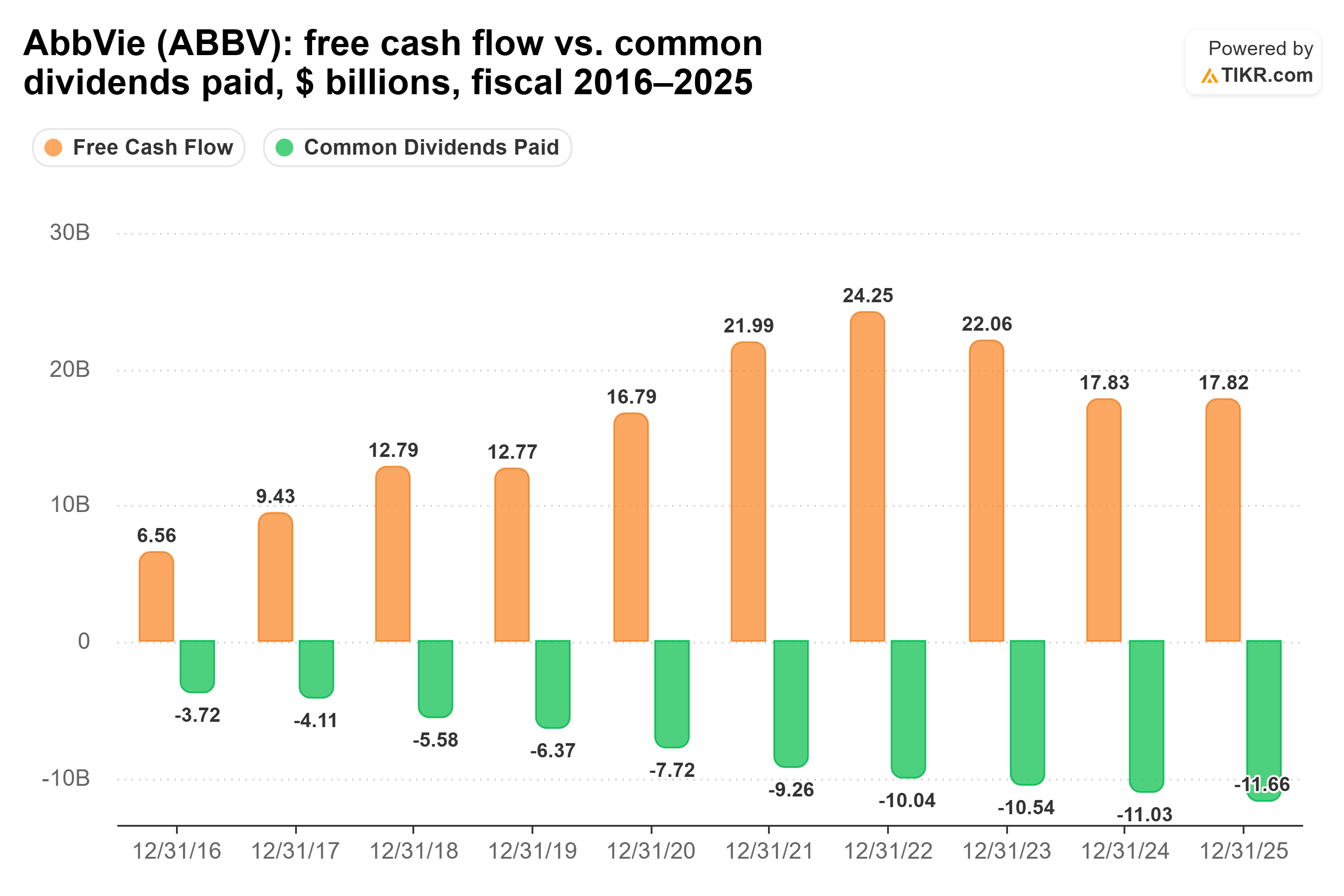
That took its cash dividend payout ratio from 41.4% in fiscal 2022 to 65.4% in fiscal 2025, and it was 65% over the twelve months to Sept. 30, 2026. That’s still manageable, but it leaves a lot less room than AbbVie had in fiscal 2022. The ratio could climb further if Skyrizi and the rest of the newer drugs stop outrunning Humira’s decline.
Enterprise keeps plenty in reserve
Enterprise’s cushion, by contrast, has held. It’s a master limited partnership, so it pays distributions on units, with a K-1 at tax time. Its distributable cash flow coverage ran between 1.63x and 1.84x every year from fiscal 2020 to fiscal 2025. Over that time, distributable cash flow per unit grew from $2.91 to $3.66, and the distribution grew from $1.78 to $2.17:
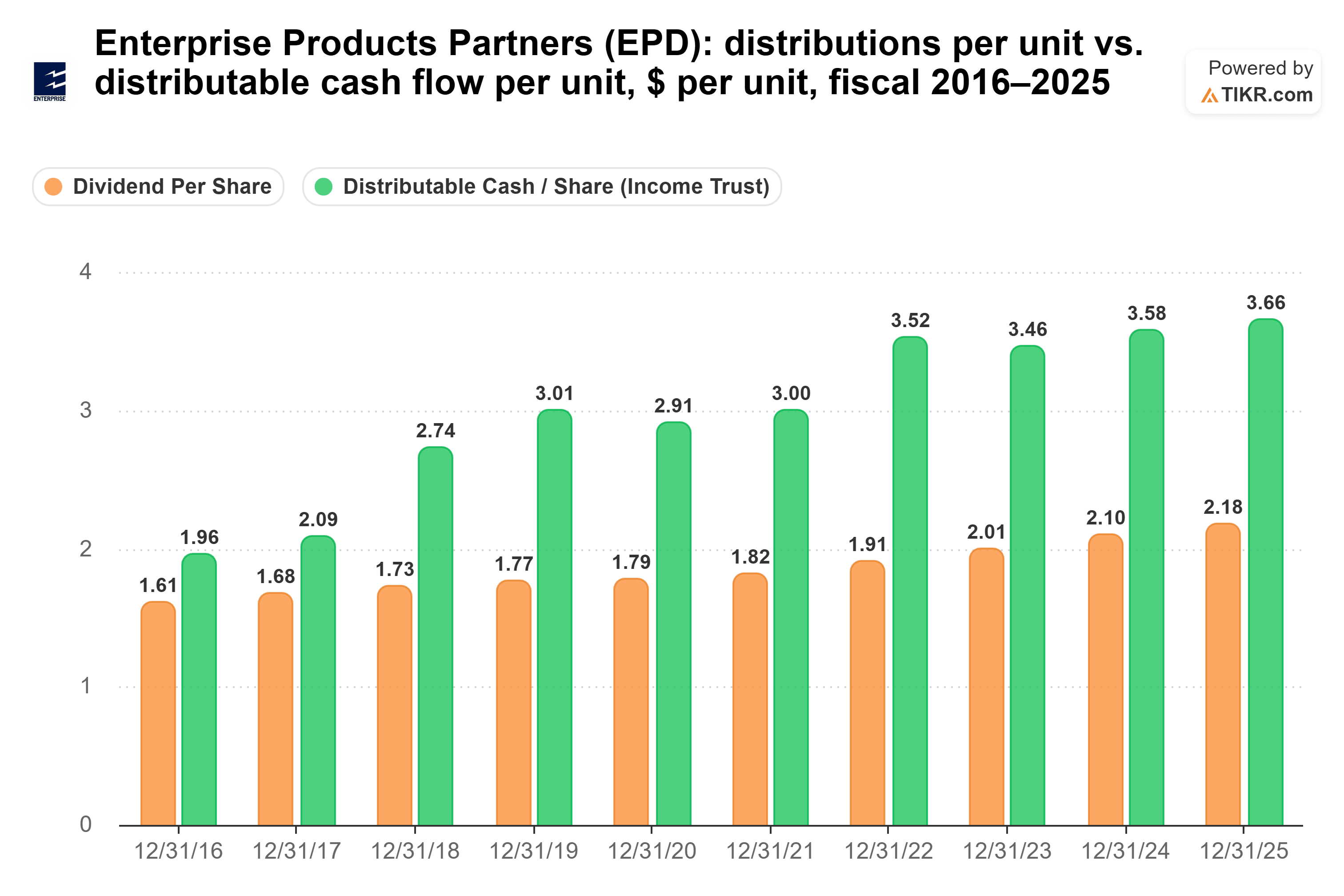
Analysts expect coverage to rise from a comfortable 1.69x in fiscal 2025 to 1.90x in 2026, on distributable cash flow of $4.25 a unit, up 16%. Last year’s final consensus landed within 1% of the actual. In the third quarter, operational distributable cash flow rose 27% from a year earlier to $2.3 billion and covered the distribution 1.9x. Permian gas processing hit a record 4.6 Bcf/d in the same quarter.
Co-CEO Jim Teague said on the Oct. 29 call that it was his last in the role, and fellow co-CEO Randy Fowler is set to become sole CEO in January 2027. On that call, Fowler said Enterprise has been “opting for targeted organic growth” over “acquisitions at top of the cycle M&A multiples.” So I’d expect the same playbook after the handoff.
Debt is the trade-off. Enterprise carries 3.2x net debt to EBITDA, against AbbVie’s 2.0x, and Fowler said, “I don’t see the need for our debt to go much lower than where it is today.”
So which dividend wins?
Enterprise Products Partners is the better dividend stock. It pays more than twice AbbVie’s yield, from distributable cash flow that covers the payout 1.7x and is still growing. Put $10,000 in each, and Enterprise pays $620 a year today against AbbVie’s $250. At their 5-year growth rates, that becomes about $886 against $443 in year 10, and AbbVie wouldn’t catch up for more than 30 years.
AbbVie’s case is still a good one. Its dividend grew faster, and it carries less debt. Analysts also expect its free cash flow to jump from $17.8 billion in fiscal 2025 to $23.1 billion in 2026 and $33.4 billion in 2027:
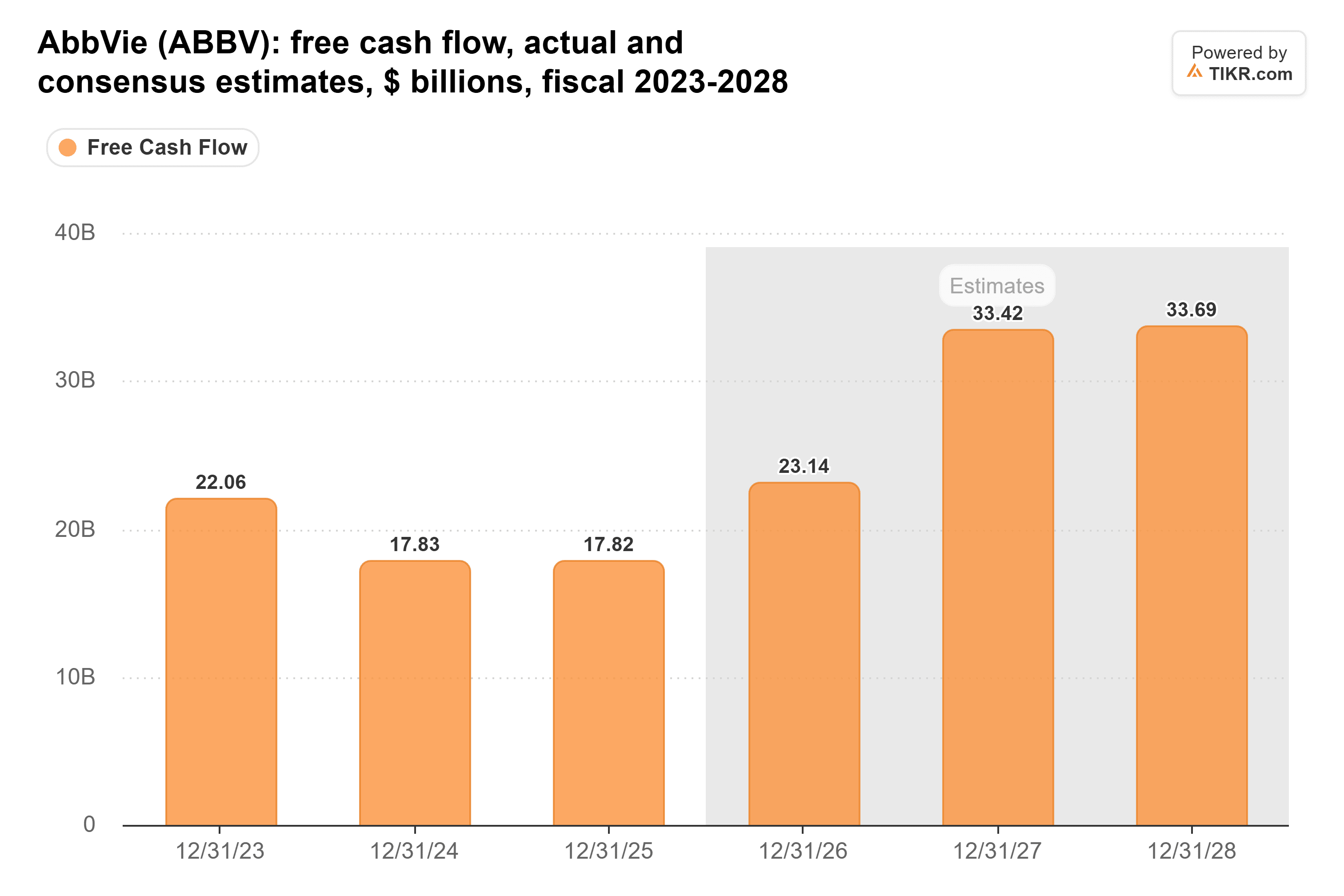
That 2026 figure comes from just three analysts, and last year’s final consensus missed the actual by 10%, though AbbVie did raise its earnings guidance in October. If analysts are right, the payout ratio falls to 52%. Even then, AbbVie’s year-10 income is a 4.4% yield on today’s $10,000. So its holders are counting on the shares to grow as well.
For income, though, a 6.2% payout with 1.7x coverage is hard to pass up. Of course, Enterprise expects 2027’s EBITDA growth to be more modest than 2026’s, and it’ll update its 2027 spending plans next quarter.
Enjoy your retirement in style with these safe 6%+ dividend yields
Dividends can hold the key to enormous wealth. But only if you buy the right ones.
Picking the right high-yield dividend stock can be the difference between a dream retirement…and scraping by every month, waiting for the next Social Security check to clear.
We’ve identified six stocks yielding 6%+ that we believe every retiree should know about right now.
Disclaimer:
Please note that the articles on TIKR are not intended to serve as investment or financial advice from TIKR or our content team, nor are they recommendations to buy or sell any stocks. We create our content based on TIKR Terminal’s investment data and analysts’ estimates. Our analysis might not include recent company news or important updates. TIKR has no position in any of the stocks mentioned. Thank you for reading, and happy investing!