Key Takeaways
- Berkshire Hathaway (BRK.B) stock gained approximately 13% from October 6 to November 6, closing near $571 as investors favored diversified businesses amid technology-sector volatility.
- Walmart (WMT) accounted for approximately 17% of Berkshire’s McLane subsidiary revenue in 2025, while Coca-Cola (KO) remains a significant equity investment.
- Berkshire repurchased $9.6 billion of shares during the third quarter, although operating earnings declined approximately 6% to $12.7 billion as insurance profitability weakened.
- Berkshire’s substantial cash reserves and aggressive buybacks support its long-term outlook, but its elevated valuation makes the stock more attractive to existing shareholders than new buyers.
What Happened?
Berkshire Hathaway (BRK.B) stock climbed approximately 13% over the past month, rising from around $506 on October 6 to $571 on November 6 as investors sought diversified businesses amid technology-sector volatility.
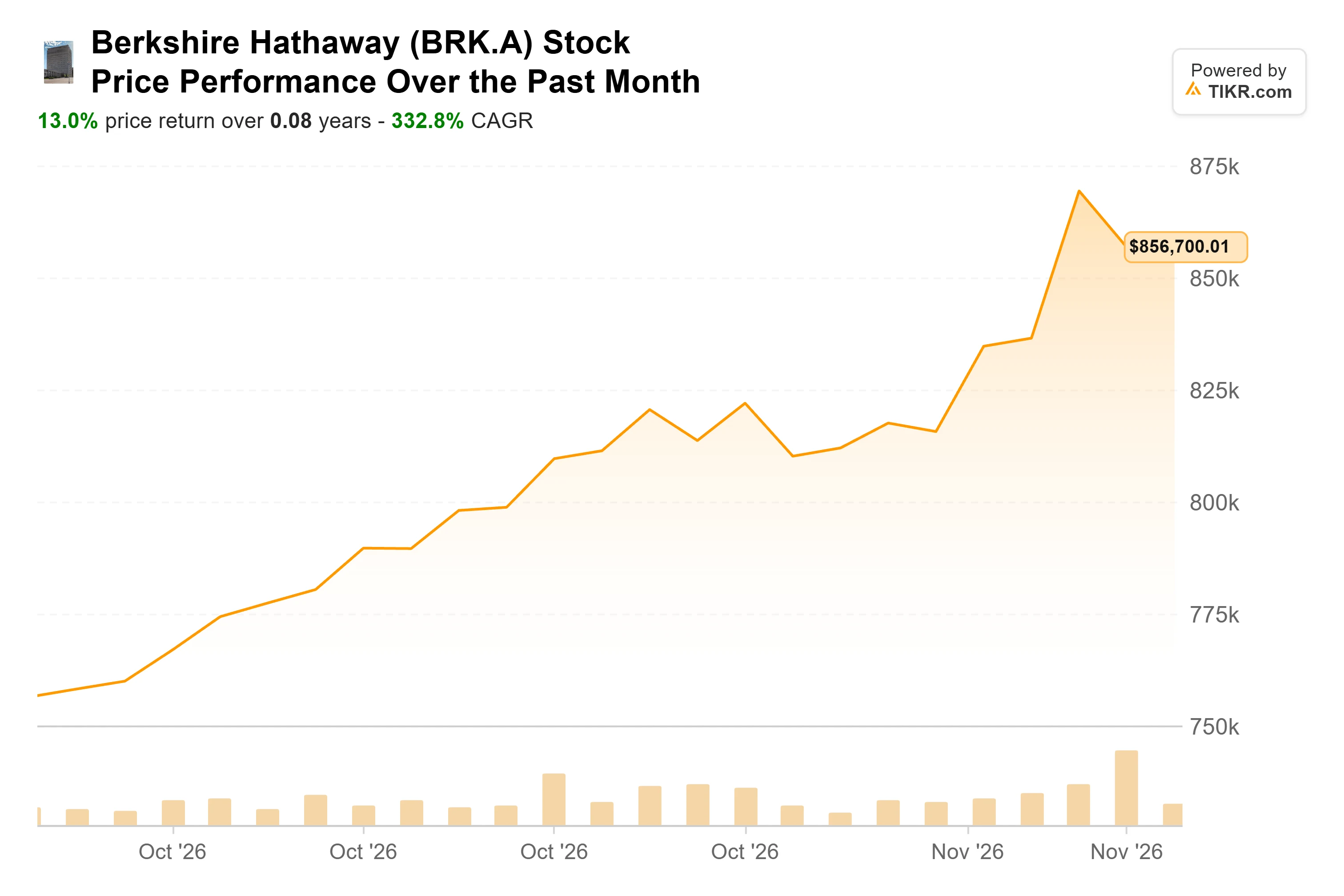
The chart above shows Berkshire Hathaway’s Class A shares (BRK.A), while the stock performance discussed in this article refers to its Class B shares (BRK.B).
Berkshire’s insurance, railroad, energy, and manufacturing operations, combined with its substantial cash reserves, attracted investor interest as Greg Abel continued the leadership transition announced by Warren Buffett in May 2025.
Coca-Cola (KO) remains one of Berkshire’s significant equity investments, while Walmart (WMT) accounted for approximately 17% of McLane’s 2025 revenue, according to Berkshire’s 2025 annual filing.
After the November 6 market close, investors received another important update when Berkshire reported third-quarter earnings on November 7.
Operating earnings declined approximately 6% to $12.7 billion from $13.5 billion a year earlier, primarily reflecting weaker insurance profitability.
Insurance underwriting earnings fell approximately 43% to $1.35 billion, while GEICO’s pretax underwriting profit declined approximately 45% to $982 million as pricing pressures and costs weighed on results.
However, Berkshire’s other businesses demonstrated resilience. BNSF railroad operating earnings increased approximately 19% to $1.73 billion, while Berkshire Hathaway Energy’s earnings rose 8% to $1.61 billion.
Manufacturing, service, and retailing earnings also improved approximately 12% to $4.04 billion, helping offset the insurance weakness.
In its earnings announcement, Berkshire described quarterly investment gains and losses as “usually meaningless,” emphasizing the importance of focusing on underlying operating earnings rather than short-term market fluctuations.
Berkshire’s third-quarter earnings report also revealed accelerated share repurchases, providing additional evidence of management’s willingness to deploy capital.
The company repurchased $9.6 billion of shares during the third quarter, compared with approximately $4.5 billion in the previous quarter, and purchased another approximately $2 billion in October.
Berkshire’s insurance and other businesses also held approximately $352 billion in cash, cash equivalents, and U.S. Treasury bills at September 30, net of unsettled Treasury purchases, according to its third-quarter financial filing.
This substantial liquidity gives Abel considerable flexibility to pursue acquisitions, make investments, and continue repurchasing shares when management believes valuations are attractive.
Is Berkshire Hathaway Stock Undervalued or Overvalued?
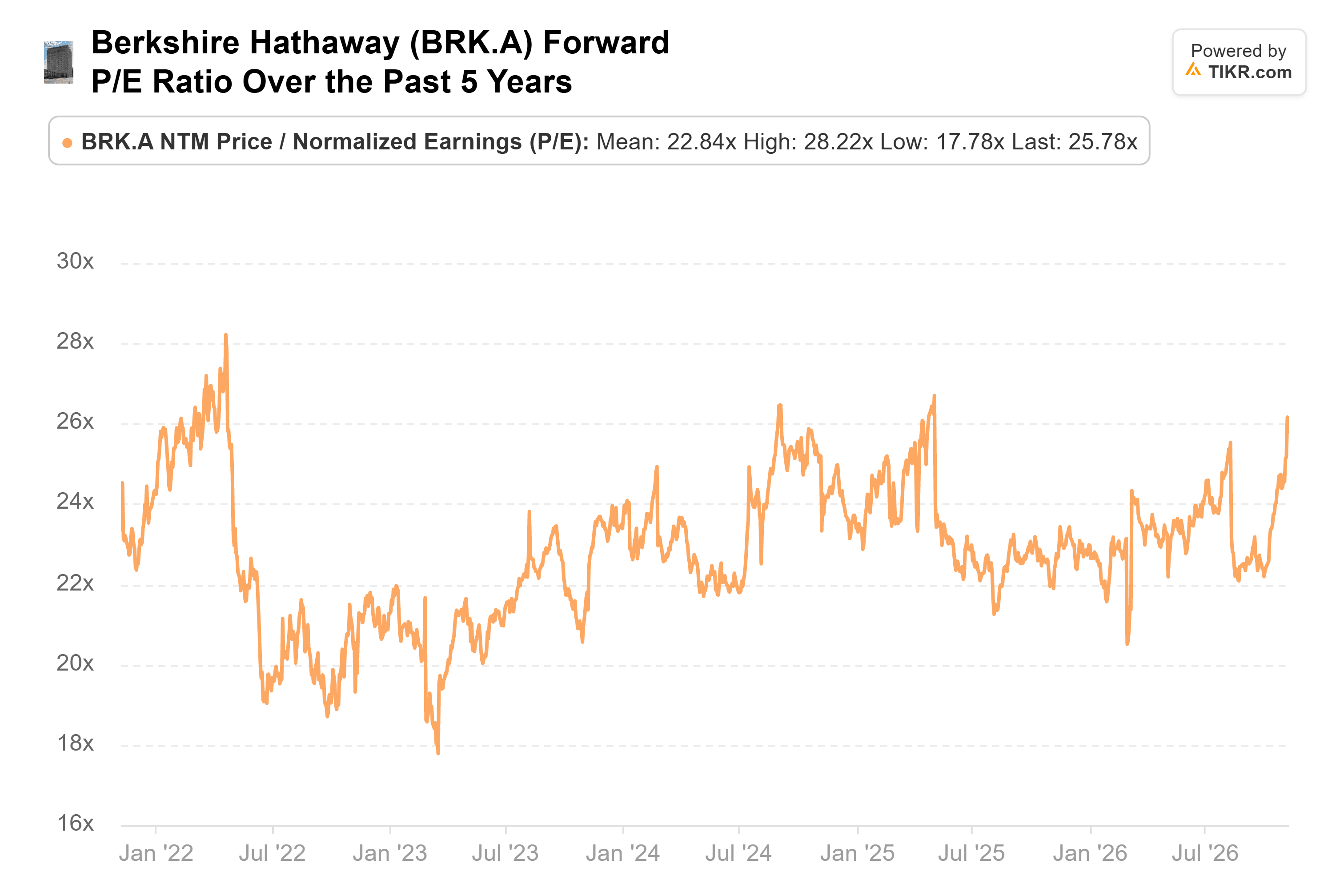
At approximately $571 per Class B share, Berkshire appears modestly overvalued relative to its historical earnings multiple. TIKR’s Class A (BRK.A) valuation chart shows a forward P/E of 25.78x, above its historical average of 22.84x, providing additional evidence that Berkshire trades at a premium.
The company’s substantial cash reserves and $9.6 billion in third-quarter buybacks support its long-term outlook, but weaker insurance profitability and relatively flat analyst earnings expectations could limit near-term upside.
The premium valuation also leaves less room for disappointment if underwriting profitability remains under pressure or future investments fail to generate stronger earnings growth.
Over the next 12 months, Berkshire’s performance will depend on Abel’s ability to improve GEICO’s profitability, sustain growth across its railroad and energy businesses, and deploy capital at attractive returns.
Berkshire looks like a reasonable hold for existing shareholders, but its premium valuation makes waiting for a better entry price more appealing than buying aggressively after the recent rally.
So what is Berkshire Hathaway stock actually worth?
TIKR lets you forecast the future price of any stock in less than a minute. Just enter a few assumptions into TIKR’s valuation model and see what Berkshire Hathaway could be worth. Start from Wall Street consensus estimates, or adjust the inputs to reflect your own view of the business. It’s free to use.
Value Berkshire Hathaway for free
Disclaimer:
Please note that the articles on TIKR are not intended to serve as investment or financial advice from TIKR or our content team, nor are they recommendations to buy or sell any stocks. We create our content based on TIKR Terminal’s investment data and analysts’ estimates. Our analysis might not include recent company news or important updates. TIKR has no position in any of the stocks mentioned. Thank you for reading, and happy investing!