
Key Stats for Microsoft Stock
- 52-Week Range: $349.20 – $555.45
- Current Price: $381.58
- Street Mean Target: $556.75
- Market Cap: ~$2.83T
- YTD Return: -19.3%
- Q3 FY2026 Revenue: $82.9B (+18% YoY)
- Q3 FY2026 Operating Income: $38.4B (+20% YoY)
- NTM P/E: 20.61x
Microsoft (MSFT) is one of the best businesses ever built, and right now it trades 31% below its 52-week high. Revenue grew 18% last quarter on a base of nearly $83 billion, Azure expanded at 35%, and operating income hit $38.4 billion in a single quarter.
The stock is down 19% year to date, not because the business deteriorated, but because investors grew cautious about the scale of AI infrastructure investment required to sustain that growth.
Whether that caution is warranted or whether it created an entry point into one of the world’s most durable compounders is the question worth working through.
Now Live: Discover how much upside your favorite stocks could have using TIKR’s new Valuation Model (It’s free) >>>
Azure Is Growing 35%, and the Revenue Curve Shows No Signs of Slowing
Microsoft Corporation needs little introduction, but the shape of the business has changed materially over the past five years.
The company operates across three segments: Productivity and Business Processes, which includes Office 365, LinkedIn, and Dynamics; Intelligent Cloud, which houses Azure and server products; and More Personal Computing, which covers Windows, Xbox, and Surface.
Azure, the cloud computing platform that rents computing power and storage to businesses over the internet, has become the engine of the entire company and the primary reason investors pay a premium for the stock.

Revenue grew from $168 billion in fiscal 2021 to $282 billion in fiscal 2025, a consistent compounding trajectory that few businesses at this scale can match. Q3 fiscal 2026 showed $82.9 billion in quarterly revenue, up 18% year over year, with Intelligent Cloud generating $34.7 billion, up 30%.
Consensus estimates project revenue crossing $330 billion in fiscal 2026 and reaching $624 billion by fiscal 2030, implying the AI-driven growth cycle has years to run.
Azure’s 35% year-over-year growth in the most recent quarter is the clearest signal that enterprise demand for cloud and AI infrastructure is accelerating rather than plateauing.
See historical and forward estimates for Microsoft stock (It’s free!) >>>
Nearly $130 Billion in Annual Operating Income, and the Margin Is Holding
The concern weighing on Microsoft’s stock this year is straightforward: the company is spending enormous sums on AI infrastructure, building data centers and acquiring GPU capacity at a pace that analysts worry could compress margins over time.
The operating income chart is the most direct answer to that concern.
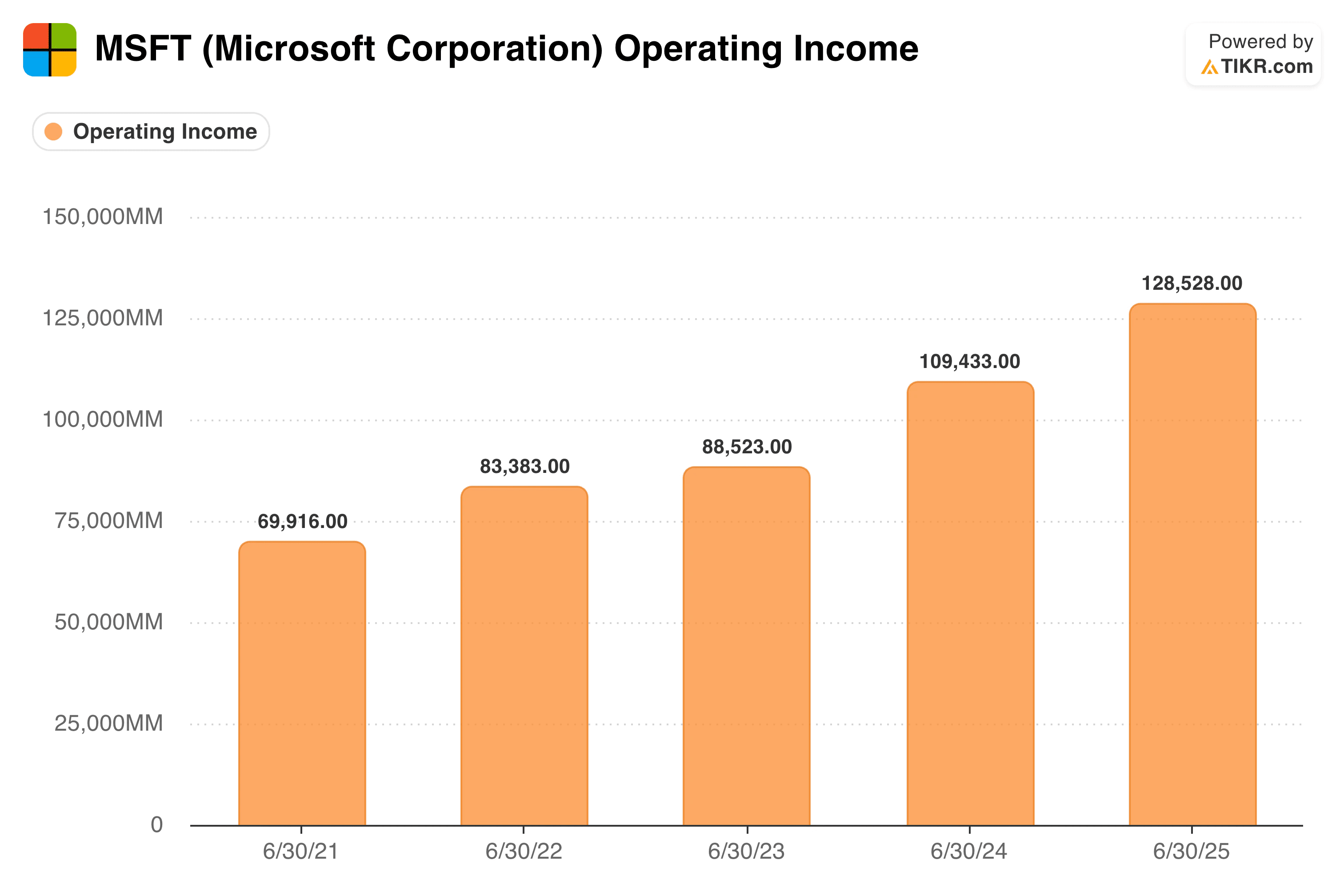
Operating income grew from $69.9 billion in fiscal 2021 to $128.5 billion in fiscal 2025, nearly doubling in four years while revenue grew roughly 68% over the same period.
Q3 fiscal 2026 delivered $38.4 billion in operating income on $82.9 billion in revenue, an operating margin of around 46%, roughly flat with a year earlier.
Microsoft is investing at scale and expanding profitability simultaneously, which is the hallmark of a business with genuine pricing power and structural cost advantages across its platform.
See how Microsoft performs against its peers in TIKR (It’s free!) >>>
What Does the TIKR Valuation Model Say About Microsoft?
TIKR’s mid-case target sits at around $789, implying roughly 107% total return over the next 3.9 years, or around 20% annualized.

Returns in the mid-case are driven entirely by earnings growth, with the model assuming around 17% revenue CAGR and net income margins expanding toward 38%, while the P/E multiple actually compresses around 6% annually throughout the forecast period.
The bull case does not depend on multiple expansion: it depends on earnings growing fast enough that the stock moves higher even as the market assigns a lower multiple over time.
The scenario range runs from around $1,100 on the low end to around $2,000 on the high end, both dramatically above the current price, reflecting how far the stock has fallen relative to the fundamental outlook.
Should You Invest in Microsoft?
Microsoft is not cheap in an absolute sense, trading at roughly 21x forward earnings for a company of its scale. But relative to its own history and relative to the growth rate it is delivering, the current price looks meaningfully dislocated from the business.
Revenue growing at 18%, Azure at 35%, operating income compounding at nearly 17% annually, a street mean target of around $557 implying 46% upside, and a TIKR mid-case pointing to around $789: those numbers tell a consistent story about a business the market has temporarily mispriced during a period of uncertainty about AI spending payoffs.
The risk is that AI capital expenditure continues rising without a proportional lift in revenue, or that Azure growth decelerates as competition from AWS and Google Cloud intensifies.
At $381, investors are being asked to pay a reasonable price for one of the most durable earnings compounders in the world.
See analysts’ growth forecasts and price targets for Microsoft stock (It’s free!) >>>
Looking for New Opportunities?
- See what stocks billionaire investors are buying so you can follow the smart money.
- Analyze stocks in as little as 5 minutes with TIKR’s all-in-one, easy-to-use platform.
- The more rocks you overturn… the more opportunities you’ll uncover. Search 100K+ global stocks, global top investor holdings, and more with TIKR.
Disclaimer:
Please note that the articles on TIKR are not intended to serve as investment or financial advice from TIKR or our content team, nor are they recommendations to buy or sell any stocks. We create our content based on TIKR Terminal’s investment data and analysts’ estimates. Our analysis might not include recent company news or important updates. TIKR has no position in any stocks mentioned. Thank you for reading, and happy investing!