Key Takeaways
- Leopold Aschenbrenner’s Situational Awareness and 16 other big funds bought or added to Micron Technology (MU) in the quarter ended June 30, and the stock is down 40% since.
- Analysts have raised their Micron earnings estimates since June, and consensus sees fiscal 2027 EPS more than doubling to $176.50.
- At 3.9x forward earnings, Micron trades about where it did at the top of the last memory cycle, before earnings fell 79%.
- The drop looks like a buying opportunity, since Micron’s long-term contracts and cash pile should soften the next downturn.
Some of AI’s best-known investors loaded up on Micron Technology in the quarter ended June 30.
Leopold Aschenbrenner’s Situational Awareness made it the fund’s second-biggest holding, and 16 other big funds bought or added to it, according to their latest 13Fs, as of June 30.
Since then, Micron is down 40% from its June 30 price as of the Nov. 6 close, and 45% below its 52-week high.
Aschenbrenner put more than a quarter of his fund on it
Situational Awareness’s 13F for the quarter ended June 30, filed Aug. 14, shows 4.8 million Micron shares worth $5.6 billion at quarter-end prices. That’s 27.6% of the fund’s US stocks, built up from a tiny stake the quarter before.
He had plenty of company:
- Philippe Laffont’s Coatue, a $93 billion hedge fund, raised its share count 1,794% to 3.14 million shares worth $3.63 billion, its third-biggest holding.
- Brad Gerstner’s Altimeter Capital opened a new $242 million position.
- Sands Capital, a $44 billion fund, opened a new $608 million position.
- Evergreen Quality Fund, with $6.2 billion in US stocks, made Micron its biggest holding, at 14.8% of its US stocks.
All told, 10 of the 17 funds opened new positions, and the other seven added to theirs.
A 13F only shows what a fund held on June 30, though, so it doesn’t say what any of them paid, or whether they’ve held on since.
TIKR tracks 51 analysts on Micron. How many say “Buy”?
See the full breakdown of Buy, Hold, and Sell ratings on Micron, along with Wall Street’s revenue and earnings estimates, all in one place. More than 500,000 investors use TIKR to research stocks like this one. See Micron’s Analyst Ratings
The estimates went the other way
But Micron’s earnings outlook has only improved since June.
In fiscal 2026, which ended Sept. 3, Micron earned $75.52 per share on a normalized basis, up from $8.29 the year before.
Analysts expect that to more than double again in fiscal 2027, to $176.50, and to keep climbing in fiscal 2028:
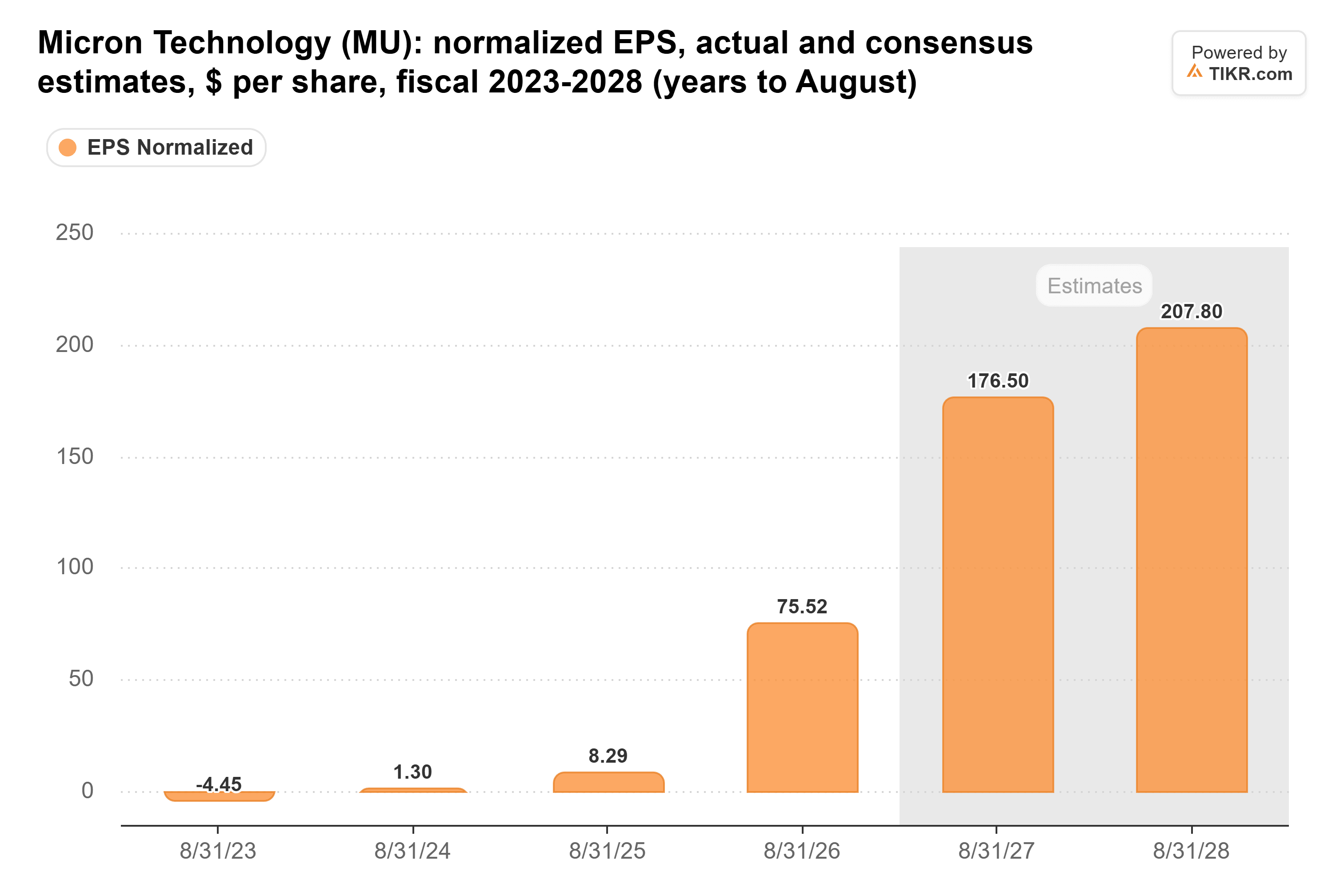
Consensus fiscal 2027 EPS is up 18% since the end of June, and fiscal 2028’s is up 27%. So investors are paying less today for more expected earnings than they were on June 30.
Wall Street’s average price target has risen from $206 a year ago to $1,562 today:
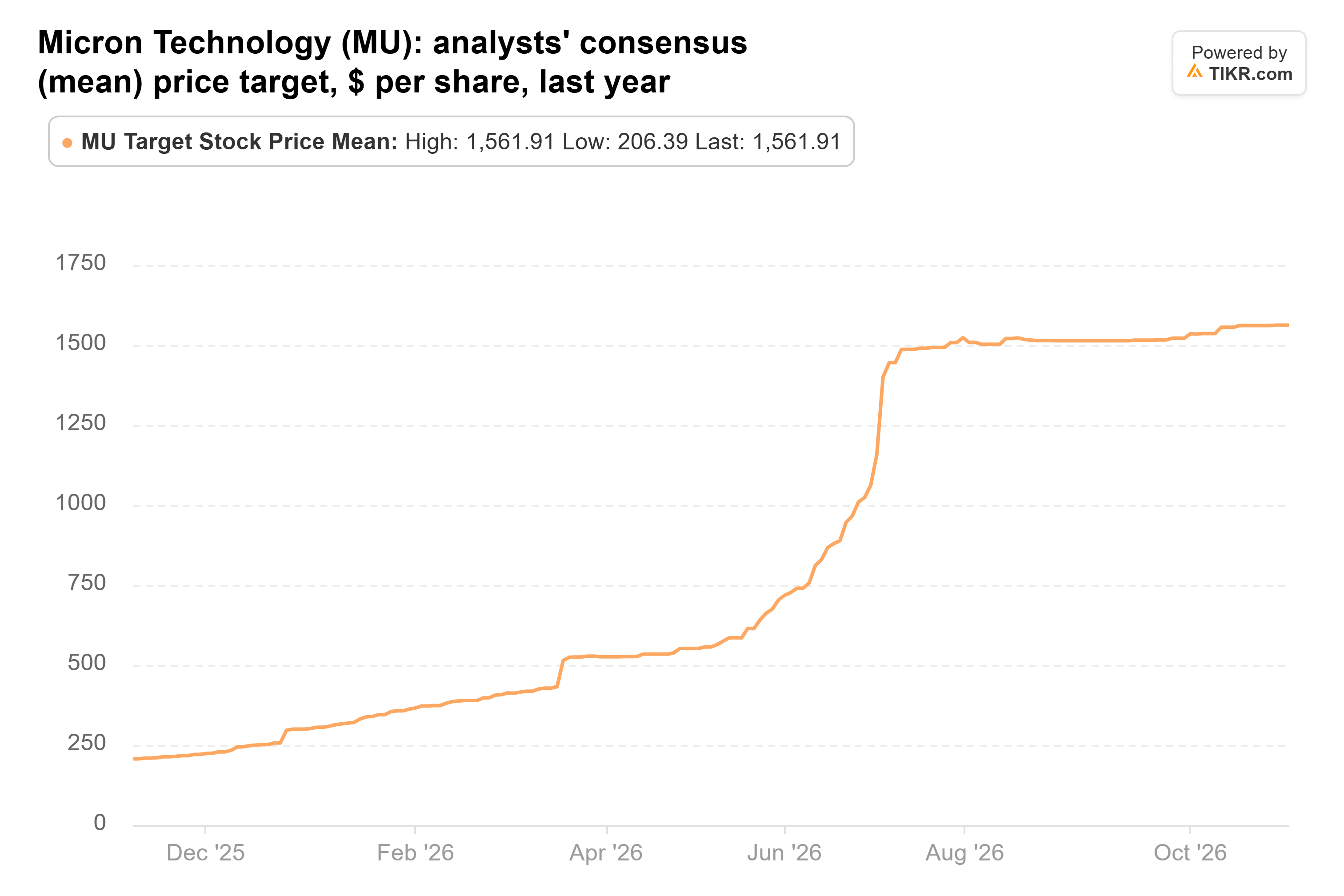
That target, from 51 analysts, sits 126% above the Nov. 6 close. (The range runs from $361 to $3,000, though, so analysts are far from agreed on how long this boom lasts.)
Micron looked this cheap in 2018, too
Many of the same funds own Taiwan Semiconductor and NVIDIA, and those have held up better since June 30: Taiwan Semiconductor is down 21%, and NVIDIA is down 7%. My read: investors are bracing for a downturn in memory prices in particular.
Micron trades at 3.9x forward earnings. That’s below the 6.5x low of its quarter-end readings over the last five years, outside the 2022-2023 downturn, when analysts expected losses.
It’s right in line with the 3.7x to 5.3x of 2017 and 2018, when the last memory cycle peaked. Then earnings fell 79%, from $11.51 per share in fiscal 2018 to $2.37 in fiscal 2020.
Analysts see some of that fade coming this time, too: consensus has Micron’s gross margin falling from 87.0% in fiscal 2027 to 65.5% in fiscal 2030, as new fabs from Micron and its rivals come online in 2027 and 2028.
Micron’s customers are locking in supply for years
Management argues this cycle is different, and it has signed contracts to back that up.
Micron has 26 multi-year take-or-pay agreements, which management estimates will cover over 35% of revenue through 2030, and it expects margins at the contracts’ floor prices to beat any past cycle’s peak quarter.
Over 75% of its 2027 output is already committed, management said on its Sept. 30 call. Of course, 35% coverage still leaves most of Micron’s sales repricing with the market.
Rival SK hynix forecasts that memory demand will keep outrunning supply through 2030.
Plus: Micron had $73.5 billion of cash and investments as of Sept. 3, against $5.2 billion of debt, and it can start buying back up to $35.16 billion of stock on Dec. 9.
I’d follow the funds in
These funds look early to me, and I’d follow them in. Micron fell 40% while analysts raised their earnings estimates, and at 4x, investors are already pricing in a sharp downturn. The contracts and the cash pile should make the next one far milder than 2018’s.
The risk is that 2018 repeats: if new supply from Micron, its rivals and China’s CXMT arrives faster than demand grows, today’s estimates will turn out to be the peak.
The funds’ 13Fs for the quarter ended Sept. 30, due by Nov. 16, will show whether Aschenbrenner and Coatue held on through the drop.
And Micron reports its fiscal Q1 in mid-December, guiding to an 86.25% non-GAAP gross margin in a quarter management calls the floor for fiscal 2027.
So what is Micron stock actually worth?
TIKR lets you forecast the future price of any stock in less than a minute. Just enter a few assumptions into TIKR’s valuation model and see what Micron could be worth. Start from Wall Street consensus estimates, or adjust the inputs to reflect your own view of the business. It’s free to use.
Disclaimer:
Please note that the articles on TIKR are not intended to serve as investment or financial advice from TIKR or our content team, nor are they recommendations to buy or sell any stocks. We create our content based on TIKR Terminal’s investment data and analysts’ estimates. Our analysis might not include recent company news or important updates. TIKR has no position in any of the stocks mentioned. Thank you for reading, and happy investing!