Key Stats for Alibaba Stock
- Current Price: $111.37
- Target Price (Mid): ~$231
- Street Target: ~$186
- Potential Total Return: ~108%
- Annualized IRR: ~18% / year
Now Live: Discover how much upside your favorite stocks could have using TIKR’s new Valuation Model (It’s free) >>>
What Happened?
Alibaba (BABA) reported a free cash flow outflow of RMB 44.7 billion in the June quarter. Its August 20 earnings call offered a rough rule for when AI spending pays for itself.
Speaking through an interpreter, management said AI growth below 33% would theoretically produce positive cash flow. That assumes current AI gross margins and a three-year payback. Management said it chose to grow faster.
Shares closed at $111.37 on October 9, up 5.36%, but remain down 24% in 2026. Details are in Alibaba’s investor relations materials.
The 33% Line Explains Part of the Burn
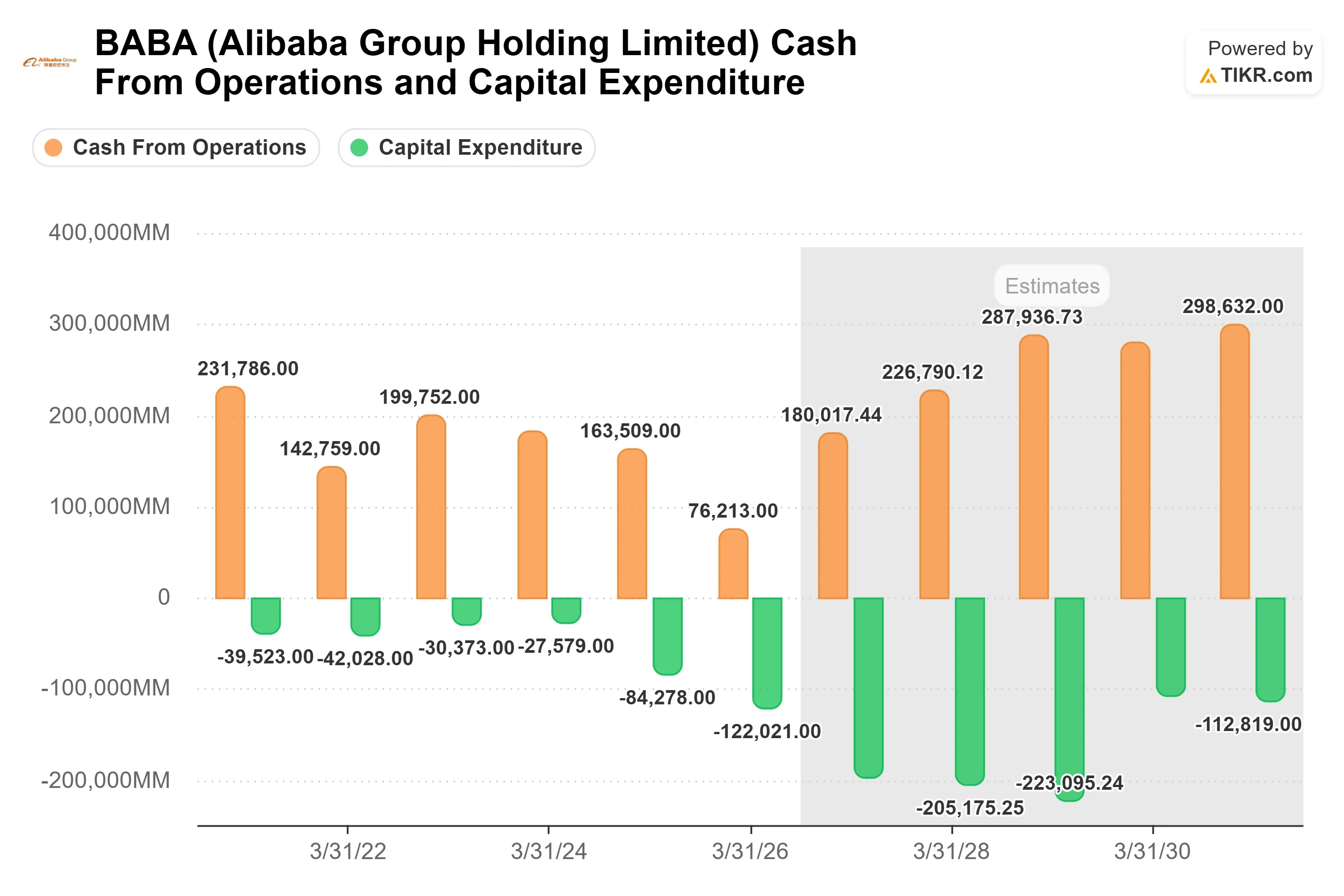
Capital expenditure was RMB 67.6 billion on TIKR’s basis, against the operating cash flow of RMB 22.9 billion. The company-reported outflow compares with RMB 18.8 billion a year earlier.
CFO Toby Xu gave three reasons for the capex jump: procurement-cycle timing, added CPU capacity for expected AI-agent demand, and higher chip prices. Management cautioned against multiplying one quarter by four.
The case for the spending rests on payback. Xu said: “Our servers equipped with chips typically reach breakeven within 3 years.”
Management said payback could shorten to 2.5 years as T-Head chips replace purchased ones. It called growing above 40% with positive cash flow its long-term direction. It also said more than 500,000 last-generation T-Head chips have already shipped.
That makes payback, not the size of the outflow, the number to track. This is a framework from the call.
See historical and forward estimates for Alibaba stock (It’s free!) >>>
The October 9 Jump Had Help From China. The Cloud Bar Is Alibaba’s Own
Part of the October 9 gain was sector-wide. U.S.-listed Chinese stocks rose on speculation that Chinese authorities curbed sell orders during Asian trading.
The same day, BofA’s Joyce Ju raised her target to $178 from $175. She also lifted fiscal 2027 to 2029 earnings estimates by 3% to 9%. Her target still sits below the Street mean of around $186.
Morgan Stanley’s Gary Yu expects September-quarter external cloud revenue to grow around 55%, up from 45%. He sees the cloud margin rising to around 13.5% from 11.6%.
Management points in the same direction. On August 20, CEO Eddie Wu said that, based on current market feedback and contract pipelines, “compute demand will continue to outstrip supply.” Through the interpreter, executives said annualized AI-related product revenue of about $7.3 billion should approach $10 billion in the September quarter.
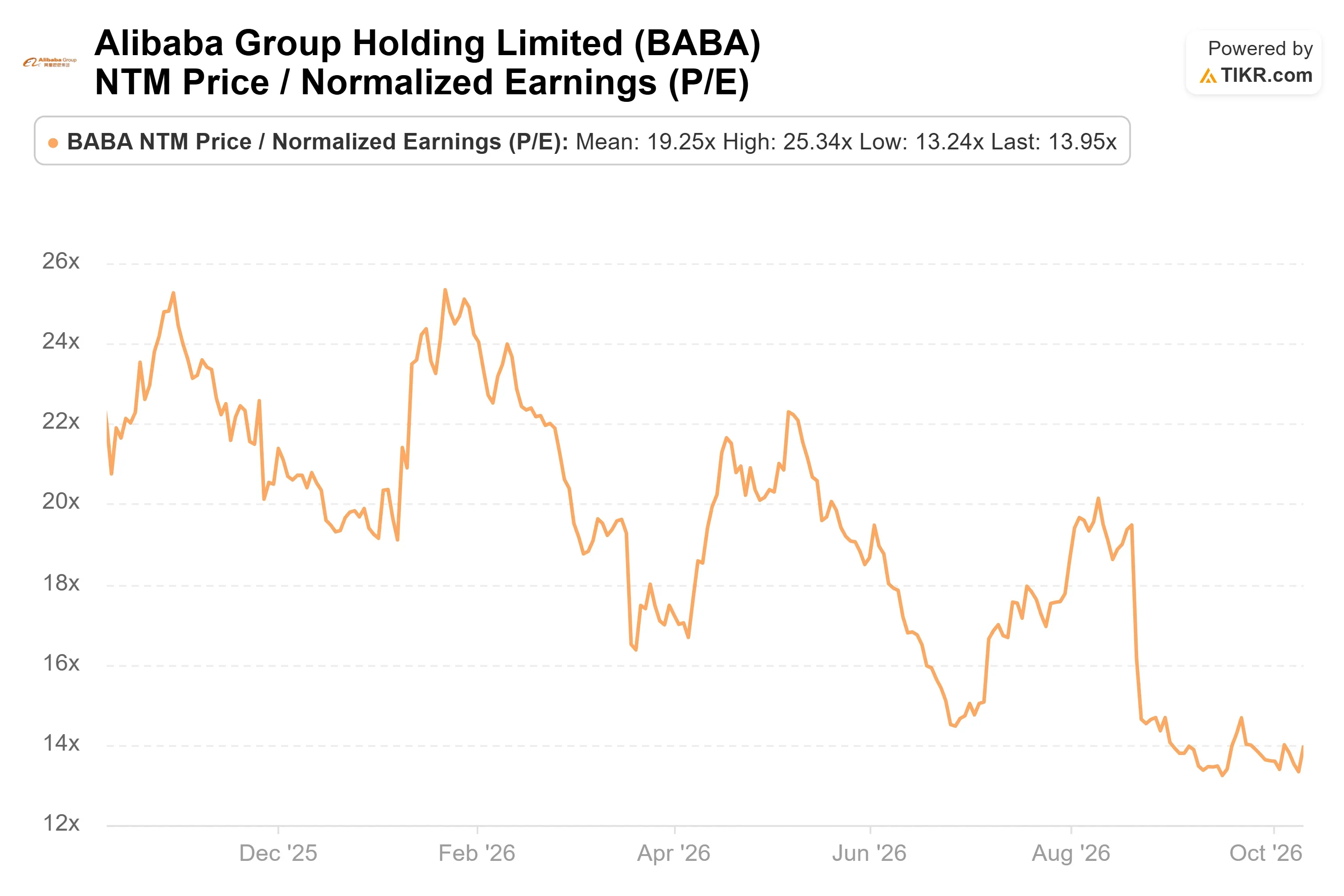
The market pays less for that growth than it did a year ago. Alibaba trades at around 14 times NTM normalized earnings, versus around 22 times on September 30, 2025. Consensus still has free cash flow negative in fiscal 2027 (ending March 31, 2027) and positive in fiscal 2028.
See how Alibaba performs against its peers in TIKR (It’s free!) >>>
TIKR Advanced Model Analysis
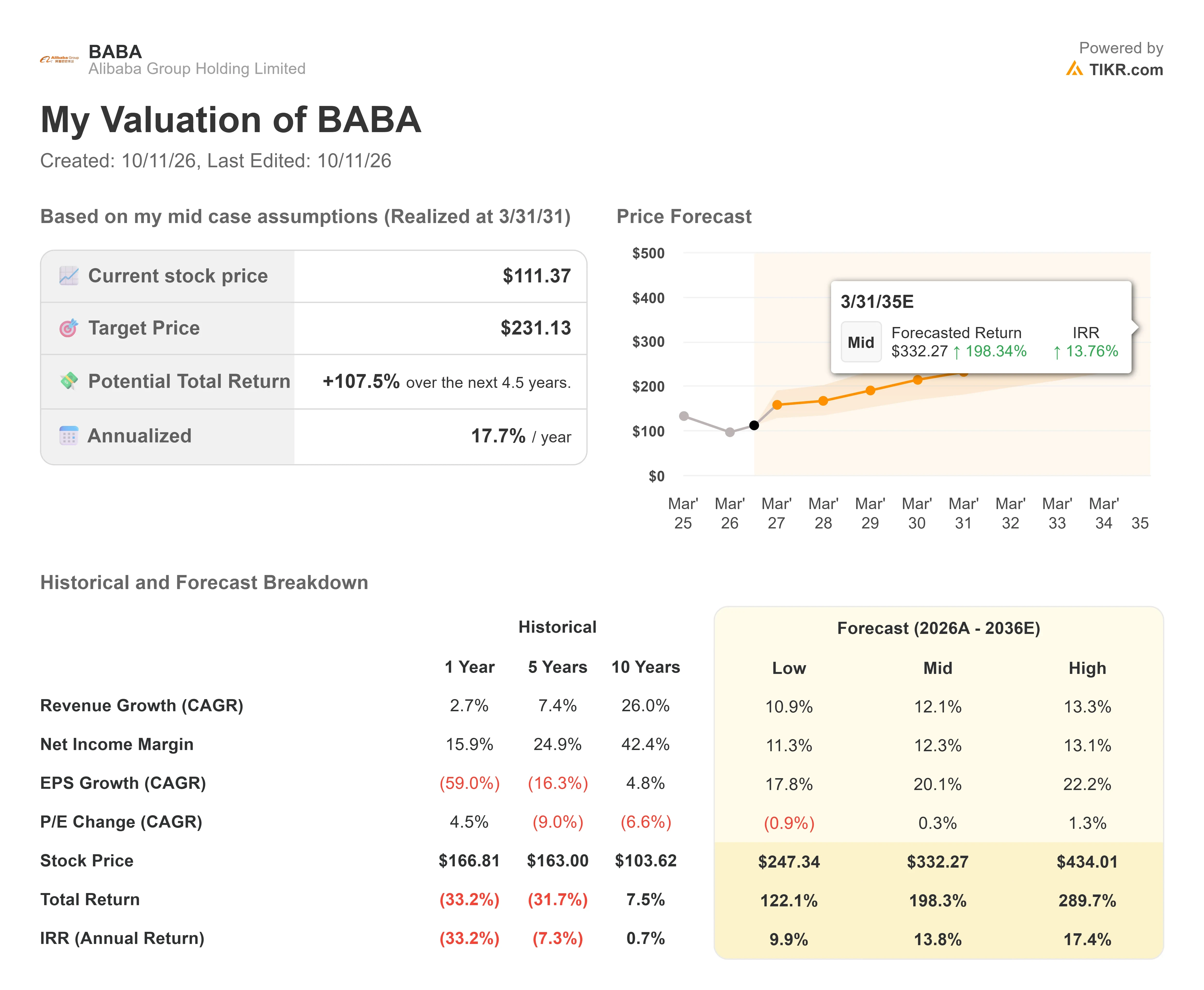
- Current Price: $111.37
- Target Price (Mid): ~$231
- Potential Total Return: ~108%
- Annualized IRR: ~18% / year
- Consensus Revenue: RMB 1,023.67 billion (fiscal 2026) to ~RMB 1.82 trillion (fiscal 2031)
- Consensus Normalized Net Margin: 6.3% (fiscal 2026) to ~12% (fiscal 2031)
See analysts’ growth forecasts and price targets for Alibaba stock (It’s free!) >>>
The mid case is the central scenario. For context, TIKR consensus has revenue growing about 12% a year through fiscal 2031, with a margin recovery, though only four analysts forecast that year.
The main risk is payback staying near three years while capex climbs, which would push positive free cash flow past fiscal 2028. Upside comes if the T-Head substitution shortens payback to 2.5 years. The downside comes if cloud growth stalls near 45%.
Conclusion
The September-quarter report is the test. It is expected around November 24, but Alibaba hasn’t confirmed the date.
External cloud growth near 55%, with a margin above 11.6%, would show the spending buying growth on schedule. Any change to the three-year payback matters as much. A shorter payback makes the burn look chosen; a longer one makes it look like a cost.
See what stocks billionaire investors are buying so you can follow the smart money with TIKR.
So what is Alibaba stock actually worth?
TIKR lets you forecast the future price of any stock in less than a minute. Just enter a few assumptions into TIKR’s valuation model and see what Alibaba could be worth. Start from Wall Street consensus estimates, or adjust the inputs to reflect your own view of the business. It’s free to use.
Analyze Alibaba on TIKR Free →
Disclaimer:
Please note that the articles on TIKR are not intended to serve as investment or financial advice from TIKR or our content team, nor are they recommendations to buy or sell any stocks. We create our content based on TIKR Terminal’s investment data and analysts’ estimates. Our analysis might not include recent company news or important updates. TIKR has no position in any stocks mentioned. Thank you for reading, and happy investing!