


Wall Street analysts are generally a conservative bunch. They rarely model a company tripling its top line, because most companies don’t. So when consensus estimates call for three separate chip names to do exactly that, it’s worth asking what the Street sees, and what would have to go right.
All three presented at Citi’s 2026 Global TMT Conference this month. Here’s what management said, and where the story could break.
Lumentum (LITE): $3.0B to $13.7B

Lumentum finished fiscal 2026 at roughly $3.0 billion in revenue. Consensus now sees $9.6 billion by fiscal 2028 and $13.7 billion by fiscal 2029.
AI data centers move data between chips using light instead of copper wire, and Lumentum makes the lasers that do the converting.
At the Citi conference, the company said it can’t build those lasers fast enough to fill orders through 2027, and customers are still paying elevated prices rather than negotiating them down. Two waves are driving it.
The first is connecting racks to each other across the data center, which management expects to double in 2027. The second is connecting GPUs to each other inside a single rack, which takes far more optical parts per rack and should grow another 3x to 4x in 2028. Management also raised its fiscal 2028 earnings target to $40 per share on stronger demand from its largest customer for optical switches, a newer product that redirects the light beam itself instead of converting it back to electricity first.
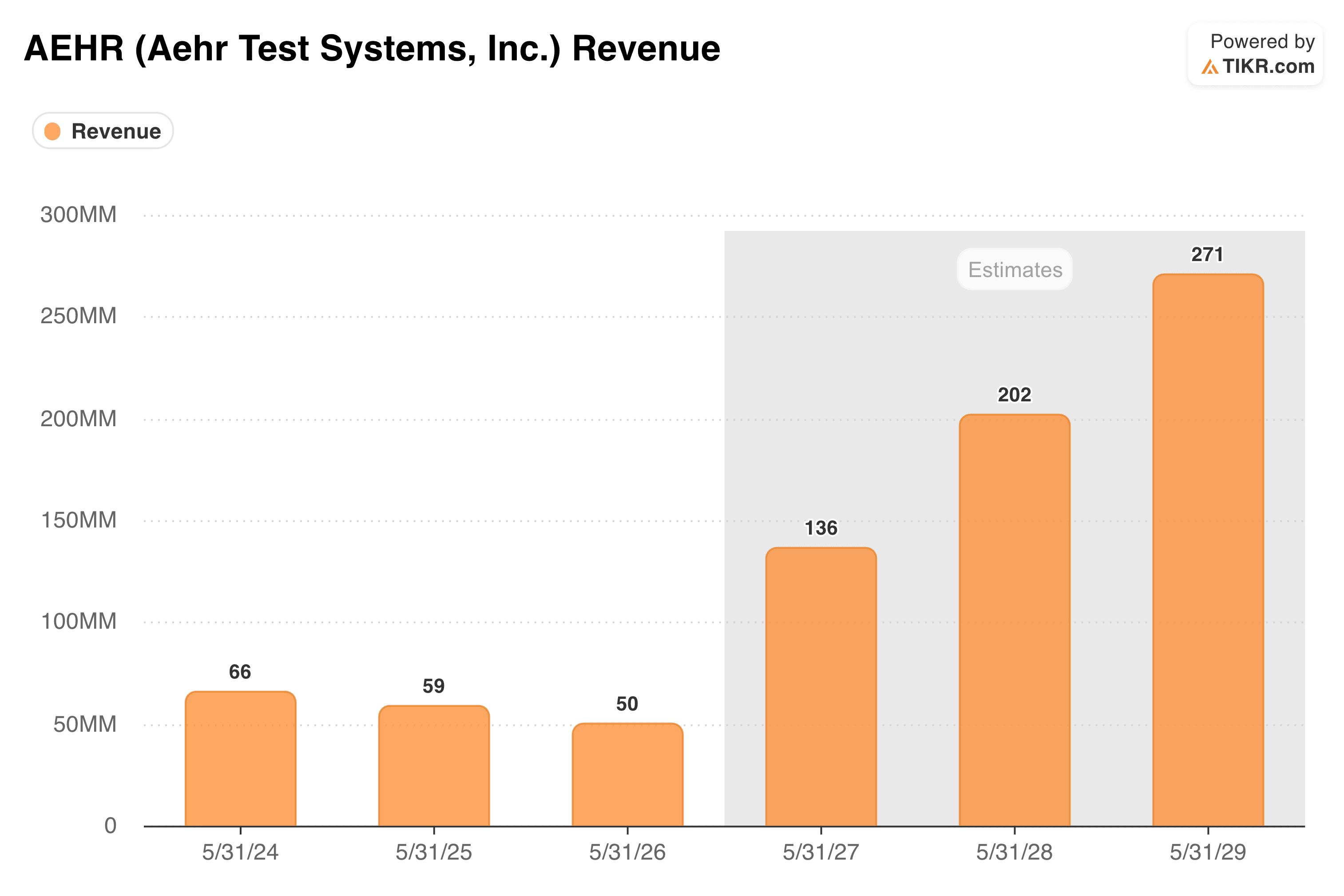
Aehr Test Systems (AEHR): $50M to $271M
Before a chip ships, it gets stress-tested at high heat and voltage to weed out the ones that would fail early. That process is called burn-in, and Aehr makes the equipment that does it. It matters more for AI chips than for ordinary ones. A single bad GPU can take down a rack holding thousands of them, and finding the failure after installation costs far more than catching it at the factory.
Aehr is the smallest name here and the most violent revision. Fiscal 2026 revenue actually fell 15% to $50 million. Then management guided fiscal 2027 to $130 million to $150 million, roughly 160% to 200% growth, on effective backlog of about $100 million. The Street had been modeling around $85 million.
Consensus now sits at $136 million for fiscal 2027 and $271 million by fiscal 2029. Notably, that guidance excludes any memory revenue, which management frames as later upside.
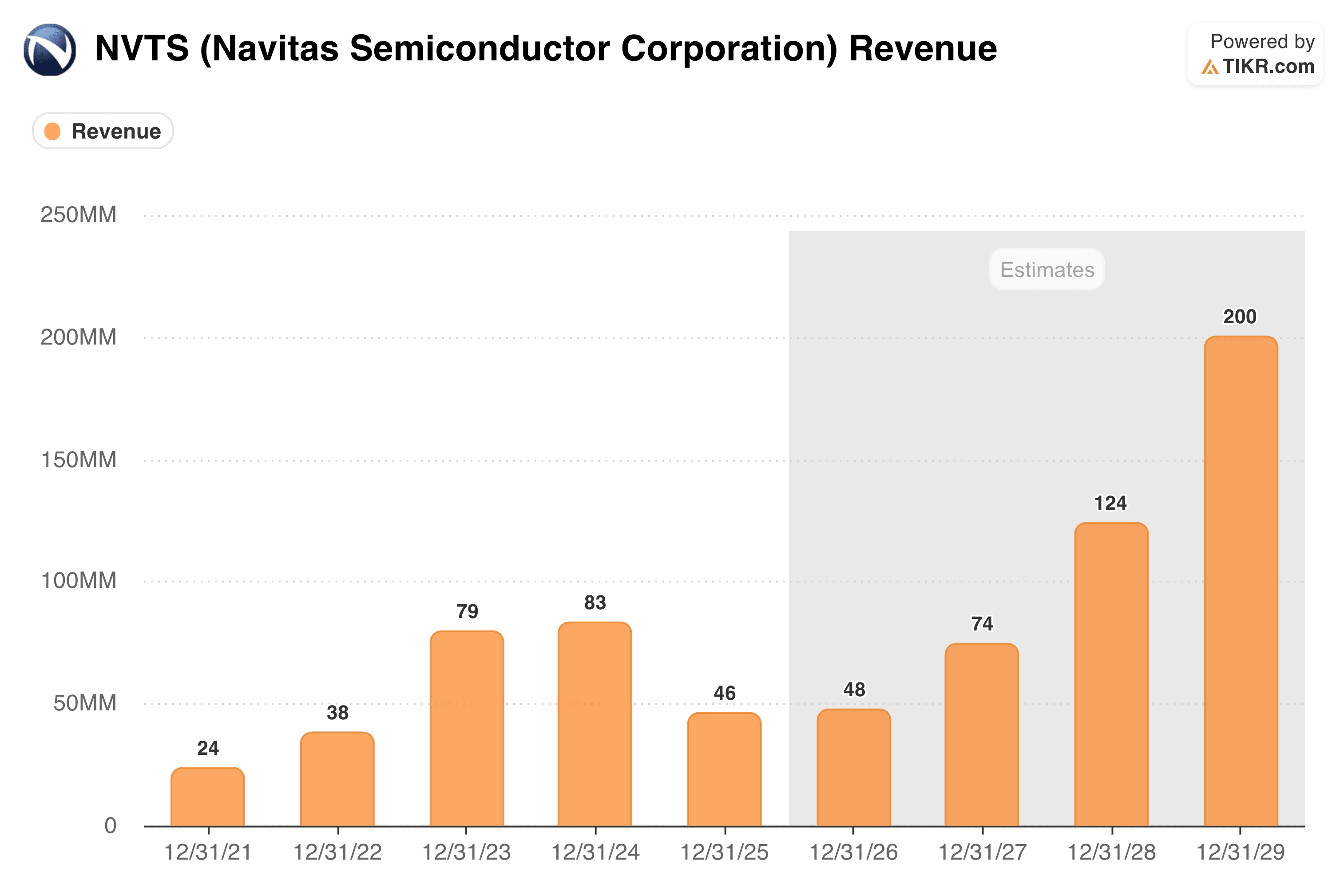
Navitas Semiconductor (NVTS): $46M to $200M
Grid electricity arrives at a data center at thousands of volts. The chips inside run on less than one. Something has to step that power down, and every conversion wastes some of it as heat. Navitas makes chips that handle those conversions using gallium nitride and silicon carbide instead of ordinary silicon, which wastes less power and takes up less space.
The company just completed a pivot away from mobile consumer, previously 85% of revenue, toward AI infrastructure. Management says AI will exceed one-third of revenue by year-end with backlog extending into 2027. The pending Claros acquisition adds $4 billion to a $4.5 billion 2030 addressable market.
The catch: consensus sees only $48 million in 2026 before the ramp to $200 million by 2029. Nearly all the growth is back-end loaded.
What would make these estimates wrong
First, customer concentration. Lumentum’s raised target leans heavily on optical switch orders from a single customer. Aehr’s backlog sits with a small number of chip programs. When a handful of customers drive most of the revenue, one of them delaying a project by two quarters is enough to break the whole model.
Second, timing. A lot of this revenue depends on products that haven’t launched yet. The new data center power designs Navitas supplies don’t arrive until late 2027, and its Claros acquisition doesn’t contribute until 2028. Aehr has told investors its revenue will land unevenly across quarters because it sells expensive equipment in large, lumpy orders. Revenue that arrives in chunks is revenue that’s easy to miss on.
Third, and biggest, all three are building capacity for a spending boom that has never been through a downturn. Lumentum is adding factories in the UK and North Carolina. That spending is committed now, but the orders it’s meant to serve arrive years later. If Amazon, Microsoft, Google and Meta slow their AI buildouts, those factories become a fixed bill against shrinking demand.
Tripling revenue is possible, but it’s also what happens when analysts take a strong backlog and extend the line. Long-term investors should watch the bookings, not the estimates.


