
Key Takeaways:
- SMB Growth: Small and medium-sized businesses are demonstrating resilience, with increasing transaction volumes across BILL’s platform.
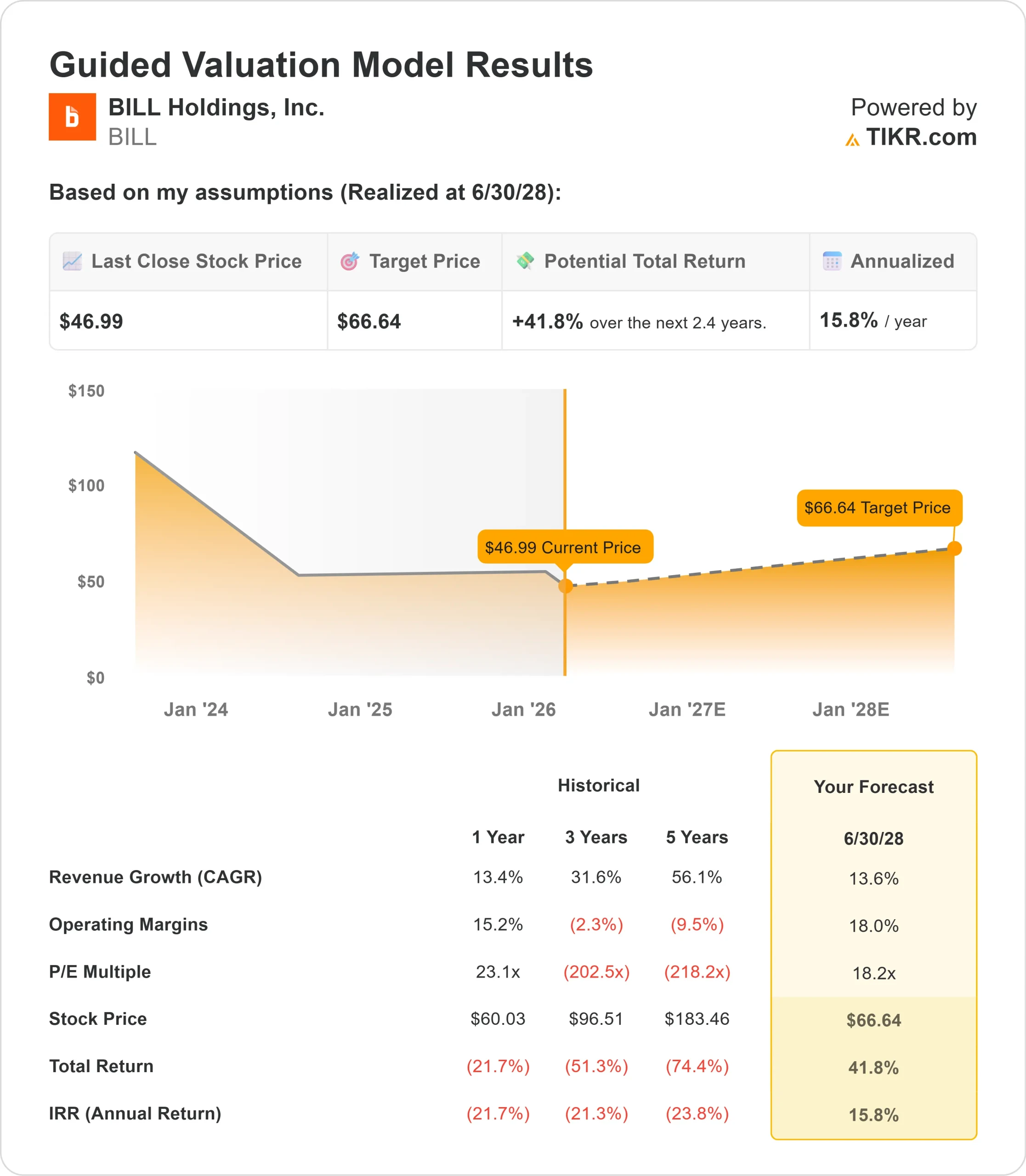
- Price Projection: Based on current execution, BILL stock could reach $67 by June 2028.
- Potential Gains: This target implies a total return of 42% from the current price of $47.
- Annual Return: Investors could see roughly 16% growth over the next 2.4 years.
Now Live: Discover how much upside your favorite stocks could have using TIKR’s new Valuation Model (It’s free)>>>
BILL Holdings (BILL) delivered strong second-quarter fiscal 2026 results with core revenue growth accelerating to 17% year-over-year and non-GAAP operating margins expanding to 18%. The company raised full-year guidance across key metrics, and CEO Rene Lacerte highlighted robust momentum across its platform.
- Transaction volumes are picking up across the business.
- The company’s same-store sales on the accounts payable and receivable platform grew 4%, up from 3% in the prior quarter.
- Core industries like manufacturing continue performing well, while construction showed a notable rebound after several weaker quarters.
- On the spend and expense side, card payment volume jumped 25% year-over-year, driven by strength in advertising, retail, and healthcare services.
- Nearly 500,000 customers now use BILL’s software to manage their financial operations, while over 8 million businesses participate in their B2B payment network.
- Businesses using multiple BILL products grew 28% year-over-year, demonstrating how deeper platform adoption drives stickier customer relationships and higher revenue per user.
- The company is leveraging agentic AI across its platform to eliminate manual workflows.
- BILL’s W-9 agent has already collected 40,000 tax documents for nearly 10,000 customers since launching in Q2.
- The invoice coding agent reduces manual steps by 90%, while the BILL Assistant agent tripled self-service rates from 13% to 40% of customer contacts.
- These AI capabilities are trained on insights from over $1 trillion in payment volume and billions of processed documents, giving BILL unique competitive advantages that new entrants cannot easily replicate.
Despite strong fundamentals and expanding margins, BILL trades at $47, offering upside for investors who recognize the company’s leadership position in financial operations software for small and medium businesses.
See analysts’ full growth forecasts and estimates for BILL stock (It’s free) >>>
What the Model Says for BILL Holdings Stock
We analyzed BILL’s transformation into the leading intelligent financial operations platform for SMBs.
- The company benefits from multiple growth drivers, including deeper multiproduct adoption, embedded distribution partnerships, and AI-powered workflow automation.
- BILL’s recent partnerships with NetSuite, Acumatica, and Paychex unlock access to nearly 1 million businesses through its Embed 2.0 strategy.
- These partnerships allow BILL to reach growing businesses inside the systems they already use, reducing friction and delivering a more unified technology stack.
- The company’s invoice financing product addresses a critical cash flow need for SMBs. Customers using invoice financing grew nearly 50% year-over-year in Q2, while origination volume increased over 30%.
- BILL improved adoption while simultaneously enhancing unit economics through better AI-powered underwriting models.
Using a forecast of 13.6% annual revenue growth and 18% operating margins, our model projects the stock will rise to $67 within 2.4 years. This assumes an 18.2x price-to-earnings multiple.
That represents compression from BILL’s historical P/E average of 23.1x over the past year. The lower multiple reflects near-term macro uncertainty affecting SMB spending patterns and the company’s shift toward larger customers, which may temporarily slow net customer additions.
The real value lies in BILL’s ability to capture a growing share of SMB financial operations spend while expanding margins through operational leverage and AI-driven efficiency gains.
Our Valuation Assumptions
Estimate a company’s fair value instantly (Free with TIKR) >>>
Our Valuation Assumptions
TIKR’s Valuation Model lets you plug in your own assumptions for a company’s revenue growth, operating margins, and P/E multiple, and calculates the stock’s expected returns.
Here’s what we used for BILL stock:
1. Revenue Growth: 13.6%
BILL’s growth centers on structural demand for automated financial operations among small and medium businesses.
The company delivered 17% core revenue growth in Q2 with acceleration across both AP/AR and Spend & Expense segments. Full-year guidance projects 14%-17% year-over-year growth in core revenue.
Management expects this momentum to continue as businesses increase multiproduct adoption and spend volumes normalize.
Recent pricing actions targeting subscription and transaction fees should also contribute to growth while better aligning with the value BILL delivers to customers.
2. Operating margins: 18%
BILL expanded non-GAAP operating margins by 290 basis points year-over-year in Q2, demonstrating strong operating leverage.
BILL expects a non-GAAP operating income in the range of $274 million to $287 million. This represents a non-GAAP operating margin of approximately 17% for the full year.
Management outlined efficiency initiatives, including geographic workforce diversification, AI-driven productivity improvements, and customer unit economic optimization.
These efforts should enable continued margin expansion as the company scales its platform while maintaining disciplined expense management.
3. Exit P/E Multiple: 18.2x
The market currently values BILL at 19.2x earnings. We assume the P/E will compress slightly to 18.2x over our forecast period as the company transitions toward larger enterprise customers and navigates the competitive dynamics in financial software.
As BILL demonstrates consistent execution on multiproduct adoption, embedded partnerships, and AI-powered innovation, the company should maintain a premium multiple relative to traditional software peers given its unique position at the intersection of software and payments.
Build your own Valuation Model to value any stock (It’s free!) >>>
What Happens If Things Go Better or Worse?
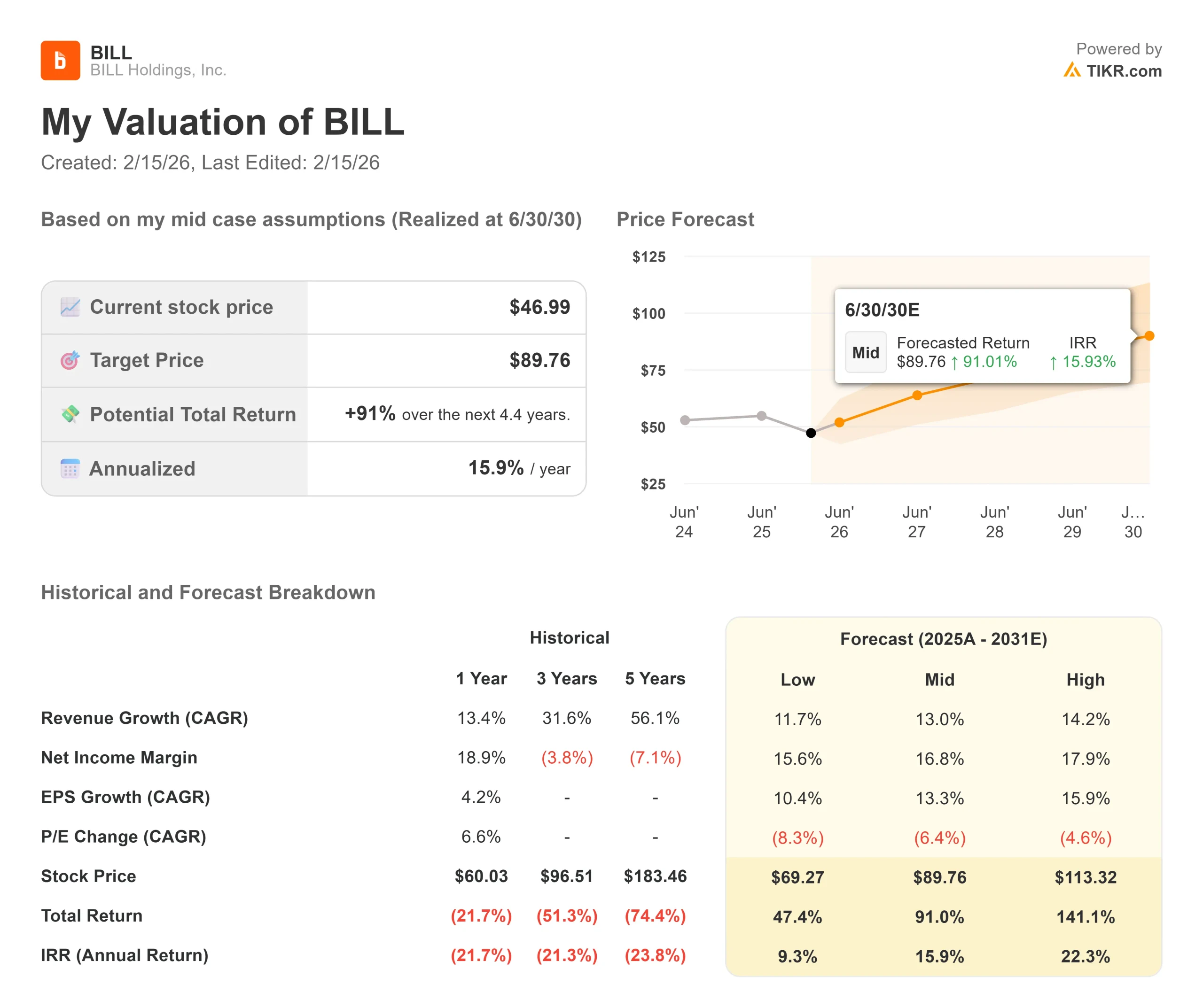
Financial software companies face competitive pressures and changing SMB spending patterns. Here’s how BILL stock might perform under different scenarios through June 2030:
- Low Case: If revenue growth slows to 11.7% and net income margins compress to 15.6%, investors still see a 47% total return (9% annually).
- Mid Case: With 13% growth and 16.8% margins, we expect a total return of 91% (16% annually).
- High Case: If SMB spending accelerates and BILL achieves 14.2% revenue growth while maintaining 17.9% margins, total returns could reach 141% (22% annually).
See what analysts think about BILL stock right now (Free with TIKR) >>>
The range reflects execution on AI product development, success with embedded partnerships, multiproduct adoption rates, and the company’s ability to move upmarket while maintaining healthy unit economics.
How Much Upside Does BILL Holdings Stock Have From Here?
With TIKR’s new Valuation Model tool, you can estimate a stock’s potential share price in under a minute.
All it takes is three simple inputs:
- Revenue Growth
- Operating Margins
- Exit P/E Multiple
If you’re not sure what to enter, TIKR automatically fills in each input using analysts’ consensus estimates, giving you a quick, reliable starting point.
From there, TIKR calculates the potential share price and total returns under Bull, Base, and Bear scenarios so you can quickly see whether a stock looks undervalued or overvalued.
See a stock’s true value in under 60 seconds (Free with TIKR) >>>
Looking for New Opportunities?
- See what stocks billionaire investors are buying so you can follow the smart money.
- Analyze stocks in as little as 5 minutes with TIKR’s all-in-one, easy-to-use platform.
- The more rocks you overturn… the more opportunities you’ll uncover. Search 100K+ global stocks, global top investor holdings, and more with TIKR.
Disclaimer:
Please note that the articles on TIKR are not intended to serve as investment or financial advice from TIKR or our content team, nor are they recommendations to buy or sell any stocks. We create our content based on TIKR Terminal’s investment data and analysts’ estimates. Our analysis might not include recent company news or important updates. TIKR has no position in any stocks mentioned. Thank you for reading, and happy investing!