


Key Takeaways
- Of the 460 big funds that have filed 13Fs for the quarter ended Sept. 30, 21 bought Visa and 29 sold it, while 136 held it.
- Coatue and Lone Pine made the biggest buys, and Viking Global made the biggest sale, but Visa is still Viking’s second-largest holding.
- Coatue and Viking Global both opened new positions in Mastercard in the same quarter.
- Visa trades a little above its five-year average multiple, so the buyers have the better case, but further gains will have to come from earnings growth.
Big money couldn’t make up its mind on Visa (V) last quarter.
Among the 460 big funds that have filed 13Fs for the quarter ended Sept. 30, 21 bought Visa by opening a position or adding 20% or more to their shares. That group covers funds readers know and funds with $1 billion or more of US stocks, and it leaves out quant and index funds. Another 29 sold out or cut their shares by 20% or more, and 136 held the stock at the quarter’s end.
Two funds on opposite sides of that split did agree on one thing, though. Coatue bought Visa and Viking Global sold it, but both opened new positions in Mastercard (MA).
The buyers went big
Philippe Laffont’s Coatue made the biggest buy. Its 13F for the quarter ended Sept. 30, filed Nov. 16, shows a new stake of 2.58 million Visa shares, worth about $926 million at quarter-end prices. That’s 1.7% of the 13F stocks of a firm that manages about $93 billion in all.
Lone Pine Capital made the bigger bet for its size. Its Nov. 16 filing shows it took its stake from 165,960 shares to 2.23 million, which made Visa its fourth-largest holding at 5.2% of its 13F stocks. Munro Partners, whose 13F holds $4.2 billion of US stocks, opened a 314,740-share position worth about $113 million.
Visa is up 16% since Sept. 30, but a 13F doesn’t say what any fund paid.
TIKR tracks 40 analysts on Visa. How many say “Buy”?
See the full breakdown of Buy, Hold, and Sell ratings on Visa, along with Wall Street’s revenue and earnings estimates, all in one place. More than 500,000 investors use TIKR to research stocks like this one. See Visa’s Analyst Ratings
Most of the sellers kept plenty
Andreas Halvorsen’s Viking Global made the biggest sale. Its 13F, filed Nov. 16, shows it cut its Visa stake by a third, from 6.39 million shares to 4.31 million. That’s about $749 million of stock at quarter-end prices. But the shares it kept were worth $1.55 billion, 4.7% of its 13F stocks, and Visa is still its second-largest holding.
Edgewood Management’s Nov. 12 filing shows it cut 38% of its shares, about $219 million worth. Visa is still its sixth-largest holding, at 5.6% of its 13F stocks. Lee Ainslie’s Maverick Capital is the one that walked away: its Nov. 16 filing shows it sold all 752,252 of its shares, about $258 million worth.
Viking didn’t turn on card networks, either. It opened a Mastercard stake of 1.48 million shares worth $818 million, now its 10th-largest holding. Coatue bought 1.60 million Mastercard shares worth $883 million alongside its Visa stake. Mastercard trades at about 29x forward earnings, close to Visa’s 28x. Analysts’ average target for Mastercard is 12% above its last close, against 9% for Visa. (In the same quarter, 10 of the 29 Visa sellers bought Taiwan Semiconductor, and 7 of the 21 buyers sold Applied Materials.)
Priced for its estimates
Visa’s earnings have kept climbing. Normalized EPS rose from $8.77 in fiscal 2023 to $13.27 in fiscal 2026 (Visa’s years end in September), and analysts expect $15.03 in fiscal 2027 and $17.14 in fiscal 2028:
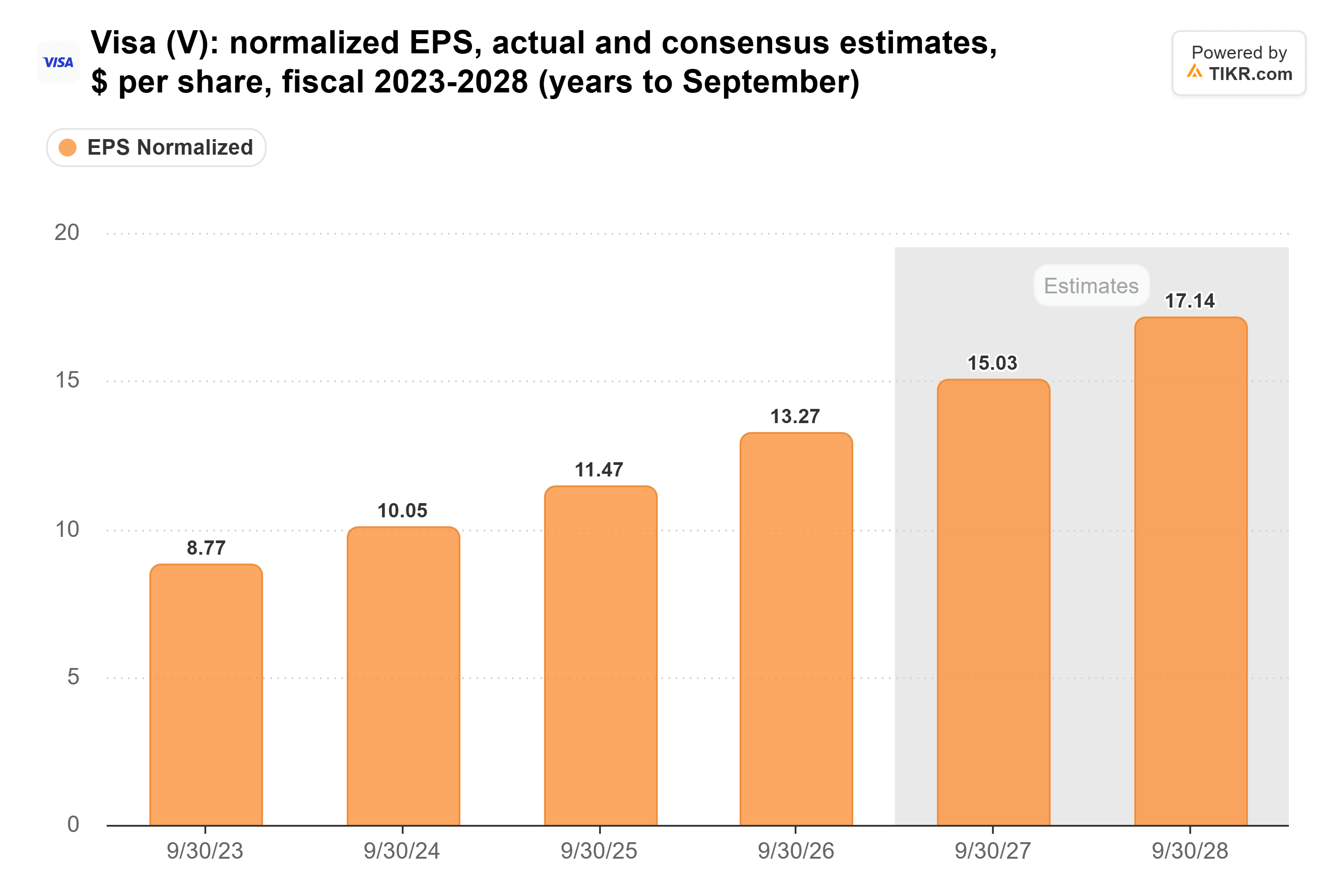
That’s 13% growth this fiscal year and 14% the year after. But the fiscal 2027 figure already sits at the top of Visa’s own guided range, and it’s only 4% higher than it was a year ago.
Most of the stock’s 29% gain over the past year came from a higher multiple. Visa now trades at 28x forward earnings. That’s a touch above its five-year average of 27x and well below its 32x peak in early 2022:
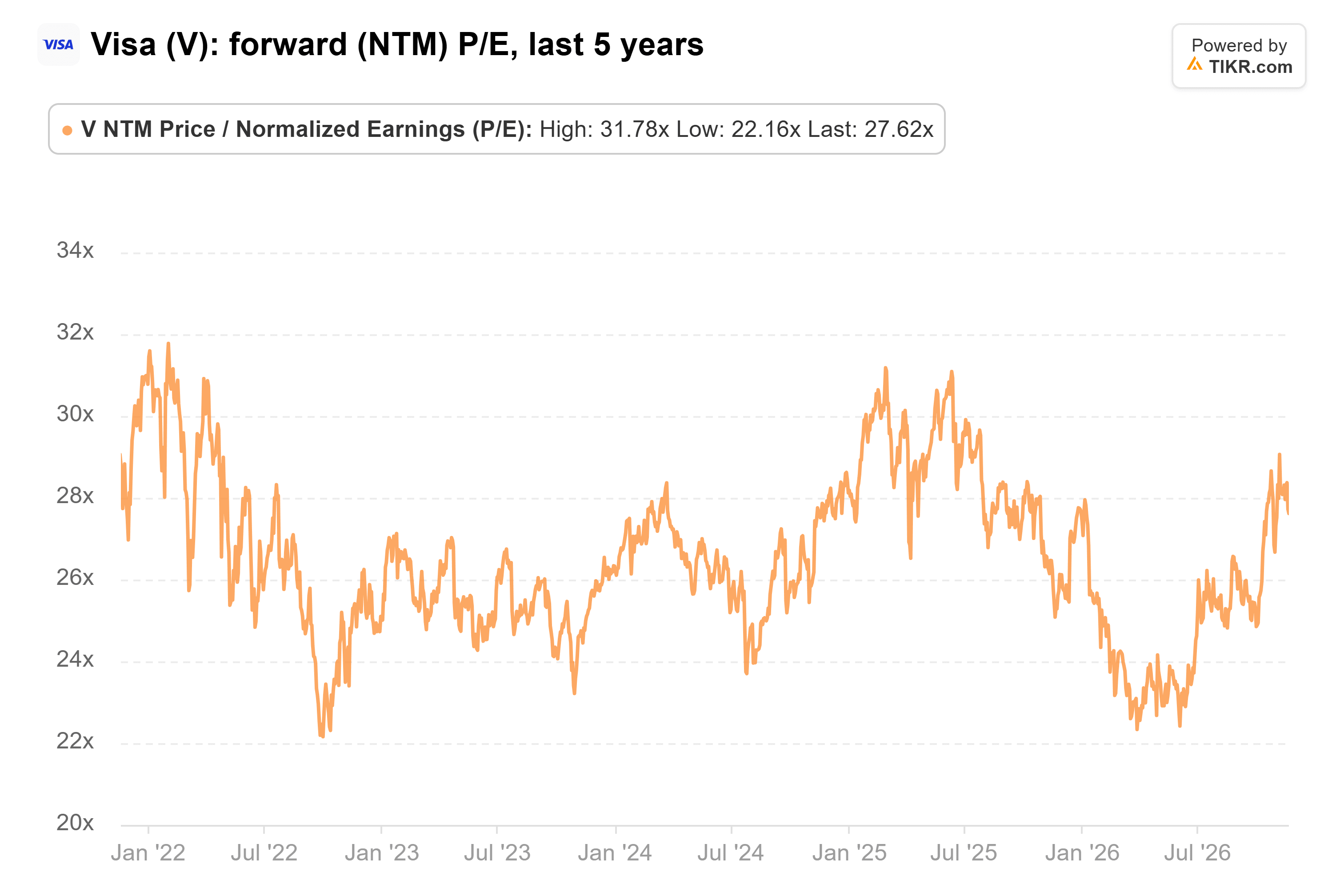
At the end of March, that multiple was about 23x.
Forty analysts cover Visa. Their average price target has climbed from $394 a year ago to $451, 9% above the last close:
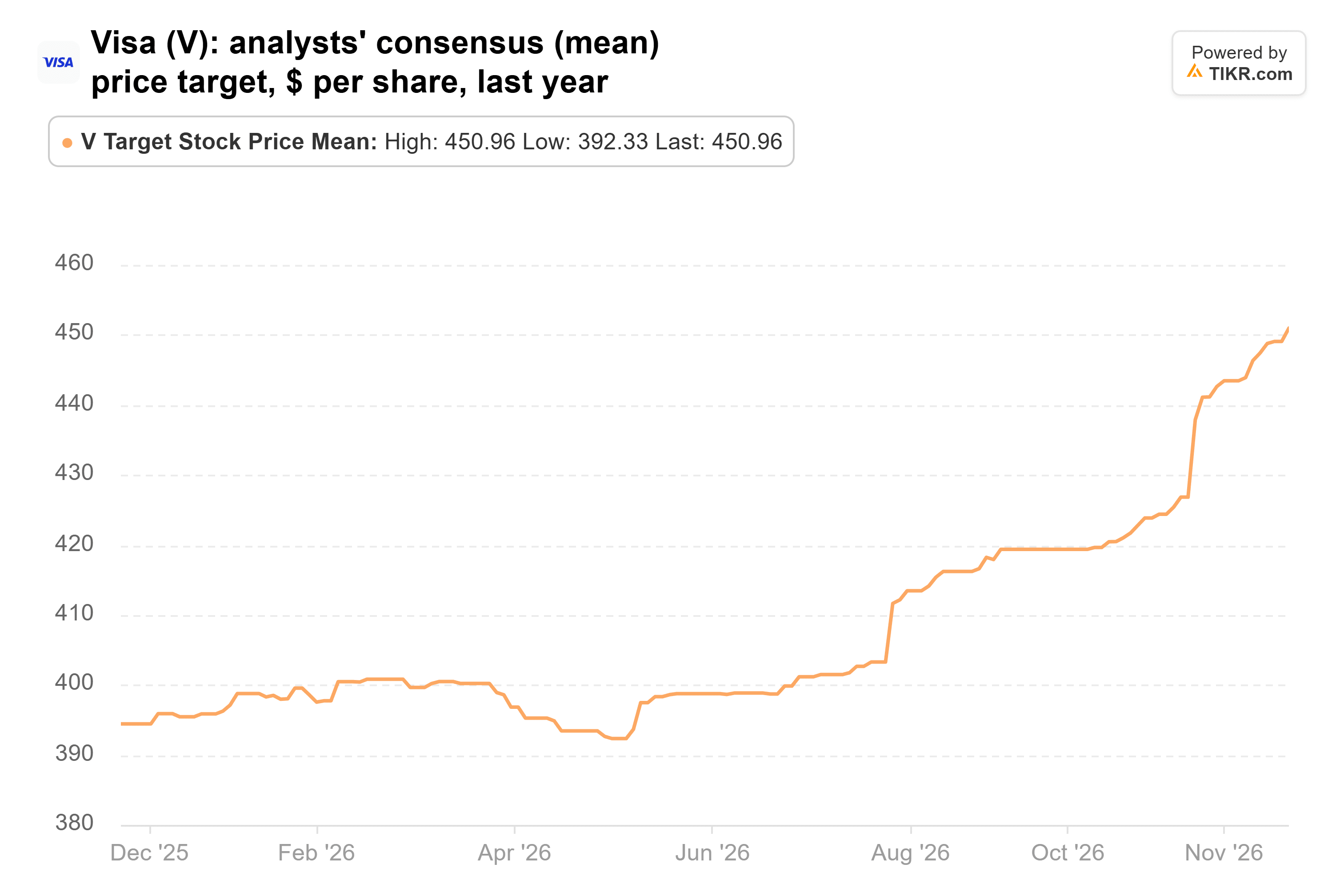
On fiscal 2028 estimates, $451 is about 26x earnings, just under Visa’s average multiple. So the Street’s target needs no re-rating, only for the estimates to hold.
The buyers have the better case
Visa’s biggest risk is the cost of keeping its bank clients. On Nov. 4, Freedom Broker cut Visa to Hold, pointing to rising client incentives and a record number of contract renewals. President Trump has also backed a routing bill that would let merchants send credit card sales over rival networks.
Still, I side with the buyers. Visa’s biggest seller kept it as its second-largest holding, and the stock trades close to its usual multiple. The Street’s target needs only the earnings analysts already expect. With the multiple back above its average, though, further gains have to come from earnings.
The next test comes early next year with Visa’s first report of fiscal 2027, a year with no World Cup. If Visa keeps EPS on track for the $15.03 consensus, the buyers look right. If analysts have to cut it, the sellers will look smart. The funds’ 13Fs for the December quarter, due by mid-February, will show who kept going.
So what is Visa stock actually worth?
TIKR lets you forecast the future price of any stock in less than a minute. Just enter a few assumptions into TIKR’s valuation model and see what Visa could be worth. Start from Wall Street consensus estimates, or adjust the inputs to reflect your own view of the business. It’s free to use.
Disclaimer:
Please note that the articles on TIKR are not intended to serve as investment or financial advice from TIKR or our content team, nor are they recommendations to buy or sell any stocks. We create our content based on TIKR Terminal’s investment data and analysts’ estimates. Our analysis might not include recent company news or important updates. TIKR has no position in any of the stocks mentioned. Thank you for reading, and happy investing!


