Key Takeaways
- Visa’s client incentives jumped 21% to $5.1 billion in its fiscal fourth quarter, and that weighed on the stock after the report.
- Analysts didn’t cut their numbers: the fiscal 2027 EPS consensus held at $15.02, and Cantor Fitzgerald raised its target to $500 from $445.
- Visa’s operating margin has stayed between 64.7% and 67.3% every year since fiscal 2017, even as incentives grew, and value-added services revenue grew 31% in the quarter.
- At 28.3x forward earnings, above its 26.6x five-year average, Visa already prices in much of that good news.
Visa (V) slipped after its fiscal fourth-quarter report on Oct. 27, closing 0.3% lower the next day. Investors fixated on the incentives it pays banks and other clients, which Visa deducts from gross revenue to arrive at net revenue.
Days later, Wall Street had moved on. Cantor Fitzgerald raised its price target to $500 from $445 on Nov. 2 and kept its Overweight rating. That followed raises on Oct. 29 from Wells Fargo, to $463 from $432, and Mizuho, to $440 from $425, with both keeping bullish ratings.
The stock has run right along with them. It rose 2.9% to a record close of $425.51 on Nov. 2, and its Nov. 3 close of $420.42 left it up 17% in the past month.
The incentives bill went up
Client incentives jumped 21% to $5.1 billion in the quarter, faster than the third quarter’s 18% pace. And about 25% of Visa’s payment volume comes up for renewal in fiscal 2027, including several large clients, against 20% in fiscal 2026.
CFO Chris Suh said that implies a step-up in incentive growth from fiscal 2026.
Everything else held up. Net revenue rose 13% to $12.1 billion, adjusted EPS rose 17% to $3.48, and management guided fiscal 2027 EPS growth to the low double digits to low teens.
Analysts kept their numbers
TIKR’s consensus estimates show analysts still expect Visa’s earnings to climb steadily through fiscal 2028:

Fiscal 2027’s $15.02 is where the consensus stood a few days before the report, and fiscal 2028’s has edged up to $17.13 from $17.04. (That $15.02 is 13% above fiscal 2026’s $13.27, which already puts it near the top of management’s range.)
TIKR tracks 40 analysts on Visa. How many say “Buy”?
See the full breakdown of Buy, Hold, and Sell ratings on Visa, along with Wall Street’s revenue and earnings estimates, all in one place. More than 500,000 investors use TIKR to research stocks like this one. See Visa’s Analyst Ratings
Services are carrying the growth
Bloomberg Intelligence global fintech and payments analyst Diksha Gera pointed to value-added services and Visa Direct on Bloomberg Intelligence’s podcast the day after the report. She said that “Visa is really building up new levers for earnings.”
Suh said on the call that value-added services revenue grew 31% in constant dollars to $4 billion in the quarter, and Visa Direct transactions grew 23%.
CEO Ryan McInerney said the client agreements heading into fiscal 2027 “are much broader, they are much deeper,” bundling more value-added services and Visa Direct in with card payments. That suggests the bigger incentive checks are buying bigger contracts.
And Visa has seen incentives outgrow revenue before without losing much profitability. Its operating margin has stayed in a tight band for a decade:
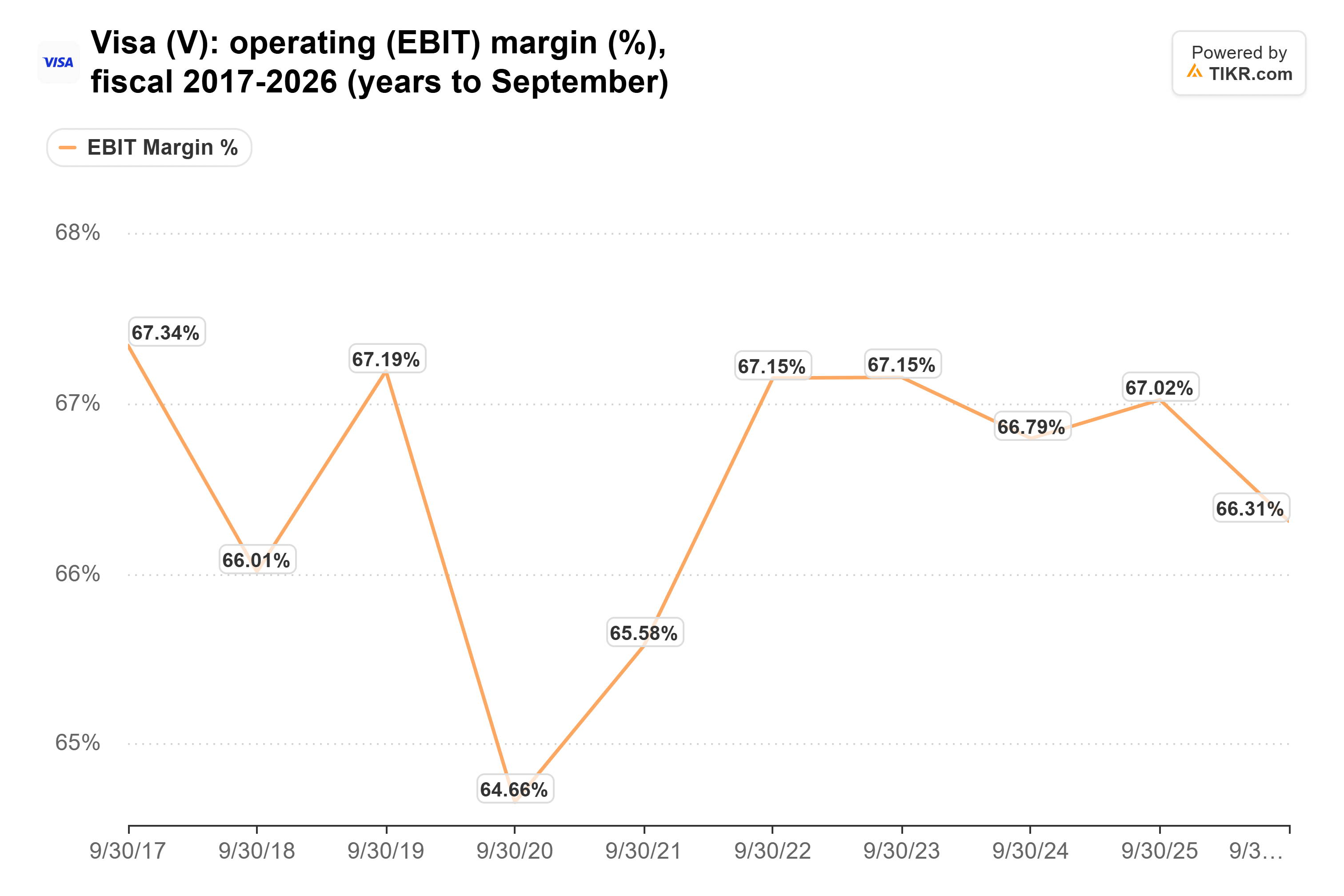
That held in fiscal 2025, too, when incentives grew 14% against 12% growth in gross revenue. The margin was 67.0% that year and 66.3% in fiscal 2026.
The risk is that marketing work tied to FIFA helped the quarter’s services growth, and management said the December quarter will lack that FIFA-related revenue.
The catch is the price
After the 17% month, Visa’s forward P/E sits well above its five-year average:

At 28.3x, it’s not far from its 31.8x peak of February 2022. At the end of March 2026, it was 22.8x.
A year from now, the next twelve months will line up almost exactly with Visa’s fiscal 2028. Cantor’s $500 works out to about 29x the $17.13 analysts expect for that year, which is above today’s multiple. At the 26.6x five-year average, the same earnings point to about $456, close to Wells Fargo’s $463.
Not every analyst is chasing the run. Freedom Broker cut Visa to Hold from Buy on Nov. 4, even as it lifted its target to $427 from $410.
Cantor is right that the incentives scare didn’t hurt the earnings path. But $500 needs investors to keep paying a premium multiple that Visa has held only in short stretches over the past five years, on estimates already near the top of guidance. After this run, much of that good news already looks priced in.
The fiscal first-quarter report, due early next year, is the first test. If incentive growth keeps outrunning the low-double-digit net revenue guide as those big renewals land, even today’s price could look full.
So what is Visa stock actually worth?
TIKR lets you forecast the future price of any stock in less than a minute. Just enter a few assumptions into TIKR’s valuation model and see what Visa could be worth. Start from Wall Street consensus estimates, or adjust the inputs to reflect your own view of the business. It’s free to use.
Disclaimer:
Please note that the articles on TIKR are not intended to serve as investment or financial advice from TIKR or our content team, nor are they recommendations to buy or sell any stocks. We create our content based on TIKR Terminal’s investment data and analysts’ estimates. Our analysis might not include recent company news or important updates. TIKR has no position in any of the stocks mentioned. Thank you for reading, and happy investing!