Key Takeaways
- Azora Capital, which manages $2.6 billion, sold all its Bank of America, State Street and Huntington Bancshares shares in the third quarter, its latest 13F shows.
- In the same quarter, it opened a new position in First Horizon, now its second-largest holding, and added 30% to its SLM stake.
- Analysts’ average targets sit 28% above Bank of America’s price, 26% above Huntington’s and 17% above State Street’s.
- Bank of America is the one I’d buy back. Its consensus target is higher than a year ago, and Huntington’s is lower.
Azora Capital is out of three bank stocks, and three months earlier one of them made up 10% of its 13F stocks. The fund’s 13F for the quarter ended Sept. 30, filed Nov. 16, shows no shares left of Bank of America (BAC), State Street (STT) or Huntington Bancshares (HBAN).
The buys were lenders too
At June 30, Azora held 4.18 million Bank of America shares worth $238 million, or 10.0% of its 13F stocks. Its State Street stake was 406,286 shares worth $69 million (2.9%), and its Huntington stake was 3.57 million shares worth $63 million (2.7%).
Its buys in the quarter were financials too. Azora opened a new position in First Horizon (FHN): 8.33 million shares worth $192 million at Sept. 30. That’s 7.3% of its 13F stocks and its second-largest holding. It also added 30% to its SLM (SLM) stake, which ended the quarter at 4.90 million shares worth $111 million, or 4.2% of its 13F stocks.
A 13F shows only what a fund held on the quarter’s last day. It doesn’t say when Azora sold or what it got for its shares.
TIKR tracks 25 analysts on Bank of America. How many say “Buy”?
See the full breakdown of Buy, Hold, and Sell ratings on Bank of America, along with Wall Street’s revenue and earnings estimates, all in one place. More than 500,000 investors use TIKR to research stocks like this one. See Bank of America’s Analyst Ratings
Bank of America still has the Street on its side
Bank of America is down 14% since Sept. 30 and is 25% below its 52-week high. Its third quarter was mixed. Net interest income rose 8% to $16.4 billion, but fixed-income trading revenue fell 17%. After a $1.2 billion penalty over its money-laundering controls, its return on tangible common equity was 12.6%, or 15% without the penalty. That’s down from 17.0% in the second quarter.
Management still guides net interest income up about 8% this year and 8% or more in 2027. Analysts cut their normalized EPS estimates for 2026 to 2028 by 1.4% to 2.4% after the report, which leaves $5.19 for 2027. At Sept. 30, the stock traded at 1.84x tangible book value, above its 10-year average of 1.59x. After the 14% drop since then, it’s much closer to that average.
The Street’s average target rose for most of the past year, from $58.98 to a $69 peak in September, and has slipped to $62.48 since:
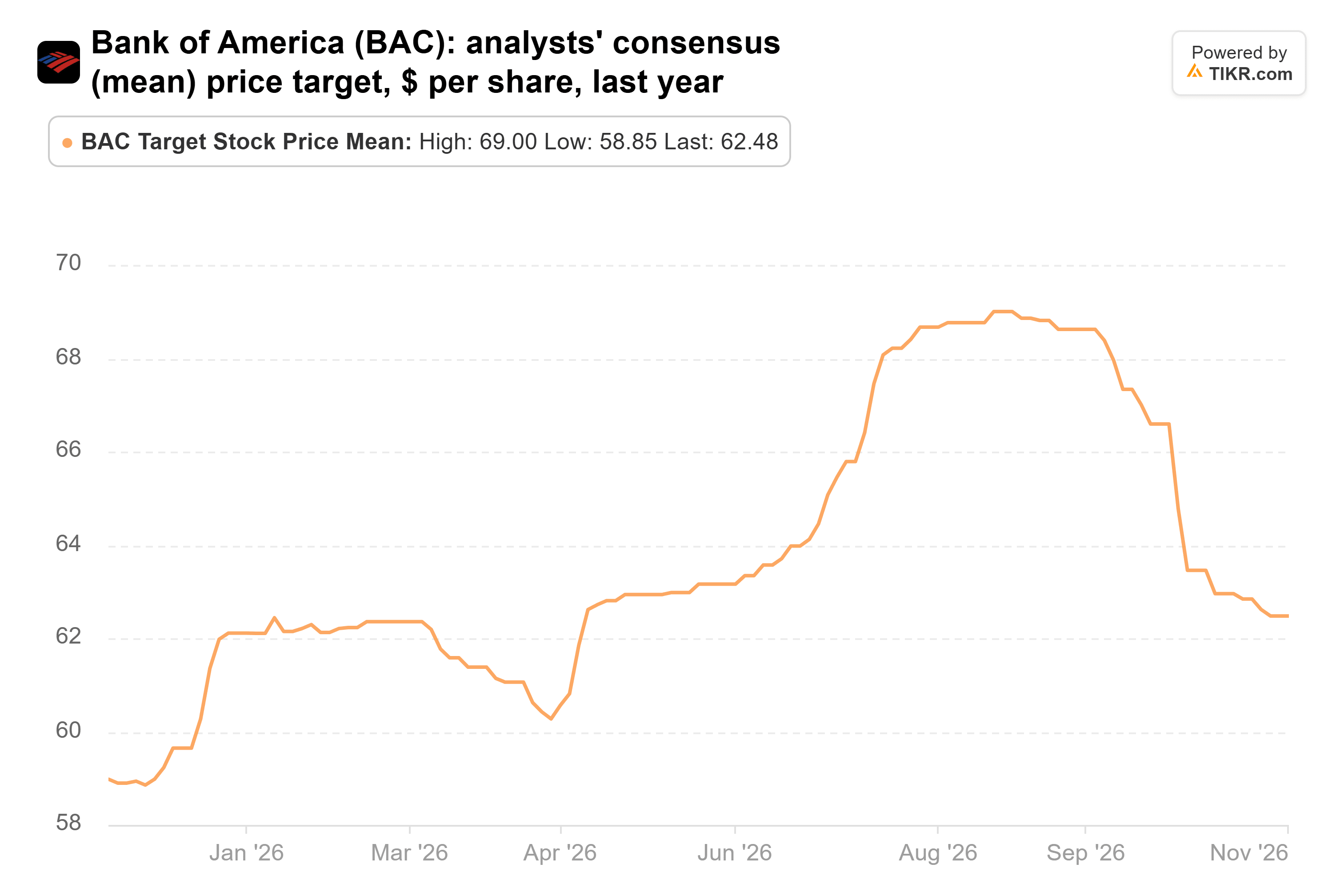
Even the lowest of the 25 analysts’ targets, $56, is above where the stock trades now.
State Street ran, and so did its targets
State Street has held up best of the three. It’s down 3% since Sept. 30, and its latest close of $165.15 is well above the $113.20 it traded at a year ago. Analysts have raised their targets along with it. The average target climbed from $130.03 a year earlier to a $199.54 peak in early October, and it was $192.63 at its latest reading:
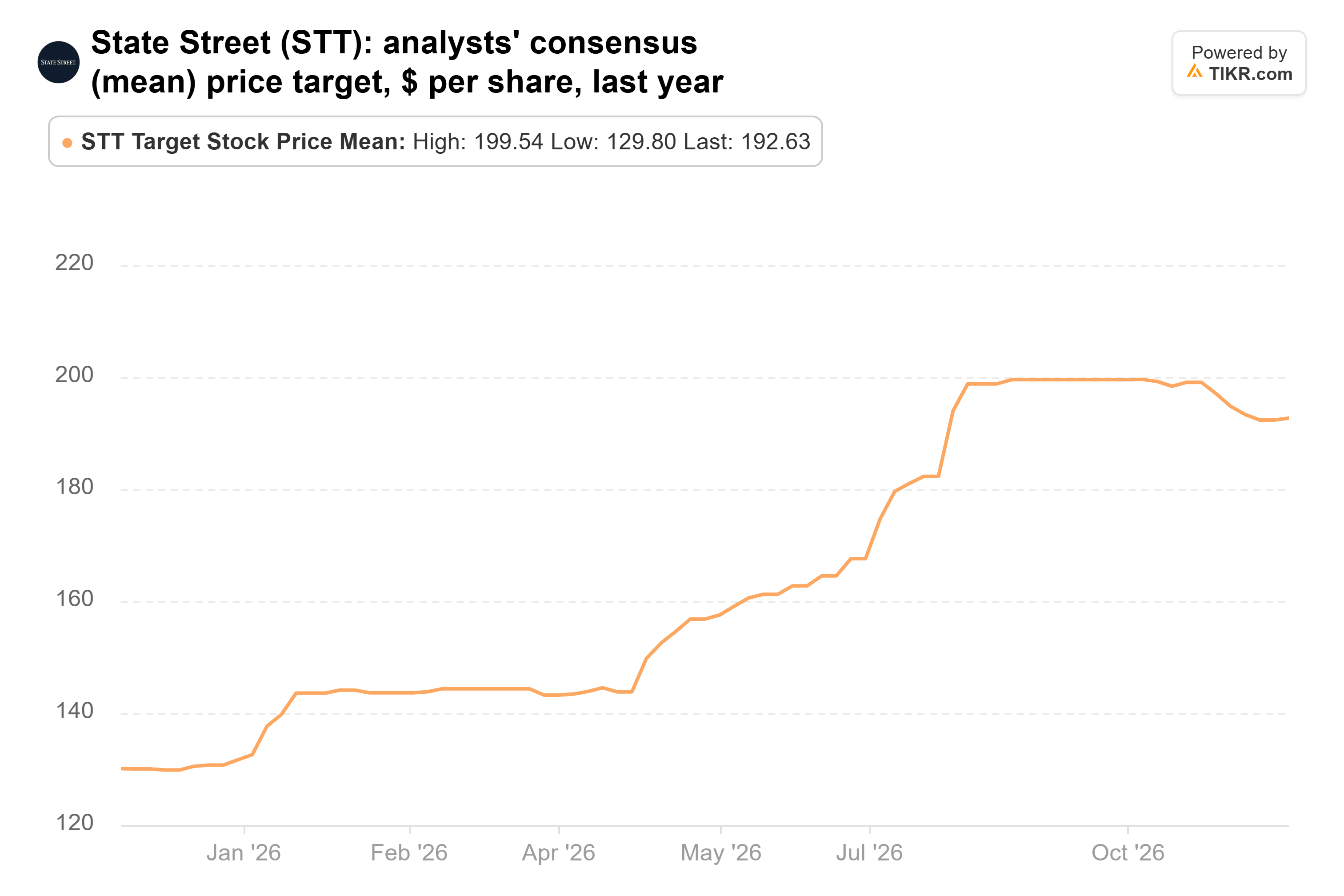
The lowest of the 17 analysts’ targets rose too, to $152 from $102. Still, the average target is only 17% above the price, the least upside of the three, and the stock trades at about 11x forward earnings. After that run, I think much of the good news is already in the price.
Huntington’s targets have slid since March
Huntington is down 16% since Sept. 30, and its latest close of $14.94 is its lowest of the past year. Analysts have cooled on it as well. The average target peaked at $20.69 in March and has slipped to $18.82, below the $19.70 of a year ago:
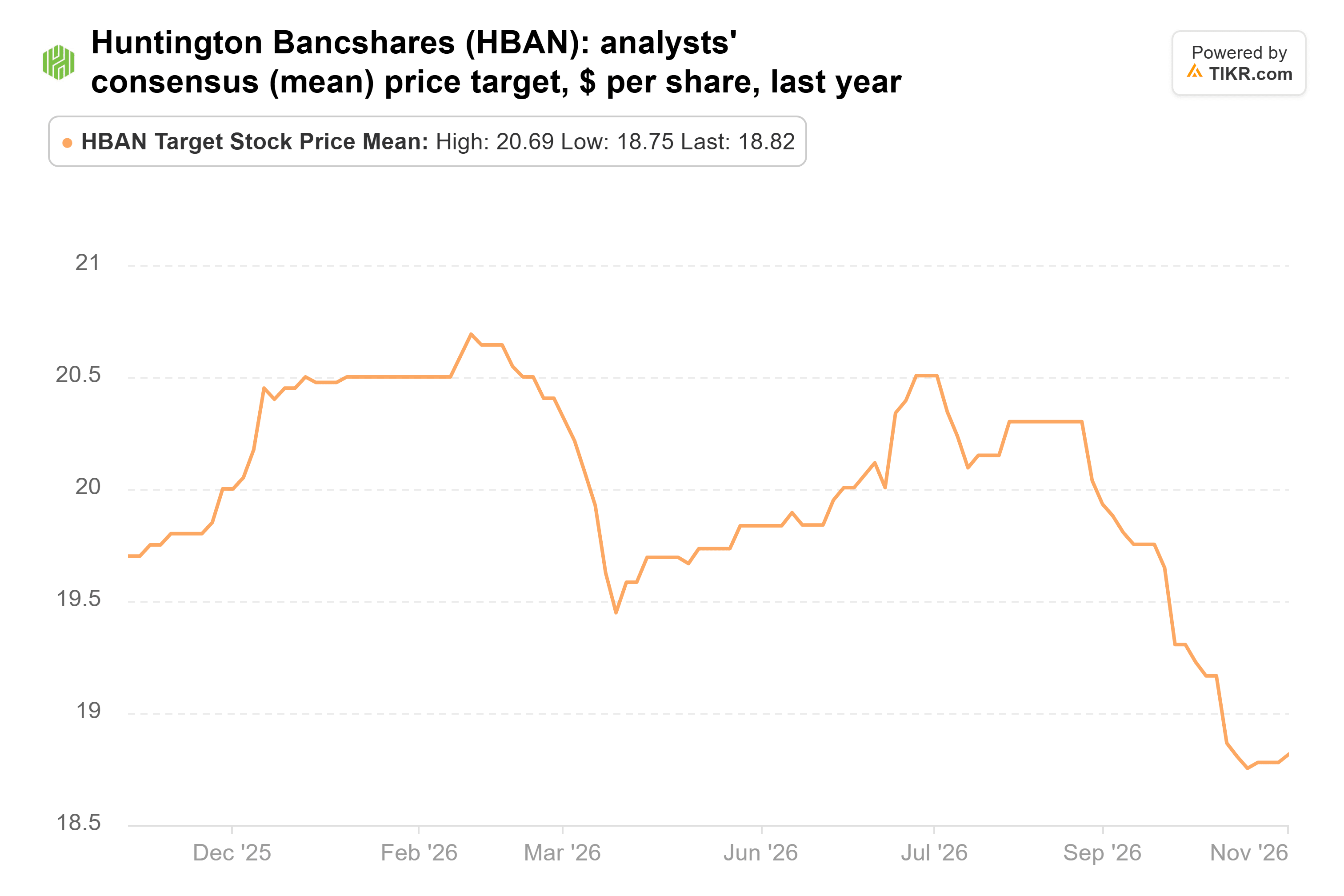
That still leaves 26% upside, but most of it comes from the price falling faster than the targets. Huntington trades at about 9x forward earnings and yields 4.2%, so it’s the cheapest of the three on earnings. Even so, I’d want the targets to stop falling before buying back in.
Bank of America is the one I’d buy back
Azora’s buys haven’t done better since the quarter ended. First Horizon is down 2% since Sept. 30, and SLM is down 31%. SLM’s average target is now $24.78, down from $34.73 a year ago.
If I could buy back only one of the three, it’d be Bank of America. Its consensus target is higher than a year ago, and every analyst’s target is above the price. Its multiple is much closer to its 10-year average, and management still guides net interest income up 8% or more next year.
The risk is capital. Its CET1 ratio was 10.9% at Sept. 30, and its minimum rises to 10.5% on Jan. 1. Add management’s own 50-basis-point cushion, and it’s aiming for 11.0%. That could slow its $6 billion a quarter of buybacks.
Fourth-quarter results in mid-January come with 2027 guidance. A net interest income guide of 8% or more and fourth-quarter buybacks of $6 billion or more would confirm the case. Azora’s next 13F is due in mid-February.
So what is Bank of America stock actually worth?
TIKR lets you forecast the future price of any stock in less than a minute. Just enter a few assumptions into TIKR’s valuation model and see what Bank of America could be worth. Start from Wall Street consensus estimates, or adjust the inputs to reflect your own view of the business. It’s free to use.
Value Bank of America for free
Disclaimer:
Please note that the articles on TIKR are not intended to serve as investment or financial advice from TIKR or our content team, nor are they recommendations to buy or sell any stocks. We create our content based on TIKR Terminal’s investment data and analysts’ estimates. Our analysis might not include recent company news or important updates. TIKR has no position in any of the stocks mentioned. Thank you for reading, and happy investing!