Key Takeaways
- TotalEnergies yields 4.4% and Hershey yields 3.4%, and each pays out just over half its free cash flow as dividends.
- Hershey grew its dividend 11.7% a year from fiscal 2020 to fiscal 2025, against 4.9% for TotalEnergies, but it didn’t raise its dividend per share in fiscal 2025.
- TotalEnergies’ free cash flow swings with oil and gas prices, while Hershey’s dividend has been taking a growing share of steadier cash.
- TotalEnergies raised its cash flow outlook in October and said it may raise its final dividend for 2026.
TotalEnergies (TTE) raised its outlook on Oct. 29 and said it may raise its final dividend to keep its commitment to return 40% of cash flow to shareholders.
Hershey (HSY) reported the same day and narrowed its full-year organic sales growth outlook to about 3%, “even as consumers grow more cautious,” in the words of CEO Kirk Tanner.
So which is the better dividend stock: a 4.4% yield from an oil major, or a 3.4% yield from a candy maker with a much faster record of raises?
| Metric | TotalEnergies (TTE) | Hershey (HSY) |
|---|---|---|
| Dividend yield | 4.4% | 3.4% |
| Dividend growth, fiscal 2020-2025 | 4.9% a year | 11.7% a year |
| Dividend growth, fiscal 2015-2025 | 3.8% a year | 9.4% a year |
| Cash dividend payout ratio (TTM) | 51% | 53% |
| Net debt/EBITDA (LTM) | 0.52x | 1.48x |
| Interest coverage (LTM) | 10.2x | 11.7x |
6 safe dividend stocks paying retirees 6%+ yields
There are over 100 stocks paying 6%+ annual dividends today.
But after an extensive investment review leveraging TIKR’s proprietary data, we now believe only six of them are truly safe for retirees.
They’re all yours as part of our new investment report. Learn more about how to get access right here.
TotalEnergies’ check has room to spare
TotalEnergies’ third-quarter 2026 adjusted net income was $9.1 billion, up more than 50% from the second quarter. Chairman and CEO Patrick Pouyanné was blunt about what drives the company: “Our strategy is fundamentally oil and gas upstream.”
That ties its free cash flow to oil and gas prices, so it swings. It went from negative $1.59 billion in fiscal 2016 to $33.7 billion in fiscal 2022, then back to $11.6 billion in fiscal 2025. The dividend kept coming even in fiscal 2016 and fiscal 2020, when free cash flow didn’t cover it:
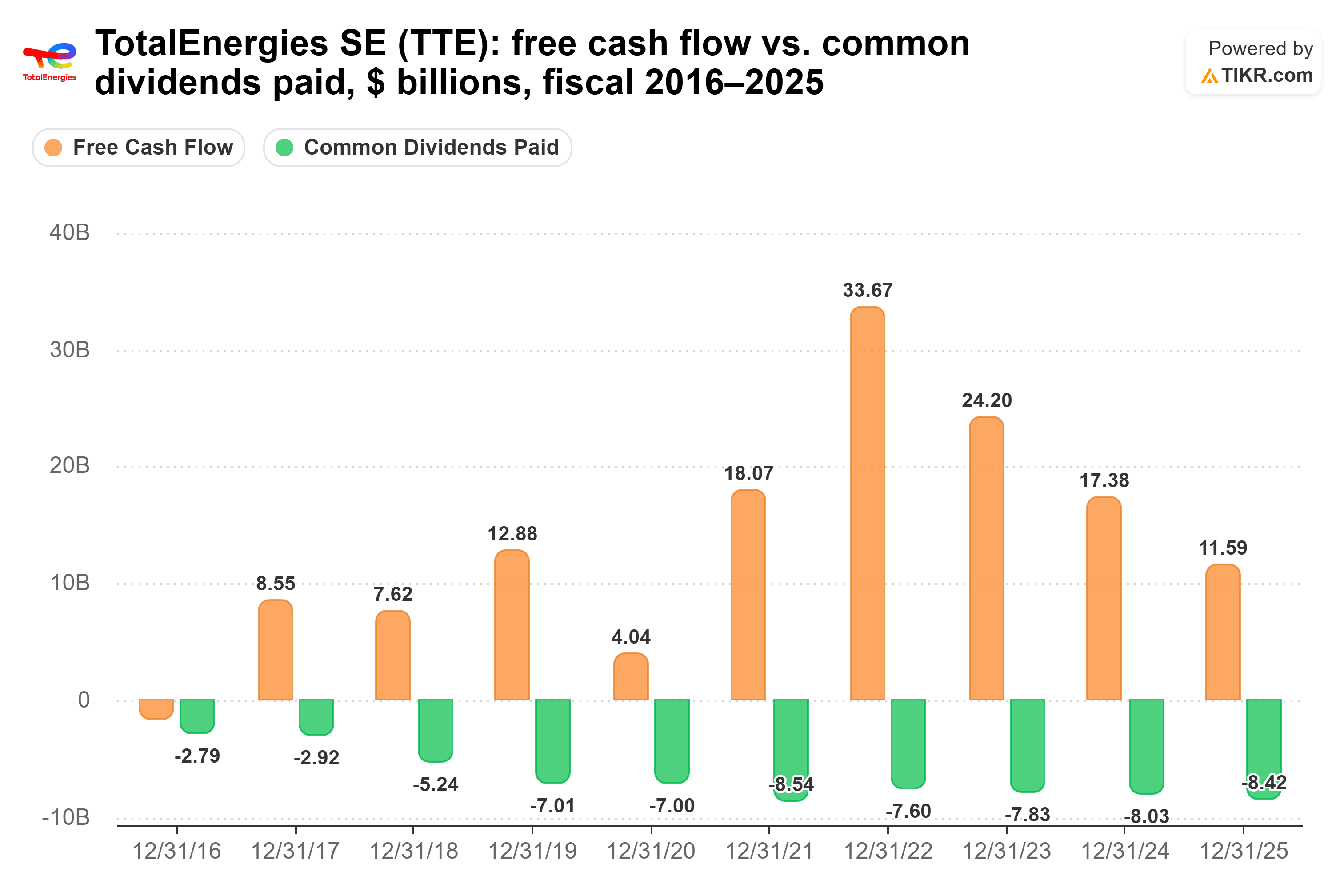
Over the twelve months to June 30, 2026, the dividend took a well-covered 51% of free cash flow, against a much thinner 72.7% in fiscal 2025. And the 40% commitment covers buybacks too: of the $3.7 billion TotalEnergies returned in the third quarter, $1.5 billion went to buybacks, which can give before the dividend does.
The dividend is set in euros, so the dollar amount a US holder collects moves with the exchange rate, and France withholds tax on it. The main risk is the Middle East: the conflict there hit around 5% of TotalEnergies’ output in the third quarter.
Hershey’s raises have hit pause
Where TotalEnergies’ dividend has grown slowly on a lumpy business, Hershey’s grew fast on a steady one: 11.7% a year from fiscal 2020 to fiscal 2025. But it didn’t rise in fiscal 2025, and its growth has outpaced the cash behind it. From fiscal 2021 to fiscal 2025, dividends paid went from $0.69 billion to $1.09 billion, while free cash flow went from $1.59 billion to $1.82 billion:
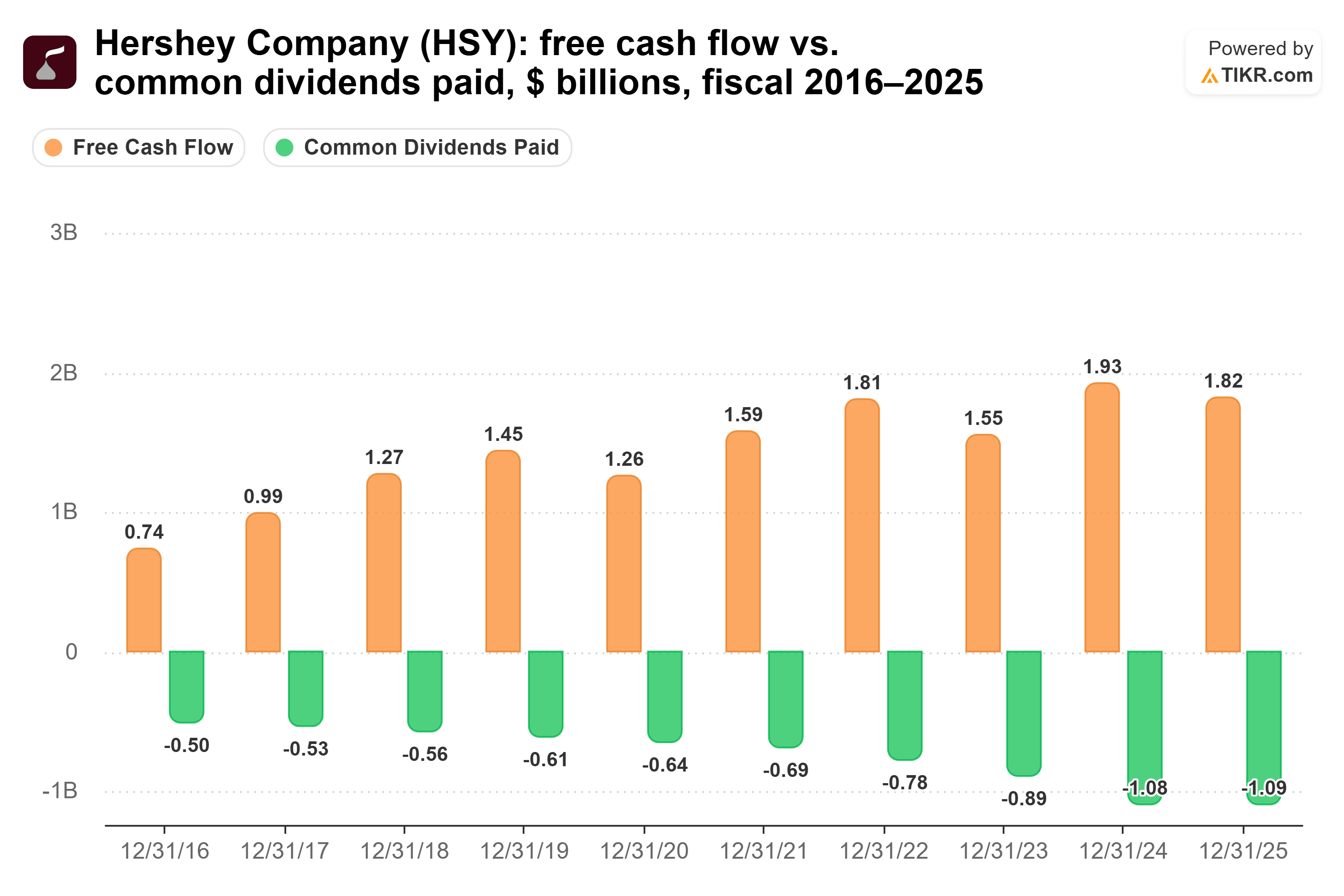
That pushed its cash dividend payout ratio from 43.2% in fiscal 2021 to 59.5% in fiscal 2025. Over the twelve months to Sept. 27, 2026, it eased to a still-comfortable 53%.
The main risk is the shopper. Third-quarter 2026 net sales grew just 0.8% organically, and Hershey says consumers are pulling back amid higher gas prices and inflation, while its higher prices are costing it volume.
So which dividend wins?
TotalEnergies is the better dividend stock. It pays the bigger check, covers it about as well as Hershey covers its own, and carries far less debt.
Hershey’s case is growth. $10,000 in Hershey pays $340 a year now, and at its 11.7% five-year pace, about $921 in year 10. The same $10,000 in TotalEnergies pays $440 now and, at its 4.9% pace, about $674 in year 10. At those rates, Hershey’s income would pass TotalEnergies’ around 2031, but those raises paused in fiscal 2025, and at the pace each dividend grew that year, Hershey’s income never catches up: about $676 from TotalEnergies in year 10, against about $340 from Hershey.
You don’t pay up for TotalEnergies’ bigger check, either. Its forward P/E of 8.9x sits above its five-year average of 7.3x, but it’s less than half Hershey’s 19x:
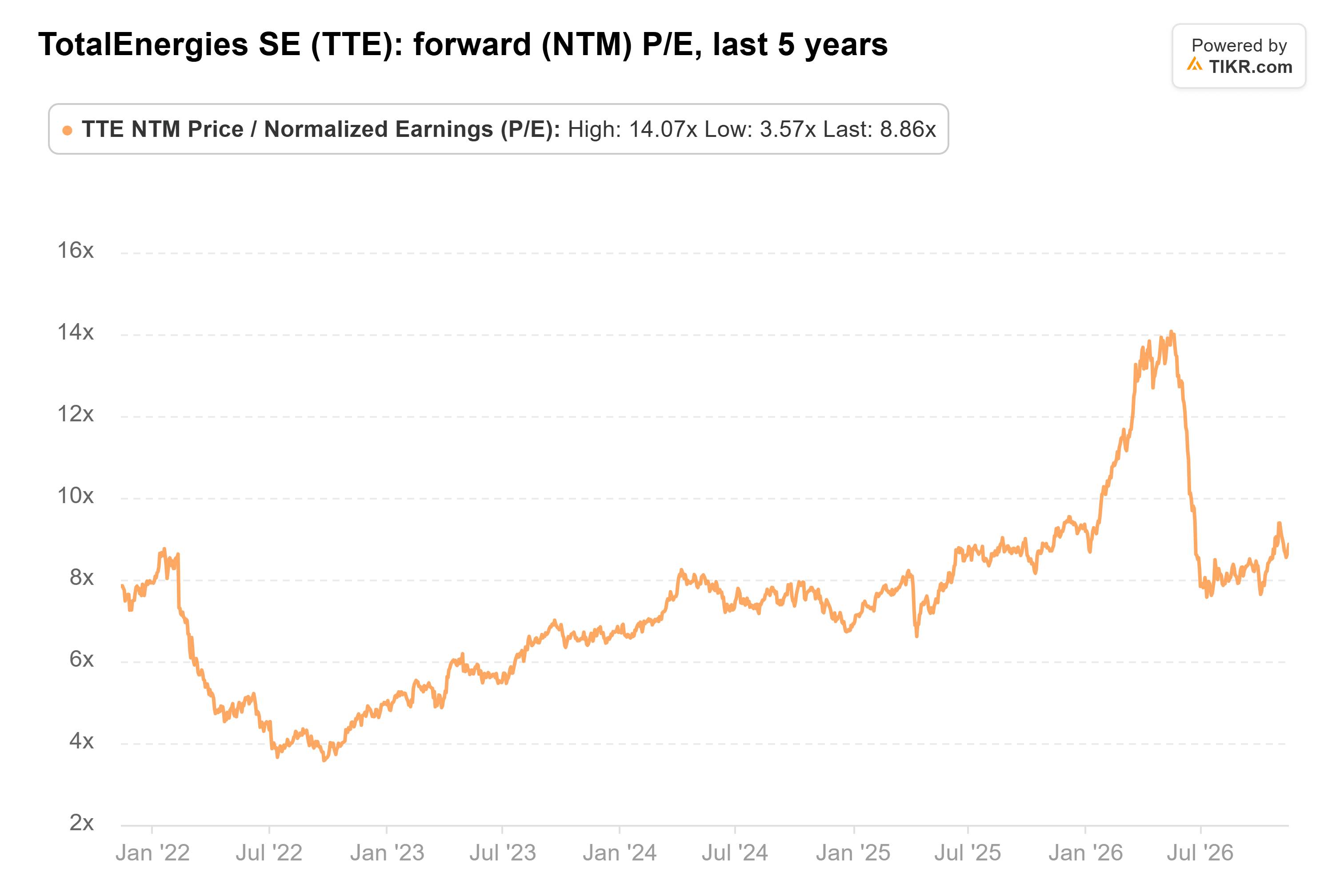
That isn’t to say Hershey’s dividend is at risk. Its free cash flow is far steadier than an oil company’s, it still covers its dividend comfortably, and management sees cocoa costs falling in 2027. It’s just that TotalEnergies pays more today, from a stronger balance sheet, at a lower price.
Of course, TotalEnergies’ cash flow will follow oil and gas prices wherever they go. The next thing to watch is its final dividend for 2026, which the company has said it may raise if cash flow reaches the top of its outlook.
Forget TotalEnergies: 6 safe 6%+ dividend yields you can buy right now
Dividends can hold the key to enormous wealth. But only if you buy the right ones.
Picking the right high-yield dividend stock can be the difference between a dream retirement…and scraping by every month, waiting for the next Social Security check to clear.
We’ve identified six stocks yielding 6%+ that we believe every retiree should know about right now. (And TotalEnergies isn’t one of them.)
Disclaimer:
Please note that the articles on TIKR are not intended to serve as investment or financial advice from TIKR or our content team, nor are they recommendations to buy or sell any stocks. We create our content based on TIKR Terminal’s investment data and analysts’ estimates. Our analysis might not include recent company news or important updates. TIKR has no position in any of the stocks mentioned. Thank you for reading, and happy investing!