Key Takeaways
- Plains All American Pipeline yields 6.8% and Bristol Myers Squibb yields 4.1%, and Plains raised its payout 16.7% a year from fiscal 2020 to fiscal 2025, against Bristol’s 6.2%.
- Plains’ fast growth came after a cut to its distribution, and the company now targets a $0.15 per unit raise each year.
- Bristol’s dividend took 55% of its free cash flow over the past year, and Plains covered its distribution 1.7x with distributable cash flow in fiscal 2025.
- Plains carries about twice Bristol’s debt relative to EBITDA, and its 2027 guidance in February is the next thing to watch.
Plains All American Pipeline (PAA) paid unitholders $0.4175 a unit on Nov. 13, 10% more than for the same quarter a year earlier. At today’s price, that’s a 6.8% yield.
Bristol Myers Squibb (BMY) pays less, at 4.1%, though it has had good news of its own. On Oct. 29, it raised its 2026 revenue outlook to as much as $50.25 billion on demand for its newer drugs. So if you put $10,000 into one of them today, which pays you more over the next 10 years?
| Metric | Bristol Myers Squibb (BMY) | Plains All American (PAA) |
|---|---|---|
| Dividend yield | 4.1% | 6.8% |
| Annual dividend | $2.52 a share | $1.67 a unit |
| Dividend growth, fiscal 2020-2025 | 6.2% a year | 16.7% a year |
| Coverage, on its own measure | 55% cash dividend payout ratio (TTM to Sept. 30, 2026) | 1.7x distributable cash flow coverage (fiscal 2025) |
| Net debt / EBITDA (LTM) | 1.7x | 3.4x |
| Interest coverage (LTM) | 9.9x | 2.8x |
6 safe dividend stocks paying retirees 6%+ yields
There are over 100 stocks paying 6%+ annual dividends today.
But after an extensive investment review leveraging TIKR’s proprietary data, we now believe only six of them are truly safe for retirees.
They’re all yours as part of our new investment report. Learn more about how to get access right here.
Bristol’s dividend is safe, and its raises are slowing
Free cash flow has covered Bristol’s dividends paid every year since fiscal 2017, climbing from $1.84 billion in fiscal 2016 to $12.9 billion in fiscal 2025:
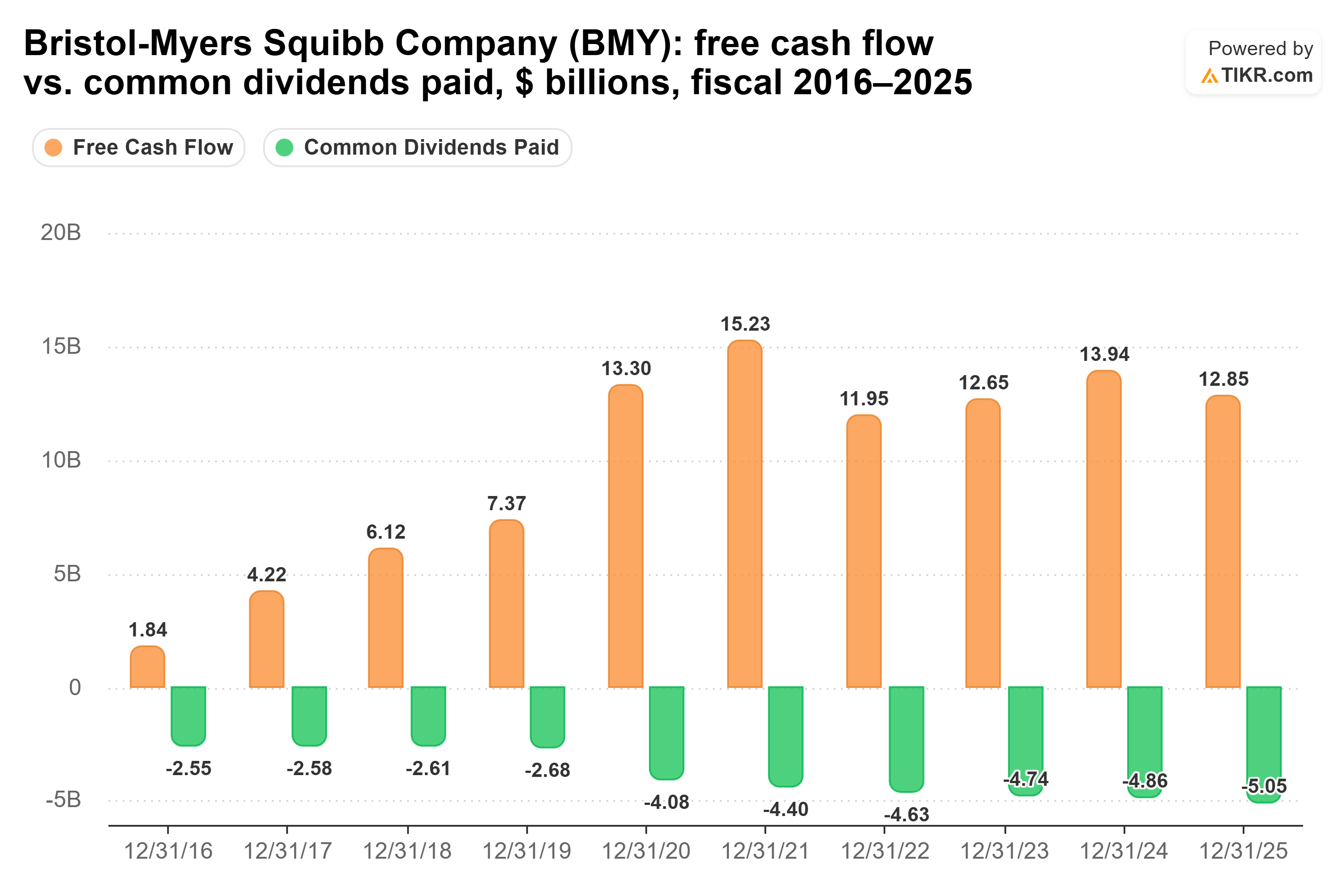
Over the twelve months to Sept. 30, 2026, dividends took 55% of free cash flow, up from 39.3% in fiscal 2025. That’s still well-covered.
The business is in a handoff. Bristol’s Growth Portfolio grew 12% to $7.7 billion in the third quarter of 2026 from a year earlier, while generic competition cut Revlimid’s sales 47%. And Bristol expects Eliquis revenue to step down $1.5 billion to $2 billion in 2027.
The dividend’s growth has slowed too. It rose 2.9% in fiscal 2025, against 6.2% a year from fiscal 2020 to fiscal 2025.
At 6.2% a year, $10,000 in Bristol pays $410 now and about $707 in year 10, or about $5,465 over the 10 years. At fiscal 2025’s 2.9% pace, the 10-year total is about $4,677.
Plains pays more, and carries more debt
Plains starts from a much bigger check than Bristol’s, with a rougher record behind it. It’s a partnership, so it pays distributions on units, with a K-1 at tax time. Its distribution fell from $2.78 a unit in fiscal 2015 to $0.72 in fiscal 2020 before climbing back to $1.56 in fiscal 2025.
Like other pipelines, Plains is judged on distributable cash flow, which has run ahead of the distribution every year since fiscal 2016:
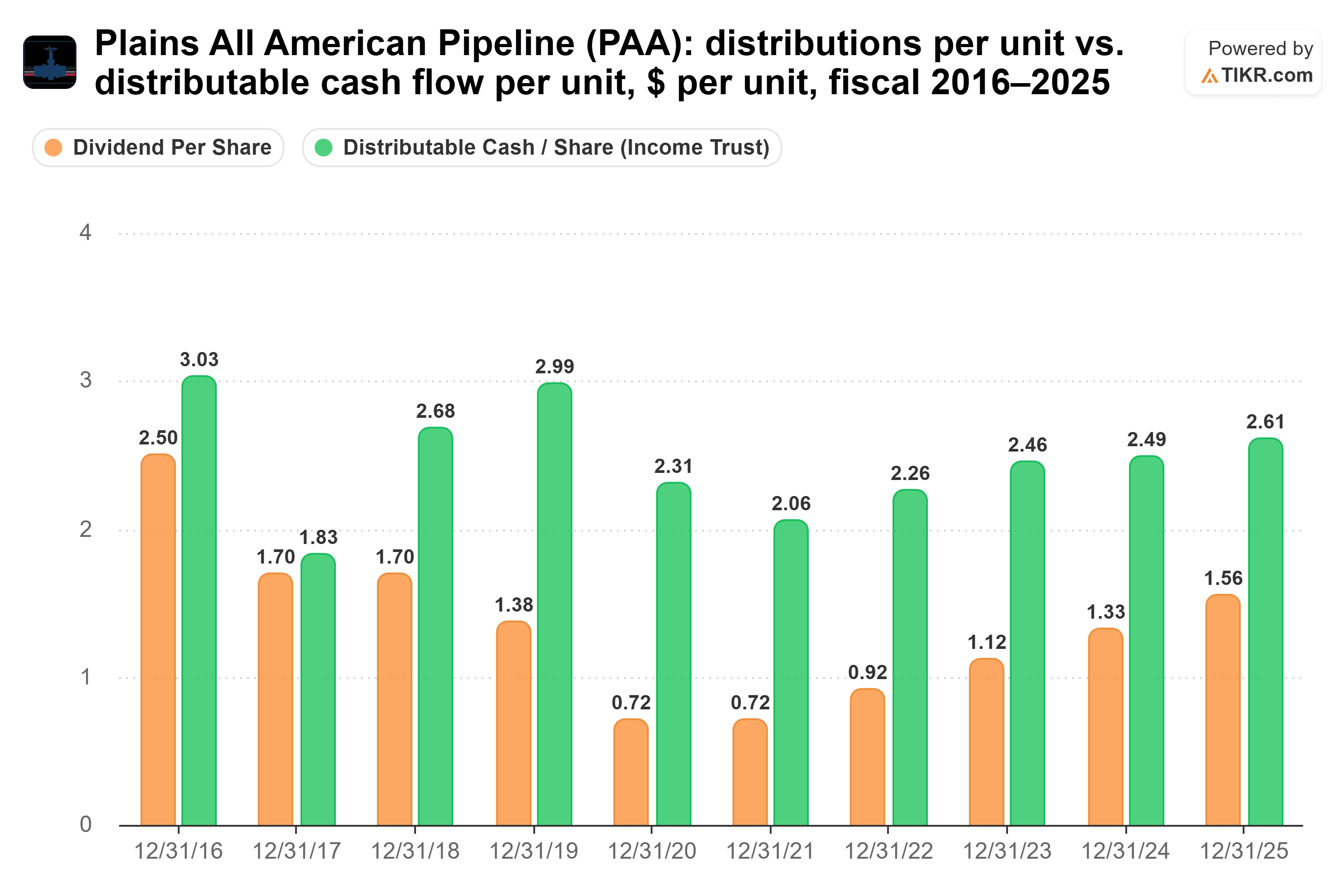
Coverage narrowed from 3.2x in fiscal 2020 to a still-comfortable 1.7x in fiscal 2025.
Plains sold its Canadian NGL business to Keyera in May 2026. CEO Willie Chiang said on the November call that this leaves its crude oil business with “a more durable and predictable cash flow stream.” Adjusted EBITDA rose 6% to $711 million in the third quarter from a year earlier, and Plains is on track for its 2026 guidance of $2.88 billion, plus or minus $50 million.
Debt is the weak spot. Net debt is 3.4x EBITDA, against Bristol’s 1.7x, and EBIT covers interest 2.8x, against 9.9x.
At 16.7% a year, $10,000 in Plains pays $683 now and about $2,747 in year 10, for about $15,088 over the 10 years.
So which dividend wins?
Plains All American pays you more over 10 years, and it isn’t close: nearly three times as much at each one’s 5-year rate.
That 16.7% won’t last, since it’s the climb back from a cut. Plains said on its August call that it aims to “return cash to unitholders through our targeted $0.15 per unit annual increases.” That’s about 9% on today’s $1.67, and a smaller step each year after. But Plains doesn’t need the raises to win. With no raise at all, $10,000 pays $683 a year, or $6,830 over 10 years, which is more than Bristol pays even at 6.2%. And 1.7x coverage leaves room for the $0.15 steps.
Bristol’s check is still a good one. It’s well-covered and carries about half Plains’ leverage, and its dividend grew from $1.49 a share in fiscal 2015 to $2.49 in fiscal 2025, a decade in which Plains’ fell. It’s just that over 10 years, Plains’ head start is too big for Bristol’s raises to close.
Of course, Plains is counting on Permian growth, which it expects near 200,000 barrels a day for 2026, and it gives its 2027 guidance on its February call. If that growth stalls while the $0.15 raises keep coming, coverage will keep shrinking.
Enjoy your retirement in style with these safe 6%+ dividend yields
Dividends can hold the key to enormous wealth. But only if you buy the right ones.
Picking the right high-yield dividend stock can be the difference between a dream retirement…and scraping by every month, waiting for the next Social Security check to clear.
We’ve identified six stocks yielding 6%+ that we believe every retiree should know about right now.
Disclaimer:
Please note that the articles on TIKR are not intended to serve as investment or financial advice from TIKR or our content team, nor are they recommendations to buy or sell any stocks. We create our content based on TIKR Terminal’s investment data and analysts’ estimates. Our analysis might not include recent company news or important updates. TIKR has no position in any of the stocks mentioned. Thank you for reading, and happy investing!