


Key Takeaways
- Vertiv rose 4.2% to $212 after an Nvidia partnership promised to bring AI capacity online about 10 weeks sooner.
- The modeled workflow cuts deployment from 90 days to 45 and supports up to 30% more first-year token output.
- Shares remain 44% below their $380 high after a Q2 revenue miss and a $1.45 billion acquisition that unsettled investors.
- The October 28 Q3 report will test backlog conversion against full-year guidance of about $14 billion in sales.
Speed has become the scarcest resource in the AI build-out. Vertiv (VRT) wants to sell it.
The power and cooling specialist rose 4.2% to $212 on October 21 after unveiling an AI factory deployment approach with Nvidia (NVDA). The pitch is simple: get GPUs producing tokens weeks earlier than a conventional build allows.
The bounce came after a rough stretch. Shares have fallen 30.3% over three months and still trade 44% below their 52-week high of $380.
Vertiv reports Q3 results on October 28, so investors get hard numbers within a week.
Ten weeks faster to first token
The new approach combines Nvidia’s Vera Rubin DSX reference design and Omniverse DSX Blueprint with Vertiv’s SimReady power and cooling assets and the 3DEXPERIENCE platform from Dassault Systèmes (DSY).
The modeled gains are meaningful:
- Configuration and validation drop from about 30 days to three.
- Deployment falls from 90 days to 45.
- Capacity comes online roughly 10 weeks earlier, supporting up to 30% more cumulative token output in the first 12 months.
Polar Data Centers is already applying the model to the first 41 MW phase of its Herøya, Norway campus, which can scale to 100 MW.
Here is what demand has meant for the top line.
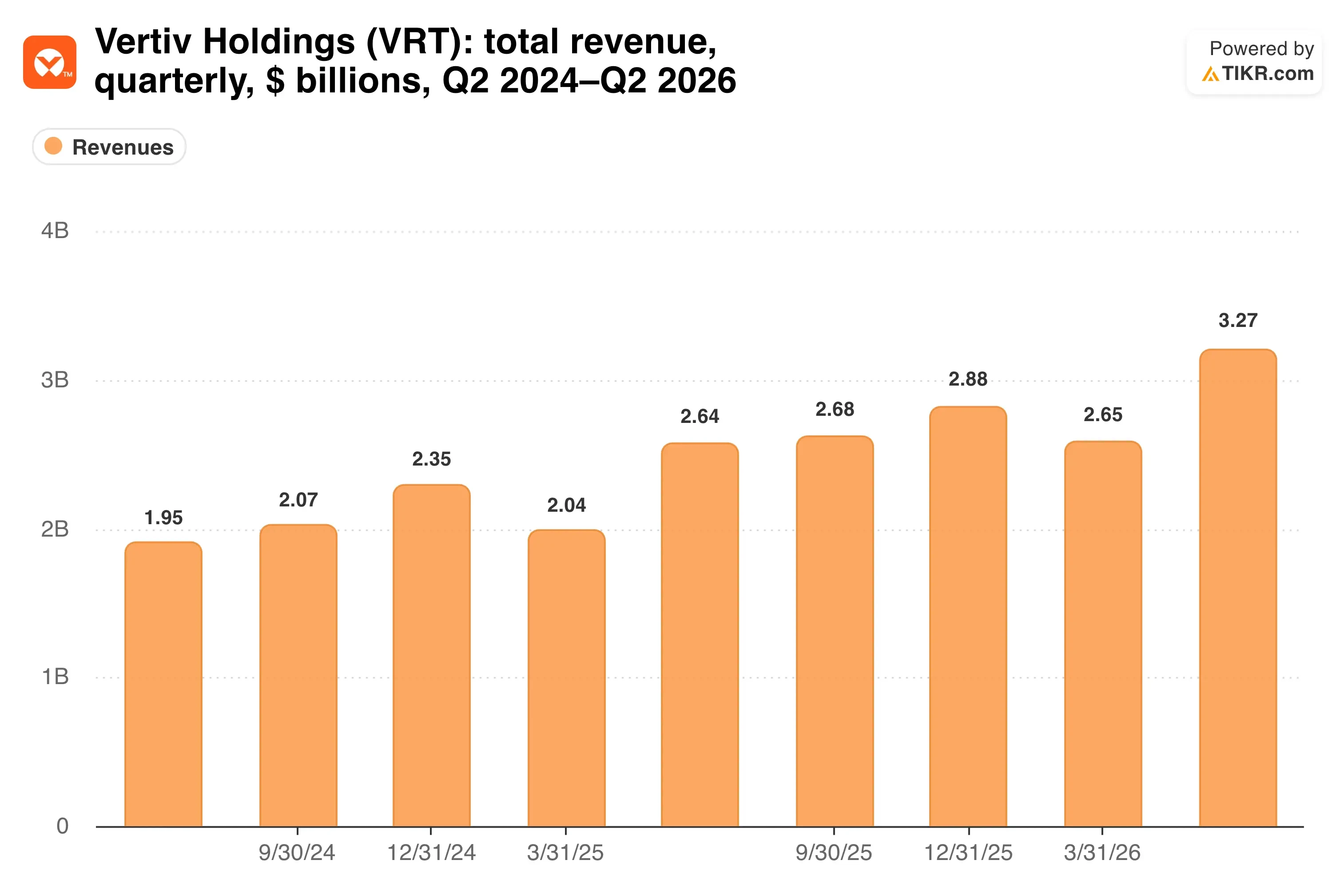
Q2 sales still grew 24% to $3.27 billion. That missed the $3.38 billion consensus, however, and the miss helped start the slide.
Moving upstream to the grid
The Nvidia deal fits a broader push to own more of each project. In September, Vertiv agreed to buy UtilityInnovation Group for $1.45 billion in cash, plus up to $1.15 billion tied to EBITDA targets.
UIG adds microgrid controls, onsite generation and storage orchestration, and behind-the-meter power design. CEO Gio Albertazzi said the deal would create a coordinated architecture “from source to chip.” Shares fell on the announcement anyway.
The price works out to about 13x UIG’s expected 2027 EBITDA. That sits below Vertiv’s own 19.8x forward EV/EBITDA, and management expects the deal to add to adjusted EPS in year one.
Earnings power is where this strategy should show up…

Adjusted EPS jumped 60% to $1.52 in Q2, far outpacing sales growth. Full-year guidance calls for $6.65 to $6.75.
TIKR tracks 30 analysts on Vertiv. How many say “Buy”?
See the full breakdown of Buy, Hold, and Sell ratings on Vertiv, along with Wall Street’s revenue and earnings estimates, all in one place. More than 500,000 investors use TIKR to research stocks like this one. See Vertiv’s Analyst Ratings
Backlog conversion now sets the multiple
The roughly $14 billion sales guide implies 31% organic growth for 2026, so the second half has to carry a heavy load. Large AI projects are lumpy, and Q2 showed how quickly timing can slip.
Vertiv also grows more slowly than the chips it supports. Nvidia’s fiscal Q4 revenue rose 73% to $68.1 billion, while Vertiv grew 24% in Q2.
How much are investors paying for that growth?
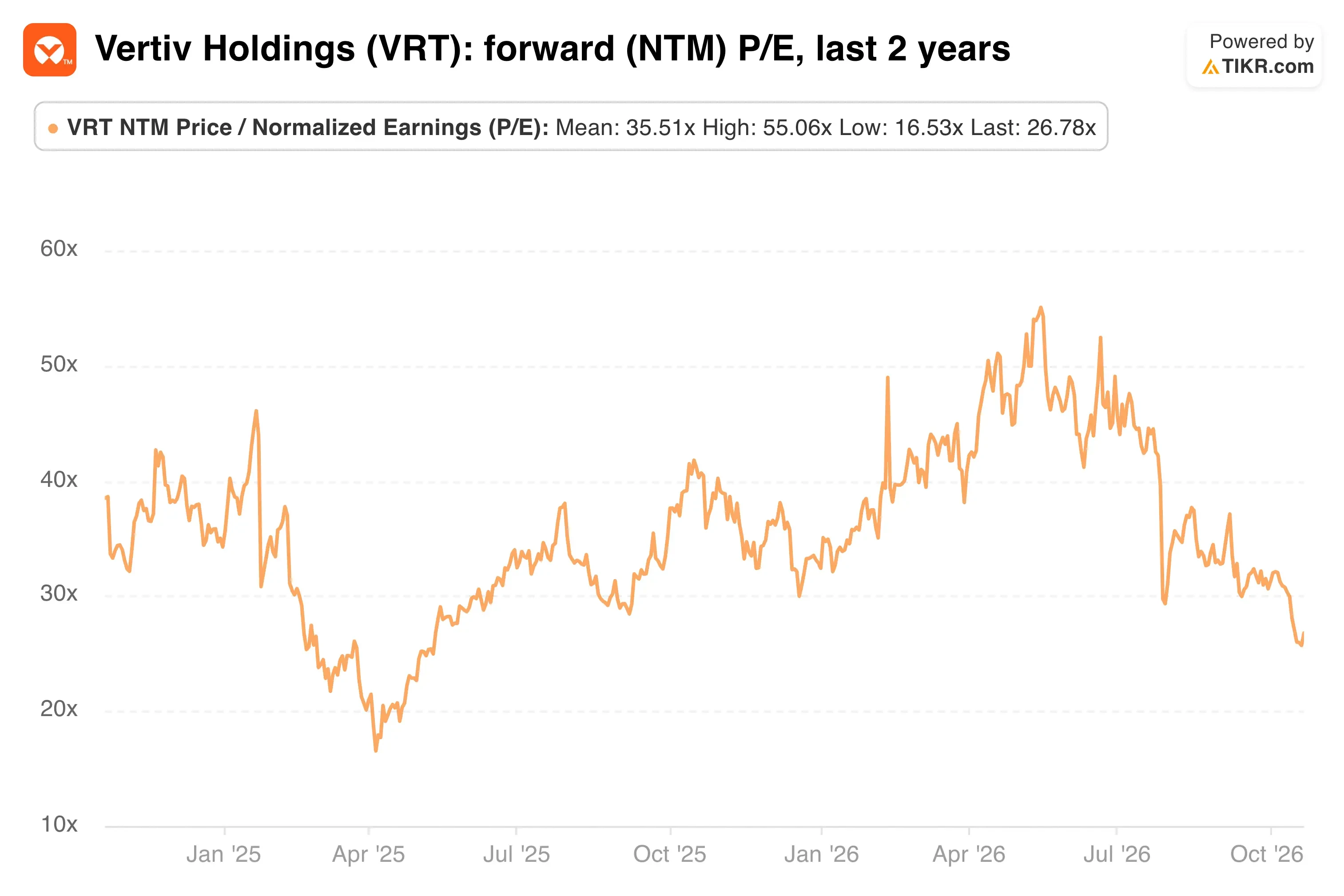
The forward P/E sits at 26.8x, and the $333 average analyst target implies about 57% upside. Net debt is only $228 million, so funding the UIG deal is easy.
My take: The Nvidia partnership is a smart move, because time to power and time to first token are what hyperscalers pay for now. The drawdown mostly reflects sentiment and lumpy project timing, and demand signals still look strong. Still, after a revenue miss, I want Q3 sales back in line before I trust the full-year guide.
October 28 is the checkpoint. Watch Q3 revenue conversion, organic orders, and whether management reaffirms the $14 billion sales target.
So what is Vertiv stock actually worth?
TIKR lets you forecast the future price of any stock in less than a minute. Just enter a few assumptions into TIKR’s valuation model and see what Vertiv could be worth. Start from Wall Street consensus estimates, or adjust the inputs to reflect your own view of the business. It’s free to use.
Disclaimer:
Please note that the articles on TIKR are not intended to serve as investment or financial advice from TIKR or our content team, nor are they recommendations to buy or sell any stocks. We create our content based on TIKR Terminal’s investment data and analysts’ estimates. Our analysis might not include recent company news or important updates. TIKR has no position in any stocks mentioned. Thank you for reading, and happy investing!


