Key Stats for Verizon Stock
- Current Price: $50.15
- Target Price (Mid): ~$69
- Street Target: ~$52
- Potential Total Return: ~37%
- Annualized IRR: ~7.5% / year
Now Live: Discover how much upside your favorite stocks could have using TIKR’s new Valuation Model (It’s free) >>>
What Happened?
Verizon Communications Inc. (VZ) closed at $50.15 on August 24, up 23% for the year and near its 52-week high of $51.68. For a stock that spent most of the last three years testing the bottom of its range, that is a real recovery, and it forces an uncomfortable question for anyone who missed it: with the turnaround now visible in the numbers and the sell-side average target at roughly $52, only a few percent above the current price, is there anything left to buy?
The answer turns on whether the two things that got the stock here are still early. One got a fresh data point the same day the stock closed at $50. The other did not exist on Verizon’s income statement a year ago.
A Second Google Deal, and What It Signals About Costs
On August 24, Verizon and Google Cloud announced an expanded AI partnership spanning customer service, network operations, marketing, and security. Verizon said its Google Cloud contact-center technology already handles the majority of its monthly inbound consumer calls and chats, and the expansion brings Gemini Enterprise deeper into that workflow.
This is a distinct deal from the dark-fiber agreement worth over $1 billion that CEO Dan Schulman disclosed on the July call, where Verizon rents physical fiber to connect Google’s data centers. One deal lowers Verizon’s cost to serve; the other, part of what management calls AI Connect, is a new revenue stream that begins layering in during 2027. Investors tracking only the wireless subscriber line are missing both.
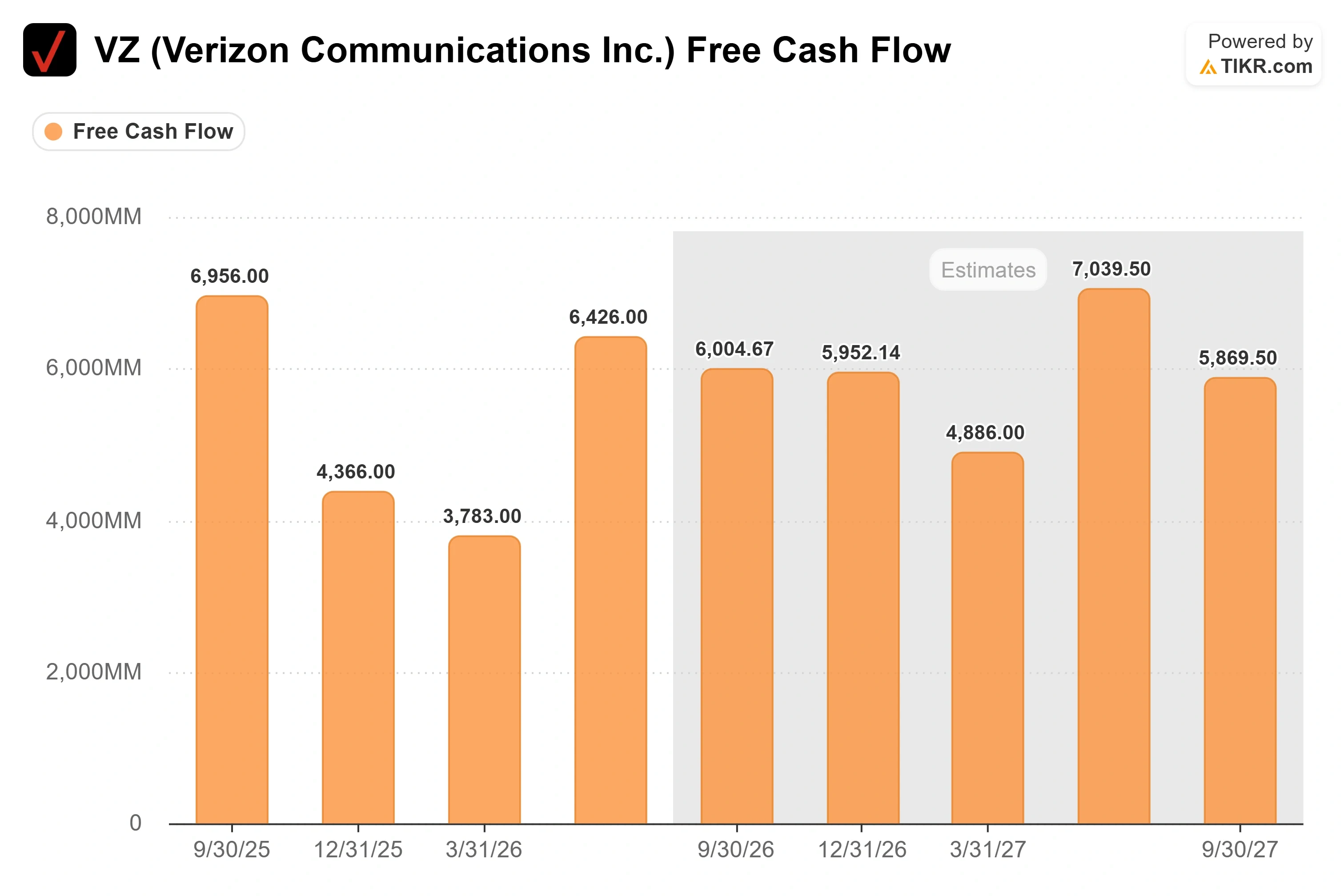
Verizon is targeting at least $9 billion of combined operating and capital savings this year, and the Q2 adjusted EBITDA margin of 40.06% was the highest it has ever reported. The same discipline drove the quarter that re-rated the stock: Consumer postpaid phone churn fell to 84 basis points, down sequentially for the second straight quarter, while Verizon posted its best Consumer postpaid phone net adds in five years at 184,000 and cut promotional acquisition and retention costs by roughly 15% and 17%. Adjusted EPS of $1.30 beat consensus and grew 6.6%, and free cash flow of $6.4 billion jumped 24%. Management raised guidance on service revenue, EPS, and free cash flow, and lifted the 2026 buyback target to as much as $4.5 billion.
Schulman put the mechanism in one line. “When you compound lower churn with healthier acquisition economics, you get exactly the kind of operating leverage you are seeing in our financial results,” said Daniel Schulman, CEO of Verizon. That is the whole model: the mid-June launch of Simplicity, a $45 subsidy-free plan, is built to keep customers longer at a lower cost to win them.
See historical and forward estimates for Verizon stock (It’s free!) >>>
Cheap Against Peers, but the Balance Sheet Sets the Ceiling
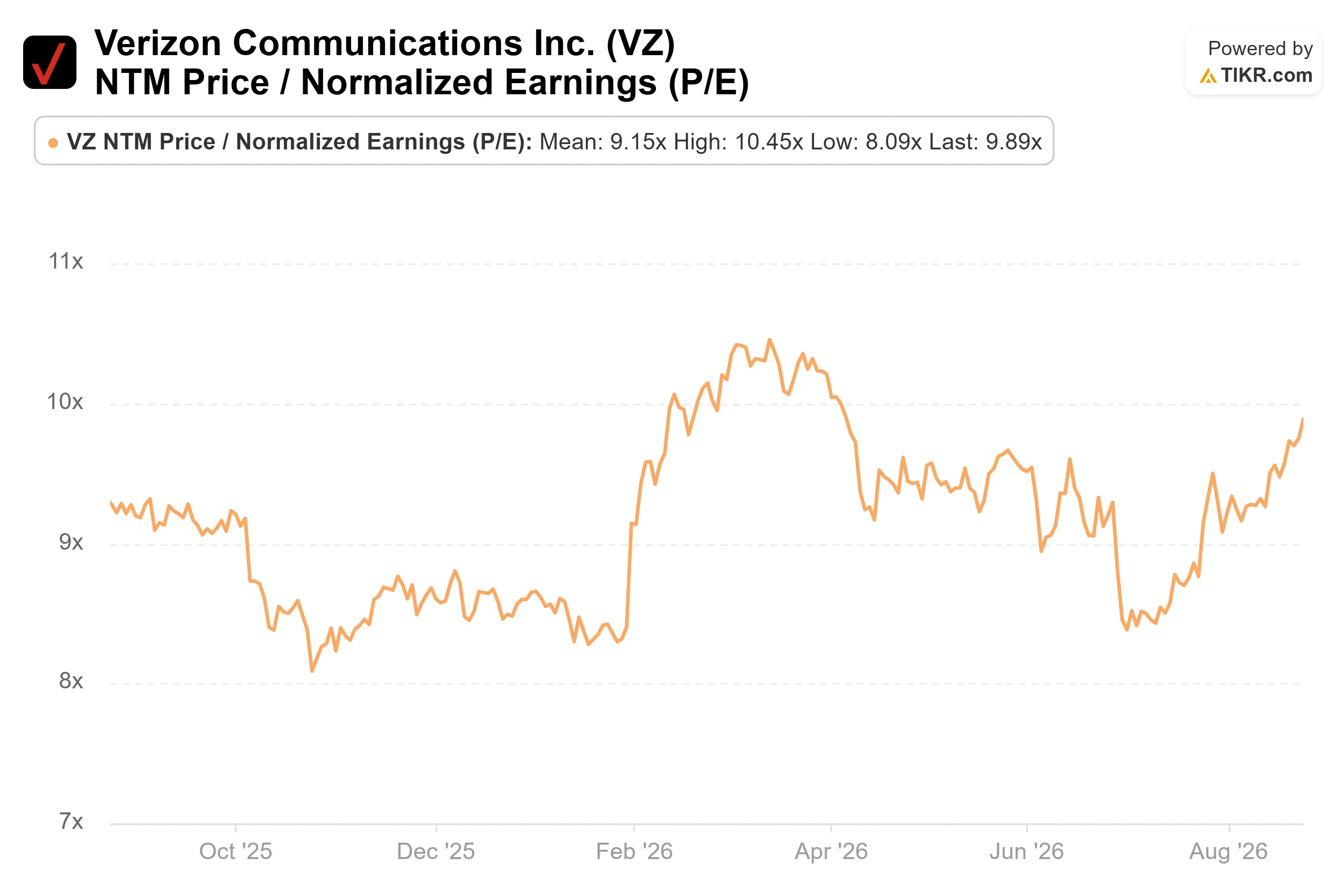
Even after the run, Verizon does not look expensive. It trades at about 9.9x NTM P/E, against AT&T near 10.7x and Deutsche Telekom near 12.1x, while paying a dividend yield around 5.7% that tops AT&T’s. A discount to a slower-growing AT&T is hard to justify for a company posting record margins, and several firms raised targets after the Q2 print. The Street high now sits at $71, even as the mean holds near $52, and that spread between the cautious average and the higher outliers is where the debate lives.
Verizon still carries about $191 billion in net debt and ended Q2 at net unsecured debt to adjusted EBITDA of 2.5x. Management is paying it down, having retired all of Frontier’s debt substantially six months early, but a balance sheet that size means the cash flow story has to keep compounding for the equity to work. A smaller reminder of tail risk landed on August 17, when the Supreme Court declined to let Verizon recover a $46.9 million FCC privacy fine, immaterial financially but a sign that regulatory scrutiny of carrier data practices persists.
See how Verizon performs against its peers in TIKR (It’s free!) >>>
TIKR Advanced Model Analysis
- Current Price: $50.15
- Target Price (Mid): ~$69
- Potential Total Return: ~37%
- Annualized IRR: ~7.5% / year
See analysts’ growth forecasts and price targets for Verizon stock (It’s free!) >>>
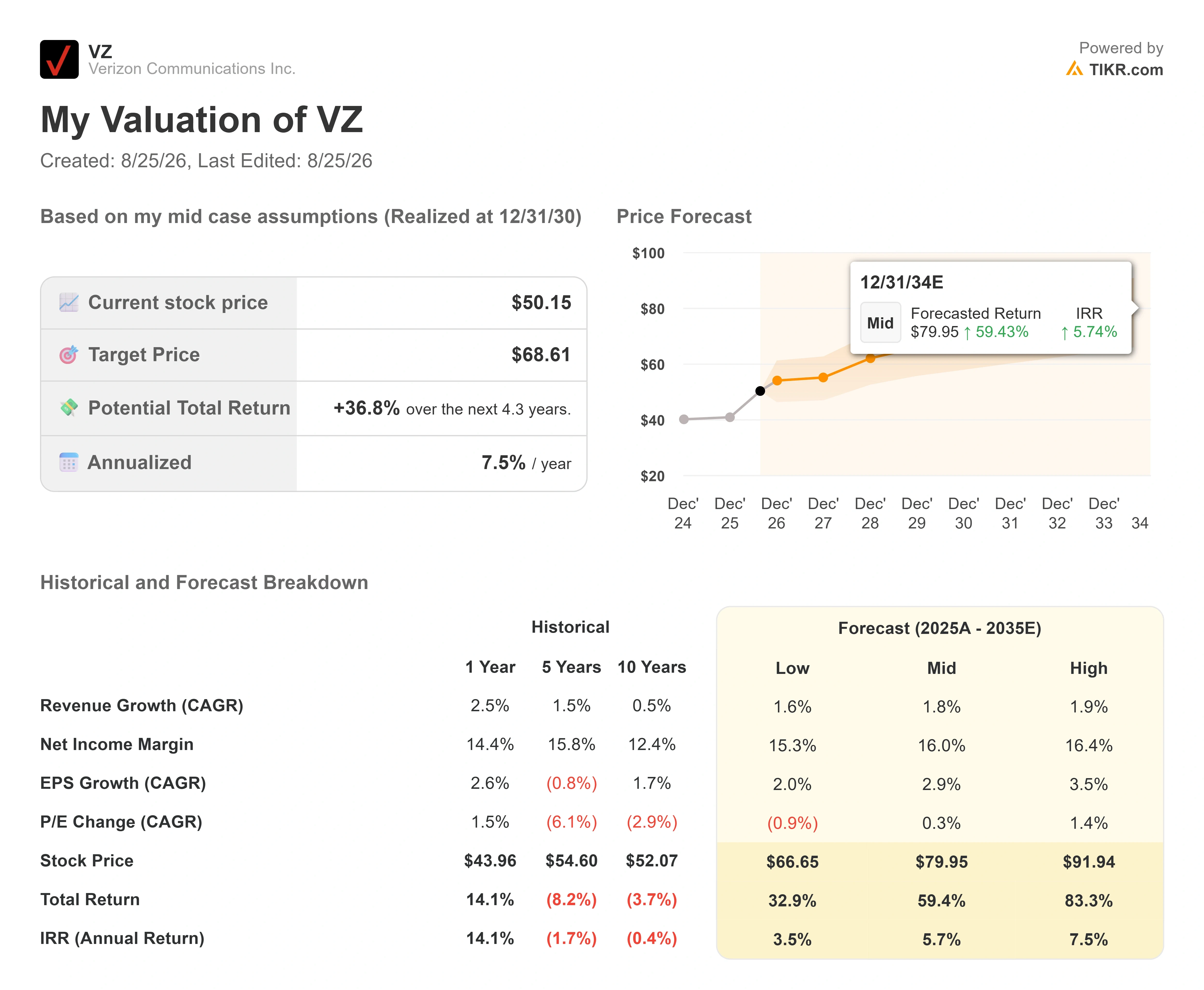
Using the mid-case scenario, TIKR’s model targets around $69 by the end of 2030, implying roughly 37% total return from $50.15 and about 7.5% annualized over the 4.3-year horizon.
- Revenue drivers: fiber and fixed wireless broadband share gains (348,000 broadband net adds in Q2), plus the early ramp of AI Connect fiber revenue starting in 2027.
- Margin driver: the $9 billion cost program that pushed EBITDA margin to a record and runs multiyear.
- Assumptions: roughly 1.8% revenue growth and a 16% net income margin, so this is a cash-return story, not a growth story.
- Primary risk: leverage plus wireless competition capping how much cash reaches shareholders.
The upside case is that AI Connect proves larger than a rounding item and re-rates the multiple as investors credit a second growth vector. The downside is that promotional intensity returns, churn ticks back up, and the stock drifts to the low end of its range as a pure yield instrument.
Conclusion
The next real test is the Q3 report, expected in late October. Watch Consumer postpaid churn: another reading at or below 84 basis points, paired with continued net-add growth, would confirm the Simplicity economics are structural rather than a launch-quarter bounce. A number drifting back above 90, or a guidance walk-back, would say the re-rating got ahead of the fundamentals. The slower catalyst is the additional AI Connect deals Schulman expects to announce by year-end. A signed contract that puts a real number on that business would tell whether the second Google deal was the start of something. Buyers at $50 are collecting a near-6% dividend to wait for the answer.
See what stocks billionaire investors are buying so you can follow the smart money with TIKR.
Should You Invest in Verizon?
The only way to really know is to look at the numbers yourself. TIKR gives you free access to the same institutional-quality financial data that professional analysts use to answer exactly that question.
Pull up Verizon, and you’ll see years of historical financials, what Wall Street analysts expect for revenue and earnings in the quarters ahead, how valuation multiples have moved over time, and whether price targets are trending up or down.
You can build a free watchlist to track Verizon alongside every other stock on your radar. No credit card required. Just the data you need to decide for yourself.
Analyze Verizon on TIKR Free →
Looking for New Opportunities?
- See what stocks billionaire investors are buying so you can follow the smart money.
- Analyze stocks in as little as 5 minutes with TIKR’s all-in-one, easy-to-use platform.
- The more rocks you overturn… the more opportunities you’ll uncover. Search 100K+ global stocks, global top investor holdings, and more with TIKR.
Disclaimer:
Please note that the articles on TIKR are not intended to serve as investment or financial advice from TIKR or our content team, nor are they recommendations to buy or sell any stocks. We create our content based on TIKR Terminal’s investment data and analysts’ estimates. Our analysis might not include recent company news or important updates. TIKR has no position in any stocks mentioned. Thank you for reading, and happy investing!