
Key Stats for Veeva Stock
- Current Price: $171.36
- Target Price (Mid): ~$305
- Street Target: ~$245
- Potential Total Return: ~78%
- Annualized IRR: ~13% / year
Now Live: Discover how much upside your favorite stocks could have using TIKR’s new Valuation Model (It’s free) >>>
What Happened?
Veeva Systems (VEEV) closed up 8.40% on June 26, a sharp single-day jump in a stock that has spent most of the past year going the other way. The move capped a multi-week rebound built on a strong quarter, raised guidance, and a steady drip of AI and CRM wins. Bulls see a company finally turning its narrative, opening new revenue pools while the core compounds. Bears see a premium software name still trading 44% below its 52-week high, betting on agentic labor that is not live yet. The question the market cannot yet answer is whether that new labor business is real or a story, and this move suggests buyers are starting to lean toward the former.
What is actually behind the rebound
The June pop did not come from a single press release. It came from a quarter that beat and a guide that went up, layered on top of a string of AI announcements that have rebuilt sentiment since late May. The freshest of those is genuinely new. On June 23, Veeva acquired Copli, a developer of agentic medical, legal, and regulatory (MLR) review software, and relaunched it as Veeva Falcon MLR. MLR, meaning the compliance review that promotional and medical content must clear before it reaches doctors or patients, has long been one of the slowest steps in pharma marketing. Veeva says the agentic version can eliminate 70% or more of that manual review work within five years, according to the company’s investor relations materials.
That deal moved the stock about 4% on the day it landed. It matters less for that one session than for what it signals: a second front in Veeva’s agentic push. The first, the broader Falcon platform announced in late May, targets clinical, regulatory, and safety work. Falcon MLR aims at the commercial side. Together they tell investors Veeva intends to sell not just software but the labor that software used to require, and that ambition is the thread running through the recent rally.
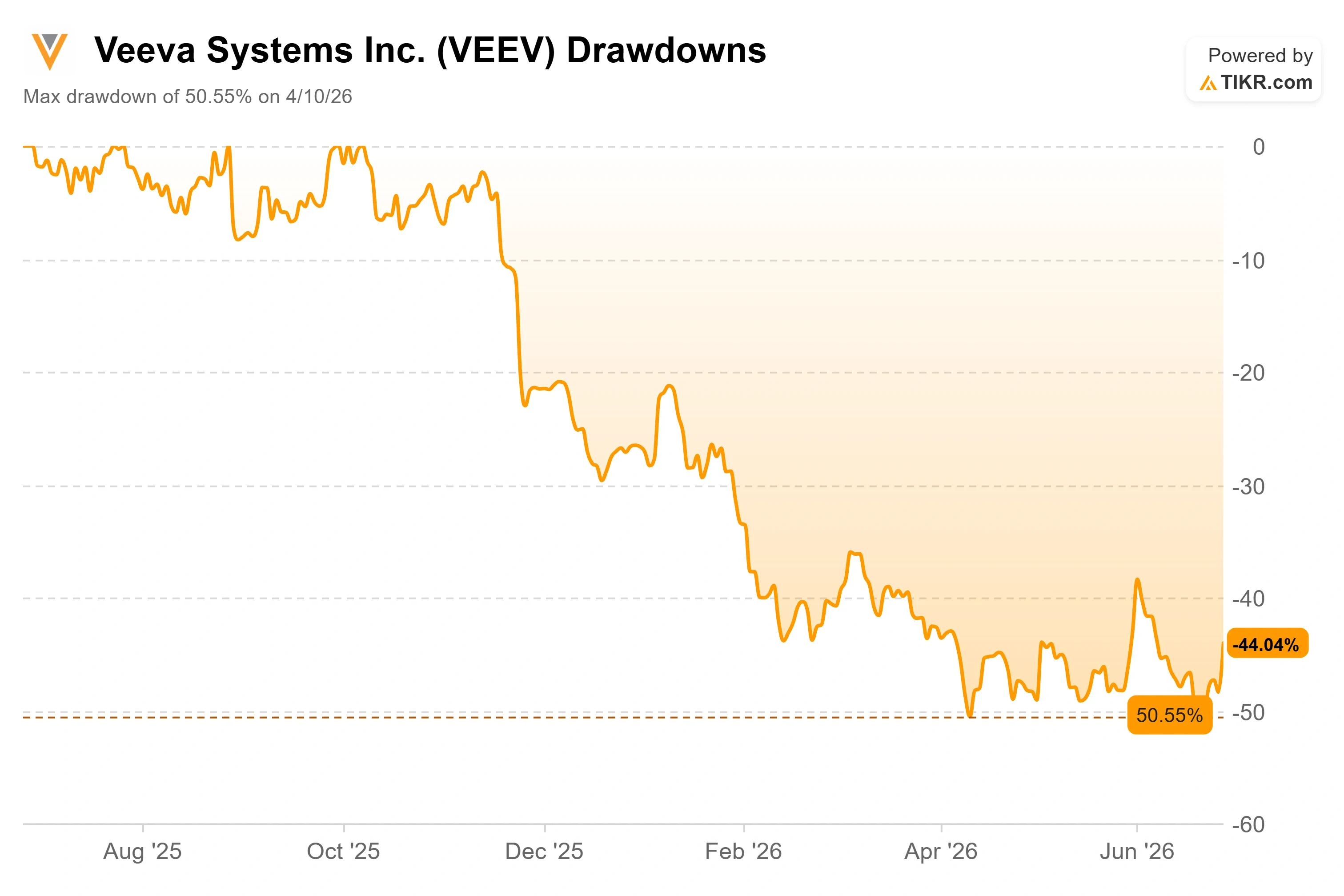
See historical and forward estimates for Veeva stock (It’s free!) >>>
Why the agentic bet is different from a normal product
Peter Gassner, Chief Executive Officer, did not frame Falcon as a feature. On the fiscal Q1 2027 earnings call, he called it “the next chapter of Veeva in our industry cloud” and described it as agentic labor, fully replacing slices of jobs people used to do inside Veeva’s applications. That is why it matters: Veeva is describing a market it does not currently serve, which changes the size of the opportunity rather than just the margin on the existing one.
The pricing logic reinforces that. Gassner said Falcon will most likely be charged by the document for clinical intake and by the case for safety, not by the seat. When asked whether this could cannibalize Veeva’s existing revenue, he was direct: “Definitely all accretive because this is not a market we address today.” For investors trying to size the move, that is the crux. If the labor revenue is additive and the agents still need Veeva’s system of record underneath, the addressable market expands without eroding the core.
The risk sits in the same place as the promise. None of this is live yet. Falcon’s early-adopter launch is planned for November 2026, and Gassner was candid that the team is being assembled “in a hurry.” A platform that reports directly to the CEO and has no paying customers carries execution risk that a mature product does not.
The numbers under the move
The rebound did not come from a weak business. Veeva reported fiscal Q1 2027 revenue of $882.95 million, up 16% year over year, with subscription revenue of $730.18 million. Adjusted EPS came in at $2.24 against a $2.14 Street estimate, a beat the company has now repeated for several quarters. Operating cash flow for the quarter was $1,127.12 million. Management raised the full-year revenue outlook to roughly $3.64 billion.
The commercial side is also turning. Paul Shawah, EVP Strategy, said Veeva now leads Salesforce 10 to 6 in its tracked top-20 pharma CRM decisions, with an overall win rate above 80% and more than 150 customers live on Vault CRM. That migration was the single biggest overhang on the stock a year ago. It is now mostly resolving in Veeva’s favor.
How VEEV stacks up against its peers
On the TIKR Competitors page, Veeva trades at an NTM EV/EBITDA of 12.22x. Certara (CERT), a smaller life sciences software peer, sits at 8.57x, and Simulations Plus (SLP) at 14.20x. Veeva’s multiple lands between the two, which is notable given its scale: a $27.8 billion market cap against roughly $908 million for Certara and $368 million for Simulations Plus. A business with Veeva’s 75% gross margin, near-monopoly position in life sciences cloud, and a new labor opportunity trading in line with sub-scale peers looks more like a discount than a premium. The compression is the case bears are arguing against and bulls are leaning into.

See how Veeva performs against its peers in TIKR (It’s free!) >>>
TIKR Advanced Model Analysis
- Current Price: $171.36
- Target Price (Mid): ~$305
- Potential Total Return: ~78%
- Annualized IRR: ~13% / year

See analysts’ growth forecasts and price targets for Veeva stock (It’s free!) >>>
Two revenue drivers anchor the roughly 12% revenue CAGR assumption: continued R&D Cloud expansion across RTSM, EDC, and safety, where management called Q1 a healthy start, and the Commercial Cloud build-out is now layered with Falcon MLR and the Ostro engagement platform. The margin driver is structural operating leverage as Vault CRM migrations remove Salesforce royalty costs from Veeva’s base, supporting a mid-case net income margin of around 41%. The primary risk is execution on agentic labor: Falcon is not live until November 2026, and any slip pushes the new opportunity out of the model entirely.
The upside: if Falcon labor revenue arrives on schedule and Vault CRM finishes its sweep of the top 20, the high case points to roughly $645 by 2036.
The downside: if agentic adoption lags and core growth settles into the low teens, the low case sits near $363 over the same long horizon, still above today’s price but a far slower path.
Conclusion
The single number to watch is subscription revenue growth at the fiscal Q2 2027 report, expected August 26, 2026. Veeva has held a 16% to 17% growth band for several quarters. A print that stays at or above 15% keeps the agentic story credible, because it shows the core can fund the Falcon build without buckling. A drop toward the low teens would tell investors the migration tailwind is fading before the labor revenue arrives, and the rebound would look premature. The harder catalyst comes later: Falcon’s November 2026 early-adopter launch is the first real test of whether agentic labor is a business or a slide. Until then, this move is the market pricing in optimism that it cannot yet verify.
See what stocks billionaire investors are buying so you can follow the smart money with TIKR.
Should You Invest in Veeva?
The only way to really know is to look at the numbers yourself. TIKR gives you free access to the same institutional-quality financial data that professional analysts use to answer exactly that question.
Pull up Veeva, and you’ll see years of historical financials, what Wall Street analysts expect for revenue and earnings in the quarters ahead, how valuation multiples have moved over time, and whether price targets are trending up or down.
You can build a free watchlist to track Veeva alongside every other stock on your radar. No credit card required. Just the data you need to decide for yourself.
Looking for New Opportunities?
- See what stocks billionaire investors are buying so you can follow the smart money.
- Analyze stocks in as little as 5 minutes with TIKR’s all-in-one, easy-to-use platform.
- The more rocks you overturn… the more opportunities you’ll uncover. Search 100K+ global stocks, global top investor holdings, and more with TIKR.
Disclaimer:
Please note that the articles on TIKR are not intended to serve as investment or financial advice from TIKR or our content team, nor are they recommendations to buy or sell any stocks. We create our content based on TIKR Terminal’s investment data and analysts’ estimates. Our analysis might not include recent company news or important updates. TIKR has no position in any stocks mentioned. Thank you for reading, and happy investing!