Key Takeaways
- Upstart fell 7.3% to $23 on Friday, leaving the stock 4% above its 52-week low ahead of Tuesday’s third-quarter report.
- Third-quarter originations reached $4.12 billion, up 42% from a year earlier but 2.6% below the second quarter.
- Hitting the $294 million adjusted EBITDA target requires about $177 million in the second half, after $117 million in the first.
- Watch revenue against the roughly $365 million consensus and whether Upstart reaffirms its $1.4 billion full-year revenue guide.
Upstart Holdings (UPST) heads into Tuesday’s earnings near the bottom of its range. The stock fell 7.3% to $23 on Friday, just 4% above its 52-week low of $22 and far below its $52 high.
Volume isn’t the issue. Upstart already said third-quarter originations reached $4.12 billion, up from roughly $2.9 billion a year earlier.
Direction is. That figure slipped 2.6% from the second quarter, and the full-year profit target now leans heavily on the back half.
At 7.6x forward earnings, the market is pricing in plenty of doubt.
Volume held, momentum stalled
The preliminary third-quarter numbers tell a mixed story:
- Originations of $4.12 billion trailed Q2’s $4.23 billion.
- September came in at $1.38 billion, or $53.1 million per origination day, slightly above the quarterly pace.
- The Upstart Macro Index sat at 1.49, a reading that still signals elevated credit risk.
Q2 set a high bar. Revenue rose 42% to $365 million, and net income more than doubled to $16.5 million. Yet EPS of $0.16 missed the $0.18 consensus, while the conversion rate dipped to 19.2% from 21.0%.
Here’s how the top line has moved over the last two years…

Consensus has Q3 revenue flat at about $365 million, so the Street already expects a pause.
The second half has to carry it
Upstart reaffirmed $294 million of 2026 adjusted EBITDA in August. First-half EBITDA was $117.4 million, which leaves about $177 million for the second half.
Compare that with what analysts pencil in for each remaining quarter.
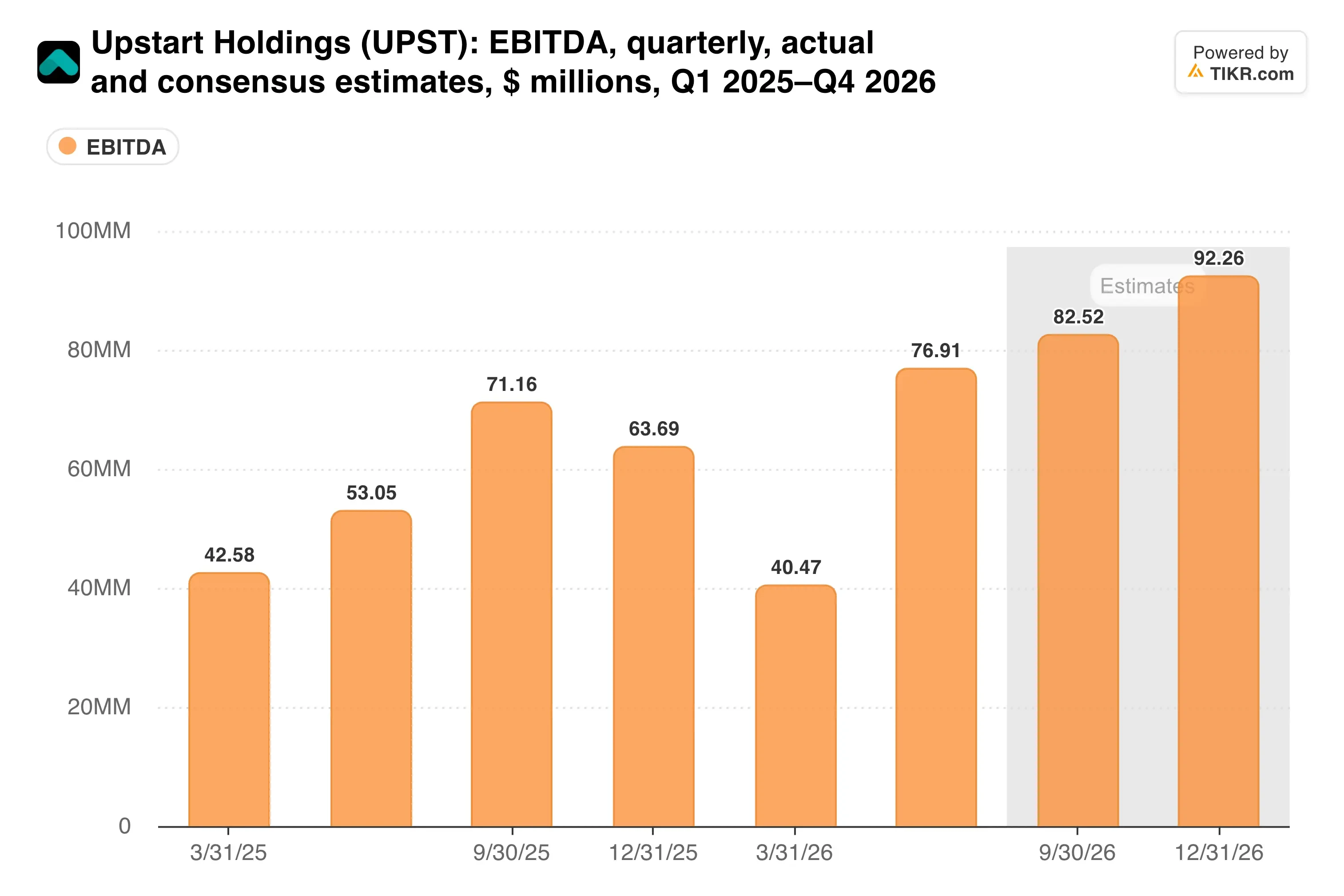
The Street’s $83.2 million for Q3 and $93.9 million for Q4 add up to the full target, which leaves little room for a soft quarter.
Funding looks steadier than it did a year ago. Upstart signed a $200 million revolving credit facility with MUFG-led lenders in October, and credit unions in Denver, Massachusetts and beyond keep adding products.
Scale isn’t the gap with peers. LendingClub guided to $11.6 billion to $12.6 billion of originations for all of 2026, while Upstart did about $8.35 billion in Q2 and Q3 alone. However, LendingClub funds itself with bank deposits, and Upstart still relies on partners and capital markets.
TIKR tracks 16 analysts on Upstart. How many say “Buy”?
See the full breakdown of Buy, Hold, and Sell ratings on Upstart, along with Wall Street’s revenue and earnings estimates, all in one place. More than 500,000 investors use TIKR to research stocks like this one. See Upstart’s Analyst Ratings
A low multiple with leverage
So why does a lender growing originations 42% trade like a value stock?

Part of the answer is the balance sheet. Upstart carries about $1.6 billion of net debt, or 12.1x trailing EBITDA, because it holds loans of its own. Auto and home lending also still run at negative margins.
Insiders are split. CEO Paul Gu bought 50,000 shares for $1.28 million in September, at about $26 each. President Sanjay Datta sold 116,000 shares for $3.17 million.
Wall Street’s average target of $38 implies 67% upside.
My take: I think 7.6x overstates the risk, but the risk is real. A weaker macro index or a funding hiccup hits Upstart’s volume fast, and the EBITDA target has no cushion left. Gu buying near current prices is the more useful signal to me, and I’d lean his way if the guide holds.
Tuesday’s report decides it. Upstart has to reaffirm $1.4 billion of revenue and $294 million of adjusted EBITDA, and it will release October originations and a fresh macro index reading alongside the results.
So what is Upstart stock actually worth?
TIKR lets you forecast the future price of any stock in less than a minute. Just enter a few assumptions into TIKR’s valuation model and see what Upstart could be worth. Start from Wall Street consensus estimates, or adjust the inputs to reflect your own view of the business. It’s free to use.
Disclaimer:
Please note that the articles on TIKR are not intended to serve as investment or financial advice from TIKR or our content team, nor are they recommendations to buy or sell any stocks. We create our content based on TIKR Terminal’s investment data and analysts’ estimates. Our analysis might not include recent company news or important updates. TIKR has no position in any stocks mentioned. Thank you for reading, and happy investing!