


Key Stats for United Airlines Stock
- Current Price: $90
- Target Price: $104
- Street Target: $135
- Potential Total Return: +15.5%
- Annualized IRR: 3%
Now Live: Discover how much upside your favorite stocks could have using TIKR’s new Valuation Model (It’s free) >>>
What Happened?
United Airlines (UAL) is currently testing the absolute limits of consumer price elasticity.
Speaking at the JPMorgan Industrials Conference on March 17, 2026, CEO Scott Kirby outlined the stark mathematical reality facing the airline: to fully offset a sudden $4.6 billion spike in fuel costs, United must increase its Revenue per Available Seat Mile (RASM), the standard airline metric for how much revenue is generated per seat for every mile flown, by 8.5 points for the remainder of the year.
Management is betting that “brand loyal” customers will absorb this cost.
According to Kirby, the average fares passengers have already paid for upcoming flights are already running 15% to 20% higher than the same period last year, and the first ten weeks of 2026 registered as the ten largest booking weeks in the company’s history.
To ensure this pricing power holds, United is actively restricting supply.
The airline proactively loaded a 1-point capacity reduction for May and June, explicitly targeting marginal, low-profit flying like mid-week departures and overnight red-eye flights.
This disciplined capacity management contrasts sharply with rivals.
Kirby openly criticized American Airlines for attempting to add 117 daily flights in Chicago with only five weeks of lead time, a schedule Kirby stated was on track to lose American $1 billion annually before the Department of Transportation intervened to cap the airport’s capacity.
Furthermore, United is actively protecting its margins through operational agility and its MileagePlus loyalty program, which generates high-margin revenue by selling miles in bulk to JPMorgan Chase regardless of whether a seat is ever booked.
Chief Commercial Officer Andrew Nocella noted that with Middle East routes suspended, the airline quickly reallocated seven 777 widebody jets, large premium-configured aircraft that command significantly higher fares, from suspended Tel Aviv and Dubai routes onto transcontinental routes like New York to Los Angeles, allowing United to retire less fuel-efficient 757 narrow-bodies and increase the mix of premium seats on its most profitable domestic corridors.
Concurrently, following a recent revamp of the loyalty proposition, co-branded credit card acquisitions are tracking up over 30% year-over-year.
“I’d much rather make the mistake of leaving a couple of months’ worth of demand on the table because we cut more and then you can get it back, as opposed to making the mistake of oil prices stay higher and longer and you’re flying flights that lose cash,” Kirby stated at the conference.
See historical and forward estimates for United Airlines stock (It’s free!) >>>
Is United Airlines Undervalued Today?
The equity currently trades at $89.95, with a 52-week range of $52.00 to $119.21, placing the stock well below its annual high despite strong operational momentum.
This optimism was reinforced by a +2.20% earnings reaction on January 20, 2026, alongside steady institutional accumulation.
TIKR data shows Barclays Bank PLC recently increased its position by over 350% to 2.85 million shares, while Goldman Sachs Asset Management holds roughly 2.6 million shares.
These institutions are primarily pricing in two structural advantages.
The first is an impending credit upgrade.
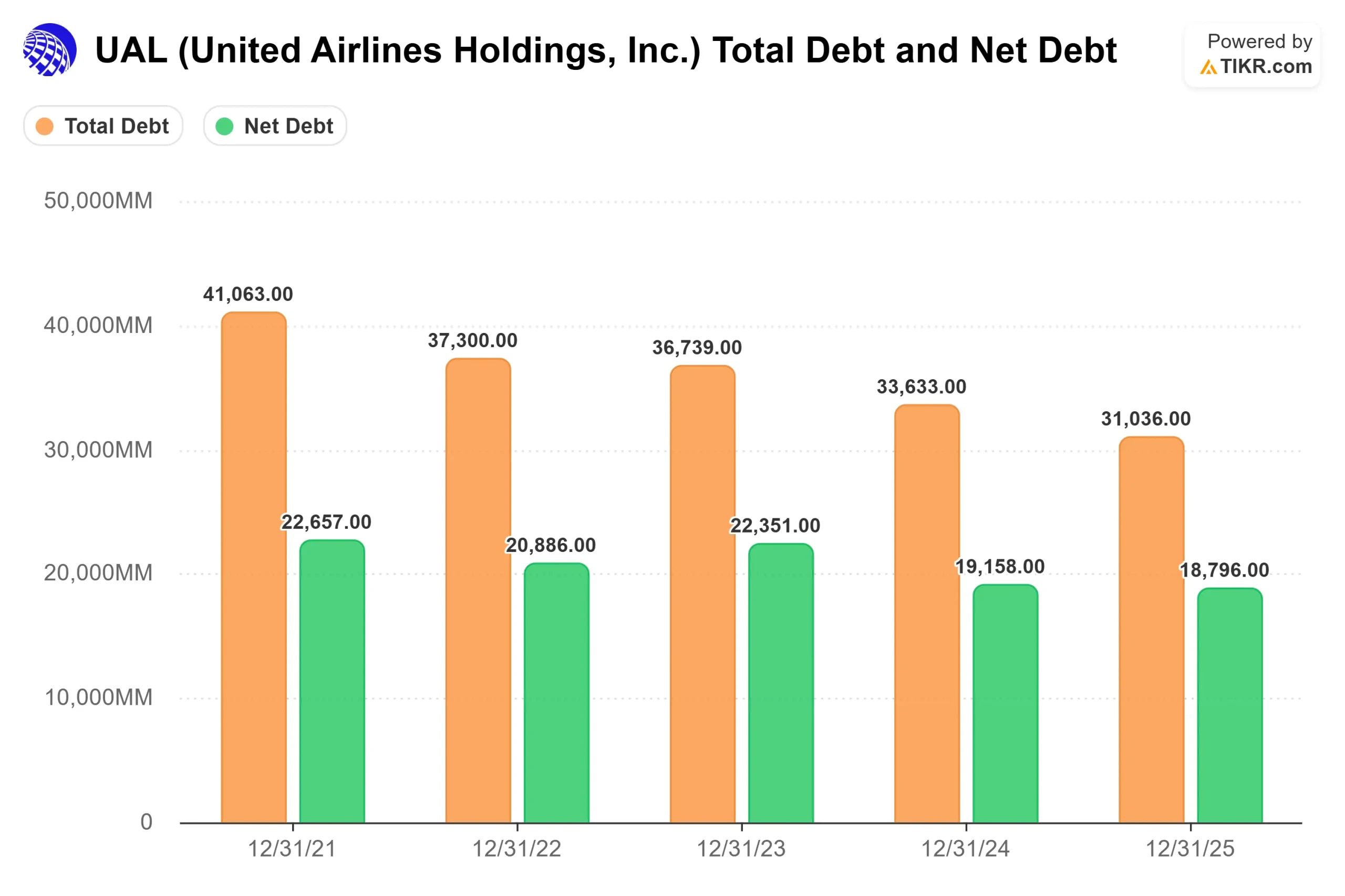
CFO Mike Leskinen noted that United recently issued $2 billion in unsecured debt that priced roughly in line with investment-grade paper.
Because United leases 50% less of its fleet than rival Delta, it has the operational flexibility to execute strategic sale-leaseback transactions to optimize its cost of capital, pushing the airline toward a formal Investment Grade rating by late 2026 or early 2027.
The second structural advantage is “Gauge,” the average number of seats per departure.
United currently averages 132 seats per flight, but Nocella noted its hubs can support 170 to 180.
Since airport fees, gates, and crew costs are fixed per departure regardless of plane size, swapping a 50-seat regional jet for a 180-seat narrow-body on the same route spreads those costs across far more passengers, directly expanding profit per flight without adding a single new route.
However, the explicit bear case for United centers on macroeconomic pressure.
While Kirby argued that overall airline demand is inelastic, a 15% to 20% sustained increase in fares will inevitably suppress some leisure volume if the broader economy cools.
The burden of absorbing a $4.6 billion fuel spike relies entirely on the consumer’s willingness to prioritize travel over other discretionary spending.
TIKR Advanced Model Analysis
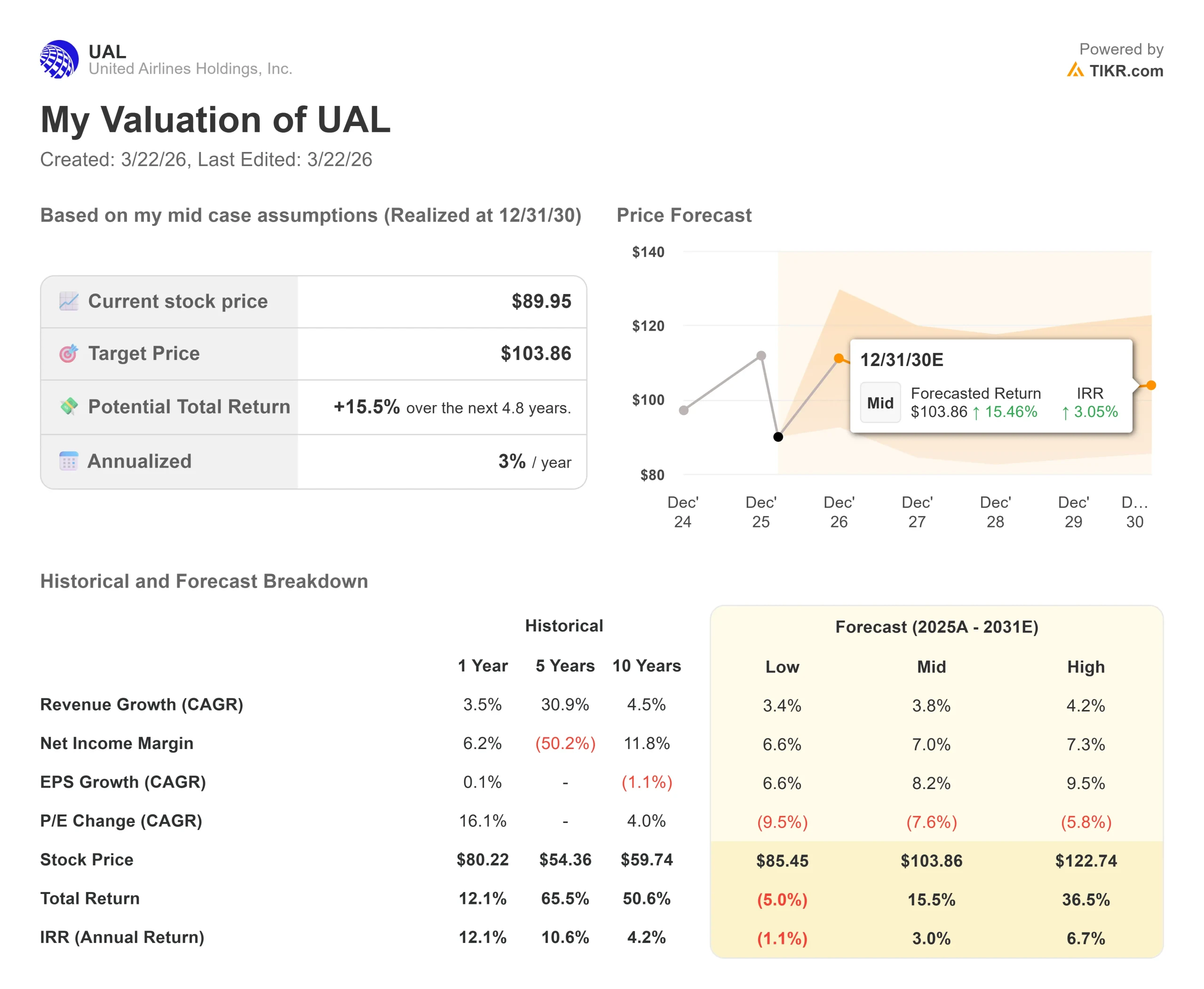
The TIKR Advanced Model illustrates a highly conservative view of United’s ability to compound growth in a high-fuel environment.
- Current Price: $90
- Target Price: $104
- Potential Total Return: +15.5%
- Annualized IRR: 3%
Build a 4-year Valuation Model for UAL for yourself (It’s free) >>>
Unlike the Street consensus, the Mid Case model projects a highly modest $103.86 target price, driven by a conservative 3.8% Revenue CAGR through the 2030 forecast period. This reflects the reality that passing through a massive fuel shock structurally limits volume growth; the airline is prioritizing yield (price) over capacity (ASMs).
The mathematical limit on the valuation is the Net Income Margin, which the model caps at 7.0%. While the “gauge” tailwind and credit card acquisitions are powerful levers, the model requires concrete proof that higher fuel prices won’t permanently erode baseline profitability. The resulting 3.0% annualized IRR indicates that the stock is currently fairly valued based on its existing cash flows, offering limited upside unless fuel prices rapidly revert to historical norms or the Investment Grade upgrade triggers a significant P/E multiple expansion.
Conclusion: United Airlines is executing a disciplined capacity and “gauge” strategy to defend its margins against a $4.6 billion fuel headwind. While Wall Street is aggressively pricing in an imminent Investment Grade upgrade with a $135 target, our fundamental modeling suggests a much more constrained 3.0% annualized return profile. Watch the Q2 2026 earnings release for the specific volume metrics in the “Basic Economy” segment; if passenger volume drops by more than 5% as yields increase, it will signal that consumer elasticity is finally breaking, requiring a reassessment of the $103 baseline target.
See what stocks billionaire investors are buying so you can follow the smart money with TIKR.
Should You Invest in United Airlines?
The only way to really know is to look at the numbers yourself. TIKR gives you free access to the same institutional-quality financial data that professional analysts use to answer exactly that question.
Pull up United Airlines, and you’ll see years of historical financials, what Wall Street analysts expect for revenue and earnings in the quarters ahead, how valuation multiples have moved over time, and whether price targets are trending up or down.
You can build a free watchlist to track United Airlines alongside every other stock on your radar. No credit card required. Just the data you need to decide for yourself.
Analyze United Airlines on TIKR Free →
Looking for New Opportunities?
- See what stocks billionaire investors are buying so you can follow the smart money.
- Analyze stocks in as little as 5 minutes with TIKR’s all-in-one, easy-to-use platform.
- The more rocks you overturn… the more opportunities you’ll uncover. Search 100K+ global stocks, global top investor holdings, and more with TIKR.
Disclaimer:
Please note that the articles on TIKR are not intended to serve as investment or financial advice from TIKR or our content team, nor are they recommendations to buy or sell any stocks. We create our content based on TIKR Terminal’s investment data and analysts’ estimates. Our analysis might not include recent company news or important updates. TIKR has no position in any stocks mentioned. Thank you for reading, and happy investing!


