Key Stats for Uber Stock
- Current Price: $71.67
- Target Price (Mid): ~$226
- Street Target: ~$101
- Potential Total Return: ~215% (over ~4.3 years)
- Annualized IRR: ~31% / year
Now Live: Discover how much upside your favorite stocks could have using TIKR’s new Valuation Model (It’s free) >>>
What Happened?
Uber Technologies (UBER) closed at $71.67 on September 11, roughly 30% below the $101.99 high it touched a year earlier and only a few dollars above its 52-week low of $65.41. The odd part is what management did from that position of apparent weakness. Days earlier, Uber cut 10% of its workforce to reinvest in growth, and then its CEO stood on a conference stage and called the stock “really cheap.”
The fear pressing on the shares has a name: robotaxis. Waymo and Tesla are scaling autonomous fleets, and the bear case says driverless cars eventually bypass Uber’s marketplace. That worry, plus a soft third-quarter guide, has capped the stock all year.
What Khosrowshahi Told Wall Street While the Stock Sat Near Lows
On September 10, CEO Dara Khosrowshahi spoke at the Goldman Sachs Communacopia + Technology Conference and made an unusually direct case. Asked why Uber would spend to acquire Delivery Hero, he pointed at his own shares: “we think our stock is really cheap.” That is a pointed thing for a CEO to say, and it frames how management reads the gap between price and value.
Khosrowshahi said U.S. mobility demand “has accelerated since late last year,” helped by falling insurance costs, safer-driver initiatives, and lower-priced options like Wait & Save that bring in new riders. He described more than 50 million Uber One members growing 50% year over year, now responsible for about half of bookings, with members spending three times more than non-members.
Days before, Uber said it would cut roughly 3,300 jobs, its largest reduction since the pandemic. Management framed this as flattening layers rather than a response to weak demand, and said the savings would fund lower prices and growth. Shares rose more than 2% in premarket trading on the news, a sign investors read it as discipline.

See historical and forward estimates for Uber stock (It’s free!) >>>
The Autonomous Question the Market Keeps Repricing
The robotaxi overhang is why the multiple stays compressed, so it deserves a direct answer. Khosrowshahi’s pitch is that Uber becomes the demand layer for autonomy, not a casualty of it. He said Uber has secured access to over 120,000 AV-ready vehicles, operates with nine AV partners today, and expects 15 by year-end, including Waymo, WeRide, Pony, and Avride.
His economic argument is the part bulls lean on. Because Uber already carries enormous demand, it can push utilization on an AV fleet roughly 30% higher than a single-brand operator could, and it can spread depot and repair costs across partners in one facility. In a business shifting from variable driver pay to the fixed cost of owning vehicles, utilization decides the economics. Khosrowshahi put the target vehicle cost at $50,000 to $60,000 including sensors and compute, with a hybrid fleet of AVs for baseload demand and human drivers layered in for peaks.
If a player like Tesla builds a consumer app at scale and keeps riders inside its own ecosystem, Uber’s aggregation advantage weakens. Autonomous trips are still a small share of Uber’s weekly trips, so the outcome is years away. Uber has spread its bets across a wide partner set precisely so no single company can strand it, and the market currently assigns that strategy little value.
What Uber Is Buying, and What the Multiple Says
Capital allocation shows how management weighs its own opportunities. Uber formally launched a cash takeover offer for Delivery Hero at €41.50 per share, an equity value near $14.8 billion, with the acceptance period running through November 5 and closing expected in the second half of 2027. This is an open takeover offer that still needs merger-control clearances, not a closed deal. Uber says it extends the platform to 99 markets and expects it to add to non-GAAP EPS by year three. Khosrowshahi described a high M&A hurdle rate because organic growth and autonomy already compete for capital, and argued Delivery Hero cleared it by nearly doubling the audience Uber can pull into its cross-platform flywheel.
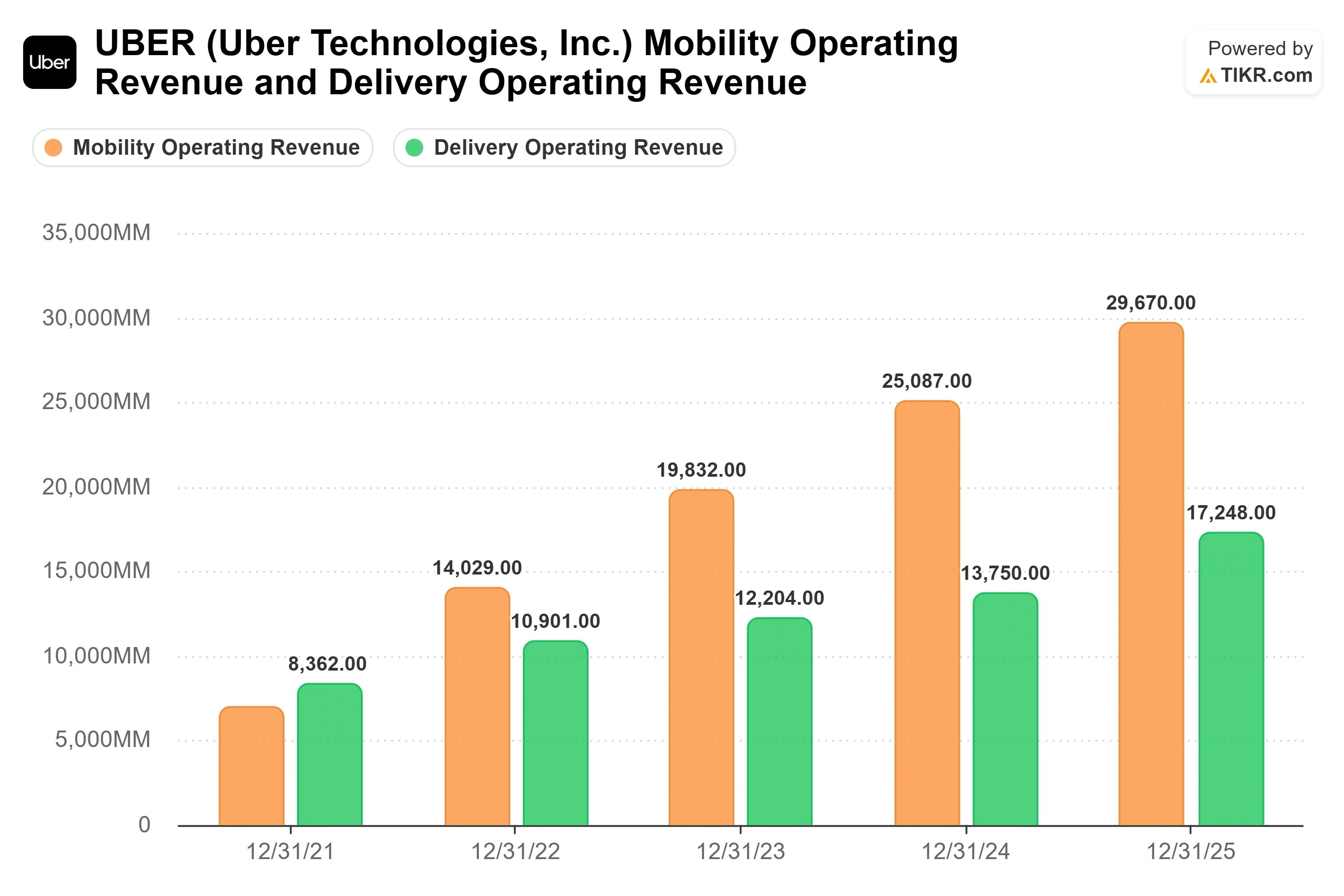
That flywheel is the core of the thesis, because members and cross-platform users spend far more. On valuation, Uber trades at 18.5x next-twelve-month P/E and an 8.4% next-twelve-month levered free cash flow yield. For a business still compounding gross bookings above 20%, those are not the multiples of a broken growth story.
See how Uber performs against its peers in TIKR (It’s free!) >>>
TIKR Advanced Model Analysis
- Current Price: $71.67
- Target Price (Mid): ~$226
- Potential Total Return: ~215%
- Annualized IRR: ~31% / year

See analysts’ growth forecasts and price targets for Uber stock (It’s free!) >>>
The TIKR mid-case valuation points to a target near $226, a total return of about 215% over roughly 4.3 years, and an annualized IRR near 31%. This is the mid case, which makes the implied return notable with the stock near multi-year lows.
- Revenue drivers: sparse-market penetration, where usage runs near 10% versus 50% in core markets and grows 1.5x faster, plus delivery expansion into the $15 billion grocery and retail category growing over 40%.
- Margin driver: the barbell strategy, using high-margin products like Uber for Business and advertising to fund low-cost options, with insurance tailwinds and the restructuring lowering the cost base. The model assumes mid-case revenue growth near 11% and net income margin near 15%.
- Upside: autonomy proves additive and membership keeps lifting spend per user, re-rating the multiple as cash compounds.
- Downside: a major AV player bypasses Uber’s marketplace and take rates compress faster than membership can offset.
Conclusion
The next real test is the Q3 2026 print, expected in early November, where Uber guided gross bookings of roughly $58 billion to $60 billion. Good looks like bookings at or above the high end with mobility holding its recent momentum. Bad looks like bookings at the low end paired with any wobble in mobility, which would hand the robotaxi bears their proof that growth is cooling. The Delivery Hero acceptance window also closes November 5, so by mid-November investors will know both whether the operating story held and whether the deal management staked its capital on actually clears.
See what stocks billionaire investors are buying so you can follow the smart money with TIKR.
Should You Invest in Uber?
The only way to really know is to look at the numbers yourself. TIKR gives you free access to the same institutional-quality financial data that professional analysts use to answer exactly that question.
Pull up Uber, and you’ll see years of historical financials, what Wall Street analysts expect for revenue and earnings in the quarters ahead, how valuation multiples have moved over time, and whether price targets are trending up or down.
You can build a free watchlist to track Uber alongside every other stock on your radar. No credit card required. Just the data you need to decide for yourself.
Looking for New Opportunities?
- See what stocks billionaire investors are buying so you can follow the smart money.
- Analyze stocks in as little as 5 minutes with TIKR’s all-in-one, easy-to-use platform.
- The more rocks you overturn… the more opportunities you’ll uncover. Search 100K+ global stocks, global top investor holdings, and more with TIKR.
Disclaimer:
Please note that the articles on TIKR are not intended to serve as investment or financial advice from TIKR or our content team, nor are they recommendations to buy or sell any stocks. We create our content based on TIKR Terminal’s investment data and analysts’ estimates. Our analysis might not include recent company news or important updates. TIKR has no position in any stocks mentioned. Thank you for reading, and happy investing!