Key Stats for Palo Alto Networks Stock
- Current Price: $330.65
- Target Price (Mid): ~$423
- Street Target: ~$393
- Potential Total Return: ~28%
- Annualized IRR: ~5% / year
Now Live: Discover how much upside your favorite stocks could have using TIKR’s new Valuation Model (It’s free) >>>
What Happened?
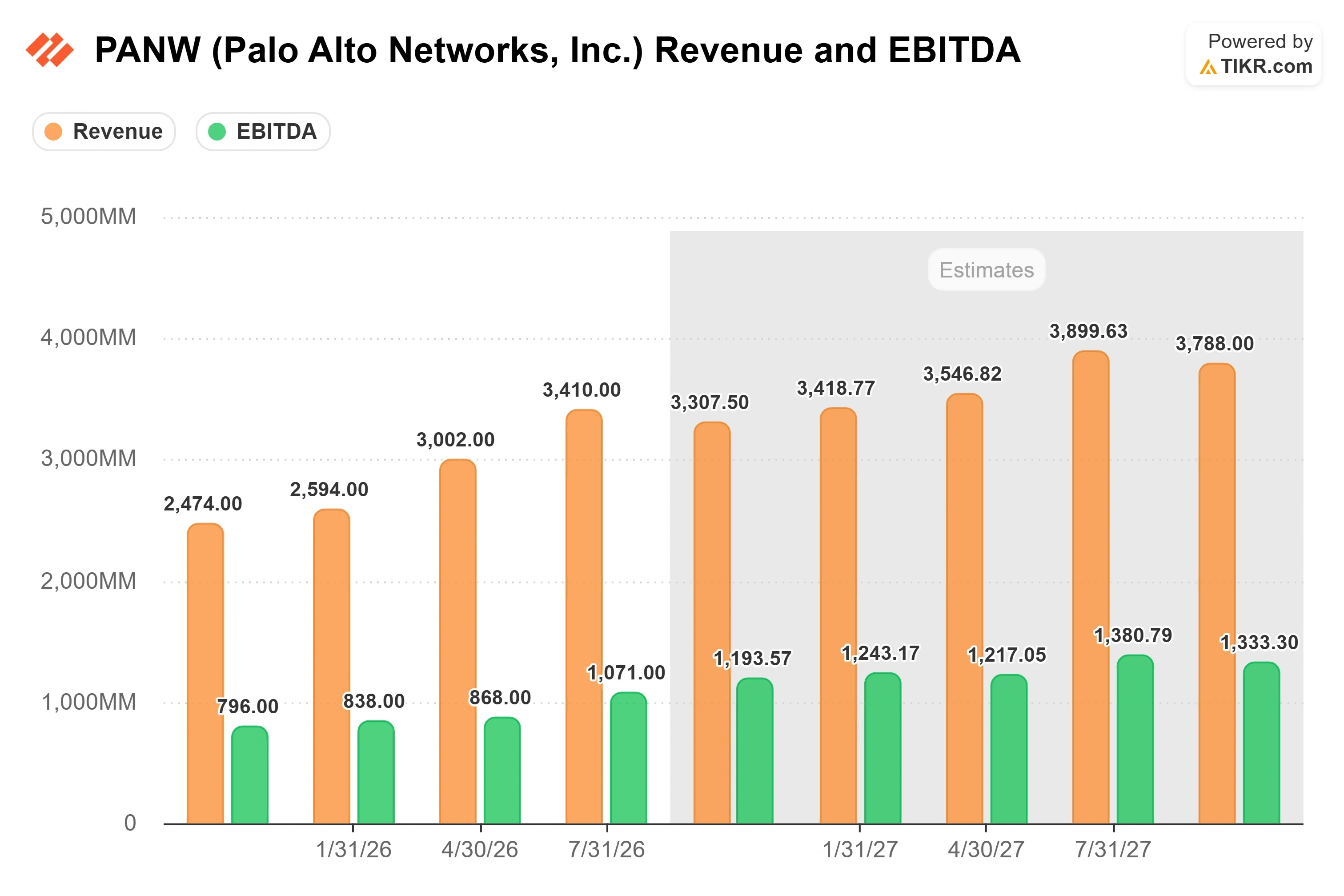
Palo Alto Networks (PANW) did everything the bulls asked for last quarter and got punished anyway. After the close on September 1, the company reported fiscal Q4 revenue of $3.41 billion, up 34% year over year, with adjusted earnings of $1.02 that topped the $0.98 the Street expected. Shares had already slipped about 5% during that day’s regular session, popped briefly on the beat, then reversed. By the next session the stock sat roughly 7% lower, and it kept drifting toward $331 over the following week.
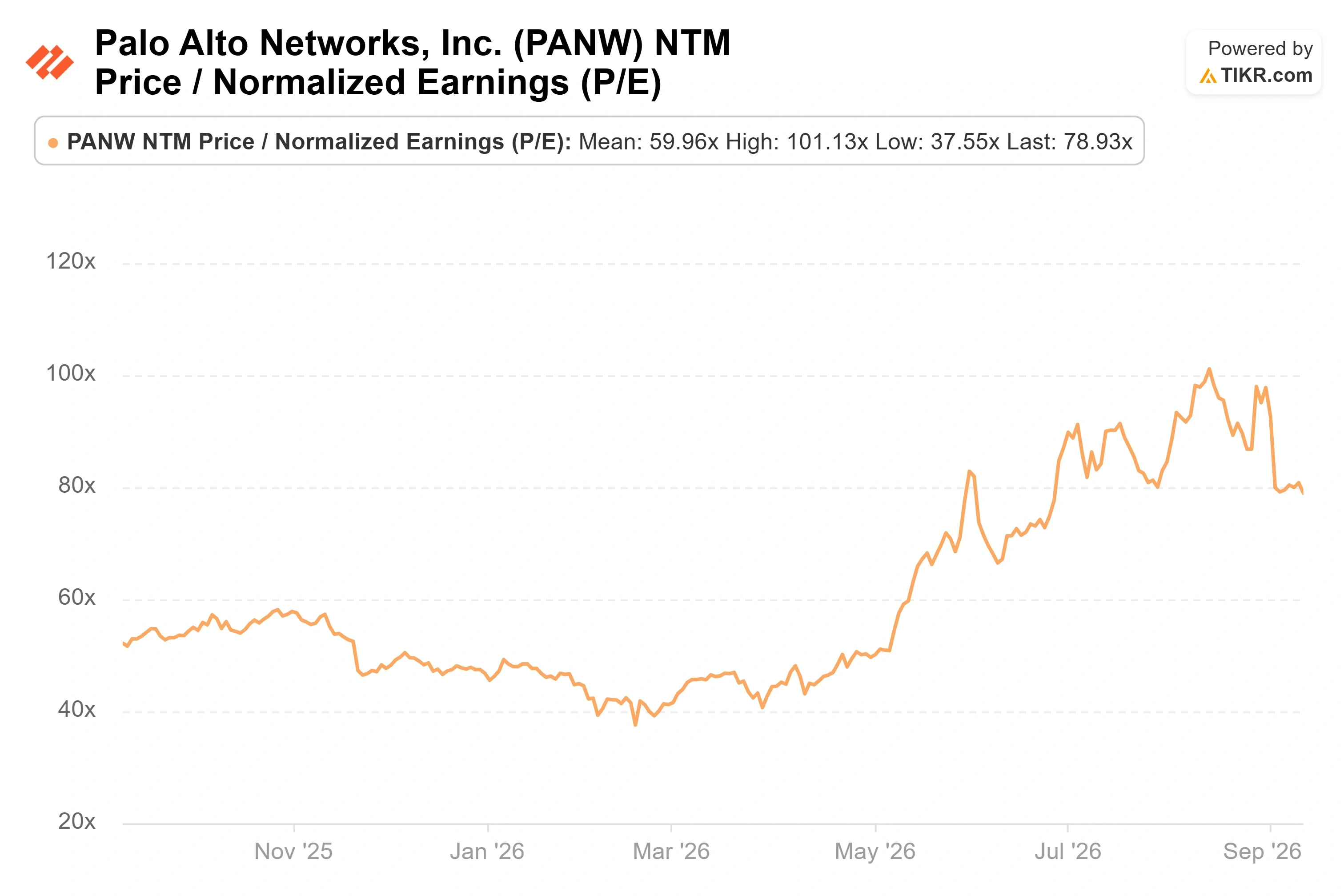
Shares still trade near 79 times forward earnings after a run that lifted the market cap to $270 billion, and even a clean beat cannot move a multiple that stretched. That is the tension for anyone eyeing the stock 17% below its August high of $398.88: the company keeps executing, and the market keeps deciding it already paid for it.
The Loss Line That Spooked a Market Priced for Perfection
Palo Alto posted a net loss of $282 million, or $0.35 per share, reversing a year-ago profit. That swing largely reflects acquisitions: the company closed its $25 billion purchase of CyberArk in February and picked up AI-agent startup Console on the day it reported. Amortization and integration costs from that spree hit the GAAP line now, while the benefits arrive later.
For a normally valued stock, an M&A-driven loss is a footnote. At 79 times earnings, there are no footnotes. The pattern has held all year: the stock sold off after Q2, Q3, and Q4, each time on results that cleared the guided bar.
On September 9, Palo Alto disclosed a critical flaw in its own PAN-OS firewall software (CVE-2026-0310), an out-of-bounds write carrying a CVSS score of 9.2. The company found it internally and reported no known exploitation, so this is a disclosed-and-patched flaw, not a breach. It added to a week of selling that analysts also tied to worries about slowing growth and a stretched multiple. Still, the timing stung: even as newer products like Prisma AIRS push Palo Alto deeper into AI security, it was flagging a hole in its own perimeter the same week its CEO explained on stage how AI now finds exactly these flaws.
See historical and forward estimates for Palo Alto Networks stock (It’s free!) >>>
Arora’s Moat Case, in His Own Words
That stage was the Goldman Sachs Communacopia conference on September 10, where CEO Nikesh Arora made the bull case concretely. His frame starts with scale: if $5 trillion flows into AI compute over five years, network traffic could rise sixfold, and, as he put it, “all that traffic has to be inspected.” Since every enterprise bit already passes through some form of firewall, more traffic is a standing tailwind for network security. It ties Palo Alto’s core business to AI infrastructure spend rather than to a security-budget line item.
Arora was blunt about what the moat actually is, and it is not software. “Somebody has to physically replace those 180 million endpoints of Palo Alto,” he said, pointing to the 19 petabytes of data the company runs through Google Cloud daily. He was candid that durability is not permanent, calling the system of record “a short-term moat” once AI rewrites the interface layer.
He also dismantled the threat investors fear most, that frontier AI labs simply absorb security. The edge economics do not work: inspecting the roughly 160 megabytes crossing a laptop daily with a frontier model would cost far more than the $30 to $40 per endpoint the industry charges. “If it’s $40, you want a cheap alternative,” he said.
A Premium the Peers Do Not Fully Explain
Palo Alto trades near 56 times NTM EV/EBITDA and 79 times earnings. Fortinet, the closest network-security peer, sits near 35 times EV/EBITDA and 44 times earnings, while CrowdStrike trades richer at about 99 times, and Microsoft, which bundles security, sits at 16 times. So Palo Alto is not the priciest name in its group, but it is valued well above the peer that most resembles its core. The premium over Fortinet is arguable on growth, given faster revenue expansion and multi-category consolidation. Whether it is arguable in full is what the model has to settle.
See how Palo Alto Networks performs against its peers in TIKR (It’s free!) >>>
TIKR Advanced Model Analysis
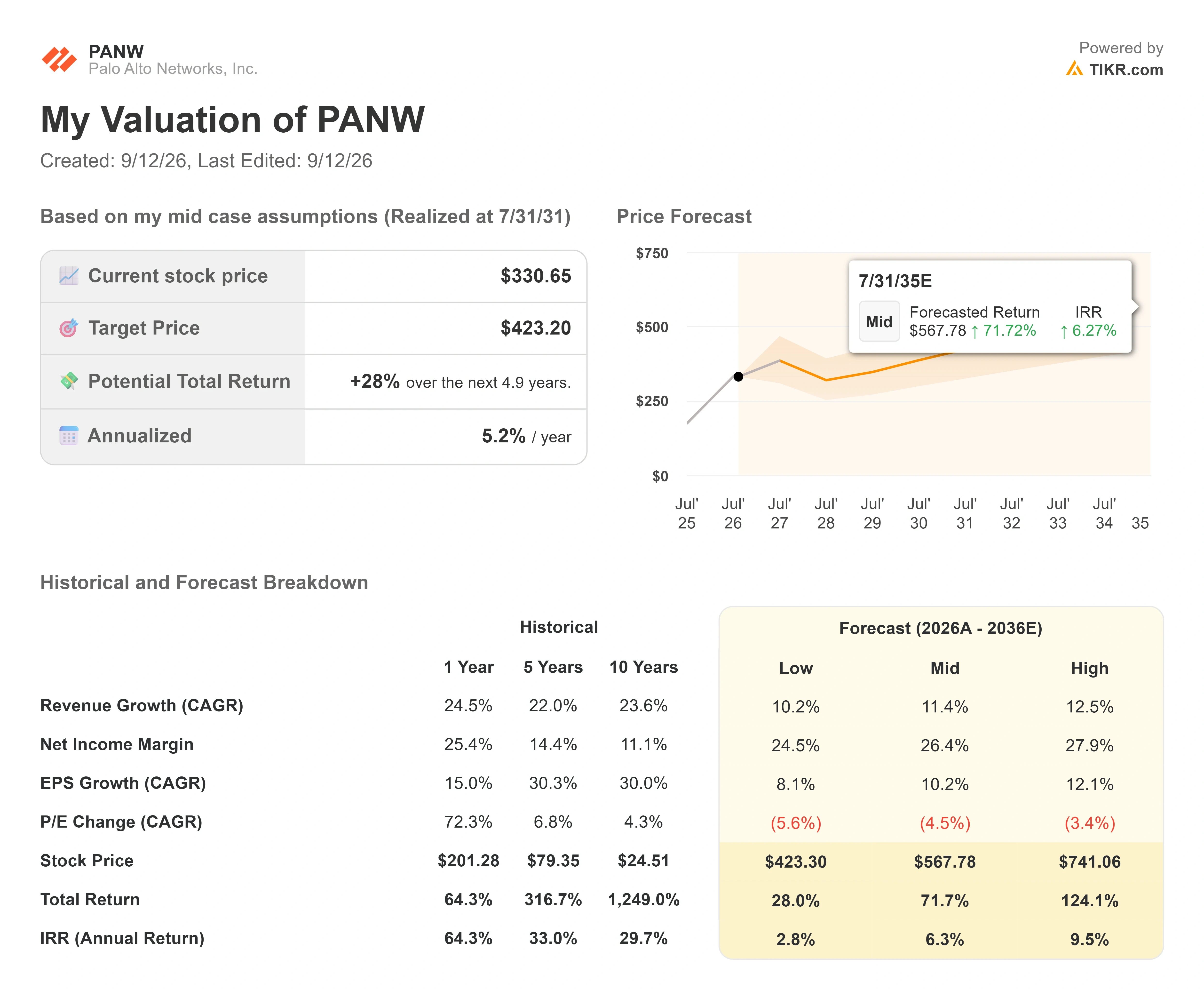
- Current Price: $330.65
- Target Price (Mid): ~$423
- Potential Total Return: ~28%
- Annualized IRR: ~5% / year
See analysts’ growth forecasts and price targets for Palo Alto Networks stock (It’s free!) >>>
On mid-case assumptions realized at July 2031, the model lands near $423, about 28% total return over 4.9 years, or roughly 5% a year. That is the model as skeptic: the business grows, but from this multiple, the return is ordinary.
- Revenue drivers: platform consolidation, where customers replace point vendors with Palo Alto’s integrated stack and lift spend per account, and the expansion of AI-security products like Prisma AIRS into a category that barely existed two years ago.
- Margin driver: the software and subscription mix shift, which pushes net margin toward the mid-20s as the platform scales.
- Primary risk: the model’s own math assumes the P/E compresses about 4.5% a year. If growth normalizes while that derating continues, the return thins fast.
- Upside: faster compounding with a steadier multiple pushes the high case toward $567, roughly 72% total return.
- Downside: the low case delivers only about 28% total return over the full forecast, roughly 3% a year, barely ahead of cash.
The model’s ~$423 mid target sits above the Street mean of ~$393. Both point in the same direction, and both call for modest annual returns, not doubling the stock delivered off its February low.
Conclusion
The next real test is fiscal Q1 2027, guided to about $3.31 billion in revenue at the midpoint. Watch the growth trajectory and whether the GAAP line turns back toward profit. A print that holds momentum near the high end and narrows the loss would mark the beat-and-drop pattern as noise. A softer guide would say the market was right to sell the beats. The stock does not need a miss to fall further. At 79 times earnings, it needs the growth story to stay exactly as good as it has been, and staying that good is the whole job.
See what stocks billionaire investors are buying so you can follow the smart money with TIKR.
Should You Invest in Palo Alto Networks?
The only way to really know is to look at the numbers yourself. TIKR gives you free access to the same institutional-quality financial data that professional analysts use to answer exactly that question.
Pull up Palo Alto Networks, and you’ll see years of historical financials, what Wall Street analysts expect for revenue and earnings in the quarters ahead, how valuation multiples have moved over time, and whether price targets are trending up or down.
You can build a free watchlist to track Palo Alto Networks alongside every other stock on your radar. No credit card required. Just the data you need to decide for yourself.
Analyze Palo Alto Networks on TIKR Free →
Looking for New Opportunities?
- See what stocks billionaire investors are buying so you can follow the smart money.
- Analyze stocks in as little as 5 minutes with TIKR’s all-in-one, easy-to-use platform.
- The more rocks you overturn… the more opportunities you’ll uncover. Search 100K+ global stocks, global top investor holdings, and more with TIKR.
Disclaimer:
Please note that the articles on TIKR are not intended to serve as investment or financial advice from TIKR or our content team, nor are they recommendations to buy or sell any stocks. We create our content based on TIKR Terminal’s investment data and analysts’ estimates. Our analysis might not include recent company news or important updates. TIKR has no position in any stocks mentioned. Thank you for reading, and happy investing!