Key Takeaways
- TSMC stock is up 23% in 2026, but it has trailed AMD and Micron and is well below its October high after worries about AI spending hit chip stocks.
- The business keeps beating its own plan: October revenue rose 59.7% to a record, and management now expects about 44% growth this year, up from about 30% in January.
- Nvidia is widely reported to be TSMC’s biggest customer, and it reports on Nov. 17; margins and 2027 demand are the main risks.
- The forward P/E is below its five-year average and 2027 earnings estimates are up since June, so the pullback looks like a chance to buy more.
Taiwan Semiconductor Manufacturing (TSM) stock is up 23% in 2026, but it has still lagged the AI chip trade it supplies. Advanced Micro Devices (AMD), whose chips TSMC makes, is up 135% this year, and memory maker Micron Technology (MU) is up 152%.
TSMC is also down 23% from its October high after fears about AI spending swept through chip stocks. And its biggest customer, widely reported to be Nvidia (NVDA), reports on Nov. 17 for the first time since Jensen Huang quit as CEO. So should you take profits, or buy more?
Demand keeps beating the plan
In January, management guided to growth of about 30% for 2026. Third-quarter revenue then rose 41.2% to $46.72 billion, above the top of guidance, and the outlook went up to about 44%. The fourth-quarter guide of $52.3 billion to $54.3 billion points to even faster growth. October was a record month, with revenue of NT$586.89 billion, up 59.7% from a year earlier.
CEO C.C. Wei put it plainly on TSMC’s Oct. 15 earnings call: “The demand actually is still far above our capability today to supply.”
TIKR tracks 36 analysts on TSMC. How many say “Buy”?
See the full breakdown of Buy, Hold, and Sell ratings on TSMC, along with Wall Street’s revenue and earnings estimates, all in one place. More than 500,000 investors use TIKR to research stocks like this one. See TSMC’s Analyst Ratings
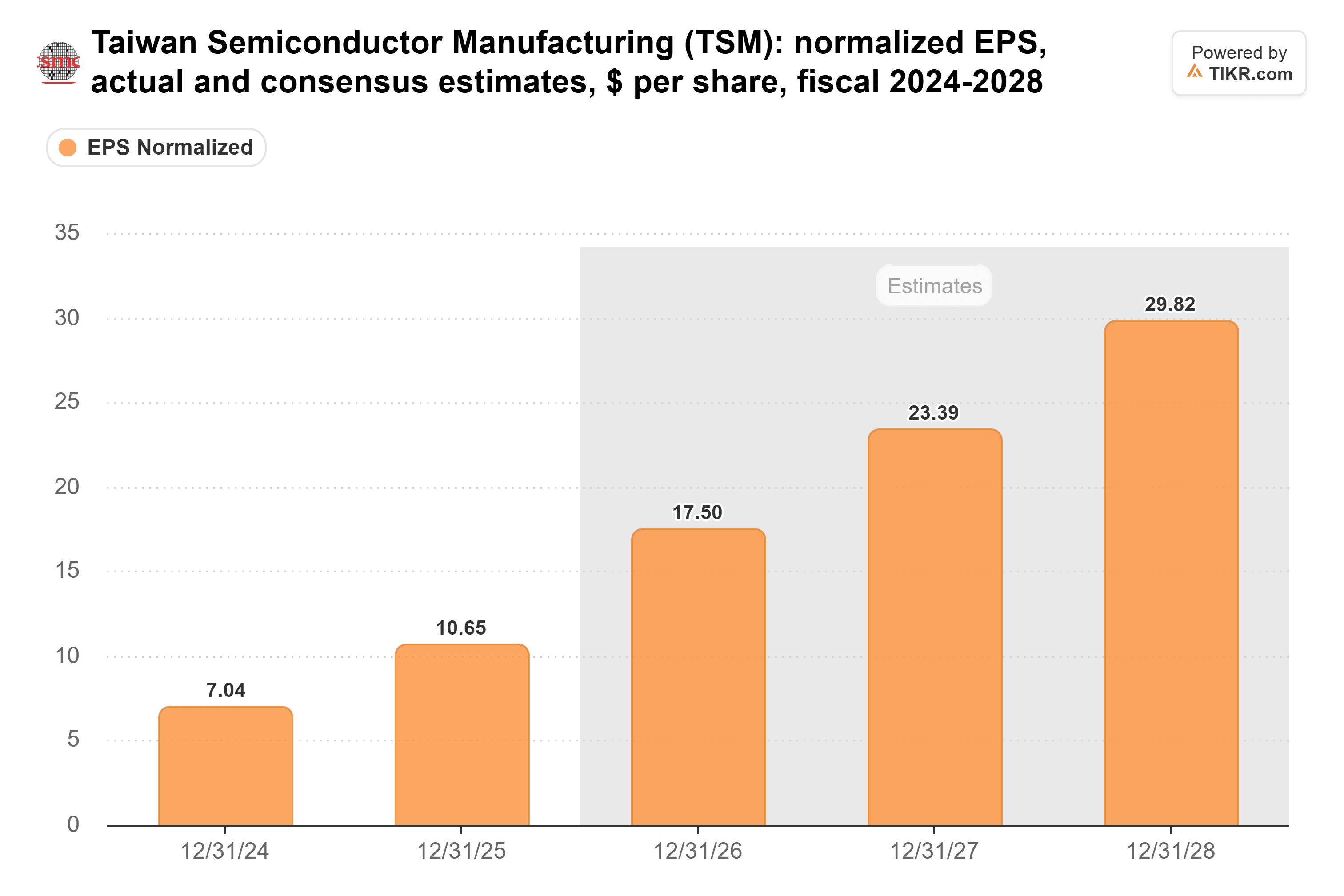
Analysts expect that demand to more than double TSMC’s normalized EPS from 2025 to 2027:
The selling started elsewhere
Intel’s weak outlook at the end of October hit the whole chip group. Then on Nov. 5, the rout deepened on three pieces of news. Democrats’ midterm wins raised fears of a slower AI build-out, TSMC customer Qualcomm warned about memory costs, and Bloomberg reported that Micron had paused its $4.5 billion Taiwan plant. TSMC had no news of its own that day.
Nvidia’s shake-up is closer to home. TSMC’s largest customer, which it doesn’t name, made up 19% of its 2025 revenue, and Nvidia is widely reported to be that customer. A new CEO won’t change how many wafers an AI chip takes, but Nvidia’s outlook is the next read on those orders.
Its customers ran further
AMD’s run comes from its own AI business: third-quarter data center revenue hit a record $8.5 billion, up 97%. After Huang left, investors moved more money from Nvidia into AMD and other rivals. TSMC makes those chips too, and the startups taking on Nvidia are competing for the same TSMC capacity.
Micron is a different case. Its gains rest on tight memory supply, and higher memory prices hurt some of TSMC’s customers: Wei said in October that rising component costs are squeezing consumer markets. The Information also reported on Nov. 6 that TSMC is weighing a move into 3D DRAM at Nvidia’s request, which would make it a Micron rival. TSMC hasn’t confirmed it.
Cheaper than it usually trades
Growth isn’t free, either. Third-quarter gross margin slipped to 66.4% as early 2nm output weighed on it. TSMC also plans $60 billion to $64 billion of capital spending this year, mostly for capacity that arrives in 2028 and 2029. And Wei said the company is “being prudent in our business planning going into 2027.”
The market is already pricing in some of that caution. TSMC traded at 16.5x forward earnings on Nov. 13, below its five-year average of 18.1x and well under its 25.4x peak in July 2024:
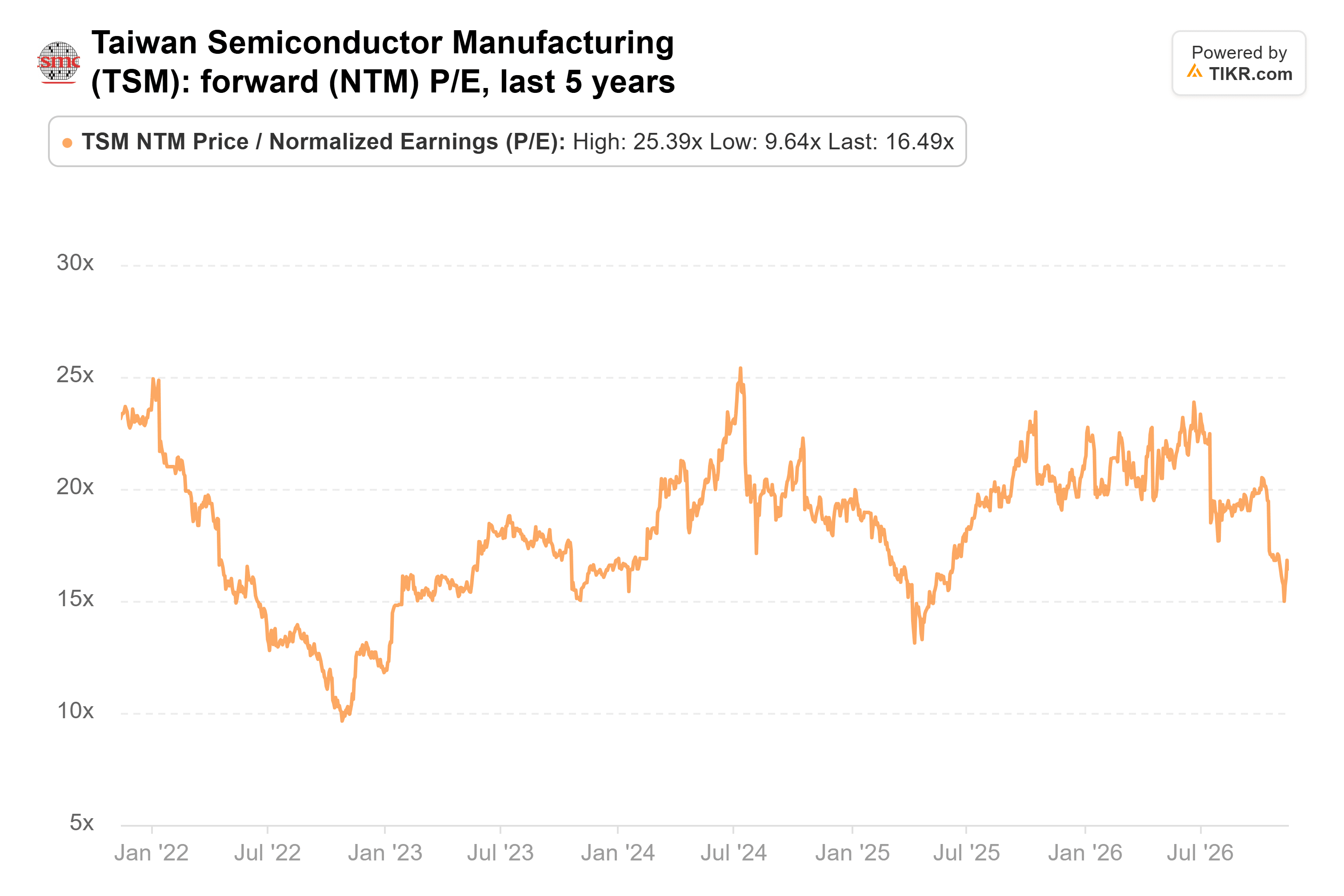
At today’s price, it’s even lower. Meanwhile, analysts raised their 2027 EPS estimate 16% from June 30 to Oct. 23, and Wall Street’s average price target of $587 is about 57% above the last close.
I’d buy more. TSMC gets paid whichever chip designer wins, and demand keeps running ahead of its own forecasts. Nvidia’s report is the first test. November sales come out in early December, and the 2027 outlook, expected in mid-January, will show whether demand can keep up with all that new capacity.
So what is TSMC stock actually worth?
TIKR lets you forecast the future price of any stock in less than a minute. Just enter a few assumptions into TIKR’s valuation model and see what TSMC could be worth. Start from Wall Street consensus estimates, or adjust the inputs to reflect your own view of the business. It’s free to use.
Disclaimer:
Please note that the articles on TIKR are not intended to serve as investment or financial advice from TIKR or our content team, nor are they recommendations to buy or sell any stocks. We create our content based on TIKR Terminal’s investment data and analysts’ estimates. Our analysis might not include recent company news or important updates. TIKR has no position in any of the stocks mentioned. Thank you for reading, and happy investing!