Key Takeaways
- Bank of America raised its AMD price target to $700 from $650 on Nov. 12 and kept its Buy rating, 39% above the stock’s $504.28 close on Nov. 16.
- Its case rests on AMD’s server CPUs, where sales more than doubled in the third quarter and management expects server revenue to double in 2027.
- At $700, AMD would trade at 47x forward earnings, above its five-year average of 35x, though 2027 estimates have risen from $15.32 to $17.64 a share in 90 days.
- BofA is bullish on the right part of AMD, but its GPU deals carry warrants for up to 320 million shares, so per-share earnings could grow more slowly than the business.
Advanced Micro Devices (AMD) is up 104% in a year, and Bank of America sees more to come. On Nov. 12, analyst Vivek Arya raised his price target to $700 from $650 and kept his Buy rating, 39% above the stock’s $504.28 close on Nov. 16.
The raise came the same day Nvidia said CEO Jensen Huang had resigned. Arya’s case, though, rests on AMD’s server CPUs.
Server sales more than doubled
AMD’s third-quarter revenue rose 45% to a record $13.4 billion, as its Data Center segment nearly doubled to $8.5 billion. In servers, CEO Lisa Su said on the Nov. 3 call that cloud and enterprise sales both more than doubled from a year earlier. Venice, AMD’s newest EPYC server chip, is off to a strong start: “Early demand is the strongest we have seen for any new EPYC generation,” Su said. Management now expects server revenue to double in 2027, and total revenue to grow more than 80%.
Bank of America is betting on the CPU lineup
Arya tied the raise to AMD’s product lineup and how it executes on Zen 6, the architecture behind Venice. He also pointed to AMD’s lead in clock speeds, core counts and thread counts, and to better visibility into supply, and lifted BofA’s 2030 server CPU market estimate to more than $240 billion from $210 billion. Supply is the bottleneck: Su said on the call that demand is running ahead of supply.
The new target is still below the $720 Arya set in September. He cut it to $650 after the third-quarter report, citing lower sector multiples. It now sits 6% above the consensus target, which has climbed from $277 to $658 in a year:
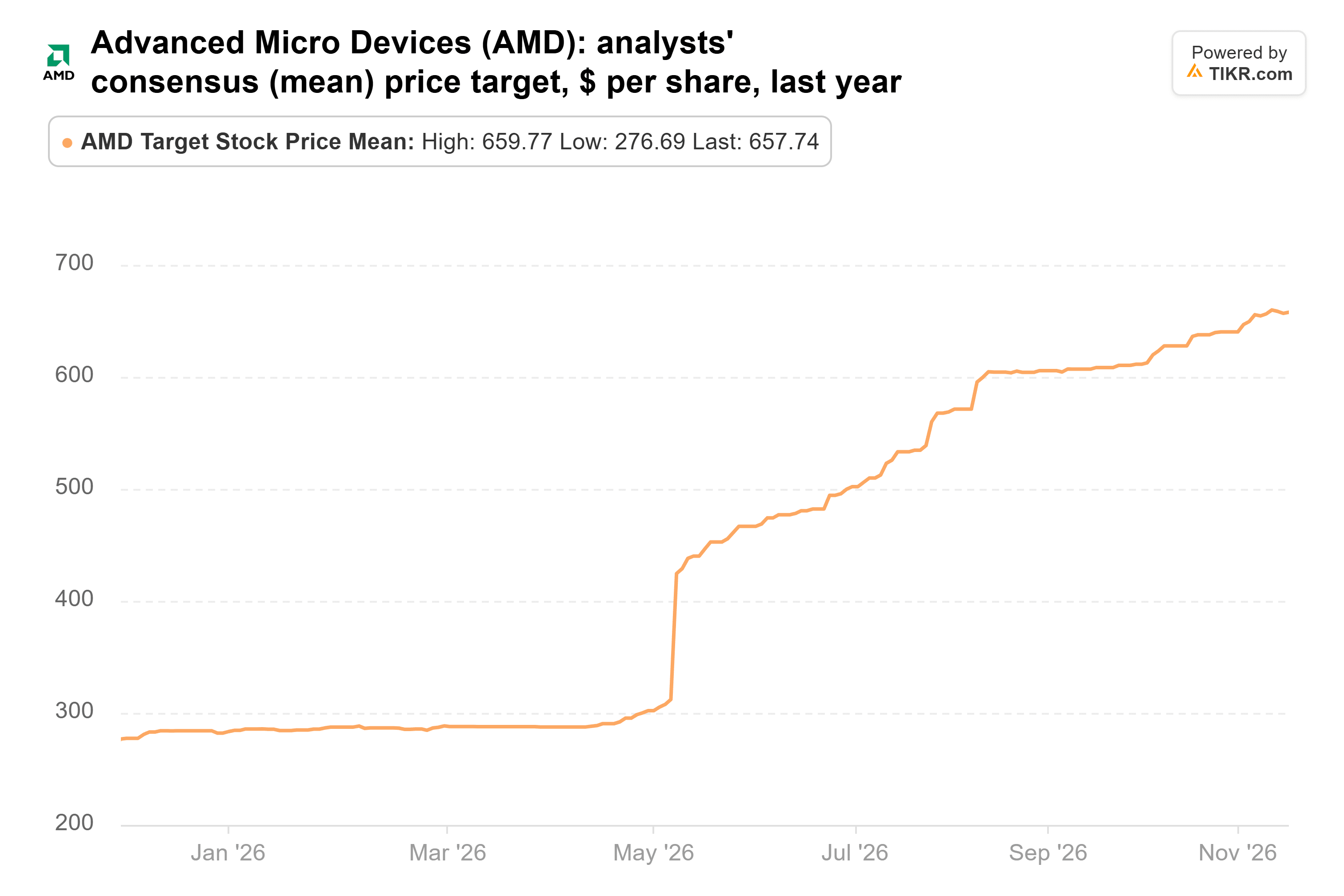
The 54 analysts covering AMD have targets from $525 to $1,250.
TIKR tracks 54 analysts on AMD. How many say “Buy”?
See the full breakdown of Buy, Hold, and Sell ratings on AMD, along with Wall Street’s revenue and earnings estimates, all in one place. More than 500,000 investors use TIKR to research stocks like this one. See AMD’s Analyst Ratings
Does $700 add up?
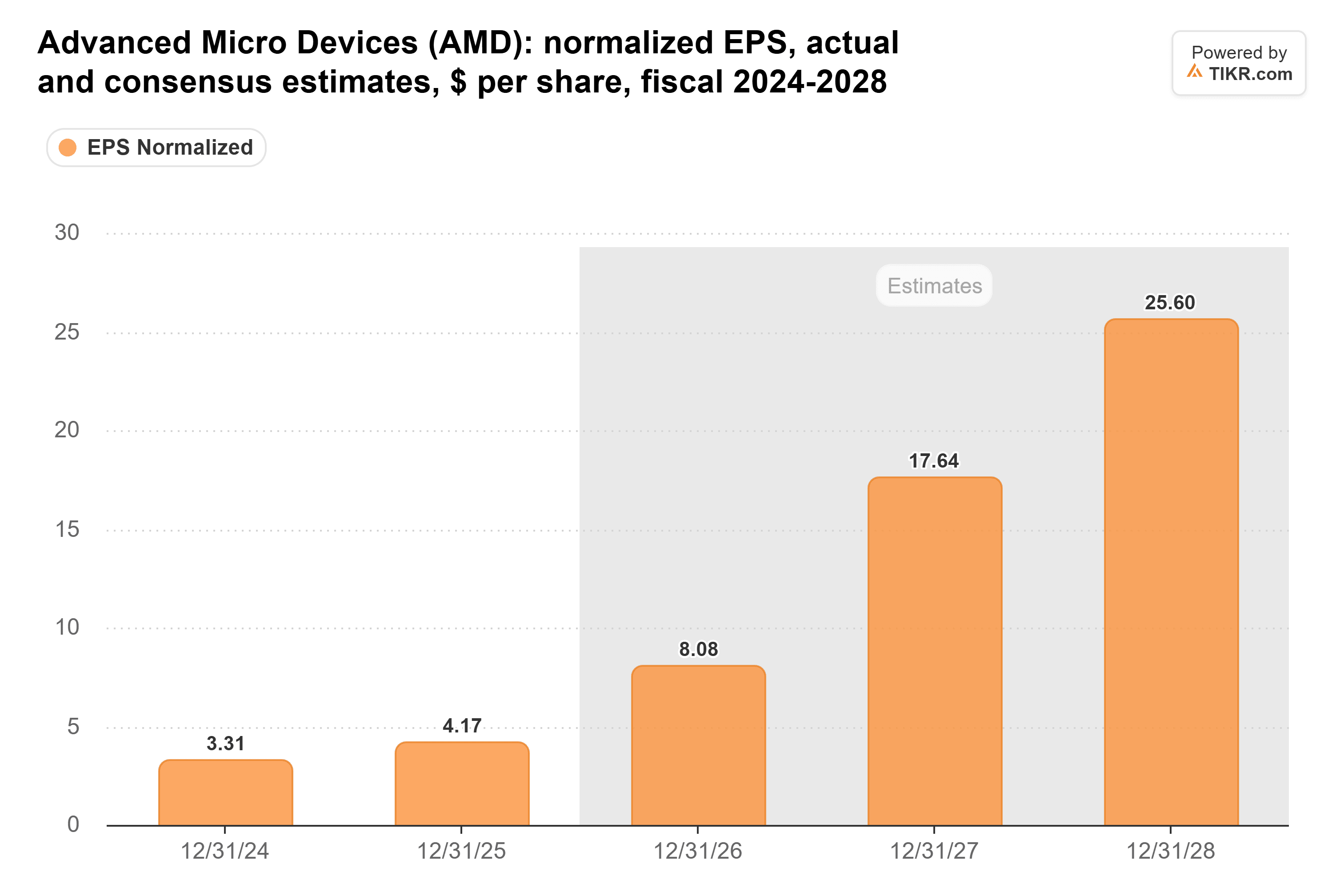
Consensus 2027 normalized earnings are $17.64 a share, up from $15.32 90 days ago, after $4.17 in 2025:
Analysts expect $15.05 a share over the next twelve months, so $700 works out to 47x forward earnings. That’s well above AMD’s five-year average of 35x, which is close to where the stock trades now:
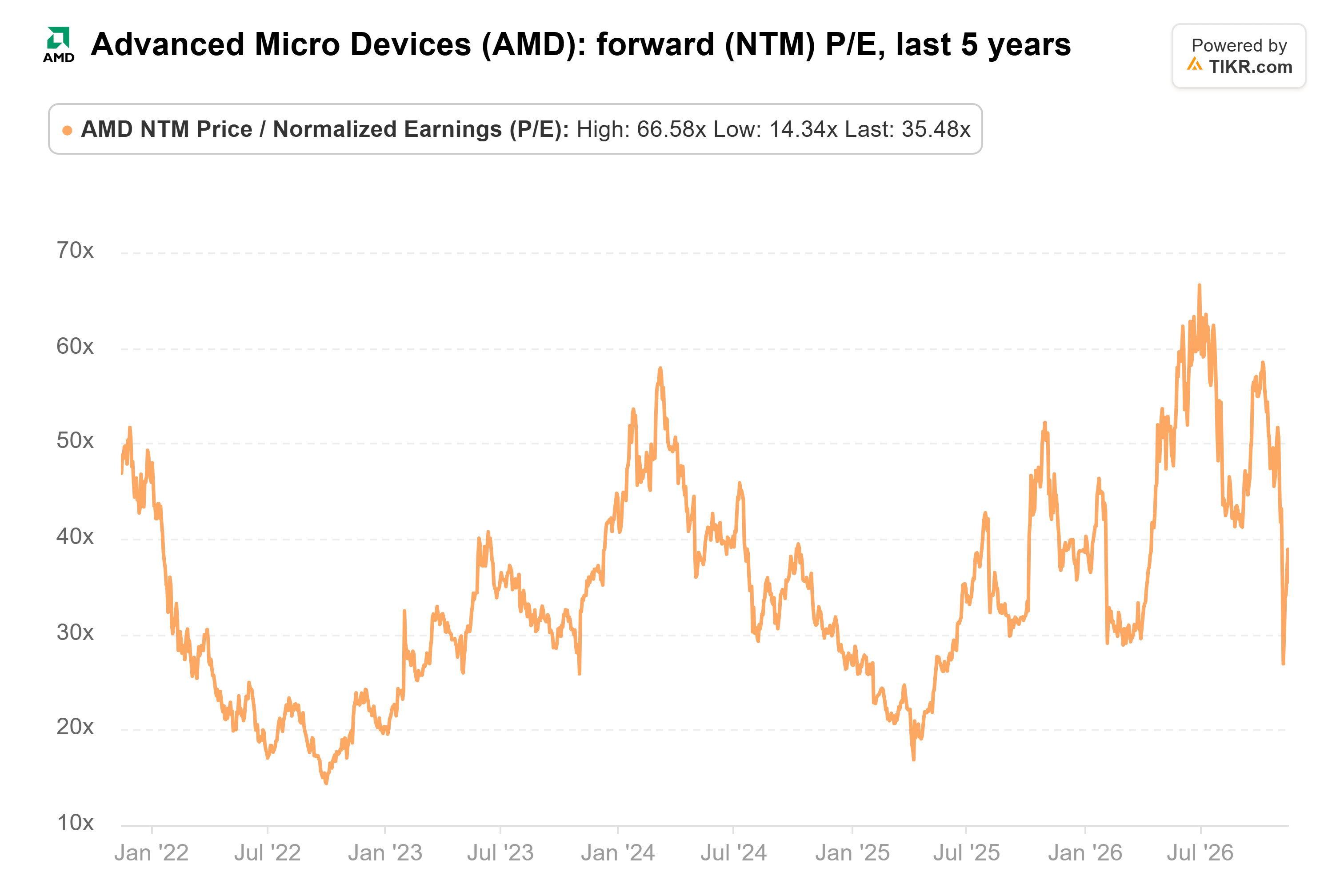
It’s also far below the 67x AMD hit in June. And that multiple shrinks as 2027’s $17.64 rolls into the forward year, if the estimates hold.
The catch is the share count
The PC market is one risk, with Su expecting a double-digit drop in PC unit shipments in 2027. The bigger one sits on the GPU side, which BofA isn’t leaning on. To win OpenAI and Meta as Helios customers, AMD granted each warrants for up to 160 million shares at a penny apiece, together nearly a fifth of its shares outstanding. The final tranche of each needs 6 gigawatts deployed and a $600 share price, a bar BofA’s target clears. CFO Jean Hu said the warrants’ quarterly noncash charges should keep rising “as we and our customers progress under this agreement.”
BofA is bullish on the right part of AMD, and the estimates behind $700 keep climbing. But the GPU deals come with shares attached, so per-share earnings could grow more slowly than the business. AMD’s fourth-quarter report, expected in early February, is the first with Helios shipping in big numbers, and the next read on whether server revenue is on pace to double.
So what is AMD stock actually worth?
TIKR lets you forecast the future price of any stock in less than a minute. Just enter a few assumptions into TIKR’s valuation model and see what AMD could be worth. Start from Wall Street consensus estimates, or adjust the inputs to reflect your own view of the business. It’s free to use.
Disclaimer:
Please note that the articles on TIKR are not intended to serve as investment or financial advice from TIKR or our content team, nor are they recommendations to buy or sell any stocks. We create our content based on TIKR Terminal’s investment data and analysts’ estimates. Our analysis might not include recent company news or important updates. TIKR has no position in any of the stocks mentioned. Thank you for reading, and happy investing!