


Key Takeaways
- Meta unveiled its $1,299.99 VR Glasses on Sept. 23, and Bloomberg’s Mark Gurman called the device “VR’s last stand.”
- If the headset flops, Meta’s earnings will barely notice: its apps made more than $5 of operating income for every $1 Reality Labs lost in 2025.
- Meta’s operating margin was 41.4% in fiscal 2025, even after Reality Labs lost $19.19 billion.
- Gurman calls Meta the number one player in smart glasses, and that’s the hardware story to watch.
Meta Platforms (META) unveiled its lightest VR device yet at its Connect event on Sept. 23. The $1,299.99 Meta VR Glasses weigh about 100 grams because the processor, battery, and storage sit in a separate 300-gram puck. They’re due in spring 2027.
On the Oct. 8 episode of Bloomberg’s Power On podcast, Vlad Savov said the launch would settle an old question: “Was it the hardware that was holding it back, or was it the content?”
Bloomberg’s Mark Gurman, best known for breaking Apple news, put it more bluntly:
“This is VR’s last stand. If this device at this weight and price point and functionality is not what makes VR successful, nothing will.”
No pressure, then.
Two very different hardware stories
Gurman is down on VR, though he has plenty of praise for the rest of Meta’s hardware. He thinks Meta’s move to put its smart glasses under the Ray-Ban and Oakley brands is going to “go down as a big business textbook success story.”
On smart glasses and spatial computing more broadly, he was even clearer: “You have to look at Meta and consider them the number one player in the space.”
That lead matters because Apple (AAPL) is the rival everyone’s waiting on. Gurman thinks Apple will launch smart glasses and that “they’ll be very successful just because of the Apple brand.” He also said, “Apple is still a year away.”
So far, the glasses look like a win, but the headset is still unproven, and it hasn’t come cheap.
The bill so far
Meta doesn’t report VR results on their own. According to Meta’s annual report, Reality Labs, which holds the headsets and the glasses alike, lost $19.19 billion in 2025, up from $17.73 billion in 2024. Over the same year, the Family of Apps segment earned $102.47 billion in operating income.
In other words, the apps made more than $5 for every $1 Reality Labs lost. That’s why Meta’s company-wide operating margin has stayed high through years of those losses…

Here’s the math on the latest year. Meta’s operating income was $83.28 billion on $200.97 billion of revenue in 2025. Add back the Reality Labs loss, and operating income would have been $102.47 billion, or a margin of about 51%. So Reality Labs costs Meta about 10 points of margin, and Meta still kept a well-above-average 41.4%.
Zuckerberg can afford to keep going
Decoder host Nilay Patel pointed this out on his Oct. 8 episode while talking about Meta giving its Muse AI agent away for free. In his words, Meta has “a giant advertising business that prints money,” and “Mark Zuckerberg has been shown willing to blow money trying to win a market as he did with Reality Labs for years and years and years.”
“And they can just run it till it works.”
The cash flow backs him up…

Free cash flow slipped from $54.1 billion in fiscal 2024 to $46.1 billion in fiscal 2025, which still leaves Meta with tens of billions of dollars a year after paying for its spending on data centers and devices.
Of course, the losses aren’t getting smaller. Reality Labs lost more in 2025 than it did in 2024, and a headset that won’t ship until next spring isn’t going to change that anytime soon.
Here’s the thing: Wall Street isn’t counting on VR
If the VR Glasses flop, the hit to earnings is small. Analysts expect Meta’s normalized EPS to rise from $29.68 in fiscal 2025 to $39.66 by fiscal 2028…
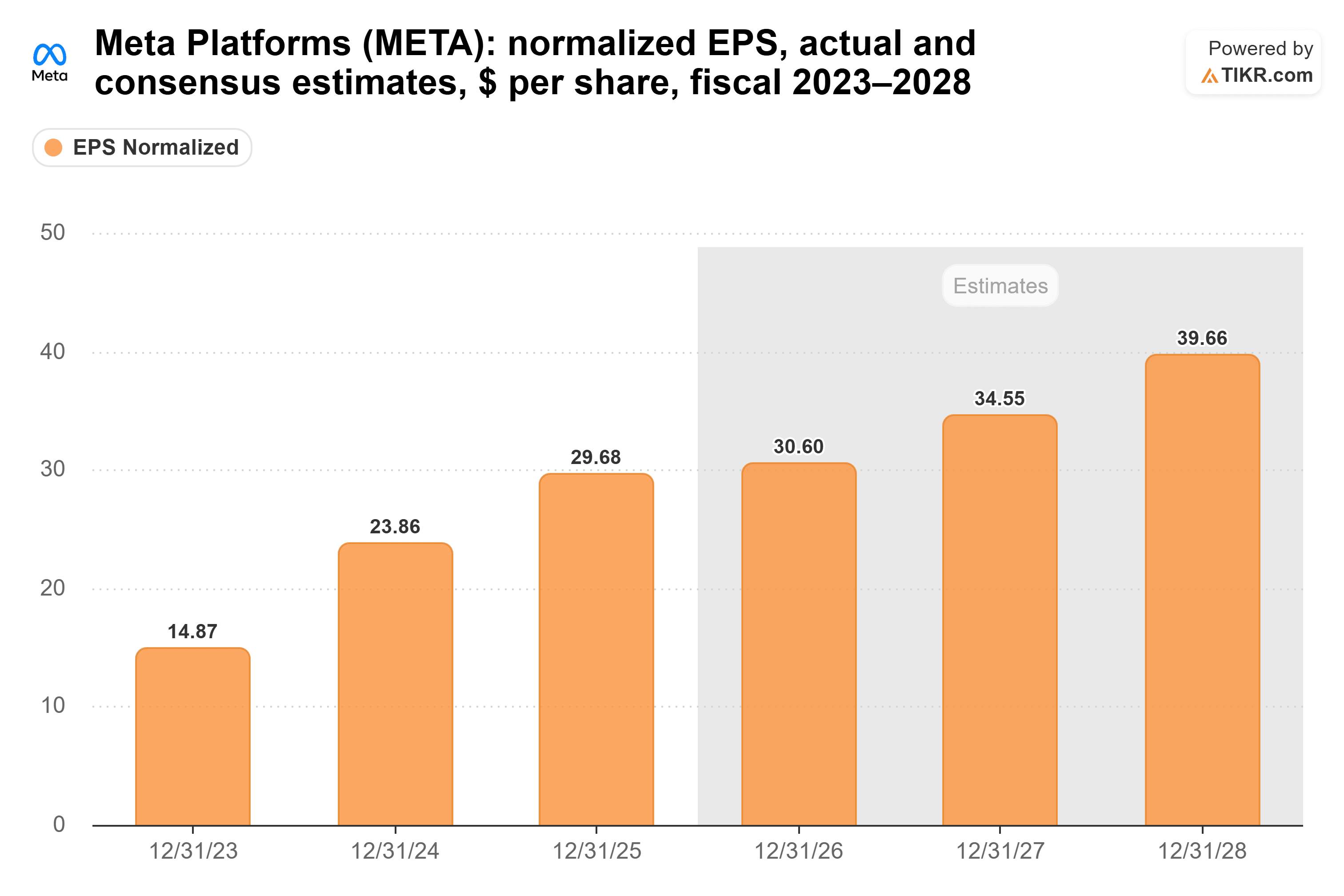
A $1,300 headset that won’t be on shelves until spring 2027 was never going to move these numbers, and nothing I saw at Connect makes me think analysts will cut their estimates.
The glasses are where I’d look instead. Savov put it well on Power On: “Meta is saying AI, and our particular AI, is the only reason we have hardware.” Now for my own speculation. If Meta is really far ahead in smart glasses, it could put its AI in front of people all day, every day, and a niche VR headset can’t do that.
So is this VR’s last stand?
For VR, Gurman may well be right. If a 100-gram headset can’t win people over, it’s hard to see what will.
For Meta shareholders, though, a flop looks like an expensive experiment that the ad business can easily pay for. The company already leads in smart glasses, and that’s the hardware that could matter more.
The first real test comes when the VR Glasses go on sale in spring 2027. The other is Apple’s glasses, which Gurman says are about a year away. Until then, watch Reality Labs’ losses in each quarterly report.
So what is Meta stock actually worth?
TIKR lets you forecast the future price of any stock in less than a minute. Just enter a few assumptions into TIKR’s valuation model and see what Meta could be worth. Start from Wall Street consensus estimates, or adjust the inputs to reflect your own view of the business. It’s free to use.
Disclaimer:
Please note that the articles on TIKR are not intended to serve as investment or financial advice from TIKR or our content team, nor are they recommendations to buy or sell any stocks. We create our content based on TIKR Terminal’s investment data and analysts’ estimates. Our analysis might not include recent company news or important updates. TIKR has no position in any of the stocks mentioned. Thank you for reading, and happy investing!


