


Key Takeaways
- SemiAnalysis founder Dylan Patel says Oracle signed its big AI cloud deals with what is essentially a fixed margin, so it can’t benefit now that GPU rental prices have risen sharply.
- Rivals are raising prices: CoreWeave raised its GPU prices 25% in July and another 10% since then, and Patel says Nebius has raised its prices too.
- Oracle’s gross margin fell from 79.1% in fiscal 2022 to 65.8% in fiscal 2026, while its total debt more than doubled to $167 billion.
- Watch for the terms of Oracle’s reported chip-financing talks with Apollo and Goldman Sachs, and for its gross margin in the next report.
Oracle (ORCL) signed a string of massive AI data center deals with OpenAI about a year ago. Since then, the price of renting out a GPU has gone up a lot.
SemiAnalysis founder Dylan Patel thinks Oracle will see very little of that windfall. Here’s how he put it on this week’s episode of the Big Technology Podcast:
“…they signed these massive deals and there’s a number of risks embedded with them. One is they signed them with a fixed margin, essentially. So now that the price of GPUs has gone up a lot for clouds, they can’t take advantage of this higher margin.”
Ouch.
That’s rough timing for a company with more than $169 billion of debt and a stock sitting 45% off its June highs. And it gets worse – Oracle is reportedly in talks with Apollo Global Management (APO) and Goldman Sachs (GS) to finance even more AI chips.
Just how much have GPU prices gone up?
Plenty. CoreWeave (CRWV) has raised its per-hour GPU prices twice, according to Insider Monkey. The first raise was 25% across all products in July, and the second was another 10% over the past two to three months.
Stack those, and 1.25 times 1.10 gets you to 1.375. That’s 37.5% more per GPU hour than before July (at least where the new pricing applies).
By Patel’s telling, Nebius (NBIS) has done even better. It has the shortest average contract length of the top clouds SemiAnalysis rates, so it “has been able to turn around and really jack up pricing and take advantage of this.”
Here’s where analysts see Nebius’ revenue heading…
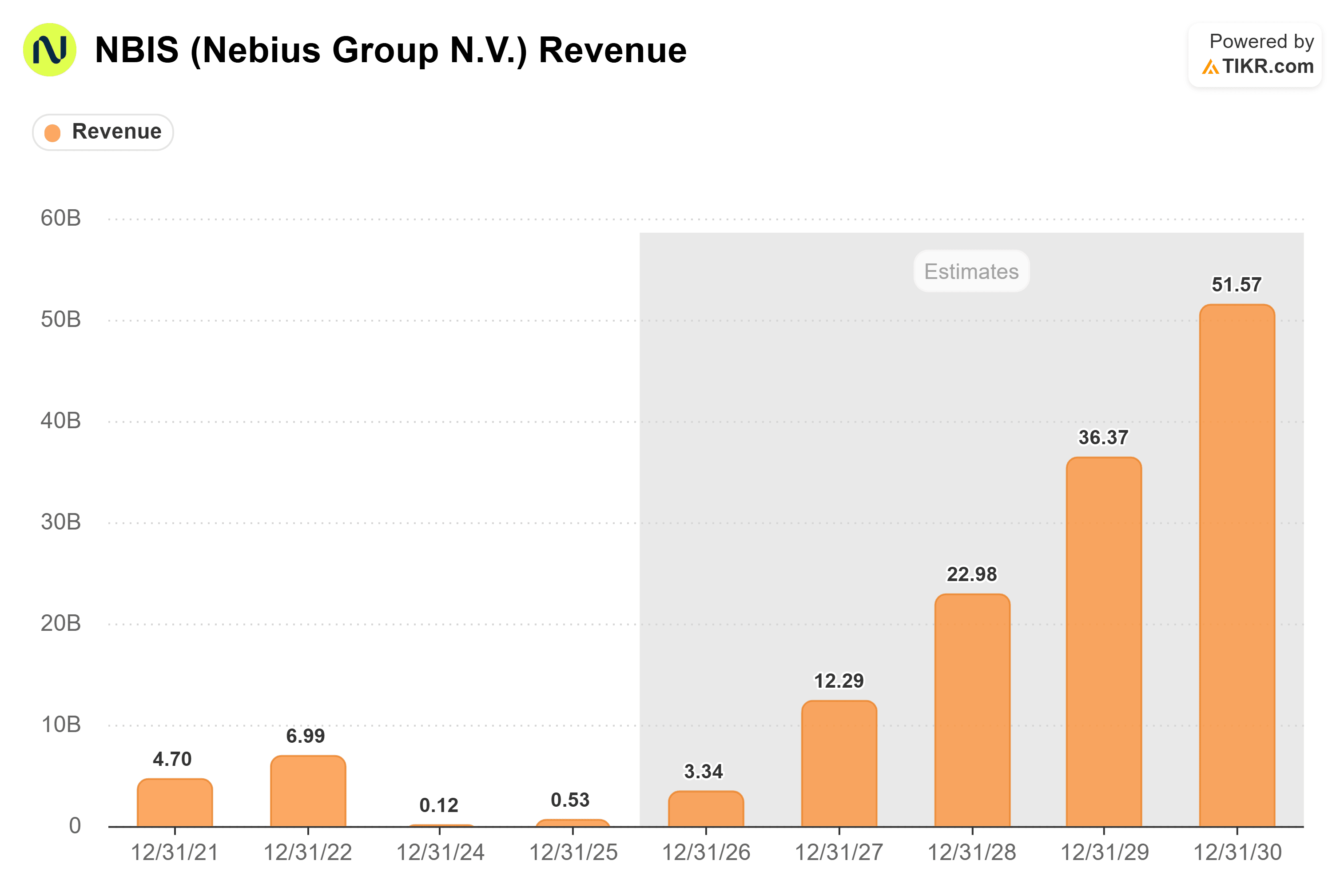
With that growth profile, I bet Nebius isn’t having too much trouble securing debt…and if they are, they can always issue equity instead.
Interestingly, Patel puts CoreWeave in Oracle’s camp, despite those price hikes. He says the two “were not able to take as much advantage because they locked themselves into long-term contracts primarily.”
The margin was already sliding
Oracle’s management has said it expects gross margins of 30% to 40% on its AI data centers over the life of a customer contract.
That’s well below what the rest of Oracle earns. So the bigger AI infrastructure gets, the more it drags down the company’s overall gross margin. That margin fell from 79.1% in fiscal 2022 to 65.8% in fiscal 2026 (the year to May 2026)…

And if the margin on those contracts is set, rising GPU prices can’t pull it back up in the near term.
And then there’s the debt
Of course, building all that capacity doesn’t come cheap. Oracle’s total debt more than doubled, from $75.9 billion in fiscal 2022 to $167 billion in fiscal 2026…

And by August, it was even higher: $169.1 billion.
To be fair, Patel doesn’t think Oracle is in trouble. He calls it “completely solvent,” and he says SemiAnalysis rates it “one of the top neoclouds in terms of quality of service.”
Steve Eisman, the investor made famous by The Big Short, is more worried. On the Oct. 2 episode of Prof G Markets, he said Oracle’s credit rating is BBB minus, one notch above junk, and that “Oracle does not want to get downgraded to junk.”
His summary? “…when you’re rated triple B minus, things can get ugly.”
By the same token, a locked-in contract has certain benefits. If GPU rental prices fall, the same short contracts that let Nebius raise prices quickly would let them come down quickly, while Oracle’s deals hold.
Those long contracts are also a big part of why lenders like Apollo and Goldman would finance chips for Oracle at all. A multi-year customer commitment is easier to lend against than a price that resets every few months.
So it cuts both ways.
Here’s how things could get ugly quickly:
There are two scenarios where I could see things going sour quickly. In the first, two things happen at once: GPU prices keep climbing, so Oracle keeps missing the upside its rivals are getting. Meanwhile, its debt keeps growing to build capacity it can’t reprice. That’s pressure on the margin and the balance sheet at the same time, at a company that’s already struggling a bit under its debt load.
The other scenario is a broader macro reset (probably a severe economic contraction) where demand falls so precipitously that Oracle’s long-term contracts come back and renegotiate for lower prices and/or less capacity. That means Oracle misses out on building its cash cushion during the good times and still gets hit when the macro environment turns, again making its debt load all the more unsustainable.
But by the same token – nothing risked, nothing gained. Oracle is making a big bet here, and if it pays off…there’s a lot of upside.
So what is Oracle stock actually worth?
TIKR lets you forecast the future price of any stock in less than a minute. Just enter a few assumptions into TIKR’s valuation model and see what Oracle could be worth. Start from Wall Street consensus estimates, or adjust the inputs to reflect your own view of the business. It’s free to use.
Disclaimer:
Please note that the articles on TIKR are not intended to serve as investment or financial advice from TIKR or our content team, nor are they recommendations to buy or sell any stocks. We create our content based on TIKR Terminal’s investment data and analysts’ estimates. Our analysis might not include recent company news or important updates. TIKR has no position in any of the stocks mentioned. Thank you for reading, and happy investing!


