Key Takeaways
- DraftKings closed at $19.15 on Oct. 7, 2026, down 42% from a year earlier, and Guggenheim’s new $30 target implies 57% upside.
- Guggenheim cut its target from $33 because it now expects DraftKings to spend about $400 million on Predictions this year, more than the $200 million to $300 million management laid out.
- Analysts have cut their 2026 earnings estimate from $1.07 a share 90 days ago to $0.88, while their 2027 estimate is $1.68, against $1.71 90 days ago.
- The call is plausible but stretched: $30 needs investors to pay 25.2x forward earnings for a stock trading at 16.1x today.
DraftKings (DKNG) closed at $19.15 on Oct. 7, 2026, down 42% from a year earlier. That morning, Guggenheim cut its price target to $30 from $33 but kept its Buy rating, which still implies 57% upside.
How DraftKings got here
The slide started on Feb. 12, when DraftKings guided to 2026 revenue of $6.5 billion to $6.9 billion and adjusted EBITDA of $700 million to $900 million, below what analysts expected. The stock fell 13.5% the next day.
On Aug. 6, second-quarter revenue fell 5% to $1.44 billion, and DraftKings swung to a $67.6 million net loss. Management blamed customer-friendly game results and heavier promotions to win Sportsbook and Predictions customers.
By September, the worry was Kalshi pulling in sports volume (TIKR covered an 8% drop on Sept. 30).
Why Guggenheim still likes it
Guggenheim’s Curry Baker cut his target because he now assumes about $400 million of net investment in Predictions this year, above the $200 million to $300 million management laid out. He expects DraftKings to frame the extra spending as money pulled forward from next year on strong customer sign-ups.
Does $30 add up?
Most of Wall Street agrees with Guggenheim: 26 Buys and five Outperforms, against five Holds and one Underperform. But their targets have fallen with the price.
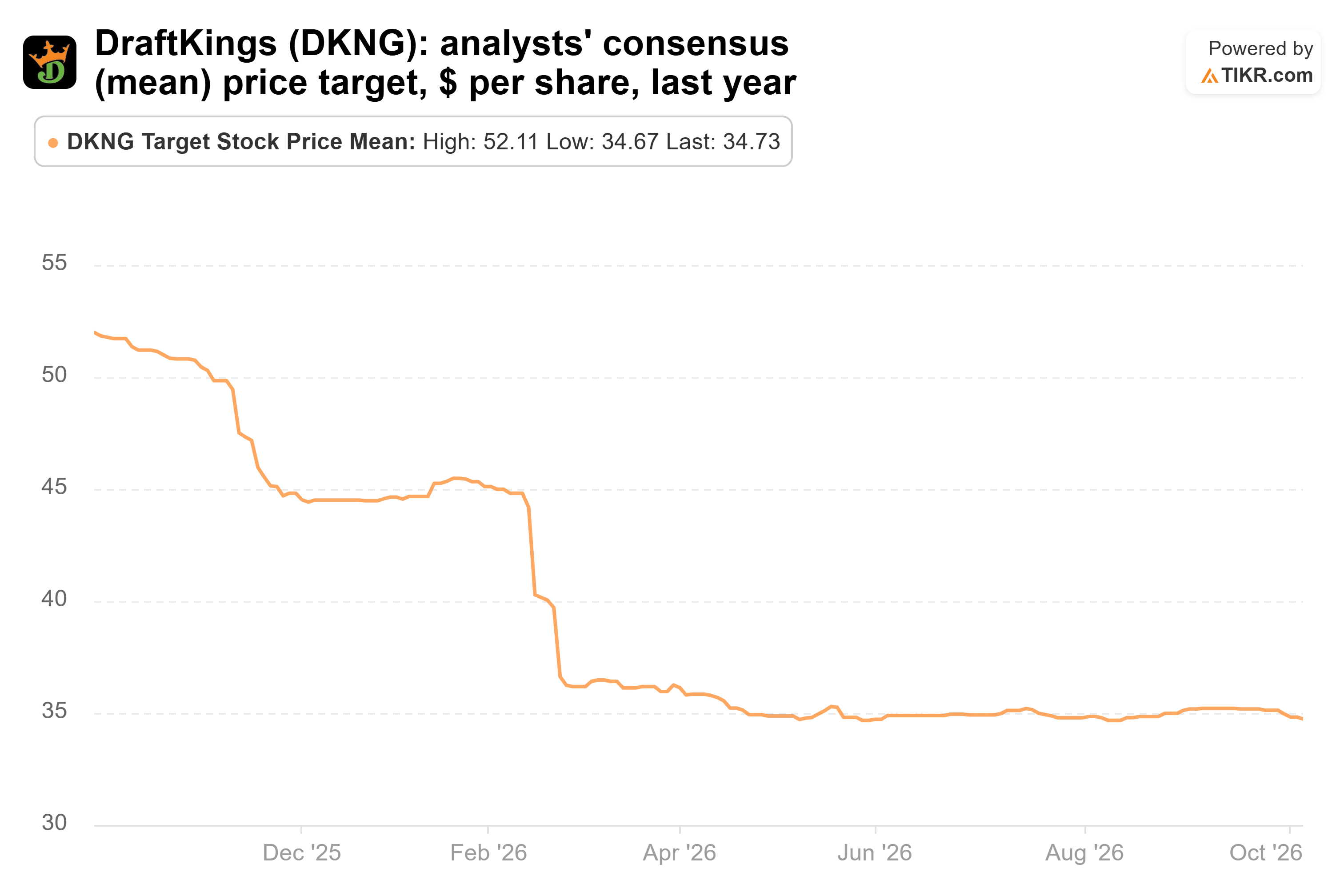
The consensus target is down from $52 a year ago to $35.
The estimates are split. Analysts have cut their 2026 earnings forecast from $1.07 a share 90 days ago to $0.88, while 2027’s sits at $1.68, against $1.71 90 days ago.

The cuts are landing on this year, when the Predictions spending happens, and they could get deeper if other analysts adopt Guggenheim’s $400 million.
DraftKings trades at 16.1x forward earnings, above its five-year average of 12.9x. That history is a weak guide: in February 2024 alone, the multiple swung from -234.3x to 158.5x, the year DraftKings earned $0.24 a share.

At $19.15 and 16.1x, the market is pricing in about $1.19 a share over the next twelve months. Guggenheim’s $30 divided by $1.19 is 25.2x, well above both today’s multiple and the five-year average.
So is Guggenheim right?
The risk is that Predictions eats cash longer than expected while Kalshi keeps winning sports volume.
I think the call is plausible but stretched. The 2027 estimates back it, but $30 needs 2026 estimates to stop falling and a market willing to pay 25.2x for DraftKings’ earnings.
The third-quarter report is the test. If management holds its $700 million to $900 million adjusted EBITDA guidance despite the bigger Predictions bill, $30 starts to look a lot more reasonable.
So what is DraftKings stock actually worth?
TIKR lets you forecast the future price of any stock in less than a minute. Just enter a few assumptions into TIKR’s valuation model and see what DraftKings could be worth. Start from Wall Street consensus estimates, or adjust the inputs to reflect your own view of the business. It’s free to use.
Disclaimer:
Please note that the articles on TIKR are not intended to serve as investment or financial advice from TIKR or our content team, nor are they recommendations to buy or sell any stocks. We create our content based on TIKR Terminal’s investment data and analysts’ estimates. Our analysis might not include recent company news or important updates. TIKR has no position in any of the stocks mentioned. Thank you for reading, and happy investing!