Key Takeaways
- Jensen Huang’s ouster as Nvidia’s CEO has Congress weighing tighter limits on AI chips reaching China, with Huang due at a closed-door hearing on Nov. 18.
- Tighter rules could cost Nvidia some Chinese sales, but Huawei, China’s main alternative, can’t make enough chips to take that market anytime soon.
- Bloomberg’s Mackenzie Hawkins puts Huawei’s capacity for its Ascend 950DT chip in the low hundreds of thousands and says Huawei’s own executives see China’s demand going unmet until 2030.
- The risk to watch is a Chinese lab completing a frontier training run on Huawei chips. DeepSeek reportedly plans one, but it hasn’t happened yet.
Jensen Huang’s ouster as CEO of NVIDIA (NVDA) has reopened Washington’s fight over how many American AI chips should reach China.
Huang has agreed to appear at a closed-door congressional hearing on Nov. 18, the day after Nvidia reports earnings. And Senators Jim Banks and Elizabeth Warren want to fold the AI Overwatch Act, which would tighten export controls on advanced AI chips, into the annual defense bill.
The standing worry with every new restriction is that it hands China’s market to Huawei. But Ben Buchanan, a Johns Hopkins professor who worked on export controls in the Biden White House, argued on the MTS podcast this week that China has no one ready to take it:
“The one thing China lacks is chips.”
He went further, too: “there’s never been a single Chinese system trained on Chinese chips of any kind of real capability.”
Huawei’s supply backs him up.
TIKR tracks 62 analysts on Nvidia. How many say “Buy”?
See the full breakdown of Buy, Hold, and Sell ratings on Nvidia, along with Wall Street’s revenue and earnings estimates, all in one place. More than 500,000 investors use TIKR to research stocks like this one. See Nvidia’s Analyst Ratings
Huawei has more orders than chips
Bloomberg reported in September that DeepSeek plans to deploy at least 160,000 of Huawei’s Ascend 950DT chips at a new data center in Inner Mongolia to run its models. For training, DeepSeek has so far relied on NVIDIA.
Huawei can’t deliver even that order quickly. On Odd Lots podcast this week, Bloomberg’s Mackenzie Hawkins said Huawei won’t be able to fill it for more than a year. She put Huawei’s capacity for that chip in the low hundreds of thousands: “It’s just orders of magnitude less than what NVIDIA is shipping globally.”
So one customer’s order could eat up a big share of Huawei’s 950DT supply. And Hawkins added that “Huawei’s senior executives themselves say it’ll take until 2030 to satiate domestic demand.”
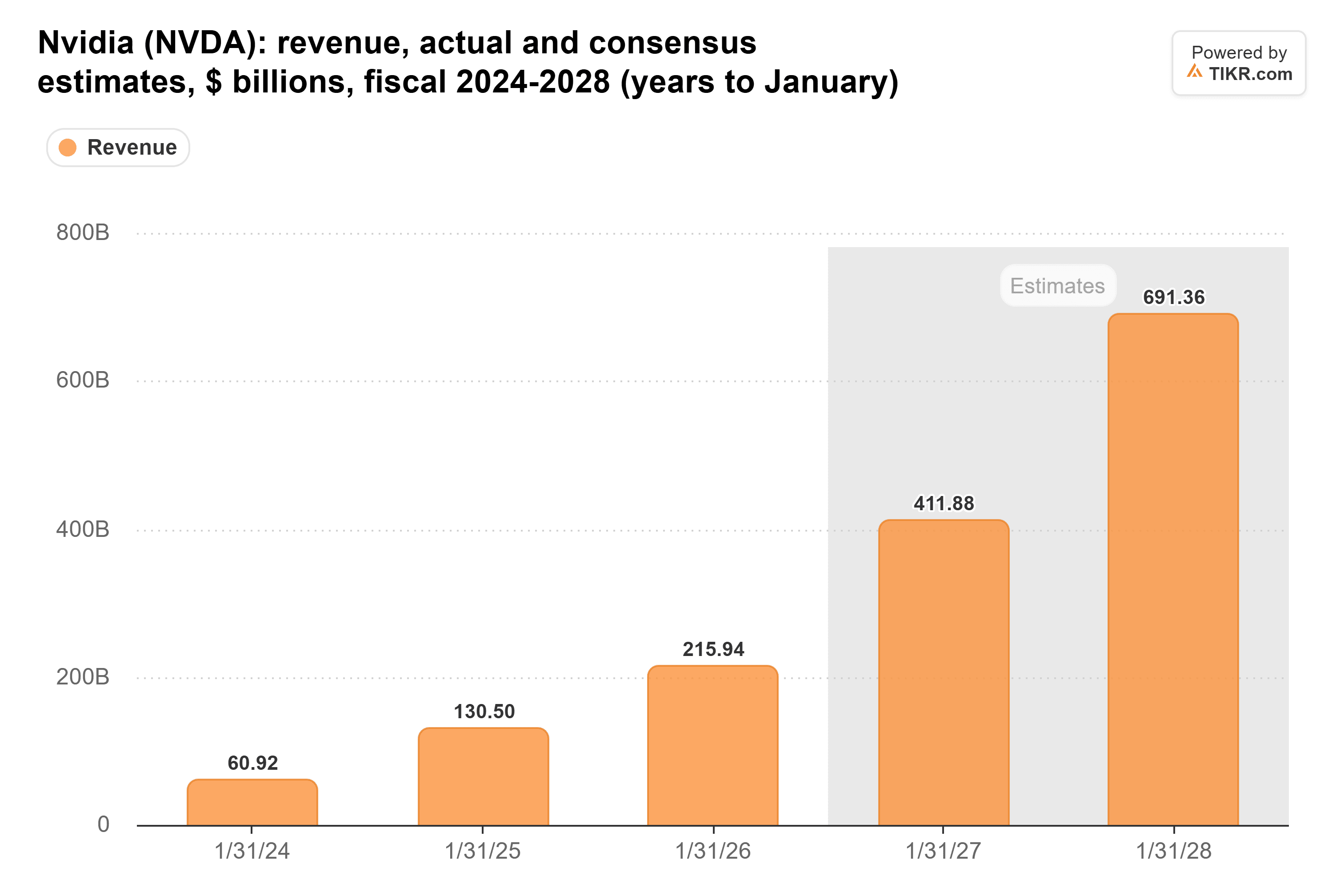
Nvidia, meanwhile, sells at a scale Huawei can’t come close to. Analysts expect its revenue to nearly double to $412 billion in the fiscal year ending January 2027, from $215.9 billion. They see $902 billion two years after that:
China barely shows up in NVIDIA’s sales anymore
Tighter rules would still cost Nvidia something, just less than you might think. Customers headquartered in China, Hong Kong included, brought in $19.7 billion in the fiscal year ended January 2026. That was about 9% of revenue, down from $25.0 billion a year earlier. By the July 2026 quarter, shipments to China were under 1% of Nvidia’s data center revenue.
What’s left at stake is the H200 sales Washington approved last December and the overseas clouds that Chinese firms may be renting from. Commerce officials have been investigating whether Singapore-based Megaspeed rented out NVIDIA-powered computing to Chinese firms on US export control lists. Baird’s Tristan Gerra, who downgraded the stock this week, expects a new ban on H200 exports to China and estimates “this could translate into a $5B write down.”
That would sting, but Nvidia has absorbed a China charge before. It took a $4.5 billion charge on the H20, its China chip, in the fiscal year ended January 2026. Its gross margin still came in at 71.1%:
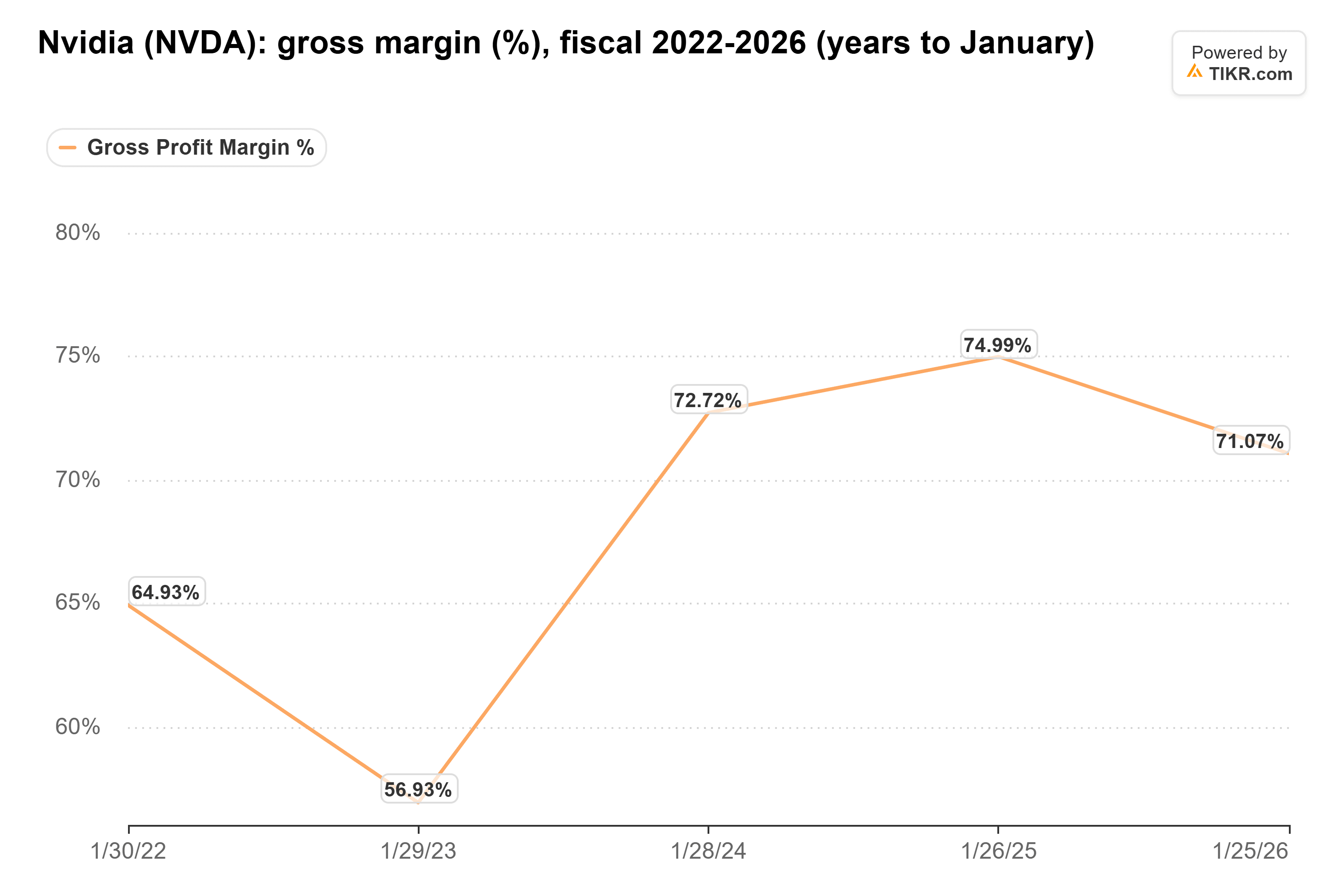
A chipmaker facing a rival at scale doesn’t hold gross margins above 70% three years running.
Baker’s worry is the long game
Atreides Management’s Gavin Baker has argued that selling China chips a step behind America’s best kept its labs hooked on American hardware. On losing Huang, he was blunt: “If we lose Jensen, the odds of China winning AI go up significantly.”
His evidence is that Chinese labs are adapting their models to domestic chips. Baker wrote that DeepSeek reportedly gave Huawei and Cambricon early access to its V4 model, and that “a Huawei-led team has since post-trained V4-Pro on Ascend chips.”
That’s real progress. But post-training is the lighter tuning that comes after a model’s main training run. Hawkins has been waiting a year for the bigger milestone: “are we going to see a frontier Chinese lab complete a successful training run on Huawei chips?” DeepSeek plans to pretrain its next model on Ascend chips, China’s STAR Market Daily reported on Nov. 3. Neither company has confirmed it.
Huawei is still years away
Huawei can’t replace Nvidia in China until it makes far more chips. So tighter enforcement after Huang’s exit would mostly squeeze a China business that’s already under 1% of Nvidia’s data center revenue. It wouldn’t hand Huawei a market it can serve. Chinese labs would just stay short of compute. For Nvidia shareholders, the Nov. 17 report matters far more in the near term than Huawei does.
Baker’s long-run worry is fair, though. Hawkins noted that every Chinese lab training on Huawei’s hardware helps Huawei make that hardware better. If a Chinese lab trains a frontier model on Ascend chips, I’d take Huawei far more seriously as a rival.
So what is NVIDIA stock actually worth?
TIKR lets you forecast the future price of any stock in less than a minute. Just enter a few assumptions into TIKR’s valuation model and see what NVIDIA could be worth. Start from Wall Street consensus estimates, or adjust the inputs to reflect your own view of the business. It’s free to use.
Disclaimer:
Please note that the articles on TIKR are not intended to serve as investment or financial advice from TIKR or our content team, nor are they recommendations to buy or sell any stocks. We create our content based on TIKR Terminal’s investment data and analysts’ estimates. Our analysis might not include recent company news or important updates. TIKR has no position in any of the stocks mentioned. Thank you for reading, and happy investing!