Key Takeaways
- Tesla stock is down 17.1% over the past year, closing at $372.22 on October 23, with the worst damage coming after a second-quarter report that showed a $1.1B cash burn.
- The Street’s mean target of $408.36 sits 9.7% above the close.
- Q3 free cash flow swung back to $1.53B as Tesla cut its 2026 capex guide to about $20B from more than $25B.
- SpaceX says any Tesla merger would need approval from Musk as its controlling shareholder, and no terms exist yet.
Tesla (TSLA) stock is down 17.1% over the past year, closing at $372.22 on October 23, after a July report that paired Tesla’s first cash burn in more than two years with a spending plan of more than $25 billion.
The October report undid part of that. Free cash flow swung back to positive and Tesla cut its spending guide, yet the shares fell 2% the next day. Tesla stock now sits 16.4% above its July 23 close of $319.69 and 25.4% below its record intraday high (by my math).
Tesla Stock Peaked in December, Then Spent Spring Giving It Back
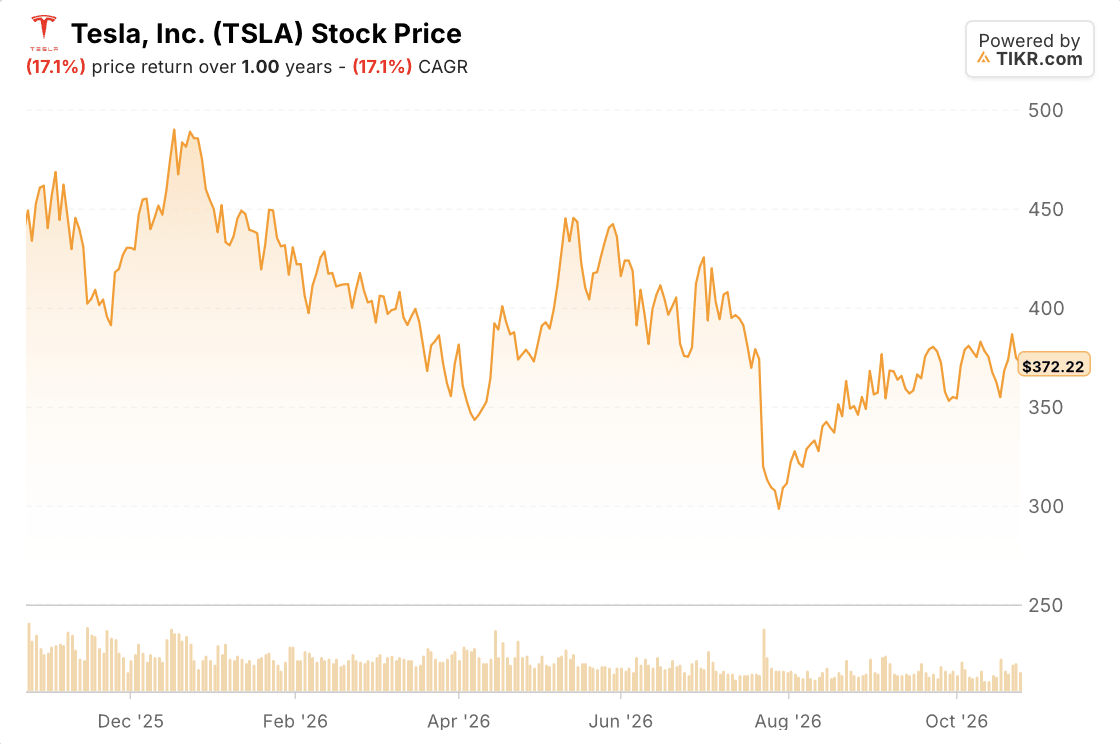
The one-year window opens at $449.00, working back from the printed return. Tesla stock hit a record intraday high of $498.83 in December, and spent the next four months sliding: it closed 2025 at $450 and ended March at $372.
The first-quarter delivery count didn’t help. On April 2, Tesla reported 358,023 deliveries against a Visible Alpha estimate of 368,903, and the stock bottomed in the mid-$340s that month.
A rally into the mid-$440s followed in May with no single event behind it. By June 30 the stock closed at $421, and on July 2 Tesla delivered 480,126 vehicles, 19.2% above the 402,776 the Street expected. That beat lasted three weeks.
The July 22 Report That Did the Real Damage
Tesla’s second quarter looked fine at the top line: revenue of $28.24 billion against a $25.71 billion estimate. Below it, things fell apart. Adjusted earnings per share came in at $0.33 against the $0.51 analysts expected, and operating margin shrank to 1.4%.
The bigger problem was capital expenditure (capex, the money spent on factories, chips and equipment). Tesla spent $5.8 billion in the quarter, pushing free cash flow to negative $1.1 billion. CFO Vaibhav Taneja kept the 2026 capex guide above $25 billion, said spending would grow for the next two or three years, and warned that negative free cash flow would deepen in the second half.
Tesla stock fell 14.5% to $319.69 on July 23, its biggest drop since March 2025, according to Bloomberg. That’s 24.1% below the June 30 close in less than four weeks, and the slide carried the stock near $300 in early August.
TIKR Tracks 48 Analysts on Tesla. How Many Say “Buy”?
See the full breakdown of Buy, Hold, and Sell ratings on Tesla, along with Wall Street’s revenue and earnings estimates, all in one place. More than 500,000 investors use TIKR to research stocks like this one. See Tesla’s Analyst Ratings
Why Tesla Shares Slipped on a Cash-Positive Quarter
The climb back was steady. Tesla stock closed at $371 on October 2, the day Tesla reported 486,532 third-quarter deliveries against a 456,896 estimate.
Then came the October 21 third-quarter update. Free cash flow was $1.53 billion, capex fell to $4.73 billion from $5.8 billion in the second quarter, and Tesla cut its 2026 capex guide to about $20 billion. Automotive gross margin excluding credits rose to 18.1% from 16.3%. Energy gross margin jumped to 33.1% from 20.4%, which Taneja tied primarily to tariff refunds and warranty true-downs rather than pricing.
The cut wasn’t a change of strategy. Taneja told analysts on the Q3 2026 earnings call that “our CapEx for the next few years would continue to expand,” and Tesla secured capacity to borrow up to $30 billion to fund it. With more than $45 billion in cash and investments, Tesla can cover 2.3 years of spending at the new $20 billion pace (by my math).
Shares fell 2% on October 22, and Reuters tied the drop to the capex cut raising doubts about the pace of the AI and robotics push. StoneX, which rates the stock a buy with a $475 target, read the lower outlook as a deferral. Tesla stock closed at $372.22 on October 23.
What the Street Now Expects From Tesla Stock
The mean price target sits at $408.36, 9.7% above the October 23 close. It has risen 8.3% from $377.03 over the past year while the stock fell 17.1%. The mean peaked at $425.91 in July, dropped into the $390s after the second-quarter report, and jumped to its current level in the final days of the chart.

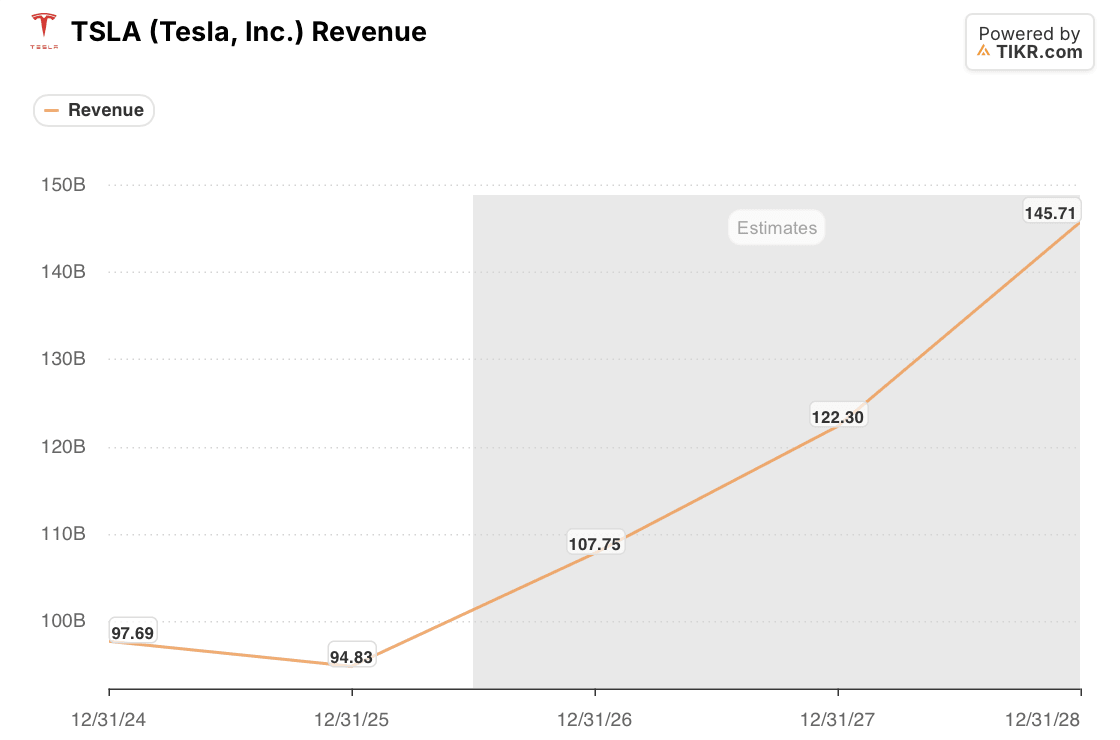
The revenue estimates show what the Street is counting on. Tesla’s revenue fell 2.9% to $94.83 billion in 2025, but analysts expect $107.75 billion in 2026 (up 13.6%), $122.30 billion in 2027, and $145.71 billion in 2028, a 19.1% jump that would leave revenue 53.7% above 2025. That 2028 step lines up with Tesla’s own timeline: Musk aims for volume chip production at the Terafab, Tesla’s planned chip factory, around the third quarter of 2028.
The SpaceX Deal Tesla Stock Can’t Price Yet
On October 20, Musk said a merger of SpaceX (SPCX) and Tesla would be “a good idea” and that both had formed special committees to discuss it. Tesla refused merger questions on its own call the next day, and a SpaceX filing on October 22 said no determination had been made and that any deal would need approval from its committee, board, and controlling shareholder, Musk himself.
Reuters has put the potential combination at about $3.5 trillion. In a Breakingviews column, Jonathan Guilford estimated Tesla would contribute 41% of the combined value, while Musk holds 85% of the vote at SpaceX against the 18% his Tesla stake carries. That gap is the whole question for Tesla holders. Guilford argued that rejecting a deal without cash, a healthy premium, or voting rights would be the rational move. Terms with any of those would give Tesla holders something for their votes; terms without them would hand Musk the control he lacks at Tesla for little in return.
Until the committees put terms on paper, I’d judge Tesla stock on what October 21 showed: $1.53 billion of quarterly free cash flow alongside management’s expectation that capital spending will keep rising over the next few years. The next checkpoint is the Cybercab launch in Dallas, which Tesla expects next month.
So What Is Tesla Stock Actually Worth?
TIKR lets you forecast the future price of any stock in less than a minute. Just enter a few assumptions into TIKR’s valuation model and see what TSLA stock could be worth. Start from Wall Street consensus estimates, or adjust the inputs to reflect your own view of the business. It’s free to use.
Disclaimer:
Please note that the articles on TIKR are not intended to serve as investment or financial advice from TIKR or our content team, nor are they recommendations to buy or sell any stocks. We create our content based on TIKR Terminal’s investment data and analysts’ estimates. Our analysis might not include recent company news or important updates. TIKR has no position in any of the stocks mentioned. Thank you for reading, and happy investing!