Key Takeaways
- Intel shares rose [4%] today after JPMorgan upgraded the stock to Neutral from Underweight and kept its $85 price target.
- Tesla committed to Intel’s 14A process back in April, so the upgrade is today’s news, and it rests on better execution and rising earnings estimates.
- Intel’s capital spending has been bigger than its cash from operations every year since 2022, so outside customers and its $20 billion stock sale are what pay for the foundry.
- Intel reports third-quarter results on Oct. 29, the next chance to see new foundry customers and the dollars they commit.
Intel (INTC) shares rose [4%] today after JPMorgan upgraded the stock to Neutral from Underweight. The bank had downgraded it in November 2022.
Tesla (TSLA) shares also rose [3%] today. Much of today’s coverage put the upgrade next to Tesla’s deal to use Intel’s 14A chipmaking process. That deal dates back to April, when Elon Musk told investors on Tesla’s first-quarter call: “We plan to use Intel’s 14A process, which is state-of-the-art.”
Even so, the two stories belong together.
What JPMorgan sees
Analyst Harlan Sur pointed out that Intel is down about 36% from its June peak. The broader chip group fell 20% to 25% over the same stretch. He gives CEO Lip-Bu Tan credit, writing that “the team’s execution on next-gen manufacturing has significantly improved.”
He also thinks the estimates are too low:
“We believe increasing agentic AI workloads (CPU intensive) and a very tight supply chain for leading edge silicon should drive continued positive EPS revisions in the upcoming earnings season and through CY27.”
JPMorgan’s 2028 EPS estimate is about 15% above consensus.
It’s still a cautious upgrade. Since JPMorgan’s 2022 downgrade, Intel’s share of server CPU revenue has fallen from 77% to 53%, and Sur expects a few more quarters of losses. Intel’s outside foundry business brought in barely $1 billion of annualized revenue in the first half of 2026. Taiwan Semiconductor Manufacturing (TSM) brought in $150 billion.
Why the foundry needed Tesla
Tan had said that Intel could rethink its advanced foundry plans if it couldn’t sign enough outside customers. Tesla’s commitment took care of that.
The money was the other half of the problem. Intel’s capital spending has been bigger than the cash its operations bring in every year since 2022.

Intel cut capex to $14.7 billion in 2025, and that was still about $5 billion more than its operations brought in. That’s why Intel’s $20 billion stock sale, set aside for new factories, matters. With an anchor customer and that cash, the multi-year plan looks fundable for the first time.
Filling those factories is how the plan pays off, and gross margin has fallen every year since 2021.

Tesla’s chips are years away
Intel’s 14A process isn’t due for high-volume production until 2028. Management aims for the foundry to break even in late 2028. Neither company has said what the Tesla deal is worth or how many chips it covers.
Analysts already expect Intel’s revenue to grow from $52.9 billion in 2025 to $83.5 billion in 2028.
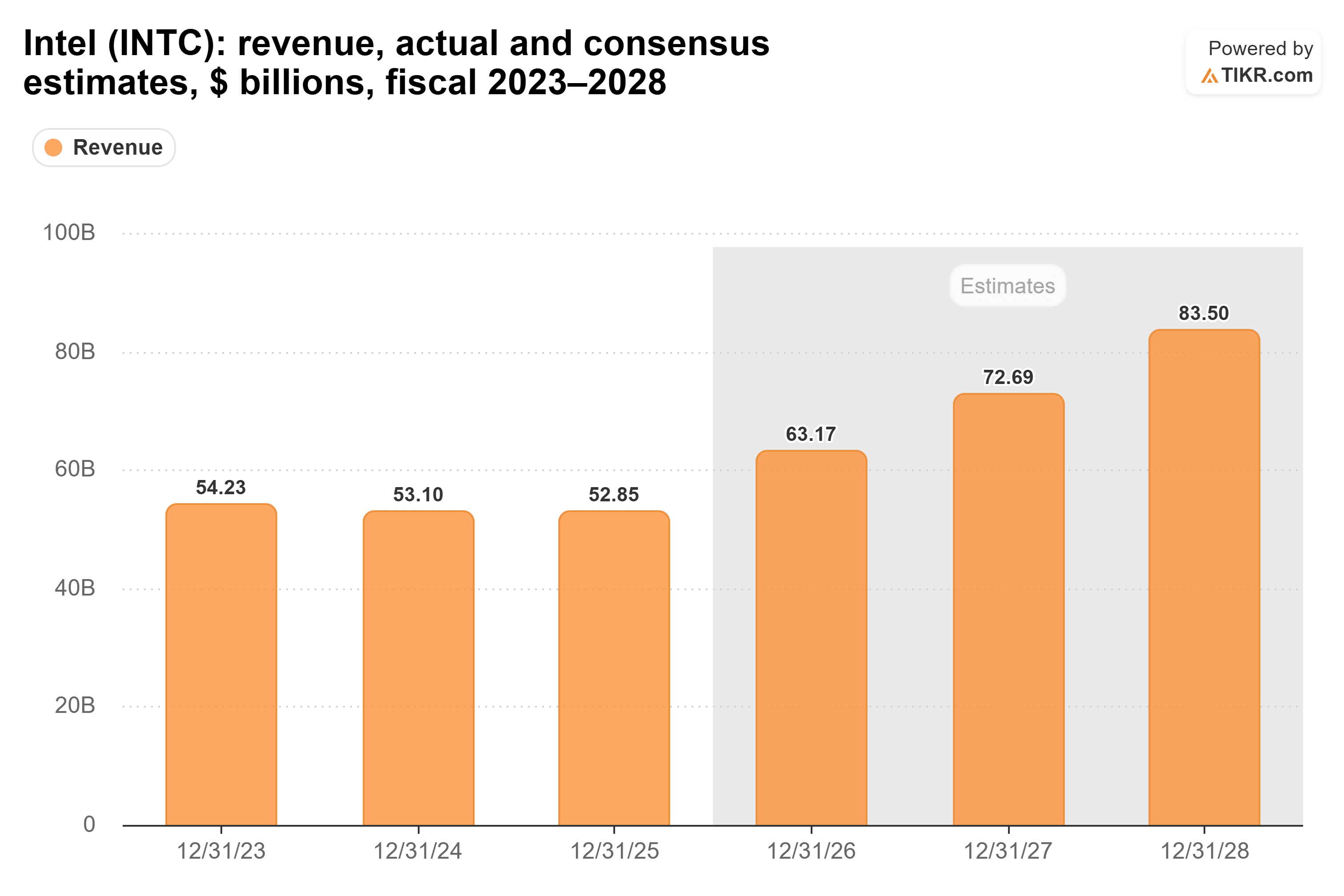
Tesla can’t be much of that growth until 14A is running at volume. JPMorgan is betting that CPU demand pushes those numbers higher still.
I think JPMorgan has it about right. Intel’s foundry now has its anchor customer and $20 billion of new capital, which answers the biggest question about the capex plan. But Tesla’s revenue arrives in 2028 at the earliest. Until then the stock depends on the earnings revisions JPMorgan expects.
Of course, one customer doesn’t make a foundry. The next test is Intel’s third-quarter report on Oct. 29: does it name more 14A or 18A customers, with dollar commitments attached?
So what is Intel stock actually worth?
TIKR lets you forecast the future price of any stock in less than a minute. Just enter a few assumptions into TIKR’s valuation model and see what Intel could be worth. Start from Wall Street consensus estimates, or adjust the inputs to reflect your own view of the business. It’s free to use.
Disclaimer:
Please note that the articles on TIKR are not intended to serve as investment or financial advice from TIKR or our content team, nor are they recommendations to buy or sell any stocks. We create our content based on TIKR Terminal’s investment data and analysts’ estimates. Our analysis might not include recent company news or important updates. TIKR has no position in any of the stocks mentioned. Thank you for reading, and happy investing!