
Key Takeaways for Synopsys Stock as of August 2026
- Three-Month Slide: Synopsys stock has fallen 21% since late May, dropping from the mid-$500s to $397.87 by August 21, even after the company beat and raised its full fiscal 2026 guidance in late May.
- Analyst Split: The Street carries 14 buys, 4 outperforms, 5 holds, 2 no opinions, and 1 underperform on Synopsys stock, with a mean target of $560.17 sitting 41% above the current price.
- Model Gap: TIKR’s mid-case model puts fair value at $727.02, implying an 83% total return and a 15.4% annualized return through an October 2030 realization date.
- Widening Divergence: The mean target actually rose from $534.65 in April to $563.74 in June even as the stock fell, meaning the gap between what analysts think Synopsys is worth and what the market is paying for it kept opening from the price side, not the target side.
Synopsys stock trades 41% below where the Street thinks it belongs, and that gap just got wider for reasons that have nothing to do with a broken thesis. See where Synopsys stock stands on TIKR for free →
Why Synopsys Stock Has Fallen 21% Since Late May Despite a Raised Guide
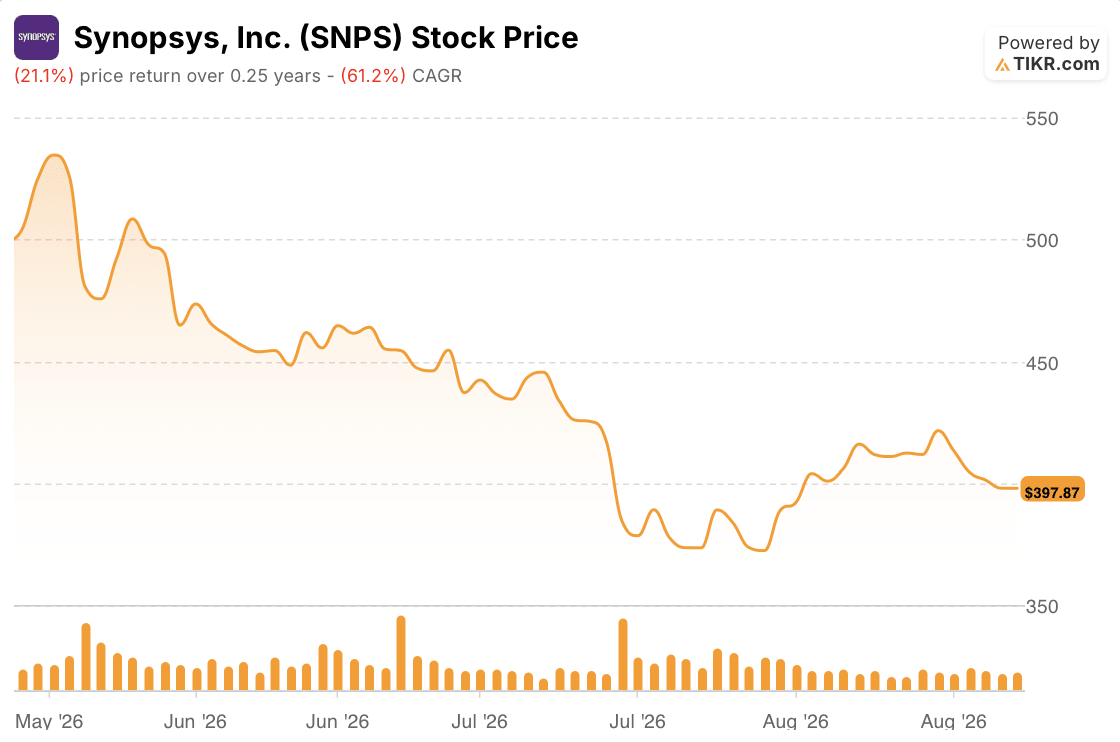
Synopsys (SNPS) stock has dropped 21% since late May, sliding to $397.87 by August 21 even though the company beat and raised its full fiscal 2026 revenue, margin, EPS, and free cash flow guidance on its fiscal second-quarter call on May 27. The stock still fell 8.7% the next trading day, making it the worst single-day performer in the S&P 500.
The disconnect traces to core EDA (electronic design automation, the software used to lay out chips), which grew slightly over 8% year over year in the quarter, below the double-digit pace the Street has trained itself to expect from Synopsys. Management framed that as noise from lumpy hardware accounting rather than a real slowdown, but the market read it as evidence that growth is settling into a lower gear even as the Ansys integration adds scale.
At Mizuho’s Technology Conference on June 9, CEO Sassine Ghazi was pushed on whether investors should expect improving growth or just durable growth, and he leaned toward durability: “we’re not expecting the customer to pay 20%, 30% more by just delivering the same… but as they are injecting a change in their workflow with agents… we are absolutely expecting that the change in monetization and business model will happen, and we will drive it and we’ll make it happen.” That answer is the market’s real worry in miniature: a business compounding at a high single-digit to low-double-digit clip today, betting on a monetization shift that has not yet shown up in a quarterly number.

The multiple backs that up. Synopsys stock’s forward enterprise value to EBITDA has fallen to 19x, down from a mean of 22x over the past year and near the bottom of its 18-to-27x range, with the peak in that window coming as recently as June. That’s a genuine re-rating, not the stock simply riding down with software peers, and it confirms the market is now pricing Synopsys for durable growth rather than the double-digit reacceleration it traded on earlier in the year.
Geopolitics piled on through the summer. Huawei’s late-May unveiling of its “Tau Scaling Law” chip design approach revived fears that Washington could tighten export controls on EDA software sold into China, a scenario that would hit Synopsys and Cadence directly. Coatue Management cut its Synopsys stake 54% in a May 15 filing, and both CEO Ghazi and CFO Shelagh Glaser sold shares in mid-June, adding supply pressure into an already nervous tape. None of that reverses the underlying demand story management laid out on the call, but it explains why a beat-and-raise quarter turned into a three-month slide instead of a rally.
Synopsys Trims Legacy Software as It Pushes for Margin Expansion
The growth-durability debate got a second data point on July 7, when Reuters reported that Synopsys is discontinuing its Equipment Engineering System and Fault Detection and Classification software, manufacturing-control tools used by Samsung, SK Hynix, and other chipmakers, alongside a round of layoffs. Synopsys confirmed it is “discontinuing certain manufacturing analytics products” to redirect resources toward AI design.
The move lines up with the more-than-300-basis-point operating margin expansion management guided to on the Q2 earnings call, but it also signals the company is actively pruning lower-margin, non-critical-path revenue rather than growing through everything, reinforcing the same durability-over-acceleration read the stock has been pricing since late May.
Street Analysts Have Raised Synopsys Stock’s Target While the Price Fell
Synopsys stock carries 14 buys, 4 outperforms, 5 holds, 2 no opinions, and 1 underperform from the 26 analysts currently covering the name, and the mean target of $560.17 sits 41% above the $397.87 close.
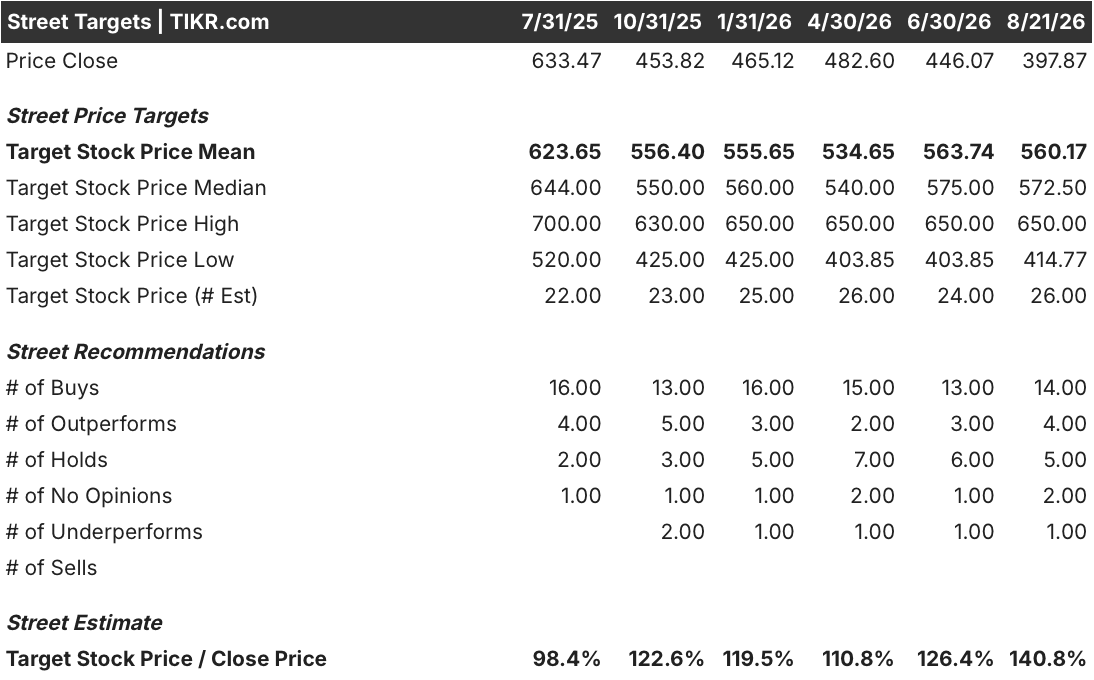
That gap did not open because analysts lost confidence. The mean target actually climbed from $534.65 at the end of April to $563.74 at the end of June, even as the stock fell from $482.60 to $446.07 over the same stretch, then kept falling into August while the target barely moved.
Coverage has also held steady at 24 to 26 analysts through the period, so this isn’t a case of the Street thinning out on the name.
The entire divergence has come from the price side: the same analysts who raised targets into the May sell-off have left them roughly in place through a further 11% price decline, which is the market signaling that the durability debate from Synopsys’s own earnings call, not a fundamental reset, is what’s driving the stock.
TIKR Values Synopsys Stock at $727, More Than 80% Above the Current Price
TIKR’s mid-case model values Synopsys at $727 by an October 2030 realization date, implying an 83% total return from the current price of $398, or 15% annualized over 4.2 years.

That return profile places Synopsys stock well above what a typical large-cap software name offers today, reflecting a stock priced for durability rather than the double-digit reacceleration the Street’s target already assumes.
The model’s gap only makes sense against Section 1’s thesis: if core EDA settles back into double digits as management still projects and the IP royalty and agentic-AI monetization shift shows up in the P&L over the next several years, the current price undercounts a business that both TIKR’s model and the Street’s mean target already say is worth considerably more.
Should You Invest in Synopsys, Inc.?
The only way to really know is to look at the numbers yourself. TIKR gives you free access to the same institutional-quality financial data that professional analysts use to answer exactly that question.
Pull up Synopsys, Inc. stock and you’ll see years of historical financials, what Wall Street analysts expect for revenue and earnings in the quarters ahead, how valuation multiples have moved over time, and whether price targets are trending up or down.
You can build a free watchlist to track Synopsys, Inc. alongside every other stock on your radar. No credit card required. Just the data you need to decide for yourself.
Access Professional Tools to Analyze SNPS stock on TIKR for Free →
Looking for New Opportunities?
- See what stocks billionaire investors are buying so you can follow the smart money.
- Analyze stocks in as little as 5 minutes with TIKR’s all-in-one, easy-to-use platform.
- The more rocks you overturn… the more opportunities you’ll uncover. Search 100K+ global stocks, global top investor holdings, and more with TIKR.
Disclaimer:
Please note that the articles on TIKR are not intended to serve as investment or financial advice from TIKR or our content team, nor are they recommendations to buy or sell any stocks. We create our content based on TIKR Terminal’s investment data and analysts’ estimates. Our analysis might not include recent company news or important updates. TIKR has no position in any stocks mentioned. Thank you for reading, and happy investing!