Key Takeaways
- Super Micro’s revenue nearly quadrupled to $19.9 billion in the September quarter and it earned $1.6 billion, but operating cash flow was negative $434 million.
- The cash went into receivables and inventory, and about $3.1 billion of customer prepayments kept the outflow from being far larger.
- At 4.7x forward earnings, the stock is priced as if the cash never comes, and the December quarter is the next test.
Super Micro Computer (SMCI) just had the biggest quarter in its history. In the three months to Sept. 30, revenue nearly quadrupled to $19.9 billion, and net income jumped to $1.59 billion from $168 million, according to its preliminary results.
That was more than $4 billion above the original guidance of $14.5 billion to $15.5 billion. But Super Micro had already raised the range on Oct. 20, and the stock fell 11% in the week into the Nov. 3 report.
Where the Profit Went
The profit hasn’t turned into cash because the build-out absorbed it. Receivables rose $3.6 billion, and inventory climbed to $15.1 billion from $12.9 billion at the end of June.
Deferred revenue rose about $3.1 billion, an “overwhelming majority” of which reflects customers paying ahead of delivery, new CFO Mark Long said on his first call. Without those prepayments, the quarter’s operating outflow would have been closer to $3.5 billion.
Analysts expect free cash flow to swing from negative $7.0 billion in fiscal 2026, the year to June, to positive $4.0 billion in fiscal 2027:
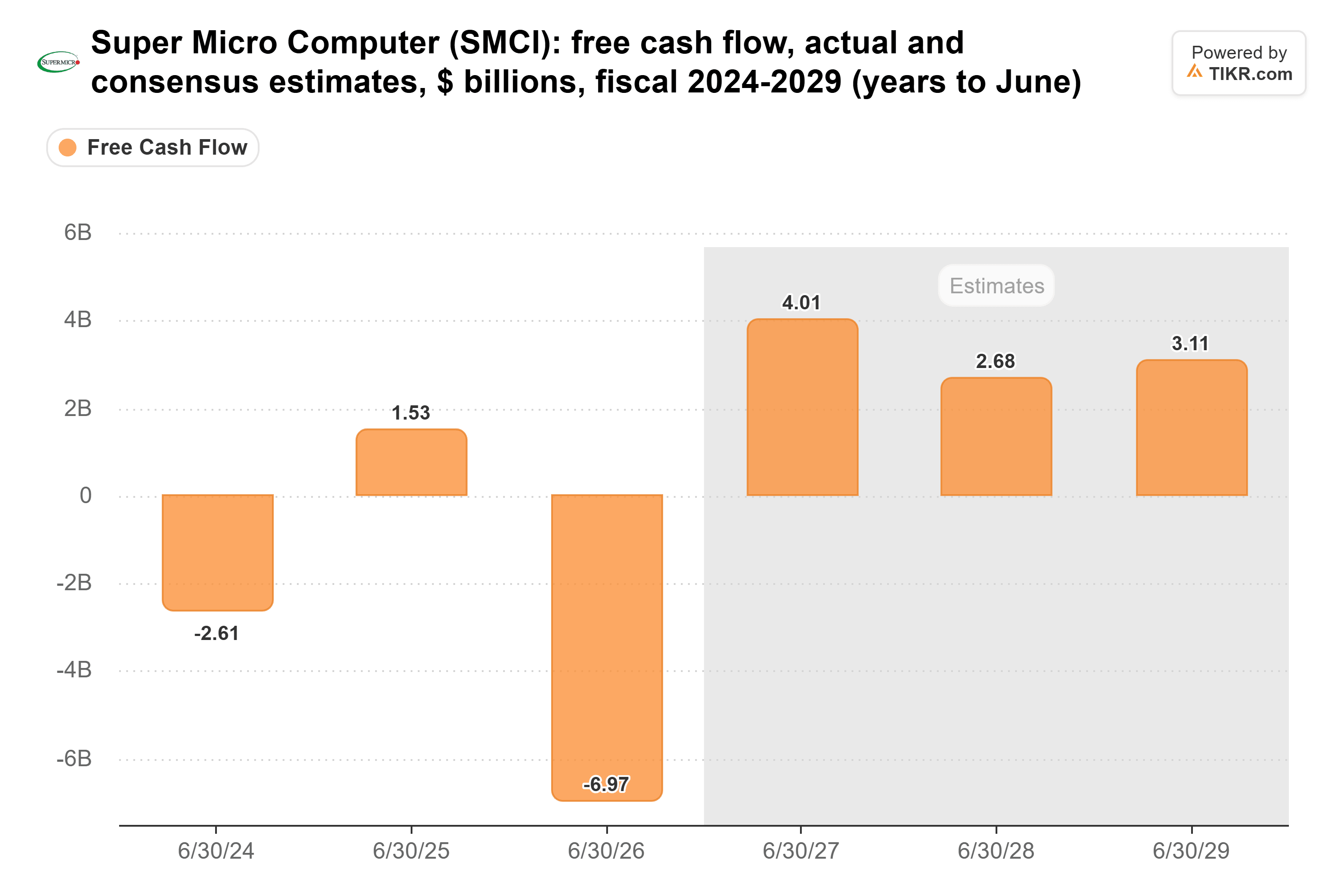
After negative $476 million in the first quarter, the next three need to bring in about $4.5 billion between them. That’s a lot to ask of a company still growing this fast.
Growth Is Eating Super Micro’s Cash
Nothing in the quarter suggests customers are slow to pay. Days sales outstanding fell to 36 from 59, with no material credit losses.
The inventory is mostly hardware waiting for data centers to be ready. Super Micro raised its full-year revenue outlook to $72 billion to $82 billion, from $65 billion to $72 billion, and Long said, “What governs the range is not demand, and it is not our ability to build.”
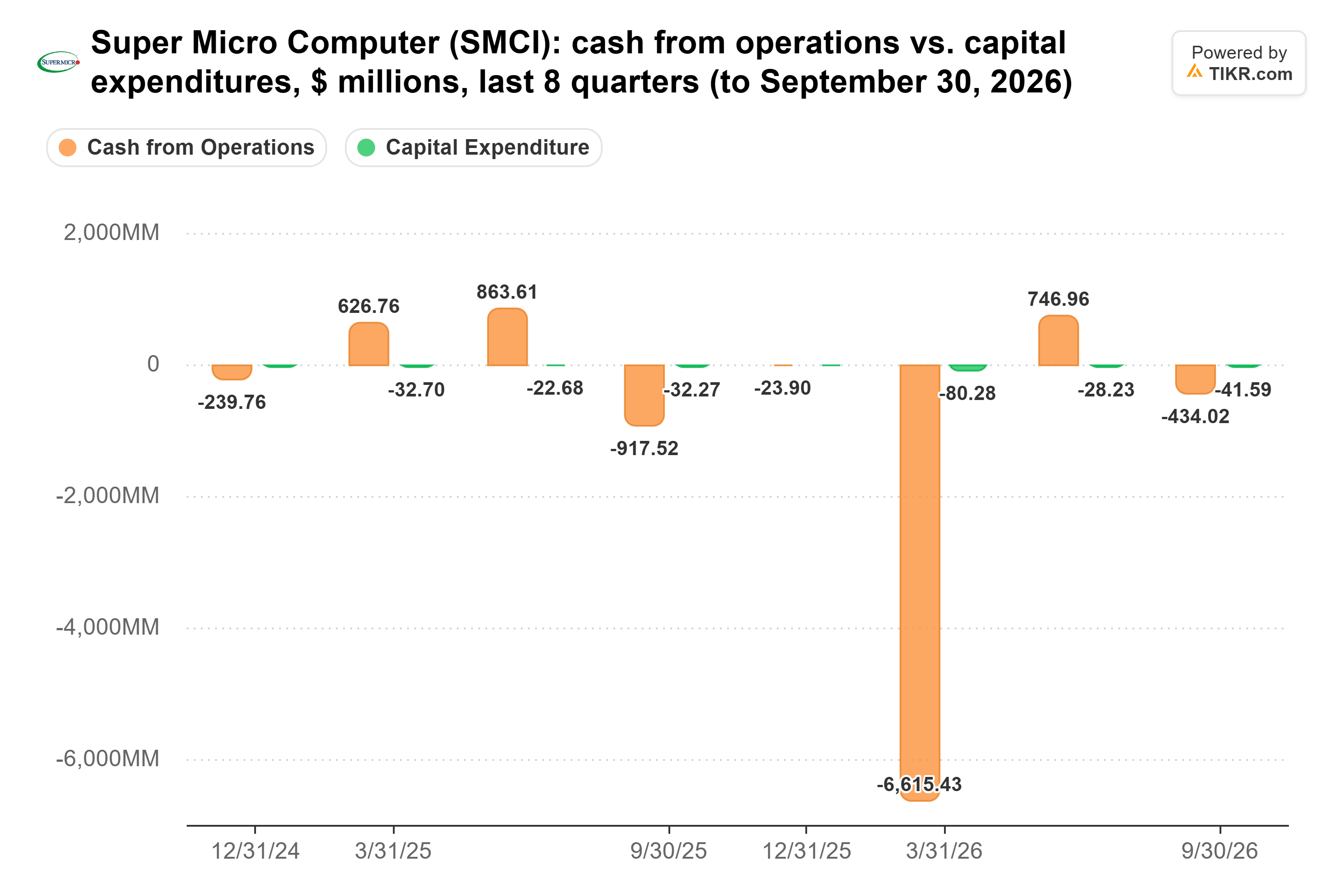
Capex isn’t the problem. It has stayed under $100 million a quarter for two years, while cash from operations has swung by billions:
TIKR Tracks 18 Analysts on Super Micro Computer. How Many Say “Buy”?
See the full breakdown of Buy, Hold, and Sell ratings on Super Micro Computer, along with Wall Street’s revenue and earnings estimates, all in one place. More than 500,000 investors use TIKR to research stocks like this one. See Super Micro Computer’s Analyst Ratings
The pattern goes back years. From fiscal 2022 to fiscal 2026, revenue grew from $5.2 billion to $39.1 billion, and Super Micro earned $5.4 billion while burning $7.9 billion of free cash flow.
The cash should come in when growth pauses, and December only half qualifies. The $19.5 billion to $21.5 billion guide is roughly flat with the quarter just reported, but that quarter included about $2.3 billion of catch-up deployments, and Long said the full-year range assumes continued sequential growth.
Concentration is the other risk. One customer made up 44% of revenue, up from 28% in fiscal 2026, and two held 49% and 17% of receivables. If prepayments shrink as those orders ship while receivables stay high, the gap widens.
Super Micro Is Priced Like the Cash Never Comes
As of Friday, the stock trades at 4.7x forward earnings, against a five-year average of 15x and a peak of 44x in March 2024:
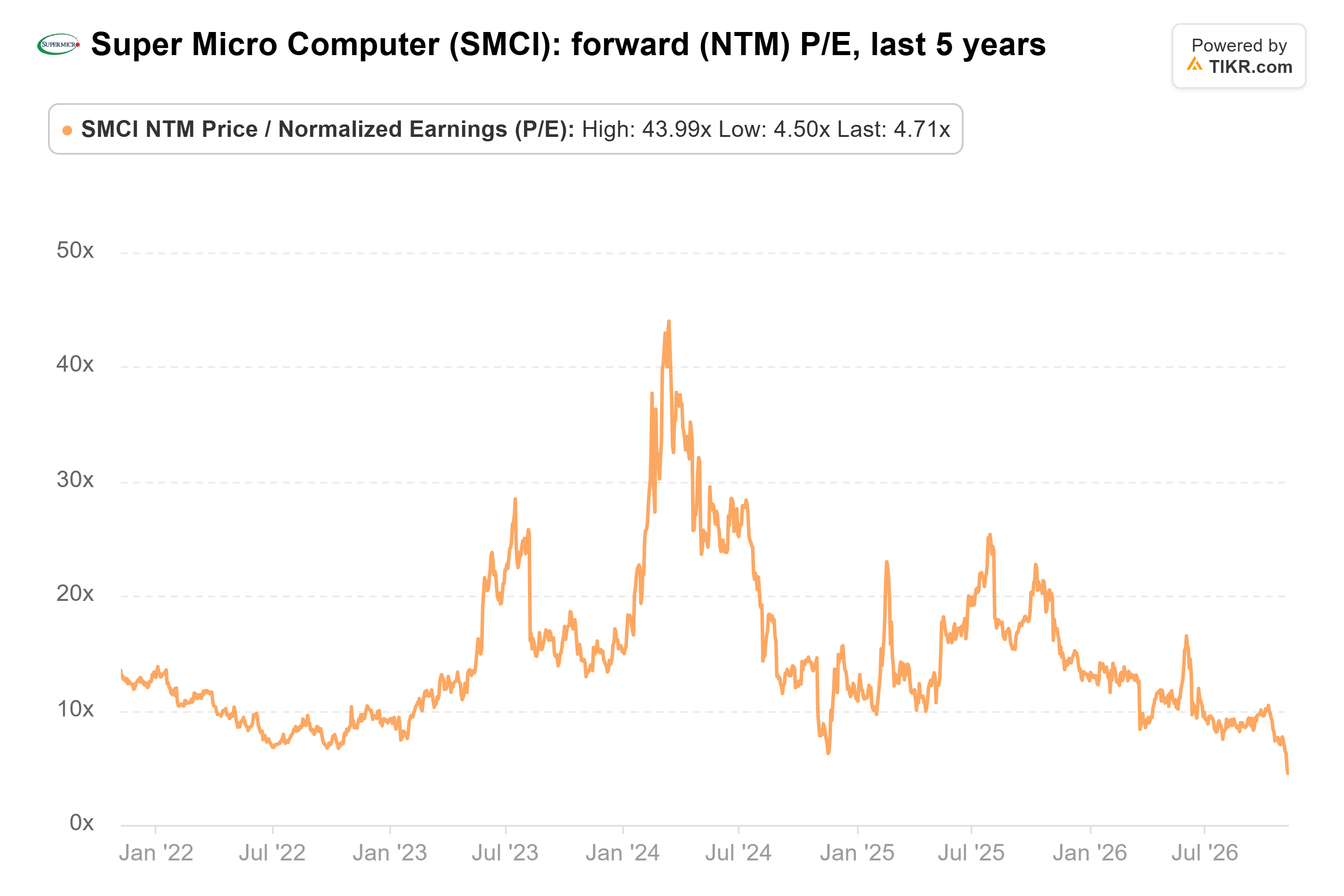
That discount looks too steep for a cash gap that Super Micro’s own collection figures tie to growth. Customers who prepay $3.1 billion in a quarter want the product. The December-quarter report, expected in early February, is the first real test. Watch operating cash flow: if it turns positive without another jump in prepayments, the problem really is slight.
So What Is Super Micro Stock Actually Worth?
TIKR lets you forecast the future price of any stock in less than a minute. Just enter a few assumptions into TIKR’s valuation model and see what Super Micro could be worth. Start from Wall Street consensus estimates, or adjust the inputs to reflect your own view of the business. It’s free to use.
Disclaimer:
Please note that the articles on TIKR are not intended to serve as investment or financial advice from TIKR or our content team, nor are they recommendations to buy or sell any stocks. We create our content based on TIKR Terminal’s investment data and analysts’ estimates. Our analysis might not include recent company news or important updates. TIKR has no position in any of the stocks mentioned. Thank you for reading, and happy investing!