Key Takeaways
- Pfizer yields 6.0% and Realty Income 5.6%, so $10,000 in Pfizer would pay about $330 more over 10 years if both kept their five-year dividend growth rates.
- Realty Income’s dividend took 75% of its AFFO in fiscal 2025, and September’s raise was its 116th consecutive quarterly increase.
- Pfizer’s dividend took 89% of its free cash flow over the twelve months to June 2026, and analysts expect its revenue to fall to $55.4 billion in fiscal 2028 as key drugs lose patent protection.
- The choice comes down to whether Pfizer’s dividend can keep growing through those patent losses.
Pfizer (PFE) raised its 2026 outlook on Nov. 3, a day after Realty Income (O) raised its own. Both yield better than 5.5% today, so either could anchor a portfolio built for income over the next decade.
But they pay you very differently. Pfizer’s 6.0% yield is the bigger check right now. Realty Income’s yield is smaller, and the company has raised its payout 116 quarters in a row.
If I can hold only one of them for the next 10 years, which one gets my money?
| Metric | Realty Income (O) | Pfizer (PFE) |
|---|---|---|
| Dividend yield | 5.6% | 6.0% |
| Annual dividend | $3.26 (paid monthly) | $1.72 (paid quarterly) |
| Dividend growth, fiscal 2020-2025 | 2.9% a year | 2.5% a year |
| Dividend record (company’s own count) | 116 straight quarterly raises | 352 straight quarterly dividends |
| Coverage, last reported | AFFO payout ratio: 75% (fiscal 2025) | Cash dividend payout ratio: 89% (TTM to June 28, 2026) |
| Net debt / EBITDA | 5.8x | 1.9x |
| Interest coverage | 2.4x | 7.0x |
6 safe dividend stocks paying retirees 6%+ yields
There are over 100 stocks paying 6%+ annual dividends today.
But after an extensive investment review leveraging TIKR’s proprietary data, we now believe only six of them are truly safe for retirees.
They’re all yours for free as part of our new investment report, which you can access right here.
Realty Income keeps a cushion
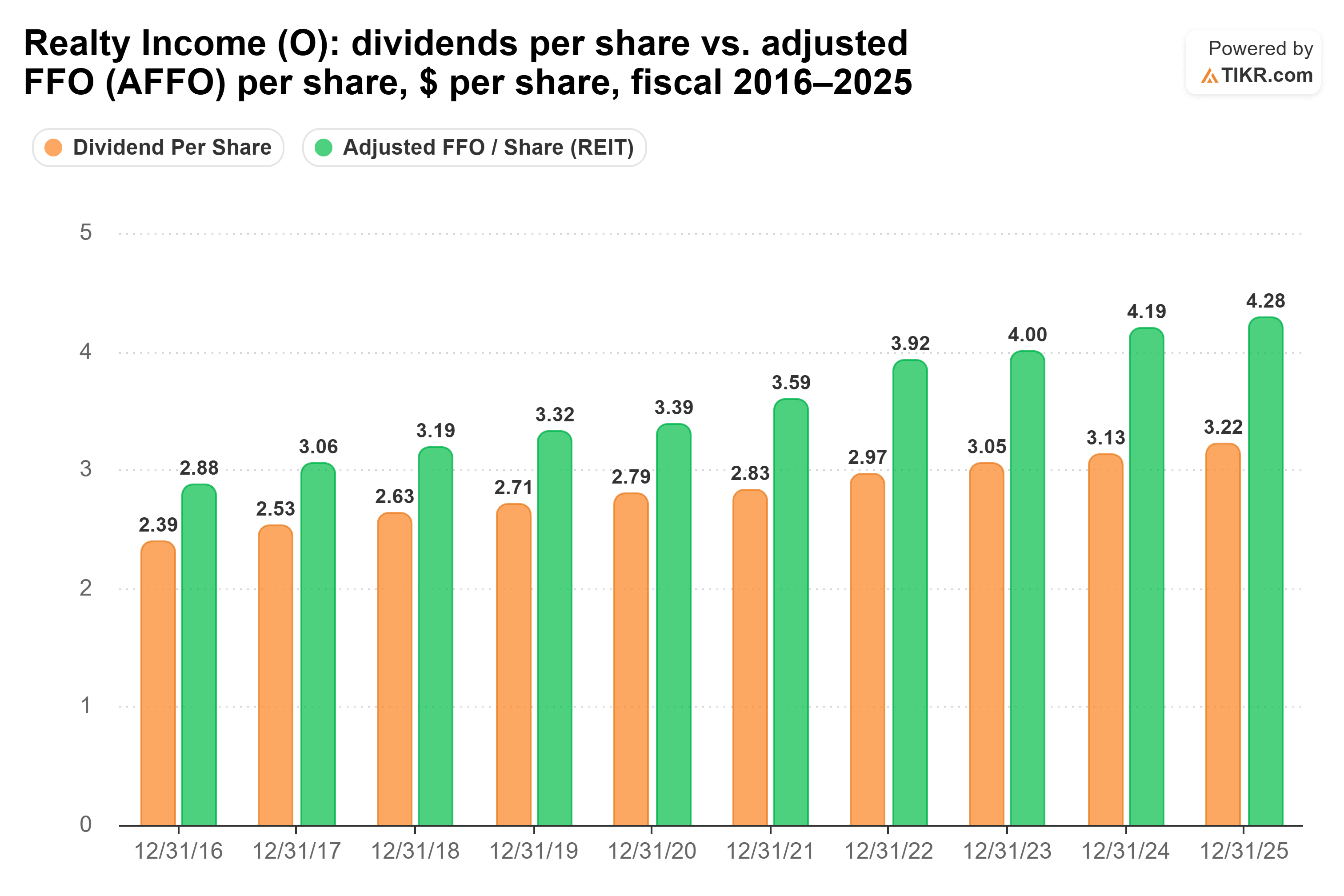
In its third-quarter release, Realty Income says its mission is to “deliver dependable monthly dividends that increase over time.” The coverage backs that up. Its dividend took 83.0% of AFFO in fiscal 2016 and a well-covered 75.2% in fiscal 2025, because AFFO per share grew faster than the payout over that decade. This chart shows both:
The business is still growing, too. Revenue rose to $1.62 billion in the third quarter of 2026 from $1.47 billion a year earlier, and occupancy was 98.8% at Sept. 30. On Nov. 2, management raised its 2026 AFFO guidance to $4.45-$4.46 a share. It’s also selling less stock to pay for deals. New shares have funded 19% of its investments in 2026 so far, against a 47% three-year average. Partners help fill the gap: on Sept. 30, KKR paid about €528.0 million for 49% of a joint venture holding 54 of its European properties.
Debt is the main risk. Net debt runs 5.8x EBITDA, and about $2.9 billion of it comes due in 2027 at a rate under 3%, so refinancing it will likely cost more.
Pfizer’s bigger check has less behind it
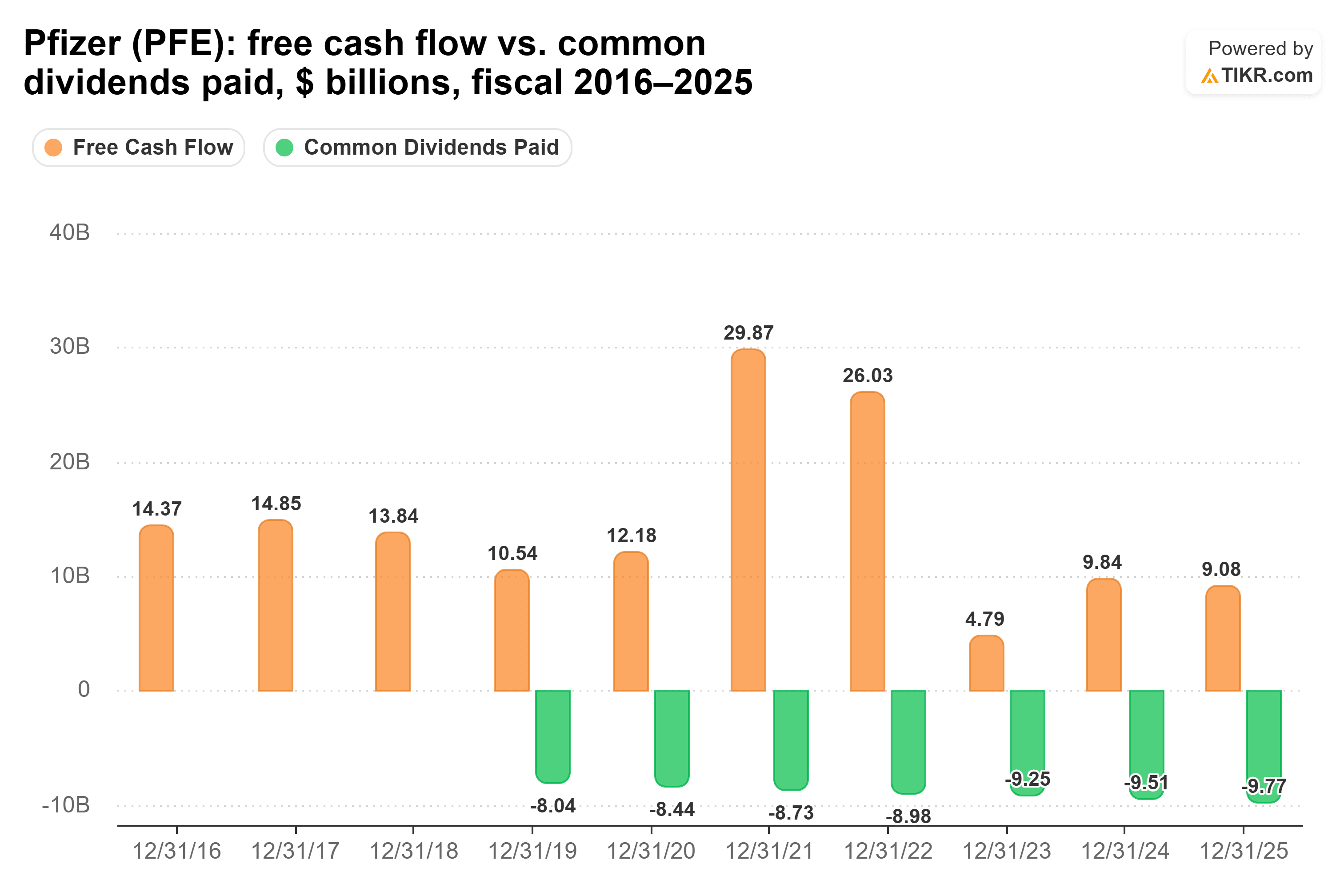
Pfizer pays more than Realty Income today, but with far less to spare. Its dividend took a risky 89% of free cash flow over the twelve months to June 28, 2026, and 107.7% in fiscal 2025. Free cash flow fell from $29.9 billion in fiscal 2021 to $9.08 billion in fiscal 2025, while dividends paid rose from $8.73 billion to $9.77 billion. This chart shows the gap closing:
Its COVID products are still fading. In the third quarter, Paxlovid fell 63% operationally and Comirnaty fell 29%. But launched and acquired products grew 32%, and on Nov. 3 Pfizer raised its 2026 revenue guidance to $62.0-$64.0 billion. The same day, it named interim CFO Cecile Guegan to the job permanently, so the team behind the dividend policy stays put.
CEO Albert Bourla said on Pfizer’s second-quarter call that “even the most stretched scenarios that we are running, we will be able to maintain our dividend.” That’s a promise to keep the dividend growing. The quarterly dividend is still $0.43 a share, the same $1.72 a year Pfizer paid in fiscal 2025.
So which dividend wins?
Realty Income gets my dividend dollars for the next 10 years.
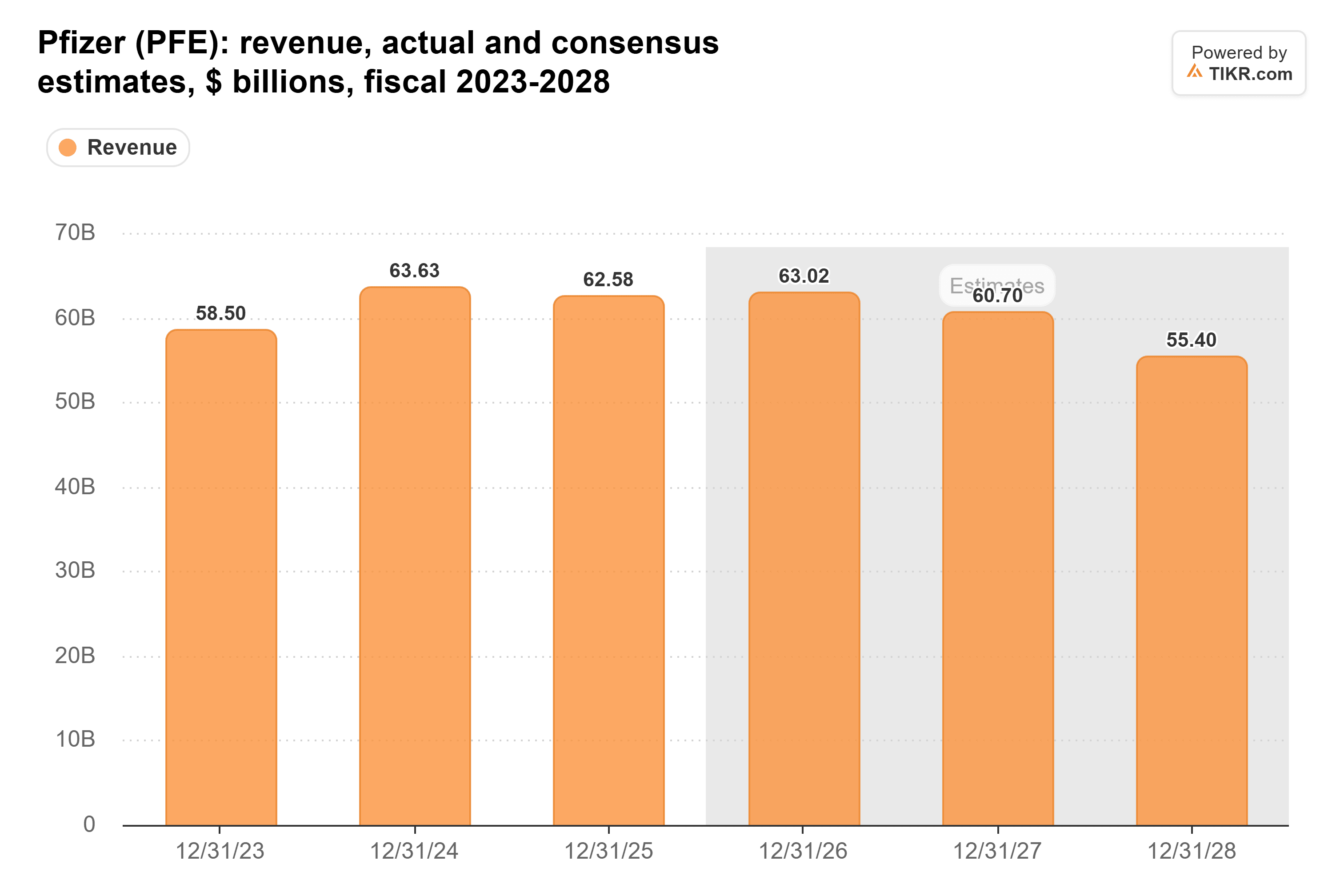
On paper, Pfizer pays more. At each company’s five-year growth rate, $10,000 in Pfizer pays about $6,723 over the decade, against $6,393 for Realty Income. That assumes Pfizer keeps raising its dividend 2.5% a year, but analysts expect its revenue to slip from $62.6 billion in fiscal 2025 to $55.4 billion in fiscal 2028 as Ibrance, Xtandi and Eliquis lose patent protection. This chart shows the estimates:
With the dividend already taking 89% of free cash flow, I’d expect Pfizer to hold it at $1.72 for a while. At that level, $10,000 pays $600 a year, or $6,000 over 10 years, which is less than Realty Income’s $6,393.
Pfizer has a real case. It yields more, carries far less debt, and management aims for high-single-digit yearly revenue growth from the end of 2028 through 2033 on a risk-adjusted basis. New drugs like Elrexfio, which met its Phase 3 goal on Oct. 27, would help it get there. Still, Realty Income has more room behind its dividend and more than 32 straight years of raises, and I’d rather count on that for a decade.
The next thing to watch is Pfizer’s 2027 guidance. Guegan said it will reflect two of Pfizer’s products getting Medicare’s negotiated prices in 2027. If that guidance shows free cash flow climbing well clear of the dividend, I’d take another look at Pfizer.
Forget Realty Income: 6 safe 6%+ dividend yields you can buy right now
Dividends can hold the key to enormous wealth. But only if you buy the right ones.
Picking the right high-yield dividend stock can be the difference between a dream retirement…and scraping by every month, waiting for the next Social Security check to clear.
We’ve identified six stocks yielding 6%+ that we believe every retiree should know about right now. (And Realty Income isn’t one of them.)
Disclaimer:
Please note that the articles on TIKR are not intended to serve as investment or financial advice from TIKR or our content team, nor are they recommendations to buy or sell any stocks. We create our content based on TIKR Terminal’s investment data and analysts’ estimates. Our analysis might not include recent company news or important updates. TIKR has no position in any of the stocks mentioned. Thank you for reading, and happy investing!