Key Takeaways
- Super Micro raised its fiscal 2027 revenue outlook to $72 billion to $82 billion, from $65 billion to $72 billion, and its CEO says even the new range is conservative.
- To reach the low end, Super Micro needs less revenue per quarter than it made in its first quarter once a one-time catch-up is taken out.
- CFO Mark Long says the pace of customers’ data center construction sets the range, and he names land, power and building shells as the industry’s binding constraints, which also hold back the Nvidia-powered racks Super Micro ships.
- At 4.7x forward earnings, investors are pricing in a miss, and the risk to watch is data center construction, including a possible moratorium in Texas.
Super Micro Computer (SMCI) just raised its outlook for the year, and its CEO thinks the new one is still too low.
On its fiscal first-quarter call, Super Micro raised its revenue outlook for the year ending June 2027 to $72 billion to $82 billion, from $65 billion to $72 billion. An analyst asked what was holding back the second half. CEO Charles Liang pointed to shortages of key components and the economy, and said that if neither turns into a big problem, the second half will be “much bigger than our first half.”
“And if that’s the case, $72 billion to $82 billion becomes very, very conservative.”
That’s two big ifs. Investors weren’t convinced either: shares sank 11% in a week despite a $4 billion beat.
But CFO Mark Long added a third limit: the buildings Super Micro’s servers go into. That reaches Nvidia (NVDA) too.
TIKR tracks 18 analysts on Super Micro Computer. How many say “Buy”?
See the full breakdown of Buy, Hold, and Sell ratings on Super Micro Computer, along with Wall Street’s revenue and earnings estimates, all in one place. More than 500,000 investors use TIKR to research stocks like this one. See Super Micro Computer’s Analyst Ratings
Liang has the numbers on his side
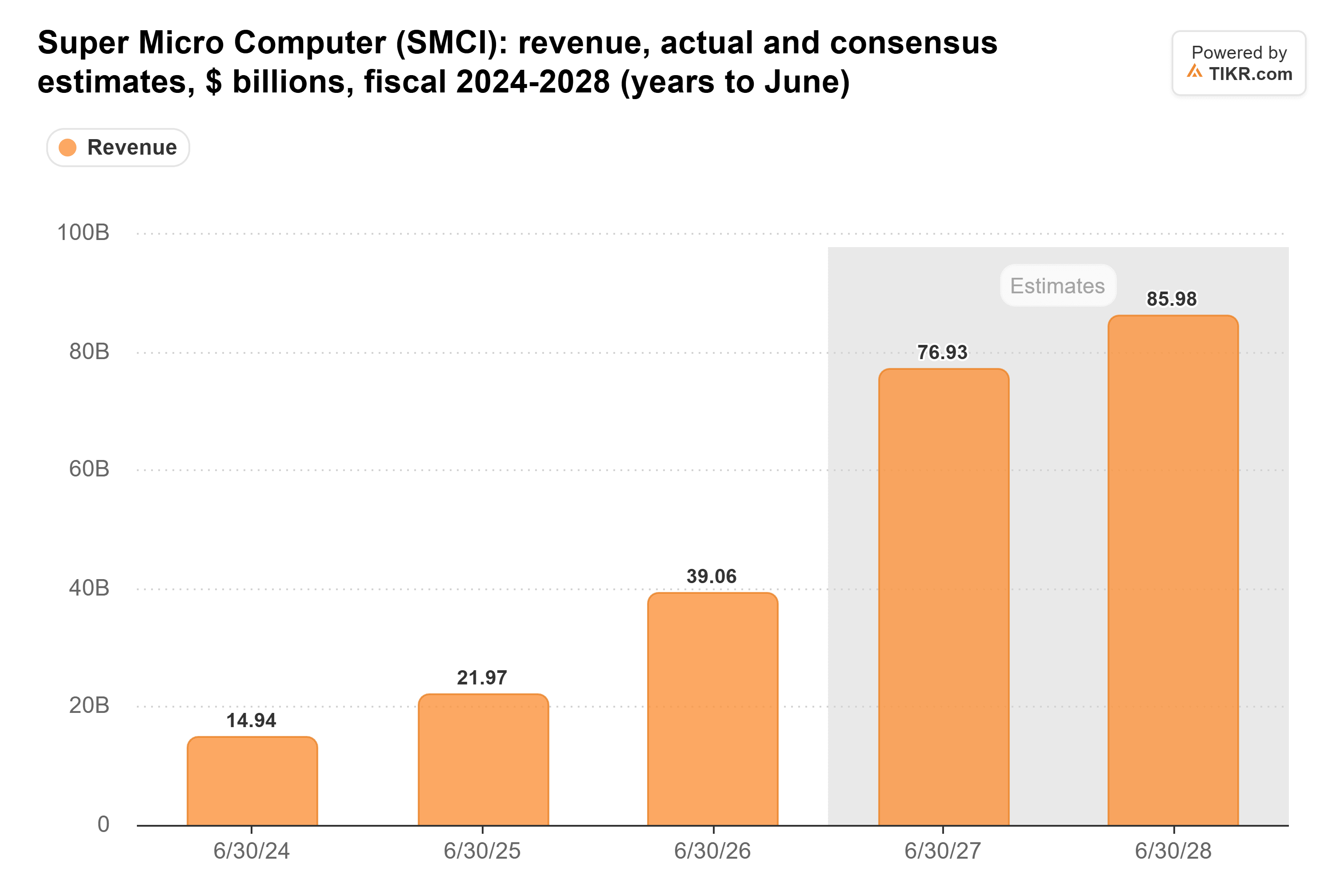
Analysts have already moved to the middle of the new range. The fiscal 2027 consensus is $76.9 billion from 15 analysts, after revenue grew from $14.9 billion in fiscal 2024 to $39.1 billion in fiscal 2026:
The quarter Super Micro just reported makes the low end look very reachable. Revenue was $19.9 billion in the September quarter. Long said about $2.3 billion of that was catch-up from earlier deployments, which leaves about $17.6 billion of underlying revenue.
To reach $72 billion, Super Micro needs $52.1 billion over the next three quarters, or about $17.4 billion a quarter. That’s less than the underlying business just did. Long said the range still assumes “continued sequential growth in underlying demand,” so the bottom of it leaves plenty of room for things to go wrong. The second-half outlook also doesn’t count on significant growth in selling prices, even though Long said key component costs have been rising “sometimes more than quarterly.”
Investors are pricing in a miss
Investors aren’t paying for any of that. Super Micro trades at 4.7x forward earnings, about a third of its 15x average over the past five years:
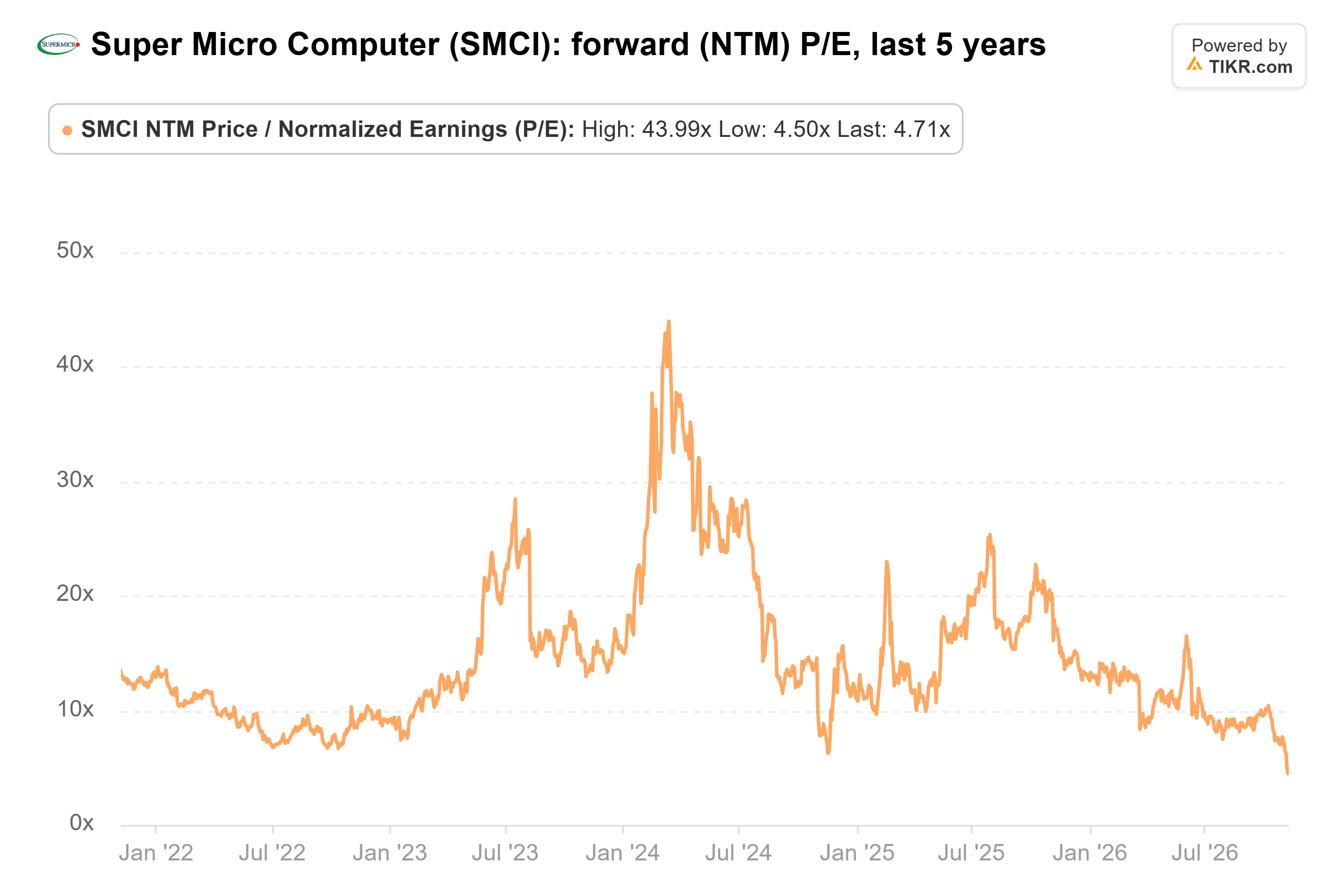
That’s well off its 44x peak in March 2024, and close to the five-year low of 4.5x it hit on Nov. 5. When investors pay that little for estimates that just went up, they clearly doubt Super Micro will hit them.
Super Micro can’t ship into an empty lot
Long said on the call: “What governs the range is not demand, and it is not our ability to build. It is the pace at which customer facilities become ready to receive what we’ve already manufactured and the availability of key components.” He also named the bottleneck: “The binding constraints on AI build-outs across this industry right now are land, power and data center shells.”
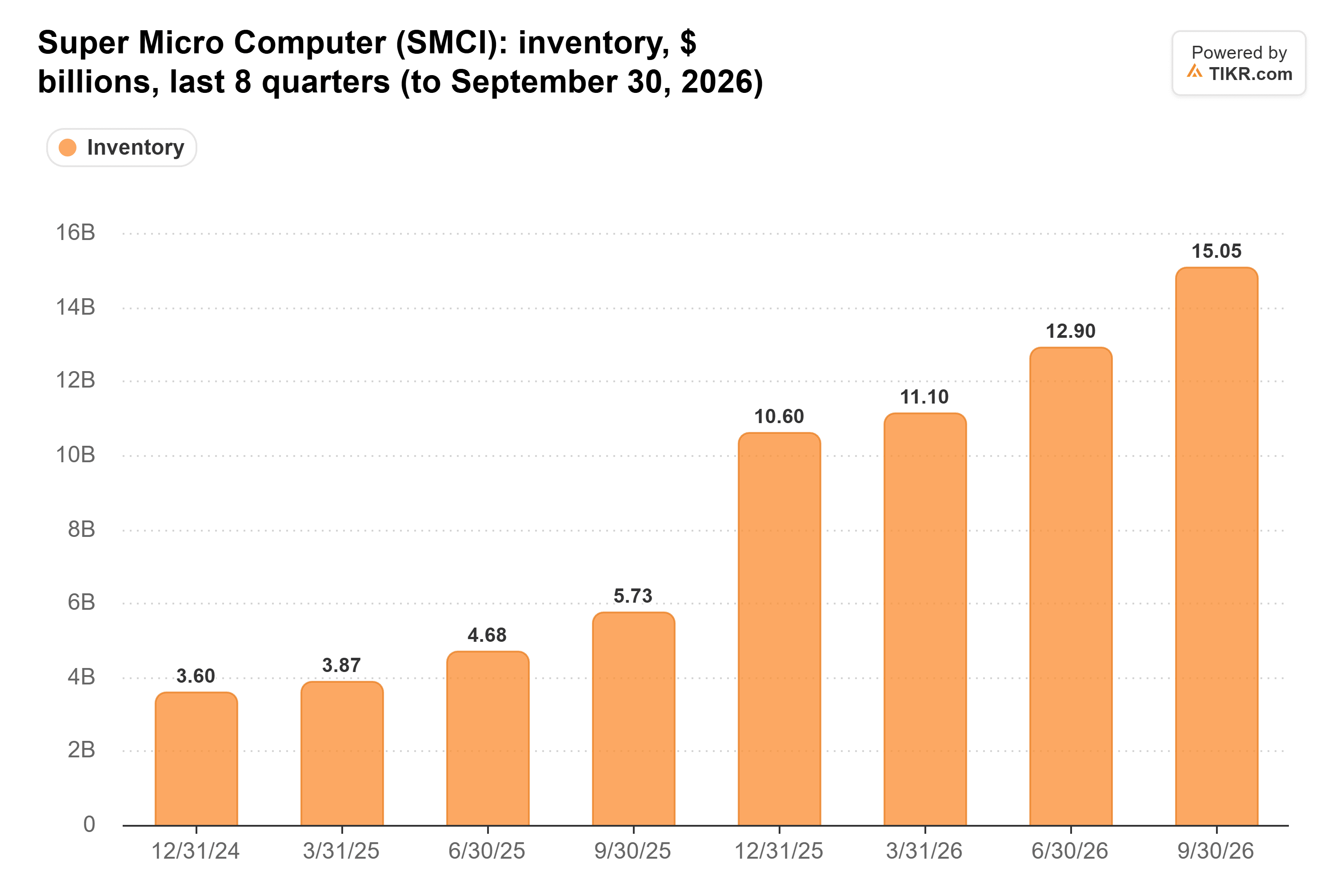
Super Micro’s inventory includes the parts and systems it has bought and built ahead of those deliveries. It has more than quadrupled since the end of 2024, to $15.1 billion at Sept. 30:
Customers aren’t backing out. Deferred revenue rose about $3.1 billion in the quarter, and Long said the overwhelming majority of it was customers paying in advance. Deliveries this lumpy make every late building hurt more. One customer made up 44% of September-quarter revenue, and Long said, “A single deployment today can exceed our total quarterly revenue from just 1 year ago.”
Nvidia needs the same buildings
Long said those constraints apply across the industry, and Super Micro’s business runs on Nvidia’s chips. AI systems made up 71% of its September-quarter revenue, and it began shipping Nvidia’s Vera Rubin racks on Sept. 23. The chips in today’s inventory are already bought. My read is that if shells stay scarce, the next place it shows up is in the orders Super Micro and other server makers place for Nvidia’s next chips.
How fast data centers get built is now a political question too. Texas accounts for more than 25% of planned US data center capacity through 2030, according to Yahoo Finance, and Democrat Gina Hinojosa, who promised a data center moratorium, just unseated Gov. Greg Abbott. That’s why the election raised fears of data center moratoriums. A moratorium in a state that size would slow the very shells Long calls the binding constraint, and Super Micro would be left holding more servers with nowhere to go.
Conservative, as long as the shells go up
The way I see it, Liang has earned his “very, very conservative.” At 4.7x forward earnings, the stock has far more room to run than to fall if the build-out keeps its schedule. The real danger is one big customer’s building running late, since a single deployment can now swing a quarter. Long promised to update investors on building readiness as the year goes on, and the December-quarter report, expected in early February, should show us whether the shells are going up as fast as the range needs.
So what is Super Micro stock actually worth?
TIKR lets you forecast the future price of any stock in less than a minute. Just enter a few assumptions into TIKR’s valuation model and see what Super Micro could be worth. Start from Wall Street consensus estimates, or adjust the inputs to reflect your own view of the business. It’s free to use.
Disclaimer:
Please note that the articles on TIKR are not intended to serve as investment or financial advice from TIKR or our content team, nor are they recommendations to buy or sell any stocks. We create our content based on TIKR Terminal’s investment data and analysts’ estimates. Our analysis might not include recent company news or important updates. TIKR has no position in any of the stocks mentioned. Thank you for reading, and happy investing!