Key Takeaways
- Microsoft wants fewer neocloud partners and won’t renew one of its cloud contracts with Oracle, CNBC reported on Friday.
- Citi’s Steven Wieting says Microsoft’s cost of debt is about 10 percentage points below CoreWeave’s. That makes owning data centers much cheaper for Microsoft than renting them.
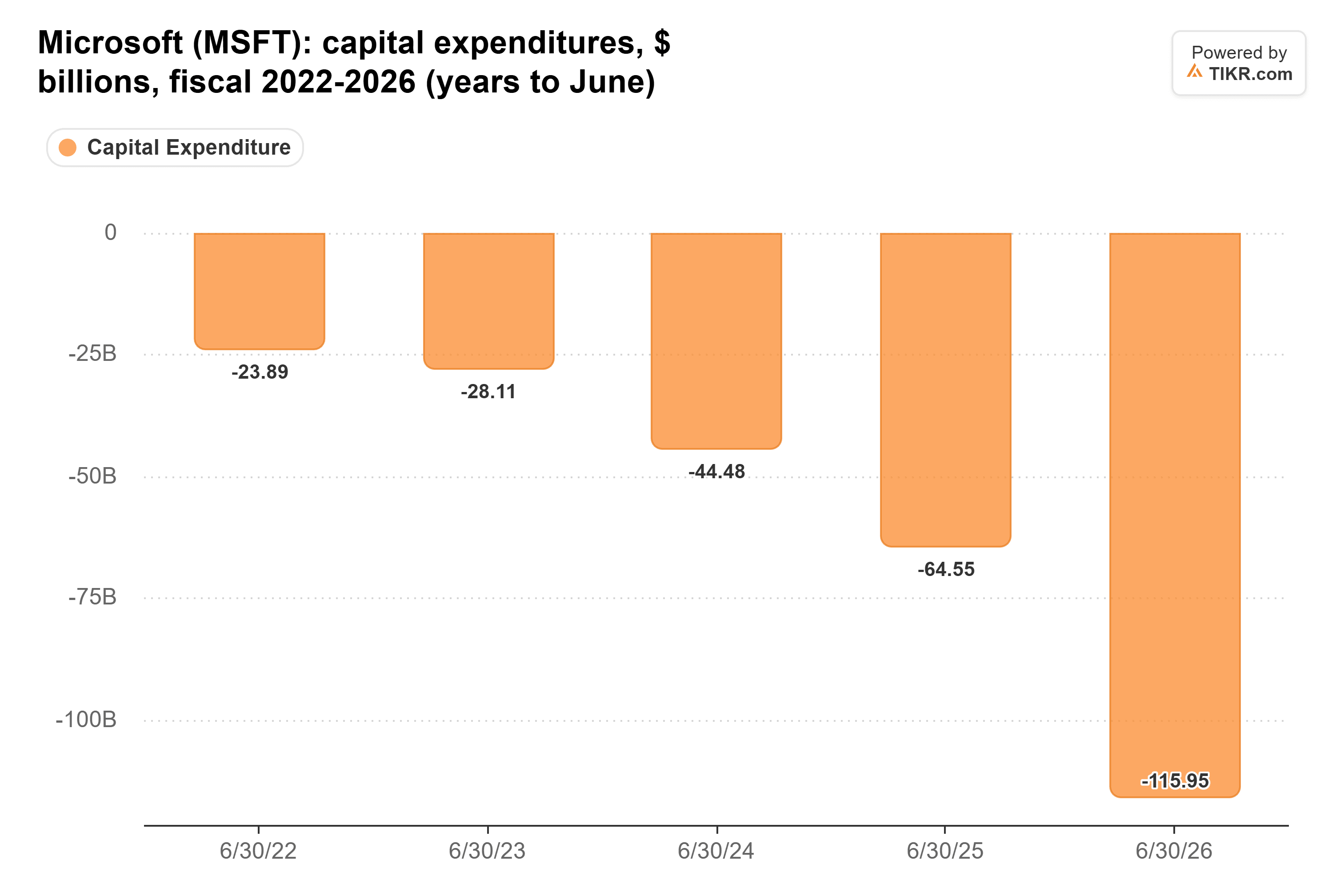
- Owning still costs a lot. Microsoft’s capex reached $116 billion in fiscal 2026, and analysts expect its free cash flow to fall to $32.7 billion in fiscal 2027.
- CoreWeave has the most to lose, and its results in the coming days will show how much it depends on Microsoft.
Microsoft (MSFT) helped create the neocloud boom. Now it’s backing away from it, and CoreWeave (CRWV) and Oracle (ORCL) stand to lose business.
On Friday, CNBC’s Seema Modi reported on Closing Bell Overtime that Microsoft has decided not to renew one of its cloud contracts with Oracle. Her sources also said Microsoft “is actively looking at shrinking the number of neoclouds it partners with as it doubles down on its own data center strategy.”
On the same show, Citi’s Steven Wieting put a number on Microsoft’s edge. Its cost of debt, he said, “is about 10 percentage points below CoreWeave.”
That’s an enormous head start.
Microsoft pays its own way
Owning data centers isn’t cheap. Analysts expect Microsoft’s free cash flow to fall to $32.7 billion in fiscal 2027 (the year to June 2027). That’s less than half the $67.0 billion it generated in fiscal 2026:
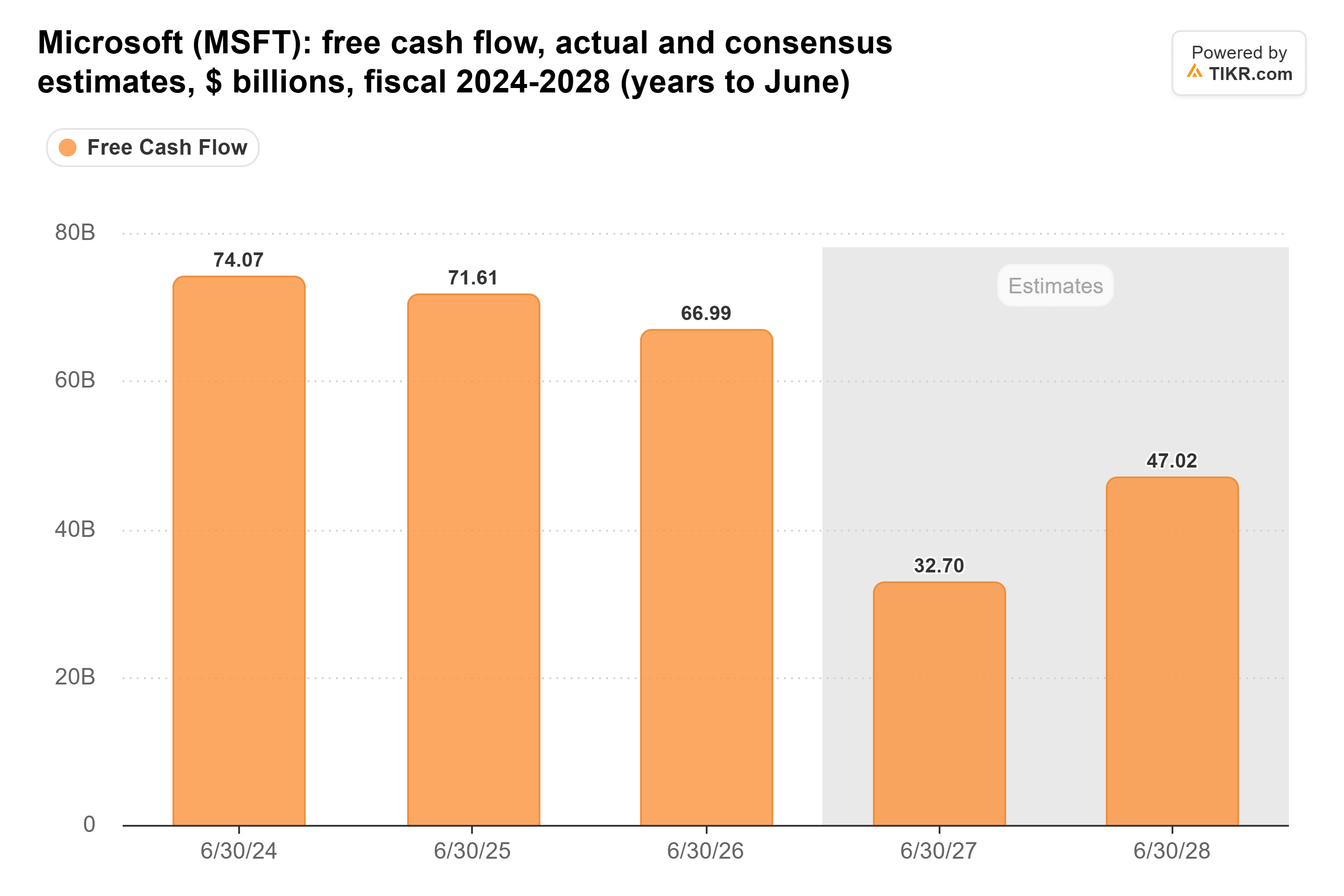
Analysts expect fiscal 2027 to be the low point, with free cash flow recovering to $47.0 billion in fiscal 2028. Capex is what’s eating the cash. It climbed almost fivefold in four years, from $23.9 billion in fiscal 2022 to $116 billion in fiscal 2026:
Still, Microsoft pays for that building out of its own operations. In the September quarter, it was the only one of the five biggest AI spenders with positive free cash flow. At June 30, it held $76.8 billion of cash and short-term investments against $40.3 billion of debt.
TIKR tracks 58 analysts on Microsoft. How many say “Buy”?
See the full breakdown of Buy, Hold, and Sell ratings on Microsoft, along with Wall Street’s revenue and earnings estimates, all in one place. More than 500,000 investors use TIKR to research stocks like this one. See Microsoft’s Analyst Ratings
Ten points adds up fast
CoreWeave is in a very different spot, since it borrows to build. Its total debt climbed from $6.28 billion at the end of September 2024 to $51.6 billion at the end of June 2026:
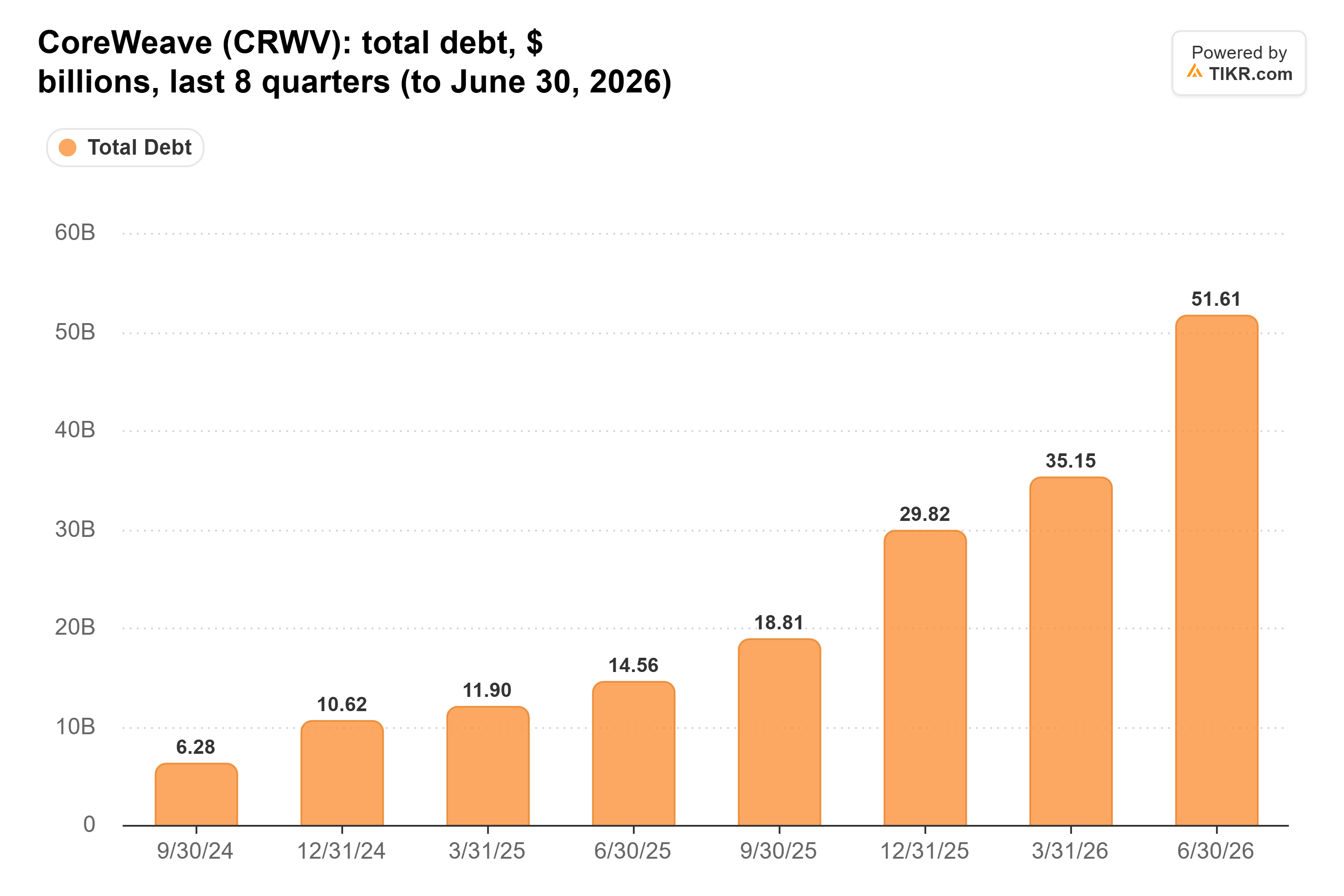
And it’s paying more to borrow. Steve Eisman, of The Big Short fame, said on The Real Eisman Playbook that CoreWeave’s debt was repriced weeks ago from a yield of 9% to 15%. “At a cost of debt of 15%, building AI data centers becomes prohibitively expensive,” he said.
Every $10 billion borrowed at 15% costs $1.5 billion a year in interest. With Wieting’s 10-point gap, Microsoft would pay $1 billion a year less on the same amount. I’d expect a neocloud to pass that cost on in what it charges, and Microsoft seems to have noticed. Bloomberg’s Brody Ford, who reported Microsoft’s pullback on Thursday, said on Bloomberg Tech that Microsoft is finding “they can’t control the delays, that the costs are higher than their internal projects.”
CoreWeave has the most to lose
Losing Microsoft work would hurt CoreWeave twice. Modi noted on CNBC that the publicly listed neoclouds use Microsoft’s AAA credit rating to secure loans. So fewer Microsoft contracts could mean less revenue and also costlier borrowing, for a company that already owes a lot. The pullback has been building, too: Microsoft rejected Nscale’s Texas expansion on Thursday, and CoreWeave sank 9%.
Oracle’s hit is smaller: one contract, tied to older A100 chips. But Oracle was one of the four big AI spenders with negative free cash flow in the September quarter, so it doesn’t have much room to lose business either.
Owning still wins, even if it’s slower
The catch for Microsoft is speed. It has been adding about 1 gigawatt of capacity a quarter, and management has said demand still exceeds what it has. Any in-house build that comes online later than a neocloud’s would have costs Azure sales. Ford also pointed out that demand is strong enough for a company like Meta or Google to take capacity Microsoft passes up, and that’s CoreWeave’s best case.
Here’s where I land: Microsoft is making the right call. With debt this much cheaper, it can own capacity for less than it pays to rent it. And Wieting argues that “the compute that’s already in place among the hyperscalers is worth more if there’s going to be a limited build-out later on.” CoreWeave is the stock I’d worry about.
Of course, CoreWeave’s results in the coming days should show how much of its business still comes from Microsoft, and whether other buyers are filling the gap.
So what is Microsoft stock actually worth?
TIKR lets you forecast the future price of any stock in less than a minute. Just enter a few assumptions into TIKR’s valuation model and see what Microsoft could be worth. Start from Wall Street consensus estimates, or adjust the inputs to reflect your own view of the business. It’s free to use.
Disclaimer:
Please note that the articles on TIKR are not intended to serve as investment or financial advice from TIKR or our content team, nor are they recommendations to buy or sell any stocks. We create our content based on TIKR Terminal’s investment data and analysts’ estimates. Our analysis might not include recent company news or important updates. TIKR has no position in any of the stocks mentioned. Thank you for reading, and happy investing!