Key Takeaways
- On CNBC’s Halftime Report, a panelist said Micron will buy back $100 billion of stock, about 13% of its roughly $750 billion market value, at about 4x next year’s earnings.
- Buying back that much stock at that price lifts earnings per share by about 15%, and it’s still a good deal even if earnings get cut in half.
- Micron has authorized $35.16 billion of buybacks starting Dec. 9, and analysts expect $142.9 billion of free cash flow in fiscal 2027.
- The main risk is the cycle: Micron last traded near this multiple in 2017 and 2018, just before EPS fell 79%. The first buybacks will show up in the quarter ending in early March.
Micron Technology (MU) is now cheap enough to make investors nervous. Even after a 6% bounce on Friday from a 17% plunge in Thursday’s chip rout, the stock trades at 3.9x forward earnings.
On Friday’s episode of CNBC’s Halftime Report, one panelist argued that the low price is exactly the point:
“If we want to talk about Micron, let’s not forget they’re going to buy back a hundred billion dollars worth of shares for a market cap that just got a lot cheaper, is 750 billion.”
The panelist added that Micron has no debt and plenty of free cash flow, then summed it up: “at literally four times next year’s earnings, I’m okay with it.” (Strictly speaking, Micron had $5.2 billion of debt at Sept. 3, against $73.45 billion of cash and investments. Close enough.)
A hundred billion dollars is about 13% of the company. At 4x earnings, that’s a big deal.
TIKR tracks 49 analysts on Micron. How many say “Buy”?
See the full breakdown of Buy, Hold, and Sell ratings on Micron, along with Wall Street’s revenue and earnings estimates, all in one place. More than 500,000 investors use TIKR to research stocks like this one. See Micron’s Analyst Ratings
The cash is there
Start with the earnings behind that 4x. Analysts expect Micron’s normalized EPS to more than double again in fiscal 2027:
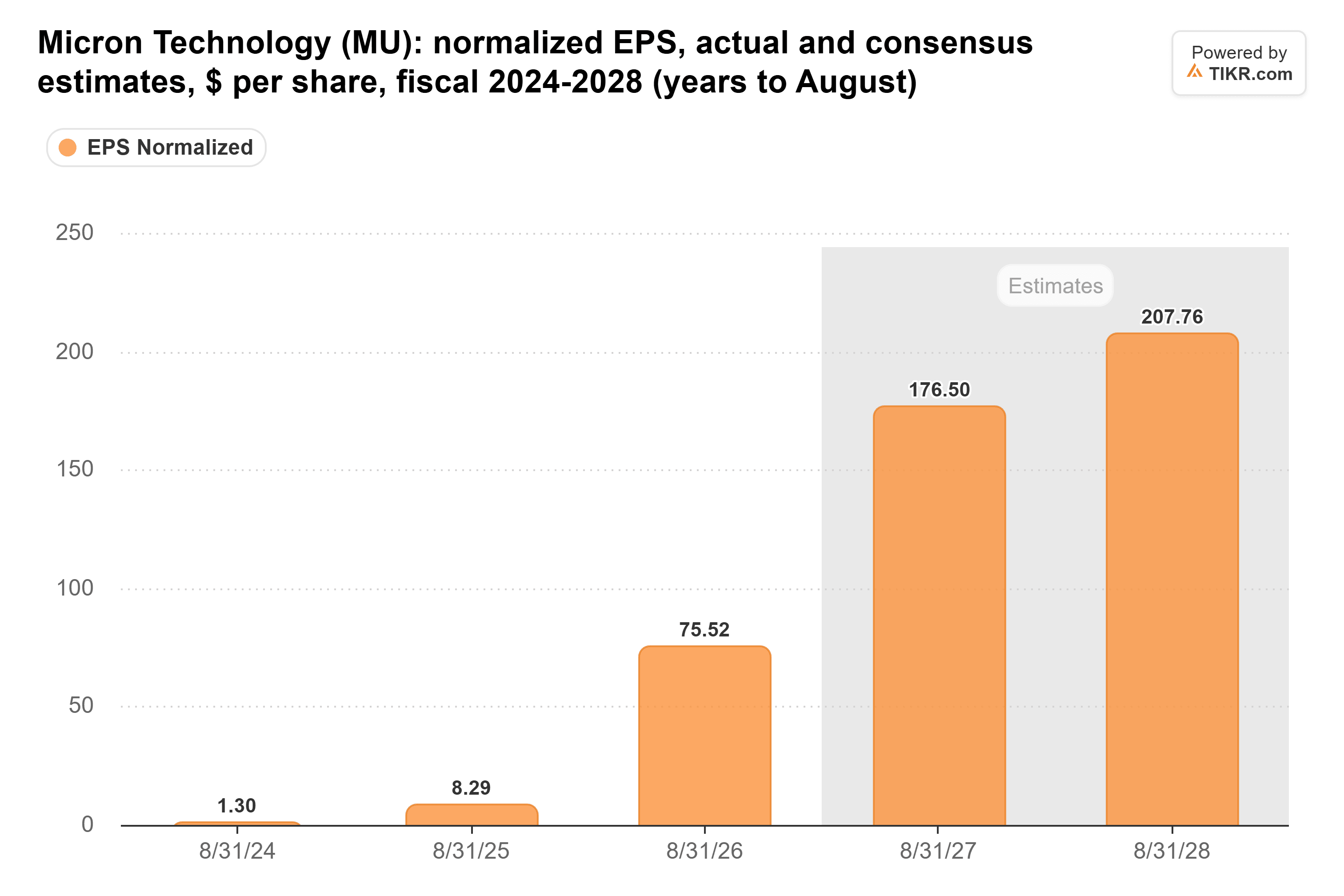
Fiscal 2028 is the estimate I’d watch for cuts. UBS analysts warn that construction pauses after the midterms could threaten around 30% of the US data-center capacity expected to be added that year.
The cash is showing up too. Free cash flow jumped from $1.67 billion in fiscal 2025 to $59.0 billion in fiscal 2026:
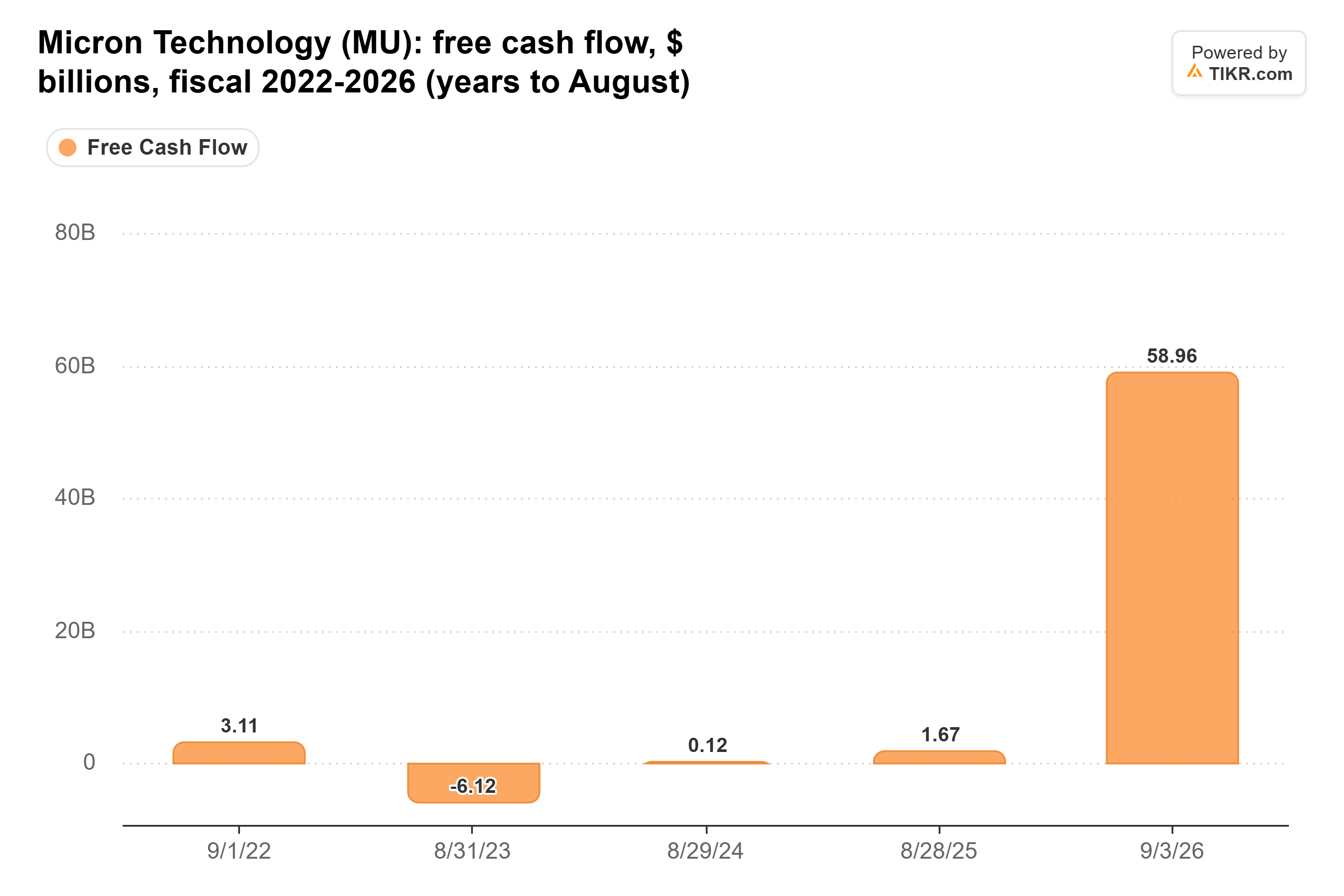
Analysts expect $142.9 billion of free cash flow in fiscal 2027 alone, so $100 billion of buybacks would take less than one year’s worth. Micron’s board hasn’t committed to that much yet. It has authorized up to $35.16 billion of repurchases starting Dec. 9, an amount based on a single quarter’s free cash flow after dividends. With cash coming in that fast, I’d expect more authorizations to follow.
The market doesn’t believe the earnings
Of course, a 4x multiple is the market telling you something. As Mike Santoli put it on CNBC’s Closing Bell Overtime the same day: “If the market believed the earnings, it wouldn’t be under four times.”
And there’s history behind that worry. Since 2014, Micron’s forward P/E has usually been near 10x on TIKR’s quarter-end readings. Today it’s close to where it traded in 2017 and 2018, right as the last memory cycle peaked. EPS then fell 79% from fiscal 2018 to fiscal 2020.
Micron’s answer this time is its 26 long-term supply agreements, which management estimates cover over 35% of revenue through 2030. But none of them has been through a falling market yet, and one veteran investor argues customers will walk away from them once prices drop far enough.
I’d still take that price
Even if the skeptics are right, shareholders come out ahead on the buyback. At 4x earnings, every dollar Micron spends buys back about 25 cents of yearly earnings. If memory prices crack and earnings get cut in half, that dollar still buys about 12.5 cents. That’s 8x, which is still below the roughly 10x Micron has usually traded at.
And retiring 13% of the shares lifts EPS by about 15% for everyone who holds on, since the same profit gets split across 87% as many shares. (That assumes Micron buys at today’s price. If the stock runs, $100 billion buys less of it.)
The risk is that Micron hasn’t been much of a buyer so far. In fiscal 2026, it repurchased just $650 million of stock. That’s less than the $1.33 billion it paid out in stock-based compensation, and its diluted share count rose 1.6%.
Bottom line: shrinking the share count at under 4x earnings is the best use of Micron’s shortage profits, and it’s a big reason I think the stock is a bargain at this price. We’ll get the first real look at it in the report for the quarter ending in early March, the first to show what Micron bought after Dec. 9. Before that, the mid-to-late December report will show whether the memory prices behind those earnings are holding up.
So what is Micron stock actually worth?
TIKR lets you forecast the future price of any stock in less than a minute. Just enter a few assumptions into TIKR’s valuation model and see what Micron could be worth. Start from Wall Street consensus estimates, or adjust the inputs to reflect your own view of the business. It’s free to use.
Disclaimer:
Please note that the articles on TIKR are not intended to serve as investment or financial advice from TIKR or our content team, nor are they recommendations to buy or sell any stocks. We create our content based on TIKR Terminal’s investment data and analysts’ estimates. Our analysis might not include recent company news or important updates. TIKR has no position in any of the stocks mentioned. Thank you for reading, and happy investing!