Key Takeaways
- Seagate Technology (STX) closed at $593.76 on Nov. 2, down 30% from its Oct. 2 close, as AI hardware stocks sold off and Sandisk (SNDK) fell 13.5% on Oct. 30 despite beating estimates.
- The slide came on top of a 10.2% drop on Oct. 2, when a report said Toshiba plans to double its hard-drive capacity for AI data centers.
- Seagate’s fiscal first quarter beat estimates and its December guidance topped them. Most analysts still cut their price targets, and Wells Fargo said nearline shipments grew less than expected.
- Analysts raised their earnings estimates after the report even as the stock fell. New supply arriving faster than demand is the risk that would justify today’s price.
Seagate Technology (STX) has given back 30% in a month, and the timing matters. The count starts at the Oct. 2 close of $848.99, which already reflected a 10.2% drop on Toshiba’s capacity news. The stock then fell 21% into its Oct. 27 report as AI hardware stocks sold off, and another 11% after a record quarter and higher guidance.
The rest of the storage group fell with it. Sandisk dropped 13.5% the day after its own beat, and on Nov. 2 Seagate lost another 7.9% as Western Digital, Sandisk, and Micron also slid.
TIKR tracks 26 analysts on Seagate Technology. How many say “Buy”?
See the full breakdown of Buy, Hold, and Sell ratings on Seagate Technology, along with Wall Street’s revenue and earnings estimates, all in one place. More than 500,000 investors use TIKR to research stocks like this one. See Seagate Technology’s Analyst Ratings
A record quarter with a soft spot
Seagate’s fiscal first quarter ended Oct. 2. Revenue rose 61% from a year earlier to $4.23 billion, ahead of the $4.14 billion analysts polled by LSEG expected. Adjusted EPS of $7.68 beat their $7.42. Free cash flow of $1.5 billion was the highest in company history.
Seagate retired $1.2 billion of debt in the quarter and $750 million more since, cutting gross debt to $1.6 billion. It also raised its quarterly dividend about 3% to $0.76. For the December quarter, it guided to $4.8 billion of revenue and $9.20 of adjusted EPS.
Analysts expect earnings to keep climbing through fiscal 2029:
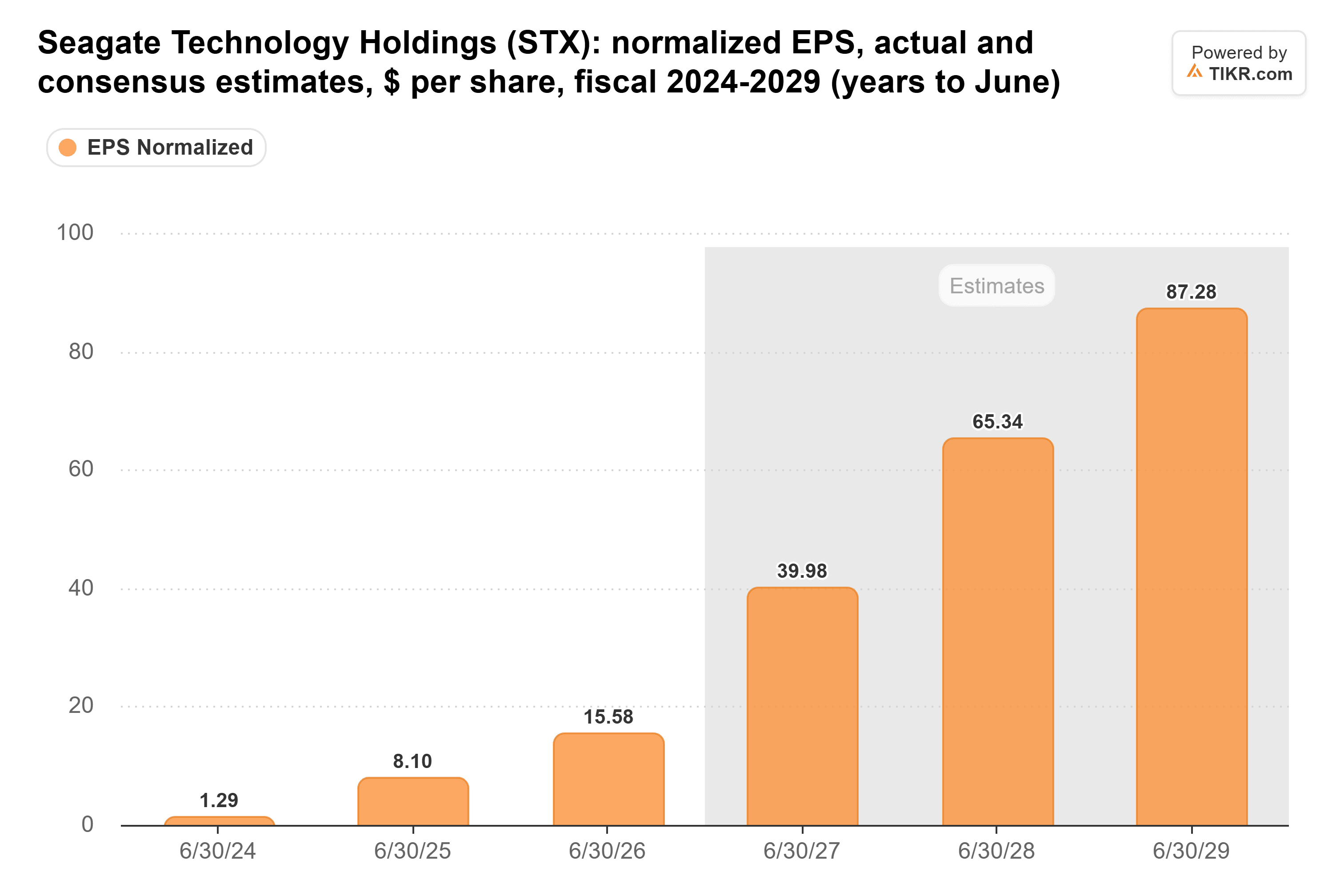
Those estimates moved up after the report, not down. TIKR’s fiscal 2027 consensus stood at $36.66 when the quarter came out and $39.98 by Oct. 31. At the guidance midpoint, the September and December quarters add up to $16.88 of adjusted EPS. That is more than the $15.53 Seagate earned across all four quarters of fiscal 2026.
The soft spot was nearline, the high-capacity drives data centers buy. Wells Fargo said nearline capacity shipments grew less than expected, and most analysts cut their targets on Oct. 28. Citi went to $1,050 from $1,300, Mizuho to $900 from $1,090, and TD Cowen to $900 from $1,000. Summit Insights downgraded the stock to Hold, while Baird raised its target to $1,350 from $1,080.
Toshiba wants to double its output
The supply scare came first. On Oct. 2, Nikkei reported that Toshiba plans to double its capacity for hard drives used in AI data centers within its fiscal 2027, partly by expanding its plant in the Philippines. Seagate fell 10.2% that day.
Tight supply is what has let Seagate raise prices. Chair and CEO Dave Mosley said in the fiscal first-quarter release that Seagate’s HAMR roadmap lets it meet growing exabyte demand “through areal density gains while maintaining supply discipline.” Seagate grows by packing more storage into each drive, not by building more drives.
Toshiba’s own announcement frames its goal the same way. Its Philippine unit aims to nearly double annual capacity on a storage-capacity basis by fiscal 2027, which for Toshiba ends in March 2028. That is a target, not shipped supply, and part of it can come from denser drives rather than more of them.
Seagate’s gross margin climbed from 19% in fiscal 2023 to 35% in fiscal 2025:
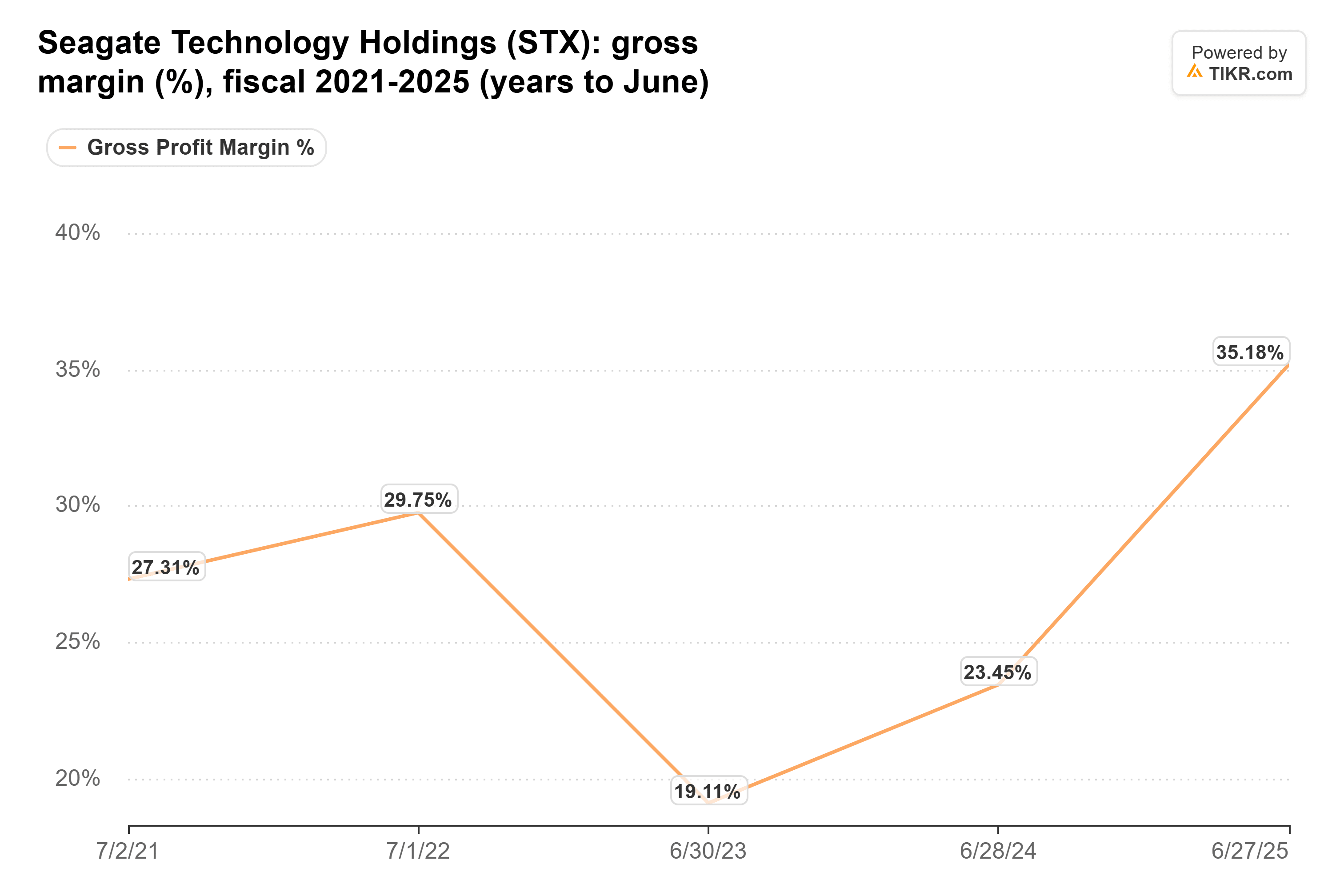
Last quarter it reached 57.8% on an adjusted basis, up from 40.1% a year earlier. If Toshiba’s capacity arrives faster than demand grows, that margin is what gives back first.
The whole AI hardware trade sold off
Seagate did not fall alone. Before its report, Wells Fargo, JPMorgan, and Rosenblatt had already cut their targets, with Rosenblatt citing sector-wide multiple compression. On Oct. 22, chip and memory stocks dropped after Lam Research’s outlook the night before and Tesla’s cut to its 2026 capital spending target. On Oct. 30, Seagate fell 8.0% and Sandisk 13.5% as the Nasdaq had its worst day since June. On Nov. 2, the Philadelphia Semiconductor Index lost another 3.4%.
When a company that just guided higher trades in lockstep with the whole group, the selling looks aimed at the AI hardware theme rather than at Seagate’s numbers.
Load up, with an eye on supply
Even after the drop, Seagate is up 116% in 2026. Yet it traded at about 13.7x forward earnings at the Oct. 30 close, down from roughly 18x just before the report:
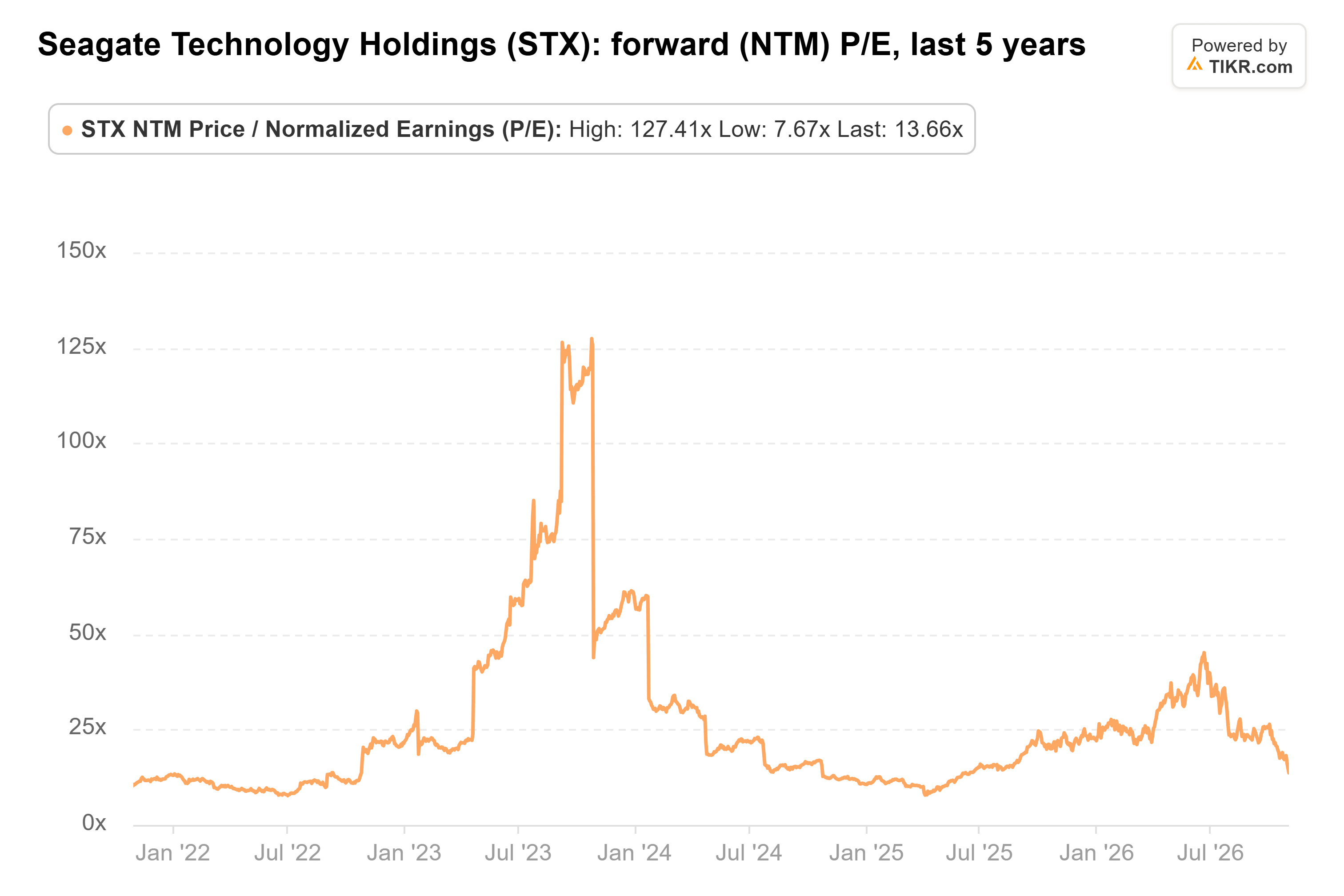
The 7.9% drop on Nov. 2 pushed the multiple lower still. Citi’s $1,050 target sits about 77% above the Nov. 2 close, and the average of 26 analyst targets compiled by StockAnalysis is about $1,045. Even UBS and Susquehanna, both at Neutral, have targets of $750 and $765, above where the stock trades.
The market is pricing Seagate as if the drive shortage is already ending, while Seagate just guided to higher sales and earnings for December. That gap argues for loading up rather than selling, for investors who can stomach the swings.
The December-quarter report, expected in late January, is the test. Revenue near the $4.8 billion guide with adjusted gross margin at or above 57.8% would confirm the pricing story. Softer nearline shipments or pricing as Toshiba’s capacity ramps would break it.
So what is Seagate stock actually worth?
TIKR lets you forecast the future price of any stock in less than a minute. Just enter a few assumptions into TIKR’s valuation model and see what Seagate could be worth. Start from Wall Street consensus estimates, or adjust the inputs to reflect your own view of the business. It’s free to use.
Disclaimer:
Please note that the articles on TIKR are not intended to serve as investment or financial advice from TIKR or our content team, nor are they recommendations to buy or sell any stocks. We create our content based on TIKR Terminal’s investment data and analysts’ estimates. Our analysis might not include recent company news or important updates. TIKR has no position in any of the stocks mentioned. Thank you for reading, and happy investing!