Key Takeaways
- Sandisk stock is up 273% in 2026 on a flash shortage and AI data-center demand, but it’s 62% below its June high, and Micron has fallen on the same worries.
- Sandisk’s revenue kept climbing as the stock fell, to $11.0 billion in the quarter to Oct. 2. But flash price gains are cooling, and Qualcomm blamed weak phone sales partly on memory costs.
- Analysts still expect Sandisk’s earnings to more than triple this fiscal year. Investors are giving almost no credit to its $88.9 billion of contracts at floor prices.
- Sandisk looks like a stock to buy more of a piece at a time, and its late-January report is the next test.
Sandisk (SNDK) stock is up 273% in 2026. But it’s also 62% below its June 25 high, and the business set records the whole way down.
Micron (MU) rode the same memory boom and fell on the same worries. The worst of them came from Qualcomm (QCOM), which blamed weak phone sales partly on the cost of memory.
The business kept setting records
A flash shortage and AI data centers’ appetite for storage drove Sandisk’s year. Revenue reached $11.0 billion in the quarter to Oct. 2, up 378% from a year earlier. Data center sales went from $269 million to $4.80 billion, 44% of the total. The non-GAAP gross margin hit 85.1%, against 29.9% a year before.
Sandisk announced its first five long-term supply contracts in April. It had signed five more by early August, when its board added a $14 billion buyback.
TIKR tracks 25 analysts on Sandisk. How many say “Buy”?
See the full breakdown of Buy, Hold, and Sell ratings on Sandisk, along with Wall Street’s revenue and earnings estimates, all in one place. More than 500,000 investors use TIKR to research stocks like this one. See Sandisk’s Analyst Ratings
Then flash prices cooled, and the AI trade cracked
But higher prices did most of the lifting. Management credited them with about two-thirds of the sequential revenue gain in the quarter to July 3, and about 40% a quarter later. Sandisk’s beat the top of its guidance by 24%, then 9%, then just 2% over its last three reports. Kioxia, its joint venture partner in flash, reported the same cooling. Its NAND price gains slowed to the mid-20s percent in the September quarter, from about 70%. Sandisk beat again on Oct. 29, with an 8-for-1 split, and the stock fell anyway.
Then came Qualcomm’s report after the Nov. 4 close. Its handset chip revenue fell 26% to $5.14 billion in the quarter to Sept. 27. Part of that was its Apple business winding down. It also pointed to “industry-wide memory dynamics.” Phones, PCs and other devices made up the other 57% of Sandisk’s revenue last quarter. So if memory costs mean fewer phones get built, both companies feel it.
Democrats’ sweep of Congress on Nov. 3 had already stoked fears of slower data-center building. Sandisk fell 22% on Nov. 5. Micron fell on the same news, though it’s still up 173% this year. Phone and PC makers bring in about a quarter of Micron’s revenue. Its own 26 supply agreements also face the same test as Sandisk’s.
Under 4x earnings, I’d buy more
Analysts haven’t followed the stock down. They still expect normalized EPS to more than triple this fiscal year, to $227.48 a share for the year to June 2027, and to keep rising after that:
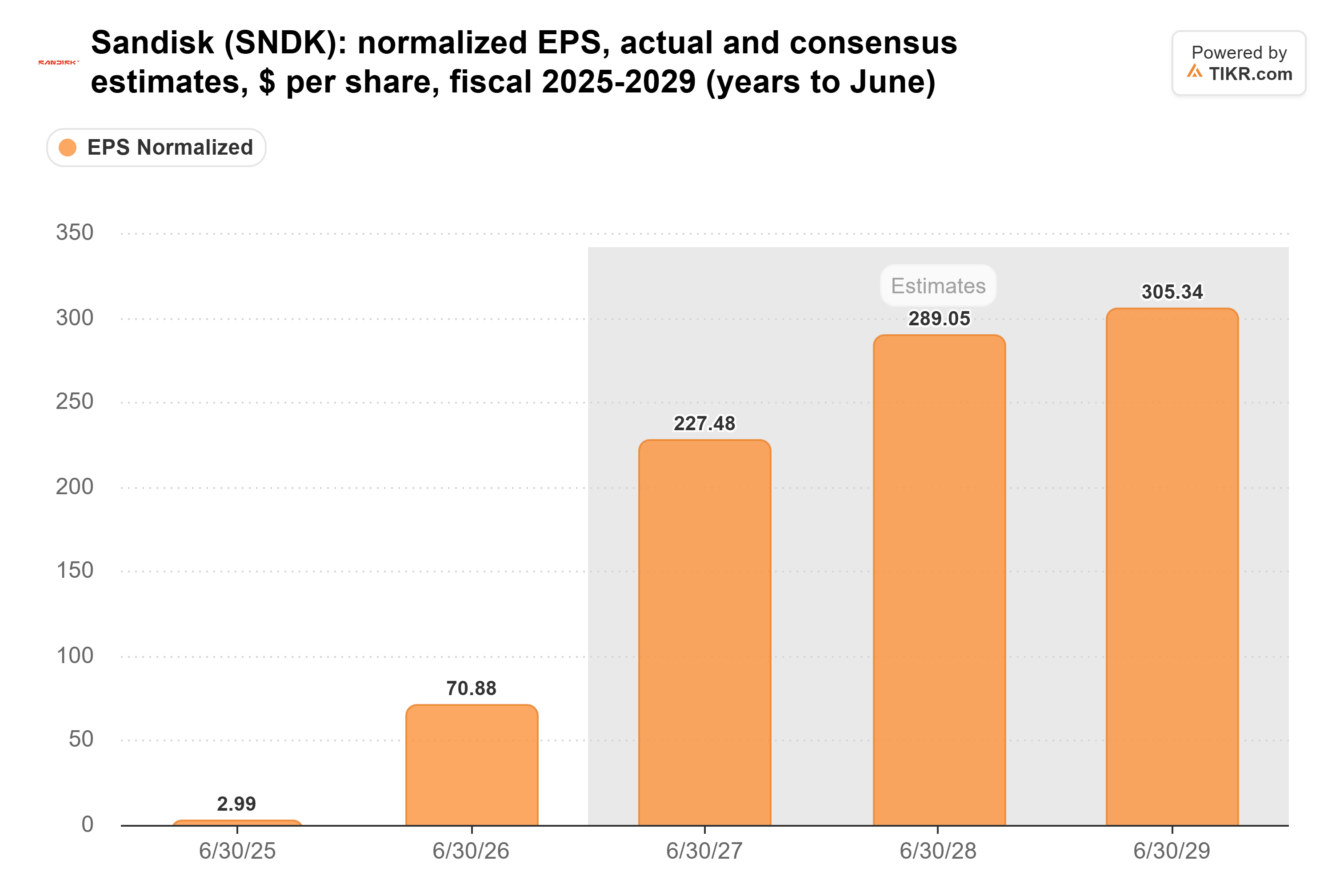
(Those are pre-split figures. The split shares start trading Nov. 20.)
Investors aren’t paying for those earnings. Sandisk traded at 3.8x forward earnings on Nov. 12, against a 10.2x average over the past year and 27.3x in January:
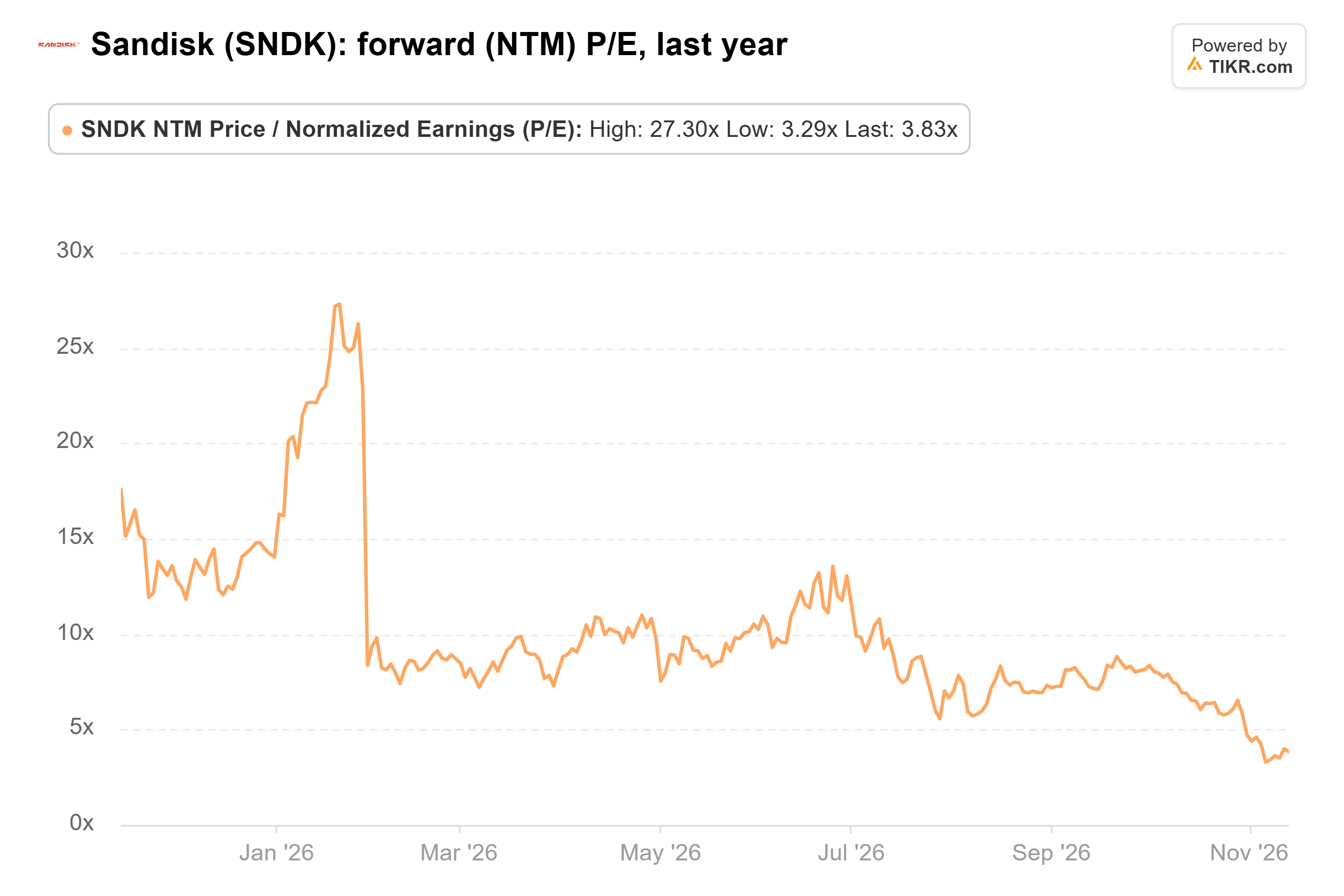
That’s a bet on a bust, and the contracts are the cushion. Sandisk had $88.9 billion of remaining performance obligations on Oct. 2, valued at floor prices that management says still earn a gross margin of about 80%. Management also says the deals cover more than half of fiscal 2027’s bits. The risk is that the contracts are young, with the oldest signed in January, and flash has always been a brutal cycle.
Bottom line: investors are treating those contracts as if they barely exist. I’d buy more, a piece at a time. Wall Street’s average target of $2,047 (pre-split) is more than double the stock. Evercore ISI kept its $2,500 target on Nov. 11.
The next test comes in late January. That’s when Sandisk reports its fiscal second quarter against revenue guidance of $12.2 billion to $12.6 billion, and gives its outlook for the March quarter, usually its weakest. A backlog above $88.9 billion would mean new or bigger contracts.
So what is Sandisk stock actually worth?
TIKR lets you forecast the future price of any stock in less than a minute. Just enter a few assumptions into TIKR’s valuation model and see what Sandisk could be worth. Start from Wall Street consensus estimates, or adjust the inputs to reflect your own view of the business. It’s free to use.
Disclaimer:
Please note that the articles on TIKR are not intended to serve as investment or financial advice from TIKR or our content team, nor are they recommendations to buy or sell any stocks. We create our content based on TIKR Terminal’s investment data and analysts’ estimates. Our analysis might not include recent company news or important updates. TIKR has no position in any of the stocks mentioned. Thank you for reading, and happy investing!