


Key Stats for RTX
- 52-Week Range: $150.61 – $226.88
- Street Mean Target: $232.27
- Market Cap: ~$300B
- Dividend Yield: 1.3%
- NTM P/E: ~30x
- 2026 Adjusted EPS Guidance: $5.80 – $5.95
Analyze your favorite stocks like RTX Corporation with TIKR (It’s free) >>>
The Business Is Firing on All Cylinders
RTX Corporation (RTX) is one of the world’s largest aerospace and defense companies, formed from the 2020 merger of Raytheon and United Technologies. Collins Aerospace makes avionics, interiors, and flight control systems for commercial and military aircraft.
Pratt and Whitney designs jet engines, including the GTF family, which now powers most new narrowbody aircraft. Raytheon makes missiles, radar systems, and air defense platforms that have become central to NATO’s collective security posture.
Q2 2026 results reinforced a consistent pattern. Net sales reached $24.7 billion, up 11% year-over-year. Collins Aerospace generated $8.2 billion in revenue, up 9%, with operating profit rising 17%.
Pratt and Whitney delivered $8.0 billion in sales, up 13%, and operating profit of $619 million, up 49%, as GTF engine production scales and aftermarket revenue grows alongside the expanding installed base. Raytheon contributed $6.1 billion in revenue, up 5%, with operating profit up 15%.
Adjusted EPS came in at $1.89, up 27% from a year ago, and management raised full-year adjusted EPS guidance to $5.80 to $5.95 and adjusted free cash flow guidance to $7.0 to $7.5 billion.
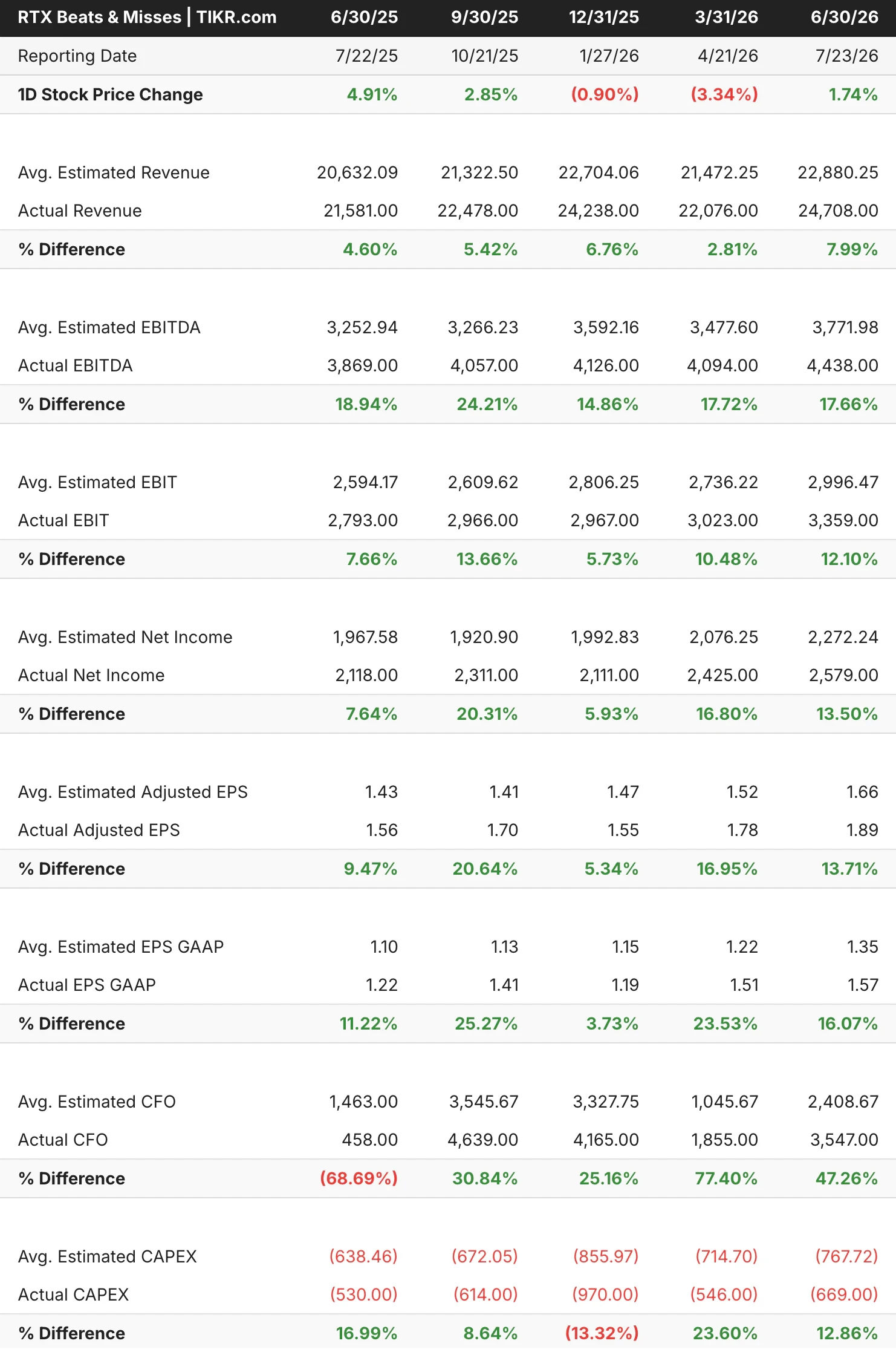
The Beats and Misses chart tells the story of a company that has made a habit of outperforming. RTX beat revenue estimates in each of the last five reported quarters, with EBITDA beats ranging from 15% to 24% above consensus and adjusted EPS beats between 5% and 21%. Those are not narrow beats on easy estimates. They reflect genuine operational momentum across all three segments simultaneously.
The backlog anchors the long-term case. RTX exited Q2 with a record $218 billion in total backlog, roughly two years of revenue already committed. The defense portion has been growing steadily as NATO allies accelerate procurement in response to geopolitical uncertainty, with Raytheon’s Patriot missile systems, StormBreaker smart weapons, and SPY-6 radar platforms all in high demand.
Value RTX Corporation instantly (Free with TIKR) >>>
What the Street Thinks the Execution Is Worth
Here is where the RTX story gets genuinely interesting. A company with five straight quarters of double-digit EPS beats, a $218 billion backlog, raised guidance, and strong momentum across all three segments would normally command an enthusiastic analyst consensus. The Street Targets chart tells a more complicated story.
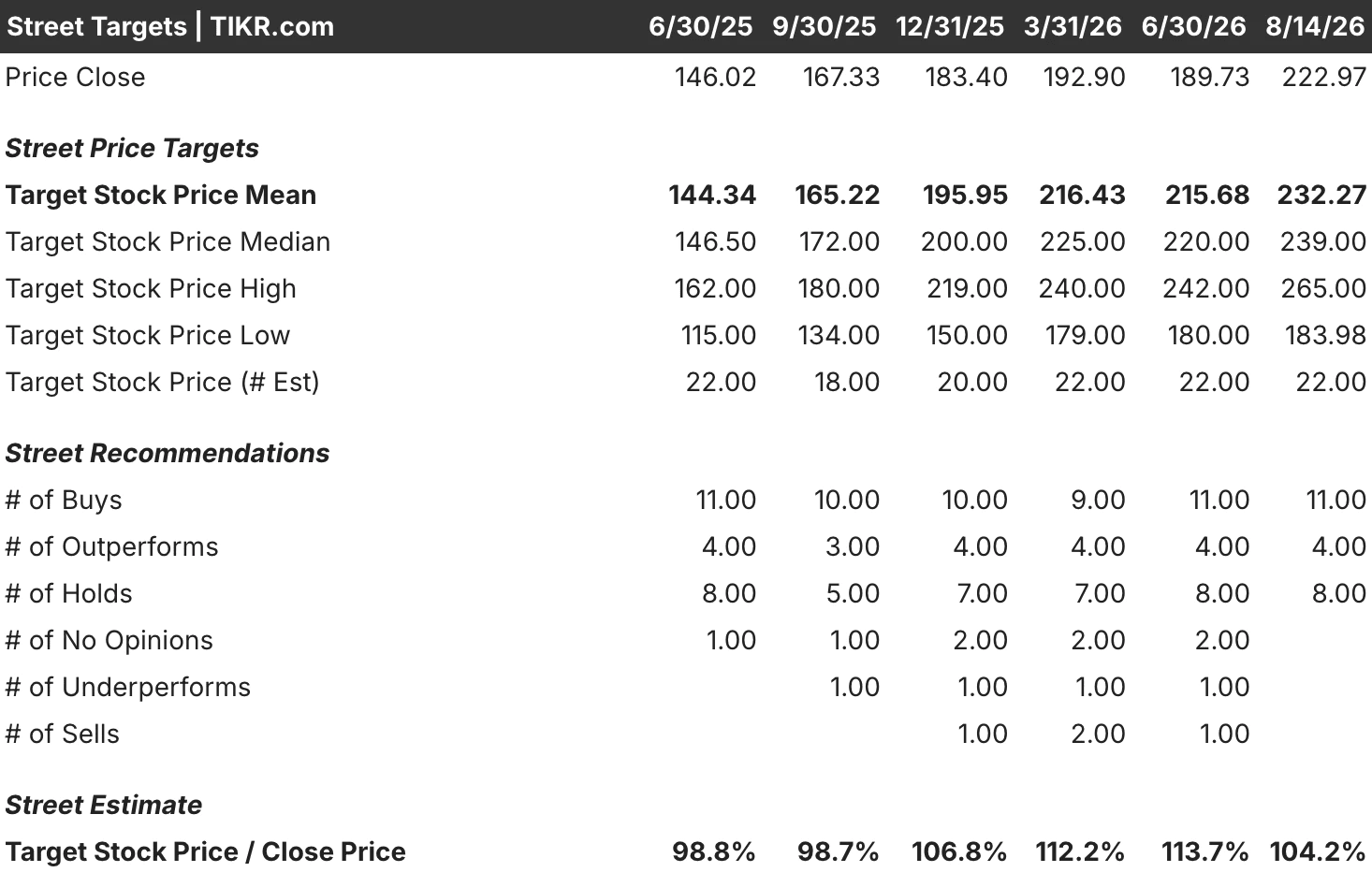
The mean analyst price target sits at around $232, just 4% above the current price of $223. The target-to-price ratio of 104% is the tightest it has been all year, reflecting a market that has been steadily catching up to RTX’s operational outperformance throughout 2026.
Eleven analysts have buy ratings, four have outperform ratings, eight have hold ratings, and one has an underperform rating.
The stock fell 3.3% on the day of Q1 earnings despite a 17% adjusted EPS beat, then fell again after Q4 results the prior quarter, both times because investors had already priced in strong results. A business that consistently beats by wide margins but generates minimal price reaction is a business the market has decided is fully valued.
At roughly 30 times forward earnings, RTX trades at a meaningful premium to traditional defense peers. The premium reflects the commercial aerospace recovery layered on top of defense growth, particularly the Pratt and Whitney aftermarket revenue that compounds as the GTF-powered fleet ages and requires maintenance and overhaul work that only Pratt can perform.
That aftermarket flywheel is real and durable. The question is whether 30 times earnings already captures it.
See analysts’ growth forecasts and price targets for RTX Corporation (It’s free) >>>
What the Valuation Model Says
The TIKR valuation model mid-case for RTX assumes revenue growing around 5% annually with net income margins expanding toward 11%, producing a mid-case target of around $239 by the end of 2030, an annualized price return of roughly 2%.
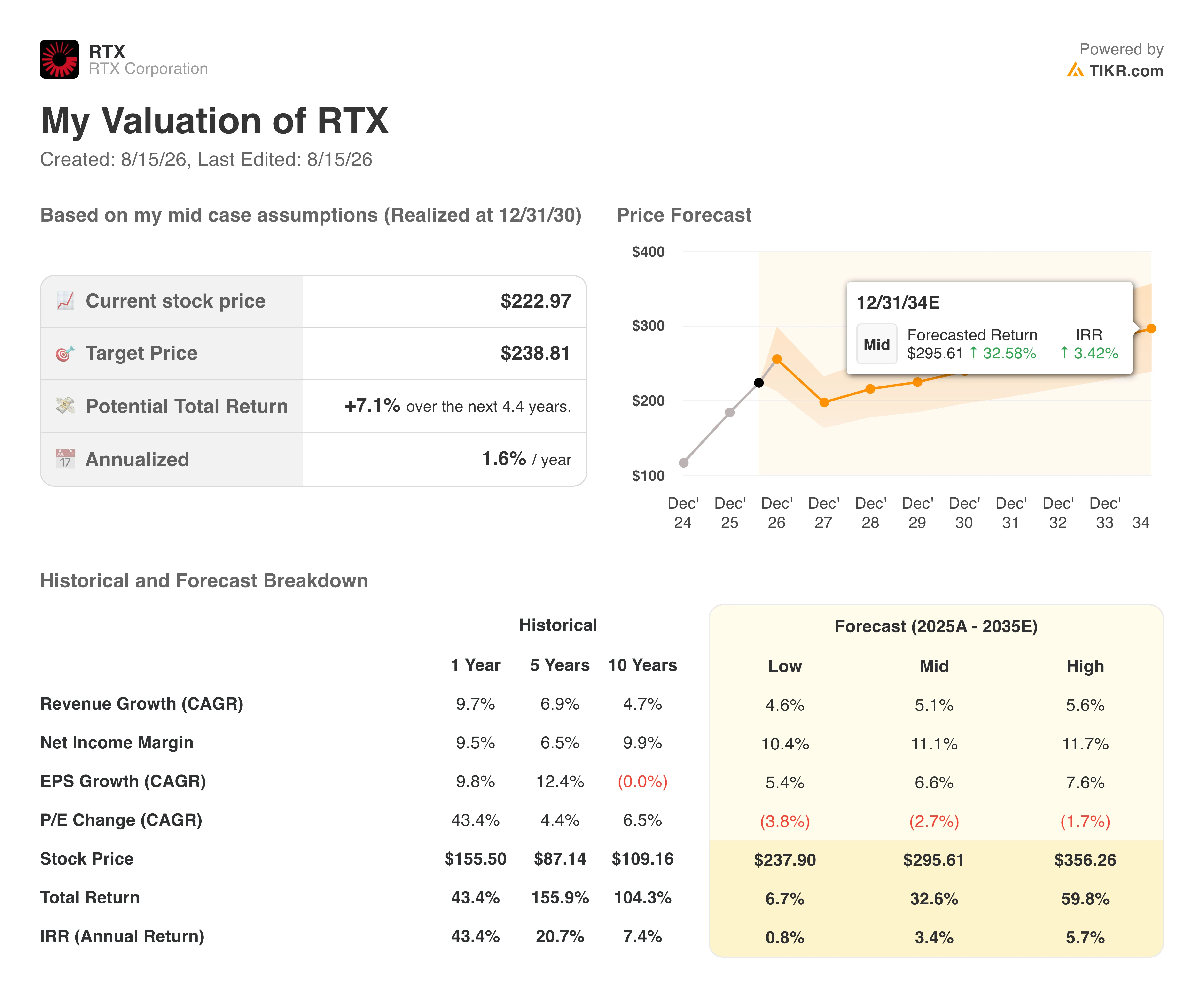
Add the 1.3% dividend yield and the total annual return in the mid-case approaches 3% to 4%, which is modest for a company delivering the results RTX currently is. The high-case scenario produces a target around $356 and an IRR of roughly 6%.
The Street’s mean target of $232 and the model’s mid-case of $239 tell essentially the same story: at current prices, RTX is a high-quality business trading close to full value, and the upside from here depends on either meaningful multiple expansion or execution that exceeds even the optimistic assumptions already embedded in the stock.
Should You Buy RTX Stock?
RTX is one of the better-run businesses in aerospace and defense, with a backlog that provides multi-year revenue visibility, three segments each performing well simultaneously, and a management team that has consistently delivered above expectations.
The commercial aerospace recovery through Pratt and Whitney’s aftermarket and Collins’ content-per-aircraft growth adds a civilian demand tailwind on top of elevated defense spending.
For investors who already own RTX, the case for holding is straightforward. For new investors considering the stock at current levels, the honest framing is that the easy money has already been made.
The business is excellent, the execution is consistent, and the valuation reflects it all, leaving little margin for error or upside surprise.
Value RTX Corporation in under 60 seconds with TIKR (It’s free) >>>
Looking for New Opportunities?
- See which stocks billionaire investors are buying to follow the smart money.
- Analyze stocks in as little as 5 minutes with TIKR’s all-in-one, easy-to-use platform.
- The more rocks you overturn… the more opportunities you’ll uncover. Search 100K+ global stocks, global top investor holdings, and more with TIKR.
Disclaimer:
Please note that the articles on TIKR are not intended to serve as investment or financial advice from TIKR or our content team, nor are they recommendations to buy or sell any stocks. We create our content based on TIKR Terminal’s investment data and analysts’ estimates. Our analysis might not include recent company news or important updates. TIKR has no position in any of the stocks mentioned. Thank you for reading, and happy investing!


