


Key Stats for Shopify Stock
- Current Price: $118.42
- Target Price (Mid): ~$290
- Street Target: ~$148
- Potential Total Return: ~146% over 4.4 years
- Annualized IRR: ~22% / year
- Max Drawdown: 46.71% on 5/13/26
Now Live: Discover how much upside your favorite stocks could have using TIKR’s new Valuation Model (It’s free) >>>
What Happened?
Shopify (SHOP) lost one of its most committed bulls on July 21, and the note explaining why is unusually blunt about what changed.
Rothschild & Co Redburn analyst Dominic Ball downgraded Shopify to Neutral from Buy and cut his price target to $130 from $160, citing what he called an “existential threat” from AI and pointing specifically at Meta Platforms. Ball expects Meta to give small businesses AI tools to build storefronts, run ads, handle payments, and manage customer relationships, all of which Shopify sells today. “With a heavy heart, we downgrade Shopify to Neutral. It has been one of our highest conviction internet names,” he wrote, adding that “the downgrade is predominantly due to the Meta threat.” He estimates 50% of Shopify’s U.S. business is exposed.
Shares gapped lower at the open on July 21 before recovering much of the decline. By late morning, Shopify traded at $123.06, down 1.14%, while the Nasdaq gained 1.58%. The stock then closed at $118.42 on July 22, down $4.61 or 3.75%, according to TIKR data.
The Exchange on May 5 That the Downgrade Now Contradicts
On the Q1 2026 call, Ball asked whether AI was accelerating small merchant sign-ups and whether integrations with tools like Claude and ChatGPT risked pushing Shopify back from the merchant’s user experience.
President Harley Finkelstein answered the second half without hedging: “Agents do not bypass Shopify, just the opposite. In fact, they write right into Shopify.” He pointed to ChatGPT moving to in-app browsers at checkout, meaning the buyer sees a Shopify storefront inside the chat window, with the economics unchanged.
Ball has now downgraded the risk that the answer was meant to close. He did not reference the call in his note and cited Meta as his reason, so this is a contrast between two documented positions rather than a stated cause.
The complication for the bear case is that Meta currently runs on Shopify’s infrastructure. When Meta launched its Business Agent globally on June 3, it opened a Business Agent Platform with integrations into Shopify, Zendesk, and Shopee so the agent can read inventory and act for merchants. That cuts in both directions. It means Meta’s agent presently depends on Shopify’s catalog, and it also means Meta is wiring itself into merchant inventory, which is where in-sourcing would begin if Ball is right.

See historical and forward estimates for Shopify stock (It’s free!) >>>
Where the Downgrade’s Supporting Claims Meet Q1 Results
Ball’s case runs past Meta, and two parts of it are directly testable against reported figures.
He argues international growth cannot fill a domestic gap, with Europe maturing toward U.S. penetration levels. Q1 disagrees for now. European gross merchandise volume grew 48%, or 35% in constant currency, and European revenue grew 42% against North America’s 33%. CFO Jeff Hoffmeister added that North America still posted its strongest quarterly growth rate in over four years.
He also questions Shop Pay’s position in a genuinely agentic world, and that one is harder to dismiss. Shop Pay processed $35 billion of GMV in Q1, up 59%, while Shopify Payments handled $67 billion, reaching 67% penetration, three points higher than Q1 2025. If agents route payment away from merchant checkout, that penetration line is where it surfaces first.
The claim that high SMB churn makes Shopify’s system of record leaky sits awkwardly against the top of the merchant base. Finkelstein said the count of merchants doing over $100 million in GMV has nearly doubled in two years. Gruns, a supplement brand that launched on Shopify in 2023, was acquired by Unilever for over $1 billion last quarter.
Management has also put capital behind its own view. On June 2, Shopify’s board authorized an additional $3 billion of repurchases, lifting the aggregate authorization to $5 billion, with roughly $1.45 billion already repurchased as of June 1 and new purchases starting June 8. Hoffmeister framed it as reflecting “confidence in the durability of our business and the opportunity ahead.” A buyback is not a rebuttal to a competitive thesis, but it is the clearest signal available of how management reads the same risk.
Against peers, the premium remains severe. Shopify trades around 10x forward enterprise value to revenue and roughly 51x forward EV/EBITDA, against GoDaddy, near 3x and 8x, and Wix, near 1x and 5x. Those two collect largely flat subscription fees. Shopify’s revenue scales with merchant sales, which is what makes 30% growth possible and what makes Ball’s scenario dangerous.
Street counts differ by source, and the dispersion says more than any average. TIKR shows 30 Buys, 10 Outperforms, 11 Holds, and 1 Sell across 46 estimates, with a mean target of $148.41, roughly 25% above the current price, a high of $200, and a low of $105.

See how Shopify performs against its peers in TIKR (It’s free!) >>>
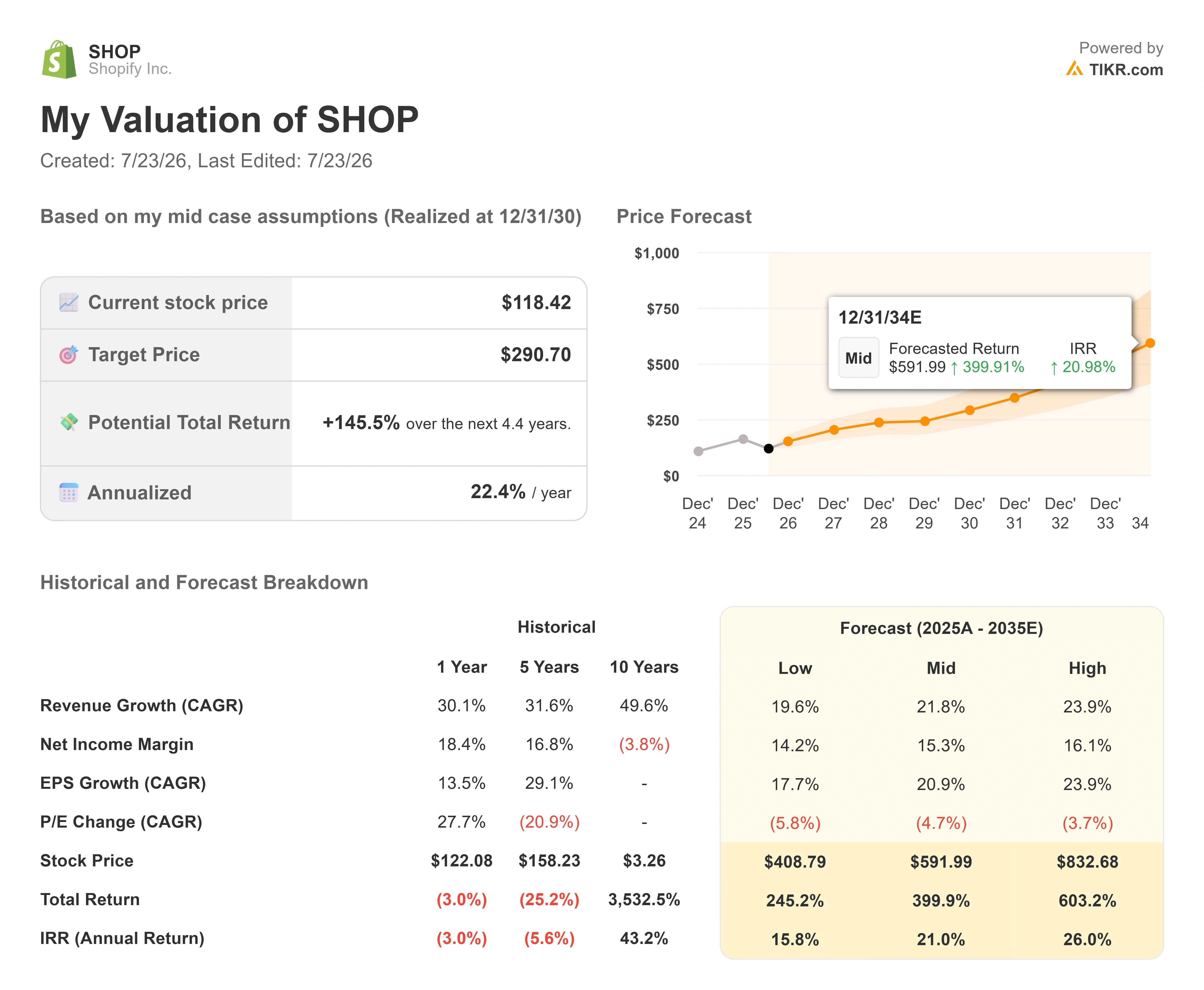
TIKR Advanced Model Analysis
- Current Price: $118.42
- Target Price (Mid): ~$290
- Potential Total Return: ~146%
- Annualized IRR: ~22% / year
See analysts’ growth forecasts and price targets for Shopify stock (It’s free!) >>>
Using the mid case over a 4.4-year horizon, the model points to around $290 per share, about 146% total return, or roughly 22% annualized. Mid case is the right frame because the central dispute is unresolved, and it already assumes deceleration from the current pace.
- Revenue drivers: payments penetration is climbing from 67% as the European markets and Mexico matured last year, and enterprise migration, where $100 million-plus GMV merchants have nearly doubled in two years.
- Margin driver: operating leverage with headcount discipline. Hoffmeister said headcount has been slightly down year-over-year for three years, and he does not see that changing.
- Primary risk: Ball’s thesis proving right. If Meta in-sources the SMB merchant relationship, same-store growth slows, and Rothschild’s bear case models group growth halving.
- Upside: payments and enterprise carry growth through the AI transition and the multiple re-rates off a depressed base.
- Downside: Meta captures the front end, growth halves, and the multiple compresses toward peer levels.
All model outputs are scenario estimates on stated assumptions, not floors or forecasts.
Conclusion
Shopify reports Q2 2026 before the open on August 5, covering the quarter ended June 30. That is the first full quarter overlapping Meta’s Business Agent launch on June 3, which makes it the earliest real test of Ball’s thesis rather than an argument about it.
Management guided to high-20s revenue growth against 34% in Q1, with roughly half a point of currency tailwind versus more than two points in Q1. Benzinga reports consensus near $3.44 billion in revenue and 37 cents in EPS, though other trackers carry slightly higher EPS estimates.
Watch payments penetration above everything else. It reached 67% in Q1 and Hoffmeister flagged Europe as a near-term drag on that metric. Another step higher suggests agentic commerce is running through Shopify’s rails, and Ball is early. A stall, or visible deceleration in same-store growth, and a $130 target starts looking generous.
Shopify beat revenue estimates in each of the last five reported quarters, and the stock fell on four of those five days. August 5 will not settle whether Meta can take this business. It will show whether a beat can still move the stock at all.
See what stocks billionaire investors are buying so you can follow the smart money with TIKR.
Should You Invest in Shopify?
The only way to really know is to look at the numbers yourself. TIKR gives you free access to the same institutional-quality financial data that professional analysts use to answer exactly that question.
Pull up Shopify, and you’ll see years of historical financials, what Wall Street analysts expect for revenue and earnings in the quarters ahead, how valuation multiples have moved over time, and whether price targets are trending up or down.
You can build a free watchlist to track Shopify alongside every other stock on your radar. No credit card required. Just the data you need to decide for yourself.
Analyze Shopify on TIKR Free →
Looking for New Opportunities?
- See what stocks billionaire investors are buying so you can follow the smart money.
- Analyze stocks in as little as 5 minutes with TIKR’s all-in-one, easy-to-use platform.
- The more rocks you overturn… the more opportunities you’ll uncover. Search 100K+ global stocks, global top investor holdings, and more with TIKR.
Disclaimer:
Please note that the articles on TIKR are not intended to serve as investment or financial advice from TIKR or our content team, nor are they recommendations to buy or sell any stocks. We create our content based on TIKR Terminal’s investment data and analysts’ estimates. Our analysis might not include recent company news or important updates. TIKR has no position in any stocks mentioned. Thank you for reading, and happy investing!


-via-Canva-@Joshua-Woroniecki-from-Pexels-via-Canva/@Aflo-Images-from-アフロ(Aflo)-via-Canva-@Joshua-Woroniecki-from-Pexels-via-Canva)
